Jensen Huang is gone, but NVIDIA is still raking in massive profits: its first earnings report topped market expectations, has the successor successfully steadied the ship?
1
The First Major Test in the Post-Jensen Huang Era
With the continuous development of AI, this company seemed unstoppable over the past years.
But before the release of this earnings report, Jensen Huang resigned.
On November 11, Jensen Huang stepped down from his positions as Nvidia's president, CEO and board member, effective immediately. CFO Colette Kress will serve as interim CEO, and the board of directors has begun to search for a permanent successor. He has led the company for 33 years, growing it from a graphics processor manufacturer to a core supplier of AI computing platforms. Most of the large transactions and ecological layouts over the years were promoted by him. The company stated that daily operations and product roadmaps will not be interrupted.
Amid the turmoil caused by the management reshuffle, Nvidia's stock price fell another 4.12% on Monday, closing at $156.14. Compared with the closing high of $239.24 set on October 6, the cumulative decline has approached 35%. Against this backdrop, this earnings report not only needs to answer whether AI demand remains strong, but also undertakes the task of stabilizing investor confidence.
The first answer Nvidia delivered is that its single-quarter revenue exceeded 100 billion US dollars. The third-quarter financial report for fiscal 2027 released in the early morning of November 18 (Beijing Time) shows that as of October 25, the company's quarterly revenue reached 115.844 billion US dollars, a year-on-year increase of 103% and a quarter-on-quarter increase of 20%. This result exceeds the midpoint of the company's previous guidance of 108 billion US dollars, and is also higher than the market expectation of about 108.9 billion US dollars surveyed by FactSet.
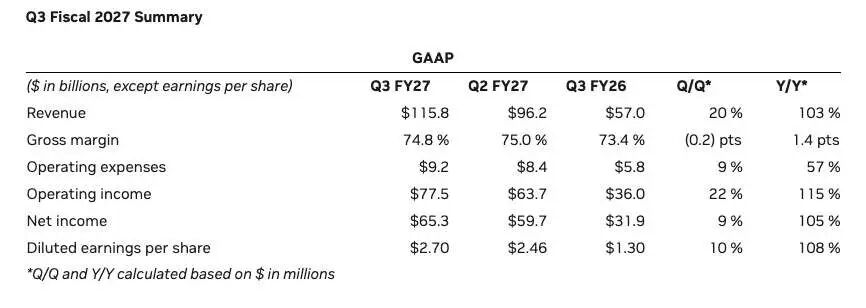
Profits also continued to grow. According to GAAP standards, quarterly operating profit was 77.52 billion US dollars, a year-on-year increase of 115%; net profit was 65.287 billion US dollars, a year-on-year increase of 105%; diluted earnings per share was 2.70 US dollars. Adjusted earnings per share was 2.68 US dollars, higher than the previous market expectation of about 2.48 US dollars. From revenue to profit, this report card continues Nvidia's strong performance of the past few quarters.
Among them, the data center business contributed the vast majority of the growth. The quarterly revenue of this business reached 107.6 billion US dollars, a year-on-year increase of 110% and a quarter-on-quarter increase of 21%, accounting for about 93% of total revenue. The revenue of the edge computing business was 8.2 billion US dollars, a year-on-year increase of 42% and a quarter-on-quarter increase of 14%. Nvidia's revenue structure is already highly concentrated in infrastructure construction centered on AI data centers.
An important support for this round of growth is the start of delivery of the new-generation platform Vera Rubin. Nvidia called the Vera Rubin NVL72 the fastest-ramping product in the company's history in its earnings report, and the related racks have been running at partners including CoreWeave, Google Cloud, Microsoft Azure, Oracle Cloud Infrastructure and Nebius. Oracle and Google Cloud have also launched cloud services based on Vera Rubin.
Kress emphasized in the earnings report that the company's growth momentum is real, Vera Rubin has a strong start, and the product roadmap is still advancing as planned. For Nvidia, which has just lost its founder CEO, this statement directly responds to the market's most concerned question: whether the already formed product, engineering and customer cooperation system can continue to maintain the original rhythm.
The history of tech giants also shows that the departure of the founder will not disintegrate the business system accumulated over many years. Bill Gates handed over the CEO position of Microsoft in 2000 and withdrew from daily management in 2008, and Microsoft later completed its transformation to cloud computing; Jeff Bezos handed over the CEO position of Amazon to Andy Jassy in 2021, and e-commerce, logistics and AWS also continued to operate. For Nvidia, the CUDA ecosystem, products that have entered the delivery stage, and the AI clusters that customers are building also have continuity that spans individual tenures. Jensen Huang's departure has brought expected shocks, but the existing business still has its own operating inertia.
The guidance for the next quarter given by Nvidia also continues the growth expectation. The company expects revenue in the fourth quarter of fiscal 2027 to reach 130 billion US dollars, with a fluctuation of 3% up and down, which is higher than the analyst expectation of about 125.25 billion US dollars summarized by LSEG. This quarter has one more week than usual, and the guidance still does not include data center computing revenue from China.
However, the continued expansion of revenue is accompanied by more obvious margin pressure. In the third quarter, Nvidia's GAAP gross margin was 74.8%, and the adjusted gross margin was 74.9%, only a slight decrease from the previous quarter; in the fourth quarter, the company expects the gross margin under both calibers to drop to 71%-72%.
This means that even if higher revenue is achieved in the next quarter, the proportion of gross profit left by each dollar of sales will decrease. Calculated based on revenue of 130 billion US dollars, a one percentage point change in gross margin corresponds to about 1.3 billion US dollars in gross profit. For a company of Nvidia's scale, a change of several percentage points is enough to significantly affect profit growth.
This earnings report first proves that Nvidia's order and product delivery system is still operating at high speed. The doubling of data center revenue, the entry of new platforms into customer infrastructure, and the higher-than-expected guidance for the next quarter all provide support for the management transition. But this quarter, which ended on October 25, was earlier than Jensen Huang's departure, and the real execution test for the new management is yet to come.
What Kress took over is a company that still has strong demand, is unprecedentedly large, and also needs to take more responsibilities for supply chain investment and system delivery.
2
Earnings Report Continues to Surge, How Long Can Nvidia Dominate the Entire Market?
Nvidia's dominant position has been accumulated over decades. Starting from graphics processors, building a software ecosystem around CUDA, and then continuously investing in high-bandwidth memory and inter-chip interconnection, it has gradually expanded the competition from the performance of a single chip to the efficiency of the entire computing system. The computing, data exchange and software tools required for training large models are integrated into the same set of platforms. The deeper customers adopt this platform, the more re-adaptation and verification work they need to do during migration.
However, AI infrastructure is far more complex than GPUs. CPUs are responsible for running applications, scheduling tasks and executing tools, memory determines whether data can be sent to computing units in time, and networks determine whether a large number of chips can collaborate efficiently. Nvidia's advantages are built on the synergy of these links, and pressure is also entering from different directions: the largest customers want to take more initiative in procurement, AMD is expanding its data center business, and supply chain links such as manufacturing, memory and packaging continue to affect the delivery and cost of the entire system.
The first wave of pressure comes from cloud vendors' motivation to reduce dependence on suppliers. For enterprises building AI clusters on a large scale, GPUs are a major expenditure, and the supply rhythm, product roadmap and software ecosystem are deeply linked with the same supplier. The larger the procurement scale, the higher the value of establishing a second technical route. Customers not only want to obtain more computing power, but also want to have more initiative in price, delivery and product selection.
The cooperation between Google and Broadcom has extended to long-term supply arrangements. Broadcom disclosed in April 2026 that it will develop and supply future generations of TPUs for Google, and provide networks and other components for its next-generation AI racks, with the relevant agreement extending up to 2031. Meta also announced in the same month that it would expand cooperation with Broadcom, and promote multiple generations of chips and supporting network technologies around its self-developed training and inference accelerator MTIA. Amazon has its own chip design team. AWS acquired Annapurna Labs in 2015, and then gradually built product lines such as Graviton and Trainium. Cloud vendors have adopted different R&D and cooperation models, and are trying to convert huge computing demand into the scale advantage of self-developed hardware.
These chips do not need to replace all GPUs to change the flow of procurement budgets. Cloud vendors master their own models, software and business data, and can prioritize migrating tasks with large operation volume and stable processes. As long as the long-term cost savings are enough to cover R&D and adaptation investment, part of the workload will have the incentive to leave the Nvidia platform. The largest customers have thus become the enterprises most capable of cultivating alternative solutions.
The second force: AMD's substantial catch-up. AMD has long been making both CPUs and GPUs at the same time, and this layout is starting to pay off in the AI era. In the third quarter of 2026, AMD's data center revenue reached about 8.5 billion US dollars, a year-on-year increase of 97%. The growth drivers include demand for EPYC server processors and the Instinct GPU business. This shows that it is no longer just a "theoretical alternative", but has begun to grab market share in practice.
The third wave of pressure comes from the concentration of manufacturing links and supply chain costs. Nvidia, AMD and multiple chip routes of cloud vendors all rely on key manufacturing partners such as TSMC. Competition in chip design is becoming increasingly fierce, but upstream manufacturing, advanced packaging and HBM supply cannot expand rapidly at the same time. Even if customers add chip suppliers, they may still face the same delivery bottlenecks.
In order to ensure subsequent supply, Nvidia is making larger-scale long-term commitments. As of July 26, 2026, its supply and capacity commitments increased from 119 billion US dollars in the previous quarter to 279 billion US dollars, and the increased part is mainly related to memory procurement. Locking resources in advance supports delivery, but also leaves larger-scale demand forecasting risks to the company itself.
Demand Differentiation: Inference Has Found a New Way of Operation
The competition faced by Nvidia is changing with the way AI is used. In the past, training larger models required more GPUs, larger high-bandwidth memory and faster inter-chip networks; now, AI is beginning to move from answering questions to executing tasks, and the new demand for hardware is also differentiated accordingly. Processing a hundreds-of-page contract, generating voice in real time, and letting Coding Agent work continuously for several hours all belong to inference, but they are not necessarily suitable for the same hardware configuration.
McKinsey's analysis released in October predicts that by 2030, inference will account for about 60% of AI demand, and training will account for about 40%. This forecast means that the market that chip manufacturers will compete for in the future will be more and more composed of the daily operation after model deployment.
This brings a more complex problem to Nvidia: the growth of inference demand can expand its market, but the differences between different inference tasks are also creating opportunities for other architectures.
Take a compliance tool as an example. It reads a 300-page contract and finally returns only a small number of clauses that need attention. A lot of work takes place in the prefill stage of processing input, which tests the computing power more. Voice assistants need to continuously and quickly generate replies, and the decode stage of outputting token by token is more important, which is more sensitive to memory bandwidth and latency. The same chip can handle both tasks, but customers may end up paying for some underutilized capabilities.
Nvidia's GPUs can meet these needs. Powerful computing power supports prefill, HBM accommodates model weights and KV cache, and high-speed interconnection allows multiple GPUs to work together. This generality is also its advantage: one set of systems can adjust purposes between training and inference, and customers do not need to re-build infrastructure for each type of task. But when a certain type of task runs in large enough volume, choosing dedicated hardware for it, the cost saved may cover the software adaptation and deployment investment.
Cerebras is aiming at exactly this kind of opportunity. It makes the entire wafer into a single chip, and routes across the boundaries of different exposure areas to reduce the overhead of traditional inter-chip connections. Its WSE-3 is equipped with 44GB on-chip SRAM with a bandwidth of 21PB per second; by comparison, the H100 is equipped with 80GB HBM with a bandwidth of 3.35TB per second. The trade-off between memory capacity and bandwidth of the two is completely different: Cerebras uses a smaller on-chip capacity in exchange for extremely high access speed, hoping to make the model generate tokens faster. Inference requires a large number of tokens, which is obviously the field that Cerebras is best at.
The industry has also begun to try to split the same inference request and hand it over to different hardware for processing. The solutions listed by McKinsey include AWS using Trainium for prefill and Cerebras for decode, as well as Intel and SambaNova assigning prefill to GPUs and decode to reconfigurable dataflow units. AMD has also established cooperation with Cerebras. Competition has gone deep into the execution process of a single request: how input is processed, how output is generated, and where the cache is placed, all of which may become the basis for redistributing hardware resources.
However, dedicated chips always face a time difference. The model architecture may change in a few months, but chip development is usually calculated in years. When a chip optimized for a specific workload is delivered, the original demand may have changed. McKinsey mentioned that Google has used reinforcement learning-based layout planning for multiple generations of TPUs, and Jeff Dean has also put forward the idea of using AI to compress the chip design cycle from 18-30 months to 3-6 months. Whether this cycle can be shortened will directly affect the ability of dedicated chips to follow model changes.
The real turning point lies in Agent inference.
Answer-based inference and Agent inference may eventually move towards different hardware architectures. Answer-based inference revolves around humans waiting for answers, while Agent inference is "task completion", which is continuously executed by computers according to instructions from other computers, gradually getting rid of the restriction of real-time human participation.
This difference will change the value of latency. Every wait for a programming assistant that a developer is using will affect the work rhythm; an Agent arranged to perform code migration, inspection and repair at night has a longer execution window. For the latter, customers first care about whether the task can be completed on time and the total cost of completing the task, and they do not necessarily need to pursue the fastest response for every step.
So the priority has changed. The most important thing for Agent inference is no longer the token generation speed, but memory and storage. Agents need context, state and history: part of it exists as active KV cache, part of it is placed in host memory or SSD, and a large amount of content is stored in databases, logs, vector embeddings and object storage. Agent inference will increasingly revolve around the layered storage system around the model, and the GPU answering a single question is only one part of it. In this system, speed and capacity have to be traded off; since latency is acceptable, fewer people will pay a premium for extreme computing power. Traditional DRAM with slower speed and lower price becomes more meaningful; if the system is waiting for memory most of the time, the chip does not have to be the fastest one.
Here comes a counterintuitive judgment: Agents can consume more and more computing power, but customers' dependence on the most expensive computing power may decline. Nvidia's advantages established through high-speed computing, HBM and interconnection need to re-prove their premium under the new task structure. When "good enough" can get the job done, customers will have the incentive to allocate budgets to cheaper combinations of computing and storage.
Nvidia is not unaware of this. It launched the Dynamo inference framework to split different parts of the inference process, and at the same time delivered independent memory racks and CPU racks to support larger KV cache and faster tool calls — the core goal is to keep expensive GPUs busy. But for Agent inference that is far from being limited by GPU performance, cost and simplicity will become more and more attractive to cloud vendors.
This does not mean that Nvidia will lose its dominant position tomorrow. Training is still important, and its architecture will continue to dominate in the training field; answer-based inference is still a meaningful market, but its scale is relatively small. But in the Agent inference market, which is expected to become the largest increment — because it is not limited by the number or time of humans — the premium of Nvidia's solution will be under increasing pressure.
Jensen Huang's departure adds a layer of uncertainty to this pressure. The large transactions and ecological commitments promoted during his tenure are assets that the new management has to take over, and also questions that need to be answered: follow the original rhythm, or review everything again. This will be the answer that the market is really waiting