Jensen Huang has resigned, and there is a company that could wake up laughing in its dreams.
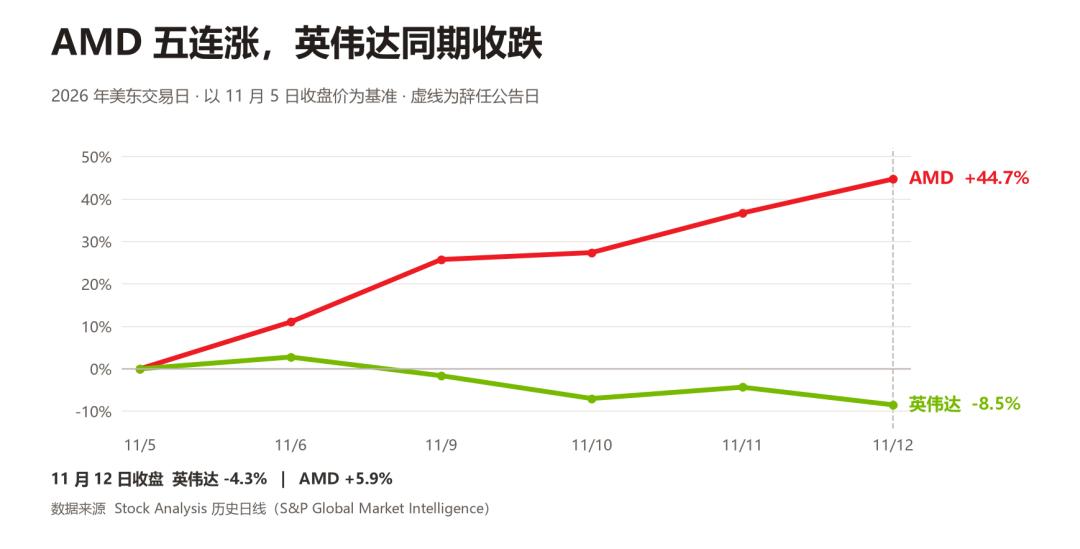
On November 12, Jensen Huang publicly announced his resignation from the positions of President, Chief Executive Officer and Director. NVIDIA's stock price plunged as much as 14.4% during intraday trading, with its market value erasing roughly 600 billion U.S. dollars at one point, before closing with a narrowed drop of 4.3%.
Meanwhile, AMD, NVIDIA's largest rival, closed up 5.9% that day. This marked AMD's fifth consecutive trading day of gains, accumulating a total increase of 44.7% from the close of November 5 to the close of November 12.
This reminds me of the prediction on Polymarket about who will succeed Jensen Huang. In the screenshot released by the official account on November 12, Jensen Huang's daughter, Jenny Huang, ranked first with 12%, while Lisa Su, CEO of AMD, and Colette Kress, NVIDIA's Chief Financial Officer, tied for second with 7% each. AMD is really way too experienced at being the "second fiddle"!

In the PC era, CPU was the core hardware component, and AMD had always been chasing after Intel. In the AI era, cloud vendors purchase GPUs in batches to build data centers, and AMD still ranks second, only that the top spot is now taken by NVIDIA.
Now that this incident has happened at NVIDIA, AMD must be over the moon with excitement!
01 AI Data Center Market Has Long Been Targeted by AMD
What AMD is targeting right now is NVIDIA's largest revenue stream.
Since NVIDIA will not release its Q3 financial report until November 17 Eastern Time, let's first look at the data from its Q2 financial report.
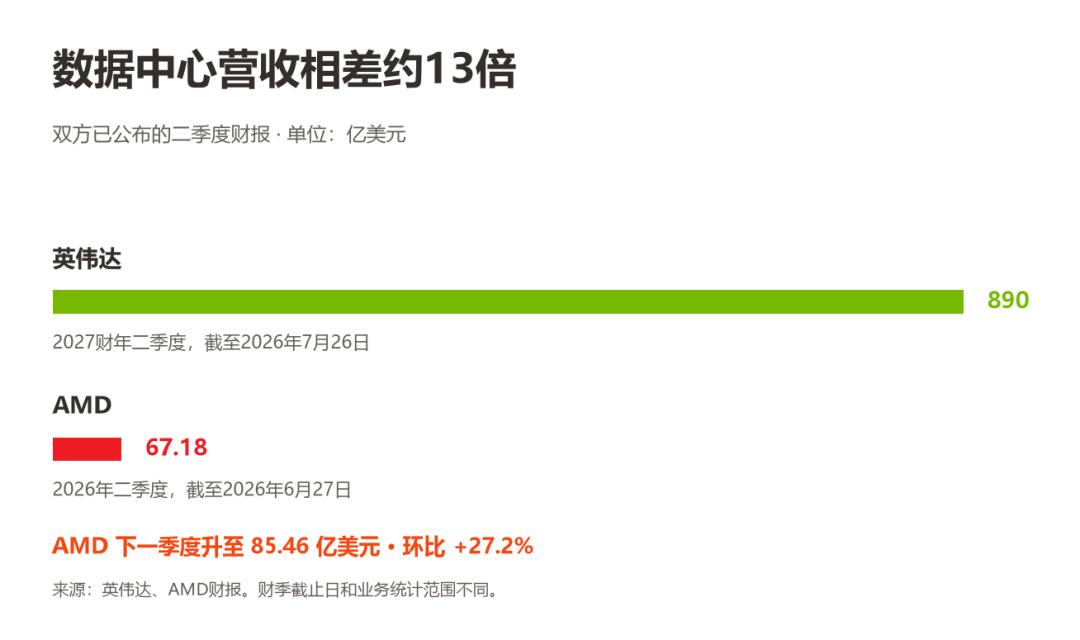
According to NVIDIA's Q2 financial report of this year, its total revenue reached about 96.2 billion U.S. dollars, of which the data center business contributed 89 billion U.S. dollars, accounting for more than 90%. In AMD's financial report, its data center business only generated 6.7 billion U.S. dollars, which also includes part of the revenue from server CPUs.
AMD has integrated its own server CPUs, AI accelerators and high-speed networks into a full rack solution called Helios, while NVIDIA's corresponding full rack product is named Vera Rubin NVL72.
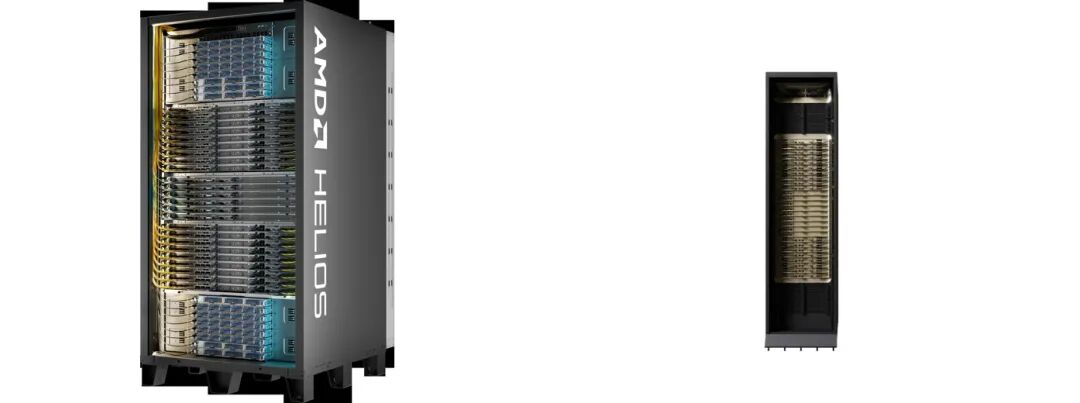
The left one is AMD Helios, and the right one is NVIDIA Vera Rubin NVL72.
On September 30, Hewlett Packard Enterprise (HPE), an enterprise IT equipment vendor, disclosed that it had signed a 1.2 billion U.S. dollar order for Helios racks with U.S. cloud service provider Vultr. AMD is now capable of participating in cloud vendor procurement projects worth billions of dollars.

The Sabey SDC Columbia data center campus in East Wenatchee, Washington, USA. Vultr once expanded its GPU computing power in the Seattle area here.
But for NVIDIA, orders of this scale can only be regarded as "small orders".
On November 2 last year, cloud computing power company IREN signed a procurement agreement with Dell for NVIDIA GPUs and supporting products and services worth about 5.8 billion U.S. dollars. In this year's Q2 financial report, a major "sponsor" alone contributed 16% of NVIDIA's total revenue, equivalent to about 15.4 billion U.S. dollars, which is more than twice AMD's data center revenue in Q2.
To put it exaggeratedly, even a tiny hair plucked from NVIDIA is thicker than AMD's waist.
But now Jensen Huang has resigned from his position at NVIDIA, and the interim CEO is Colette M. Kress, the former Chief Financial Officer. After the leadership transition, some customers may reconsider their next round of procurement plans.

Colette M. Kress, Interim Chief Executive Officer and Chief Financial Officer of NVIDIA.
Nine days before NVIDIA announced Jensen Huang's departure, AMD just released its Q3 financial report. In the report, data center revenue rose to 8.546 billion U.S. dollars, up 27.2% quarter-on-quarter and 97% year-on-year, mainly driven by strong demand for EPYC server CPUs and the launch of the Instinct MI450 series GPUs. Lisa Su said on the earnings call that this was the quarter in which AMD first shipped MI455 and Helios racks and recognized corresponding revenue.
Although the financial report does not list the revenue of Helios separately, it is clear that the full rack solution has started to generate revenue for AMD.
NVIDIA is about to release its Q3 data on November 17 Eastern Time, with the statistical period ending on October 25. At that time, Jensen Huang was still in office, so the data should not be affected. What is more noteworthy is the Q4 guidance given by the management.
For AMD, this is just like it has already equipped itself and waited for wild monsters to respawn, only to suddenly get the news that its top laner has solo killed the enemy top laner. To win this game, this is a great opportunity, but there are still many difficulties waiting ahead if it wants to "snowball" and push forward all the way.
02 Desktop Graphics Cards: AMD Is No Match for NVIDIA at All
AMD was founded in Silicon Valley in 1969, belonging to the same generation of companies as Intel, and was established even earlier than NVIDIA. It manufactures CPUs, and acquired graphics card manufacturer ATI in 2006, bringing the Radeon brand into AMD. Since then, the company has been competing with Intel for CPU business and with NVIDIA for GPU business at the same time.
At the very beginning, AMD was able to go toe-to-toe with NVIDIA, but now in the desktop graphics card segment, AMD is completely no match for NVIDIA.
According to data from Jon Peddie Research, global shipments of desktop discrete graphics cards reached about 12.5 million units in Q2 2026, with NVIDIA accounting for about 90%, AMD about 8%, and Intel about 2%.
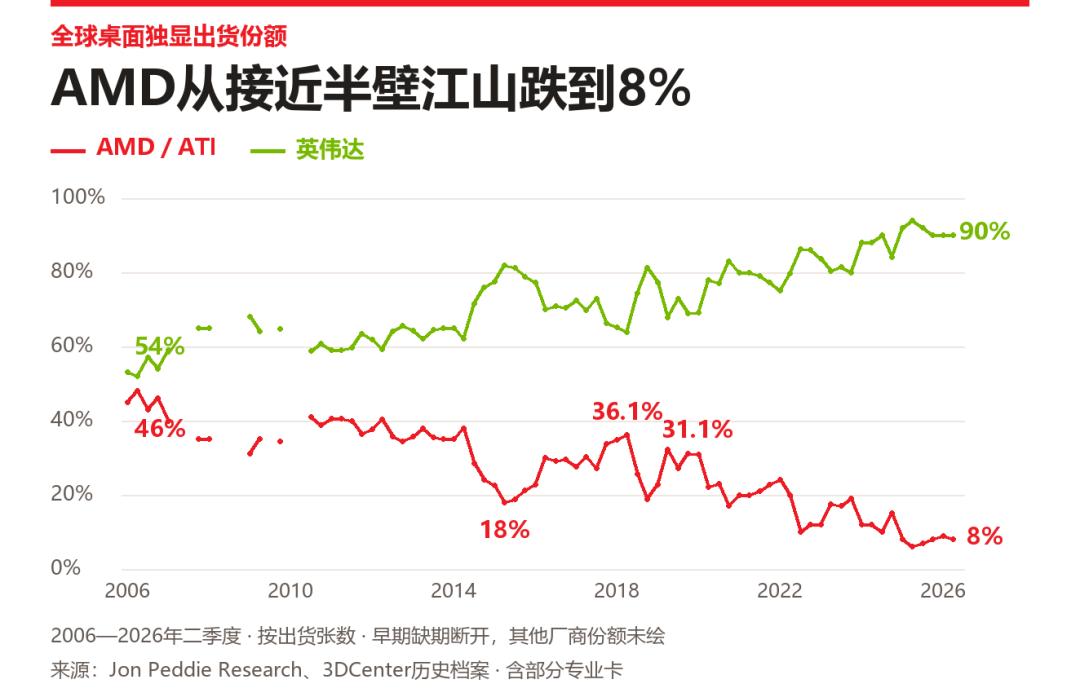
The first obvious gap between the two sides emerged between 2014 and 2015. NVIDIA first launched the more power-efficient GTX 970 and 980, while AMD did not release the Radeon 300 series and Fury X until June of the following year. By the time AMD's new graphics cards hit the market, its quarterly shipment share had dropped to 18%.
In Q2 2018, AMD's share once rebounded to 36.1%, but dropped back to 18.8% by the end of the year. That year, the demand for cryptocurrency mining faded, and both companies faced channel inventory issues. NVIDIA launched the RTX 20 series featuring real-time ray tracing in the second half of the year, while AMD did not fight back in the mainstream price range with the RX 5700 series until 2019, and its share rebounded to 31.1% at the end of the year. The later RX 9070 XT can also deliver higher frame rates at a similar budget, but by Q2 2026, AMD's desktop discrete graphics card shipment share was still only about 8%.
Today, NVIDIA's RTX 5090 still leads the flagship segment, and AMD can only compete with NVIDIA's graphics cards of the same level on cost-effectiveness. TechSpot tested 52 games in September 2026, and the RX 9070 XT priced at about 730 to 750 U.S. dollars delivered an average frame rate 24% higher than the RTX 5070 starting at 800 U.S. dollars at 1440p resolution.
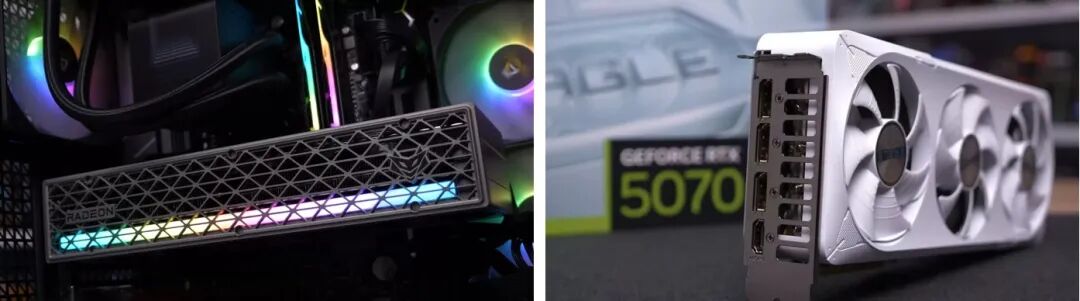
The left one is Radeon RX 9070 XT, and the right one is GeForce RTX 5070.
AMD's crushing disadvantage in the desktop graphics card market is largely attributed to Jensen Huang.
In November 2006, NVIDIA launched the GeForce 8800 that supports CUDA. Jensen Huang later recalled that integrating CUDA into consumer graphics cards would eat up a lot of profits, but he still insisted on doing so. By May 2008, the cumulative shipments of CUDA-enabled GeForce 8 and 9 series GPUs exceeded 70 million units.
What is CUDA?
CUDA is a set of software tools developed by NVIDIA. Engineers can use it to assign tasks like model training to GPUs, and directly call the pre-written and well-tested code developed by NVIDIA. For example, when dozens of graphics cards are used for training together, there are ready-made tools for data exchange between different cards.
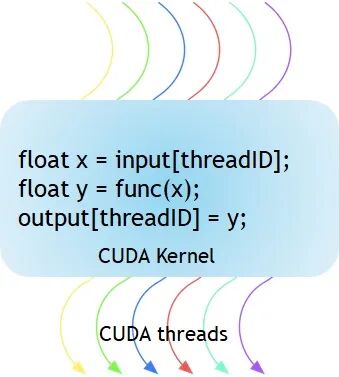
Schematic diagram of CUDA parallel computing. The same code can be assigned to multiple GPU threads to process different data at the same time.
People who buy gaming graphics cards may not use CUDA, but developers have access to easily purchasable hardware to write programs and run experiments.
Jensen Huang has left, but CUDA that developers are already accustomed to using is still there. It is relatively "easy" for AMD to win over game players, but if it wants to attract users who buy graphics cards for development purposes, it has to get past the CUDA barrier.
03 Can the Moat Built by CUDA Be Crossed?
The biggest challenge for AMD to poach NVIDIA's customers is CUDA.
This ecosystem was built by NVIDIA step by step. As written in The NVIDIA Way: Jensen Huang and His Tech Empire, NVIDIA not only integrated CUDA into affordable consumer gaming graphics cards for developers, but also sent personnel to help developers port molecular simulation programs to GPUs.
NVIDIA disclosed that by fiscal year 2026, more than 7.5 million developers are using CUDA and other supporting software tools, with hundreds of dedicated software libraries available.
Of course, AMD is not without countermeasures.
ROCm is AMD's software tool designed to rival CUDA, which allows developers to modify very little code when switching graphics card vendors. For example, if you use PyTorch to train an image classification model on your local computer, as long as all the required functions are supported, after installing the ROCm version of PyTorch, the original training script can continue to run on Radeon GPUs.
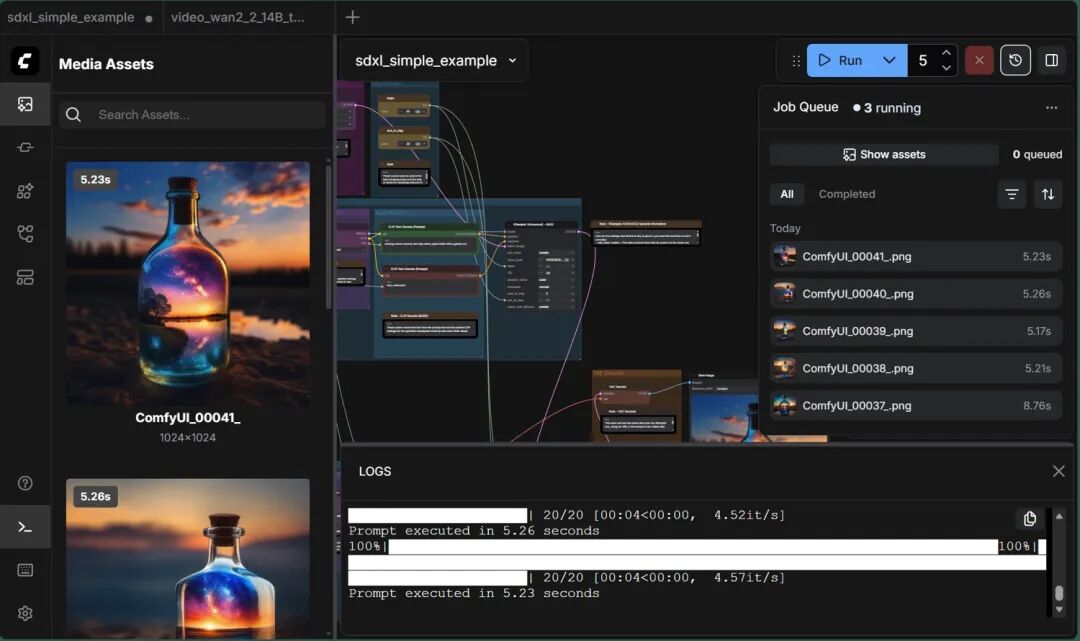
Local AI demonstration of Radeon RX 9000 series in AMD's official tutorial, showing ComfyUI running SDXL image generation.
But what makes CUDA really hard to catch up with is the massive amount of ready-made tools and existing code. The more dependent functions a project has, the more items need to be verified one by one when porting to AMD platforms.
For data centers, replacing NVIDIA hardware with AMD's is even more complicated. Even if a single graphics card can run the program normally, you still need to verify that dozens of graphics cards can work together for distributed training without any issues. This is not just a money problem, time is even more critical.
Midjourney encountered a similar problem. In May this year, David Holz, the founder of Midjourney, said in an interview that Midjourney chose Google TPU in its early stage. If it had used NVIDIA's full stack of tools from day one, the team's research progress would have been one year ahead. If he could start all over again, he would use NVIDIA GPUs from the very first day. Different technical solutions do affect the progress of business development.
