Unitree's biggest rival sees its stock price double in 12 days
Unitree Technology's recent stock price has been crazy enough.
On October 15, its share price dipped to 404.03 yuan during intraday trading. In less than a month, it shot up to 809 yuan on November 10, with a total market capitalization exceeding 320 billion yuan, nearly doubling its stock price.
However, in the humanoid robot track, there is another stock that has risen even more sharply than Unitree.
Sunway New Material.
Its lowest intraday price hit 103.8 yuan on October 23, and the highest point reached 216.02 yuan on November 9, doubling in 12 trading days. On November 11, it climbed further to 244.20 yuan, with its total market capitalization approaching 100 billion yuan.
Nevertheless, the sharp surge is followed by a terrifying slump. On November 12, Sunway New Material plunged 11.36%, evaporating about 11 billion yuan in a single day; Unitree also fell by 8.38%.
Unitree, with its founder Wang Xingxing, quadruped robots and Spring Festival Gala performance, has long been widely known. What makes Sunway New Material's stock rise so drastically?
The answer cannot avoid one person: Peng Zhihui, known as "Ji Hui Jun".
This former Huawei "Genius Youth" co-founded Agibot after leaving his post. Last year, the Agibot group took control of Sunway New Material, and Peng Zhihui served as chairman. A chemical enterprise that originally produced resin for wind turbine blades thus caught the express train of the robot industry.
And Agibot is precisely one of Unitree's strongest competitors.
According to the research report of Huifu Securities, in 2025, Unitree ranked first in the world with a shipment of about 5,500 humanoid robots, followed by Agibot with 5,168 units. In the first half of this year, Agibot disclosed a shipment of 9,700 units, which has surpassed Unitree according to third-party statistics.
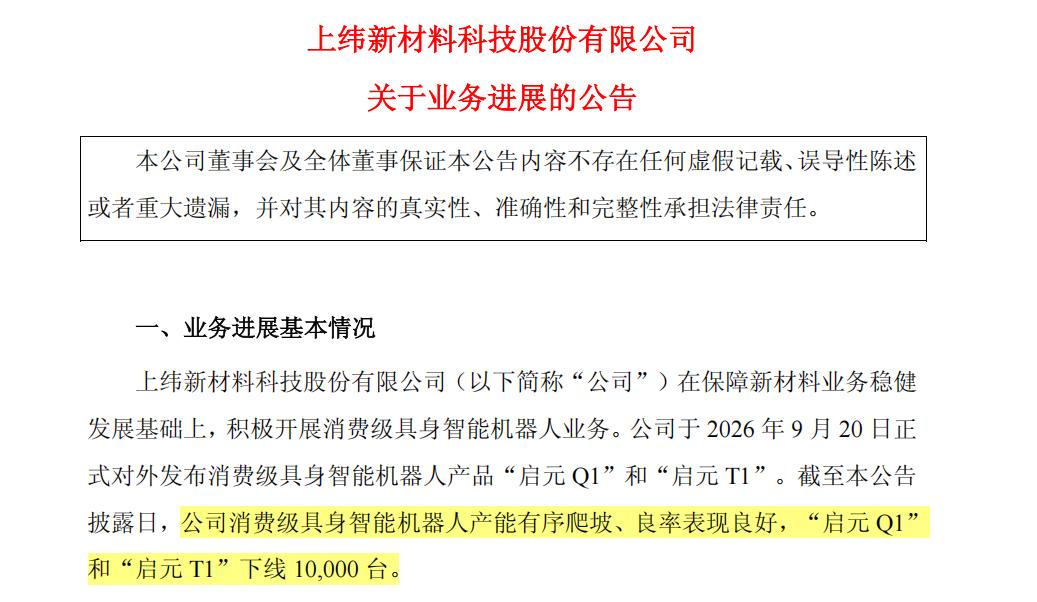
Sunway New Material is not idle either. On November 8, the company announced that the cumulative number of two consumer-grade robots, Qiyuan Q1 and T1, has reached 10,000 units off the production line, and the latter 5,000 units only took 14 days.
As robots are manufactured faster and faster, their stock prices also surge sharply.
However, when you open the financial report, the situation is completely different.
In the first three quarters of this year, Unitree made a profit of 387 million yuan, while Sunway New Material lost 422 million yuan.
Although Sunway New Material is not equivalent to the entire Agibot ecosystem, a listed company whose robot business is still in its infancy and is still burning a lot of money once had a market value approaching 100 billion yuan.
Unitree has already made profits, why does the Agibot ecosystem make the capital market so crazy?
Agibot and Unitree start head-on confrontation
In China's humanoid robot track, Unitree and Agibot are the two unmissable leading players. But looking back at the founding paths of the two companies, they have taken completely different business routes.
Unitree made its name with quadruped robots, and entered the markets of universities, scientific research institutions and developers very early, accumulating a large number of customers especially overseas.
Data shows that Unitree's overseas revenue reached 732 million yuan in 2025, accounting for more than 40% of its total revenue.
After that, its product lines gradually extended to scenarios such as education, industry and commercial performance, and its appearance on the Spring Festival Gala stage helped it successfully break out of the niche circle.
However, the ceiling of the scientific research and developer market is clearly visible. If Unitree wants to continuously increase its shipment volume, it must find large commercial customers who can place bulk purchases.
In contrast, Agibot has paid more attention to commercial applications since its birth, striving to push robots out of the laboratory and directly enter the front lines of factories, warehouses and service industries.
This road is not easy to take. When industrial customers buy robots, they not only consider whether the technology is advanced, but also pay attention to stability, efficiency and cost; but the opportunity is that once the product is recognized, customers may change from purchasing several units for testing to placing bulk orders of dozens or hundreds of units.
The growth of Agibot's shipment largely comes from the continuous development of these application scenarios. According to the industry statistics cited by Huifu Securities, in the first half of this year, Agibot's global market share of humanoid robots was about 43%, leading Unitree's 31%.
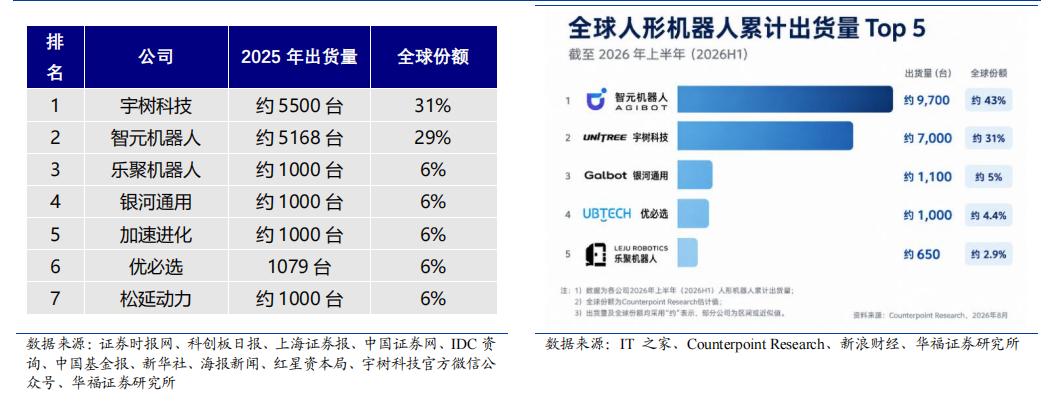
However, ranking first in shipment volume does not mean ranking first in technology, revenue and profitability, and there are also differences in product structure and statistical caliber of different companies.
But this set of data at least confirms one point: Agibot already has the scale to compete head-on with Unitree.
And Agibot is obviously not satisfied with this. Through Sunway New Material, it has set its sights on the personal and family market.
This is a completely different market from industrial robots.
Factories calculate the economic account when buying robots: how much labor can be replaced in a year, and how much production line efficiency can be improved; while ordinary consumers look at the experience account when buying robots: whether it is fun, practical, and worth the money.
The starting price of both Qiyuan Q1 and T1 is 19,999 yuan, which is much cheaper than humanoid robots that used to cost hundreds of thousands of yuan.
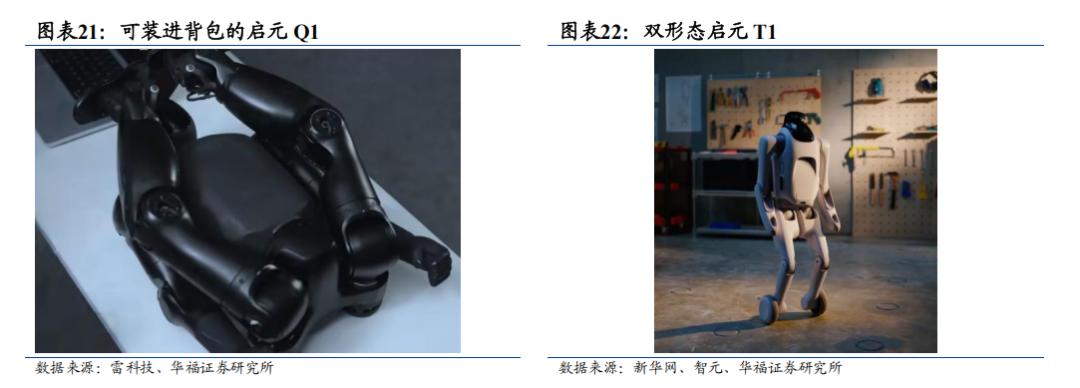
More importantly, Sunway New Material is trying to expand the production scale of personal robots.
According to the previous introduction by Gao Quanzhong, co-president of Qiyuan Robotics, at the beginning of the production line operation, the daily production capacity was only more than ten units, and later it increased to more than 200 units, with one robot off the production line every 2.5 minutes on average.
It took about a month to produce the first 5,000 units, but only 14 days for the next 5,000 units.
The company also disclosed a set of user data: monthly active users exceed 98%, the average daily online duration reaches 3 hours, and each user interacts with the robot more than 100 times per day on average.
These data at least show that early users have a certain enthusiasm for using the product. However, since the company has not disclosed the complete statistical samples and user composition, it is not possible to judge the acceptance level of ordinary families based on this.
While Agibot is making efforts in the C-end market, Unitree is also deepening into the industrial market that Agibot originally focused on.
At the beginning of November, the market regulatory authority disclosed that Unitree plans to jointly establish a joint venture with enterprises under PetroChina to carry out industrial embodied intelligent robot business.
On the one hand, Unitree is accelerating its penetration into large industrial and commercial customers, on the other hand, Agibot is seizing the consumer-grade entry through Sunway New Material. The originally parallel business trajectories of the two giants are accelerating their intersection.
Agibot's layout also has a special feature: although Sunway New Material is controlled by the Agibot ecosystem, it is a different operating entity from Agibot Innovation.
The former mainly develops consumer-grade robots, while the latter focuses on industrial and commercial scenarios. The shipment volume and revenue of Agibot Innovation will not be automatically included in the financial report of Sunway New Material. This means that how much of Agibot's scale advantage in the robot industry can eventually be converted into Sunway New Material's performance still needs time to give the answer.
After all, Unitree has already started to make money from robots, while Sunway New Material is still investing heavily in order to enter this market.
Unitree makes profits, Sunway burns cash
In order to develop the robot business, Sunway New Material has spared no expense.
The first is talent.
After the Agibot group took over, co-founder Peng Zhihui served as the chairman of Sunway New Material, and CEO Tian Hua also has a Huawei background, with more than 20 years of experience in product and business management.
At the end of October this year, Sunway New Material adjusted its senior management team again, appointing Zhao Gang as president and COO, Gao Quanzhong as co-president and CTO, and Liu Dongfang as co-president.
The three of them also came from Huawei. A group of Huawei veterans have regrouped around the consumer-grade robot business.
The second is capital.
The research report of Huifu Securities shows that Sunway New Material has 7 ongoing R&D projects for its consumer-grade robot business, with a total planned investment of about 405 million yuan, accounting for 90.9% of the total planned investment of all ongoing R&D projects at that time. As of the first half of this year, about 171 million yuan has been invested.
In the second half of the year, the speed of spending money has further accelerated.
In the first three quarters of 2026, Sunway New Material's R&D investment reached 384 million yuan, a year-on-year increase of 1182%, of which about 360 million yuan was invested in the consumer-grade robot business.
With all this money spent, the profit performance is naturally not good-looking.
In the same period, Sunway New Material's revenue was 1.209 billion yuan, a year-on-year decline of 5.51%; the net profit attributable to owners of the parent company was a loss of 422 million yuan, down 796.94% year on year.
Interestingly, the company's original material business is still making profits, with a net profit attributable to owners of the parent company of about 63.52 million yuan in the first three quarters, a year-on-year increase of 4.91%.
It is the huge expenditure of the robot business that dragged the overall performance into loss.
What is more embarrassing is that a lot of money has been spent, but the robot revenue has not kept up.
The three-quarter report shows that Qiyuan Q1 and T1 were officially launched for sale on September 20, and delivered one after another in October, and the robot business revenue has not been recognized in the first three quarters.
However, this does not mean there are no orders. As of the first half of this year, the company's robot business has received 210 million yuan of pre-payment for goods.
But pre-payment is not equivalent to revenue, and the off-line volume is not equivalent to final delivery. How much performance the orders can be converted into still needs to be verified in subsequent financial reports.
In contrast, Unitree has already made money.
In the first three quarters of this year, Unitree's revenue was 1.817 billion yuan, a year-on-year increase of 55.71%; the net profit attributable to owners of the parent company was 387 million yuan, a year-on-year increase of 270.54%.
One made a profit of 387 million yuan, the other lost 422 million yuan, with a profit difference of more than 800 million yuan.
Of course, Sunway New Material cannot be equated with the entire Agibot ecosystem, and the financial calibers of the two are different. But for investors who buy stocks with real money, whether they can make profits in the end still depends on Sunway New Material's own profitability.
What is more noteworthy than loss is whether there is enough cash to spend.
In the first three quarters of this year, the net cash flow from operating activities of Sunway New Material was about 28.15 million yuan, a year-on-year decrease of 74.59%.
In the same period, the net cash inflow from financing activities was about 489 million yuan, including 450 million yuan of related party loans, which are used for robot R&D, supply chain construction and marketing promotion.
In other words, although the original business can still provide a certain amount of cash flow, to support the rapid expansion of the robot business, Sunway New Material currently relies heavily on external blood transfusion.
Even according to the previous optimistic predictions of securities firms, this capital pressure will not disappear soon.
The research report of Huifu Securities in October predicts that from 2026 to 2028, Sunway New Material's revenue will reach 2.509 billion yuan, 3.476 billion yuan and 5.786 billion yuan respectively, of which the robot business revenue will be 620 million yuan, 1.488 billion yuan and 3.72 billion yuan respectively.
If the prediction comes true, by 2028, robots are likely to become the most important source of revenue for Sunway New Material.
But the cost is not small.
Huifu Securities predicts that in 2027 and 2028, the company's R&D expenses will reach 466 million yuan and 860 million yuan respectively, totaling 1.326 billion yuan in two years.
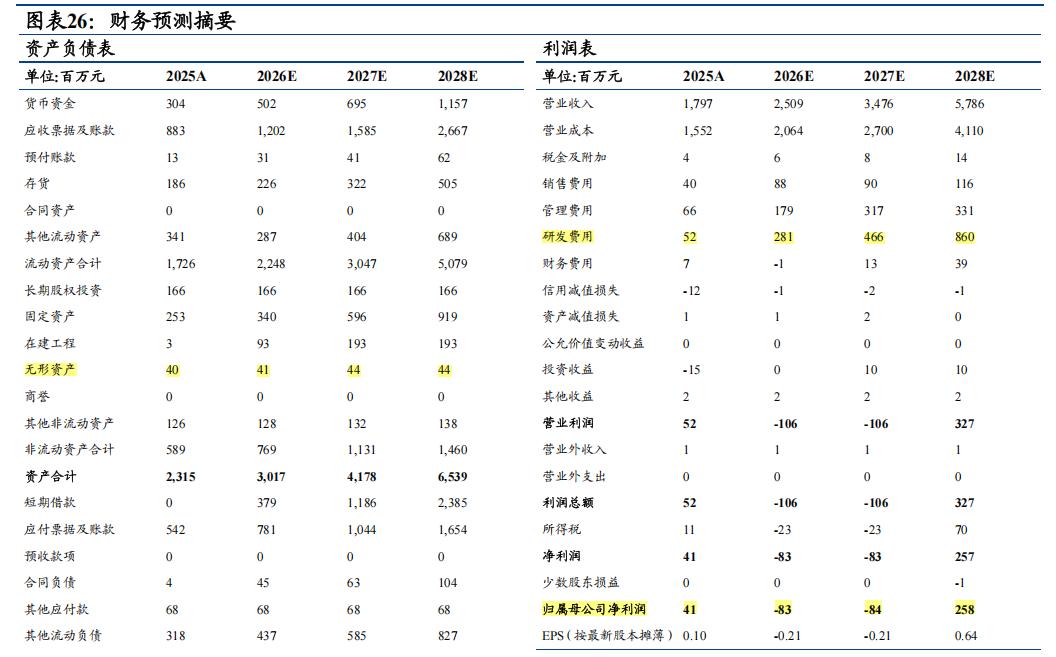
Even if the net profit attributable to owners of the parent company reaches 258 million yuan in 2028, the net cash outflow from operating activities may still be 204 million yuan, the net cash outflow from investment activities will be 504 million yuan, and the net cash inflow from financing activities is expected to be 1.171 billion yuan.
That is to say, even if it achieves profitability in the future, Sunway New Material may still need continuous financing.
It is worth noting that this research report was released before the latest three-quarter report, and some predictions have deviated significantly from the actual situation.
The research report previously predicted that Sunway New Material would lose about 83 million yuan in the whole year of 2026, but the company has already lost 422 million yuan in the first three quarters.
To achieve the original prediction, it has to earn back about 339 million yuan in the fourth quarter, the difficulty of which is self-evident.
And the capital market has already given a quite high valuation.
On November 11, the total market capitalization of Sunway New Material once approached 100 billion yuan