Li Yapeng's cultural tourism dream that he poured 3.5 billion yuan into is about to be sold at a fire-sale price.
Many veteran hotel investors develop a conditioned reflex unconsciously after years in this industry: when they see the phrase "celebrities invest in cultural tourism", what pops up in their mind first is not sentiment, but losses, debts and unfinished properties.
The protagonist of this story is Li Yapeng.
Recently, Lijiang Snow Mountain Investment Co., Ltd. associated with Li Yapeng added a new property rights transaction announcement, with the total subject creditor's rights reaching 761.34 million yuan and the principal standing at 378 million yuan, and the debtors are Lijiang Snow Mountain Investment Co., Ltd. and Weifang Sunshine 100 Real Estate Co., Ltd.
The mortgaged assets include nearly 190,000 square meters of land of Lijiang Snow Mountain Art Town, 7,000 square meters of existing commercial properties and more than 20,000 square meters of projects under construction, and the case has entered the enforcement stage.
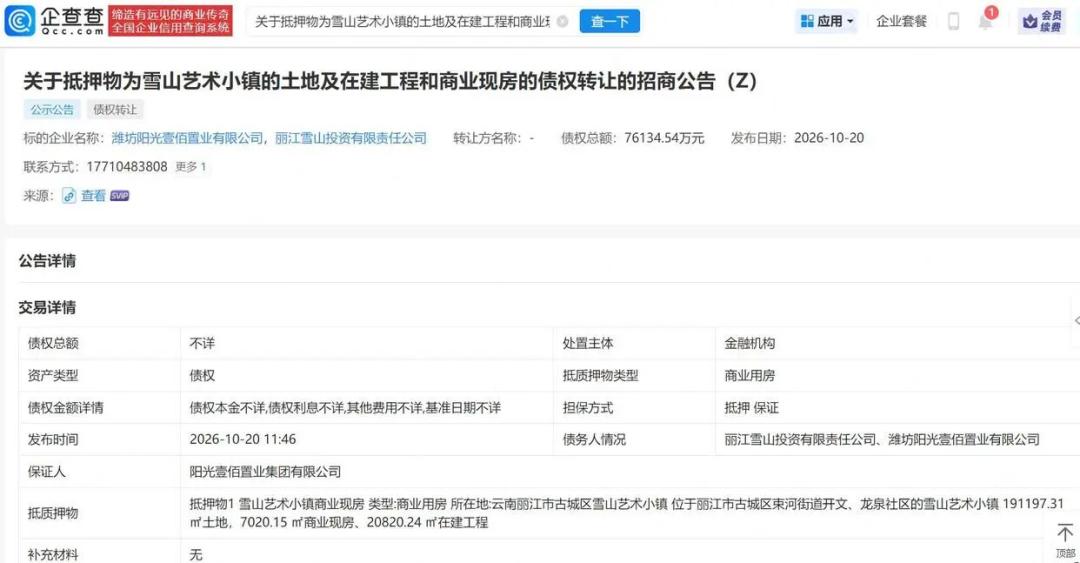
Source: Qichacha
This is far more than a simple problem of operational difficulties or strategic adjustment. As the holy land in the hearts of literary youths, one of the most expensive real estate properties in Lijiang at that time, with an investment of 3.5 billion yuan plus Li Yapeng's star effect, why did Lijiang Snow Mountain Art Town, which stacked all kinds of competitive advantages, end up in such a situation?
01 Li Yapeng's "Snow Mountain Past" and His Cultural Tourism Dream
Looking back to 2012, the early stage of Snow Mountain Art Town was extremely prosperous!
That year, Yunnan Lijiang Snow Mountain Investment, in which Li Yapeng held shares, spent 164 million yuan to acquire a plot of accommodation and catering land in Shuhe Sub-district, Lijiang City, for the development of Snow Mountain Art Town, including villas, hotels, commercial districts, apartments and other facilities. The plan was to start construction in August 2013, with a claimed total investment of 3.5 billion yuan.
Li Yapeng poured tremendous efforts into this project, and invited Japanese architect Kengo Kuma to custom-design more than 130 single-family villas here. In 2014, Snow Mountain Art Town was launched for sale, with a price as high as 21,000 yuan per square meter, making it one of the most expensive real estate projects in Lijiang at that time.
Relying on Li Yapeng's connections in the entertainment industry, performing arts stars such as Yang Kun and Hu Jun purchased properties here. The COART Art Carnival attracted more than 200,000 visitors in a single session, and public cultural spaces including Snow Mountain Art Museum, Tree Theater and Wild Country were completed one after another.
Despite such bold and large-scale development and construction, judging from the sales performance, only more than 30 villas were sold within two years after the launch.
It should be noted that the total construction area of this project is 190,000 square meters.
In 2015, Li Yapeng, who was unable to continue investing, sold 51% of the project's shares to Sunshine 100. The project valuation also shrank sharply, dropping from the initially claimed 3.5 billion yuan investment to 380 million yuan.
The buyer Yi Xiaodi is the founder of Sunshine 100 Real Estate Group. As a veteran player in the real estate industry, he was once collectively known as one of the "Six Gentlemen of Vantone" along with Pan Shiyi and others. After taking over the project, from 2015 to 2020, the total revenue in five years reached 216 million yuan, and only 26 square meters were sold in the first half of 2020.
26 square meters, what does this concept mean? The area of a single hotel room is larger than that.
In 2025, the project company of Lijiang Snow Mountain Art Town filed for bankruptcy, and the applicant was none other than the actual controlling shareholder, Sunshine 100 Real Estate Group Co., Ltd.
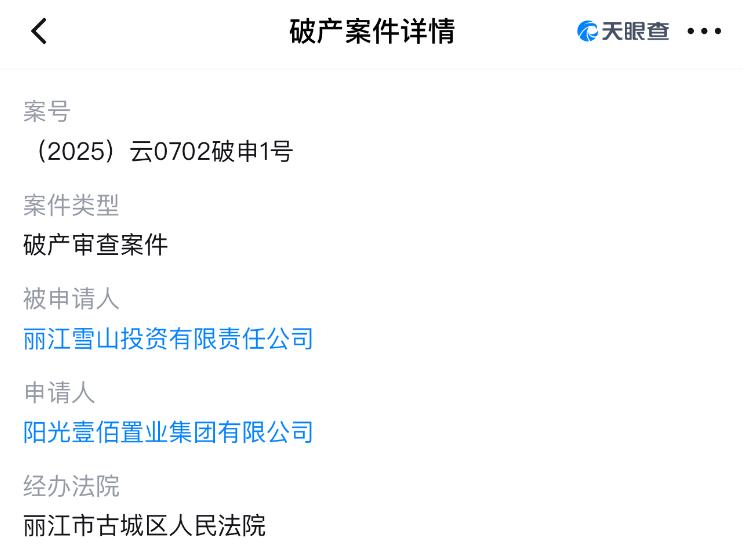
Source: Tianyancha
Now when we review the whole incident, we find a key information point: in September this year, Li Yapeng said in an interview that "when I reached a certain stage, I sold 51% of the equity to another listed company, but after taking over, this company stopped all the cultural projects and ideas I had previously operated."
Li Yapeng believes that this is one of the triggers for the decline of Lijiang Snow Mountain Art Town.
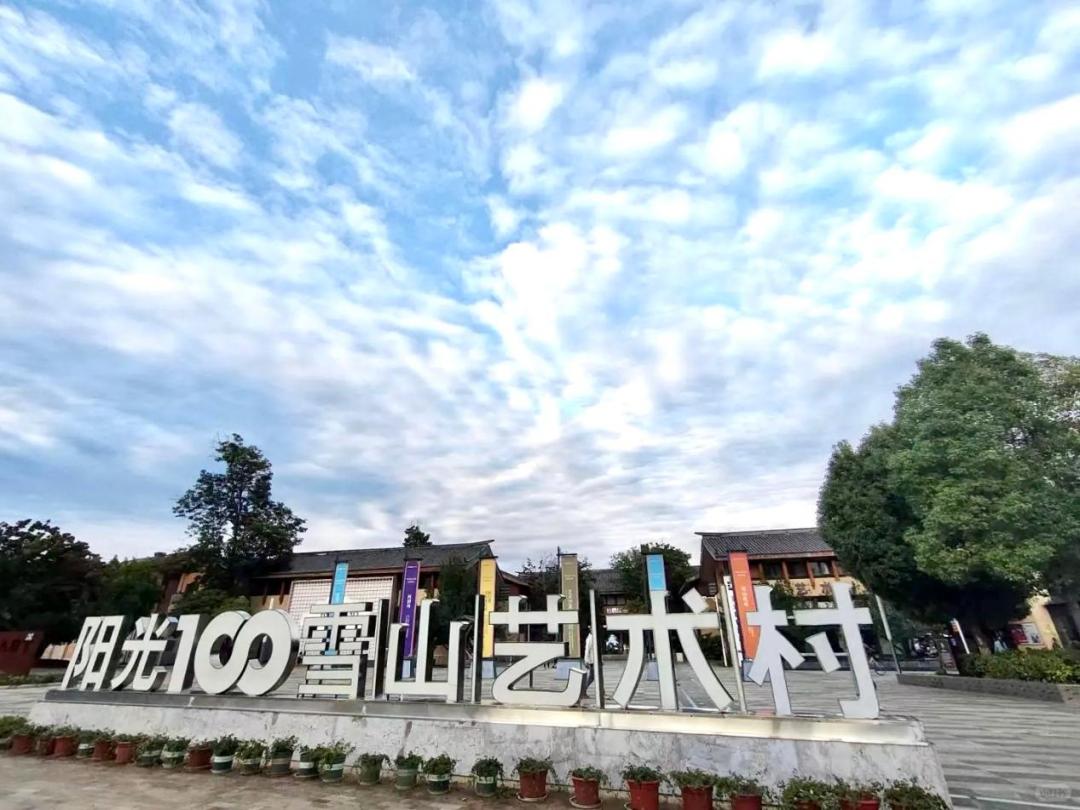
Source: Xiaohongshu
What is more talked about than the sales result is the financing structure.
In 2012, Beijing Taihe Youlian Investment Co., Ltd. injected 60 million yuan to obtain 10% of the shares, with an agreement that if the project was not completed after the three-year development period, it needed to pay 40 million yuan of fixed equity income.
In 2015, in order to let Sunshine 100 come in to rescue the project, Li Yapeng took personal unlimited joint and several liability guarantee.
But later the project was not completed on schedule, and this 40 million yuan debt fell on his personal shoulder.
In 2022, he lost the final appeal, and he did not pay off all the principal and interest until January 2026, when the personal high-consumption restriction order was lifted.
02 Neither Li Yapeng nor Sunshine 100 Should Take Full Blame
Perhaps due to Li Yapeng's extremely high public popularity, many people, seeing that the return of Snow Mountain Art Town fell short of expectations, one-sidedly attributed the problem to Li Yapeng personally.
We have to say a fair word for Li Yapeng.
As a professional real estate development enterprise, Sunshine 100, which took over the project, has such strong strength but had no way out, which shows that the problem does not lie with Li Yapeng.
In November 2025, Sunshine 100 Real Estate Group Co., Ltd. applied to the Court of Old Town District, Lijiang for bankruptcy liquidation of Lijiang Snow Mountain Investment Co., Ltd.
In October this year, the creditor's rights were listed for transfer. Among the total 761 million yuan, the principal is 378 million yuan, and the mortgaged assets are land, existing commercial properties and projects under construction.
In other words, land accounts for the vast majority of the mortgaged assets, with only 7,000 square meters of existing properties and 20,000 square meters of projects under construction. This mortgage list forms a huge contrast for a project that once claimed an investment of 3.5 billion yuan.
Some people say this is caused by the influence of external conditions.
The urban area of Lijiang has an altitude of 2418 meters, which belongs to the high plateau area. The winter is wet and cold, with an average temperature of only 1-8℃, and there is no central heating. Previously, statistics from Lijiang Housing and Urban-Rural Development Bureau showed that the annual average vacancy rate of high-end resort villas in Lijiang reached 87.3%, and the vacancy rate in winter was as high as more than 95%.
Others say this is affected by the property right attribute of the project. It is understood that this project is commercial land with 40-year property rights, not residential land, which is restricted in household registration settlement and children's education.
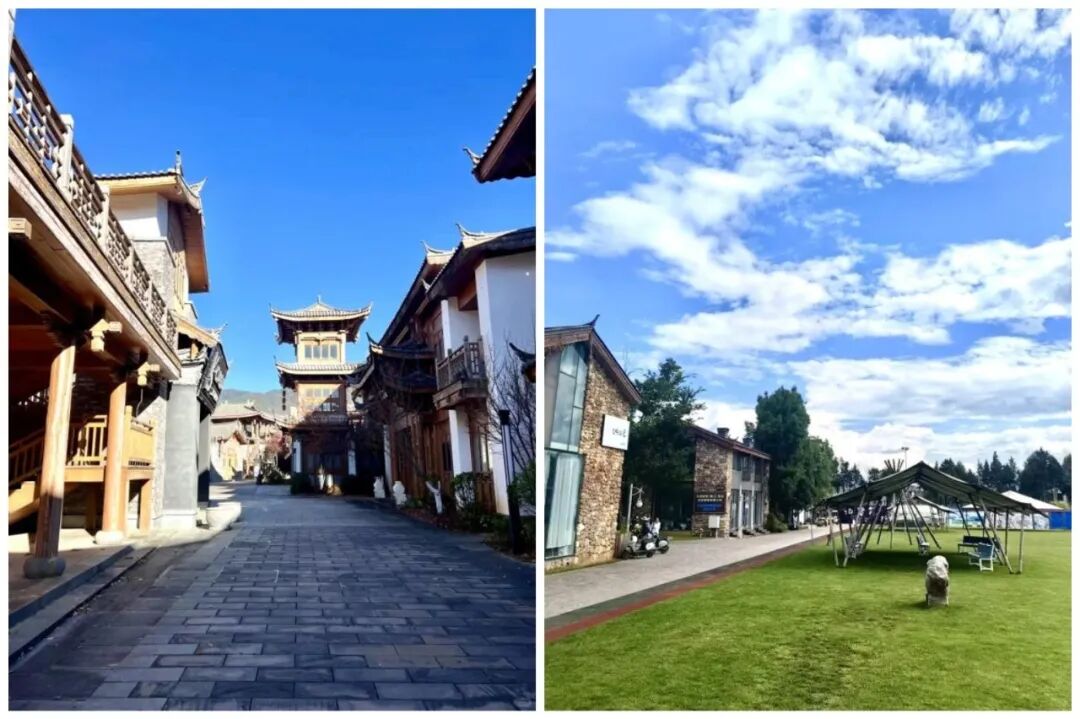
Snow Mountain Art Town Source: Xiaohongshu
These analyses are not wrong, but Hotel Finance believes that these are only superficial reasons.
The deeper problem is that what Snow Mountain Art Town sells is not just hotel rooms, but more like a "Li Yapeng-style lifestyle". The town is mostly supported by sentiment, as well as Li Yapeng's connections and popularity, but sentiment and traffic cannot be continuously converted into cash flow.
It is true that the COART Art Carnival attracted 200,000 visitors, but you cannot convert that into RevPAR;
The selling point that the famous architect Kengo Kuma personally designed the project is indeed attractive, but you cannot convert that into a premium per square meter;
Li Yapeng does have high personal popularity, but it is impossible that people will always consume for his name.
Hotel investors understand this truth best: you can pay for location, brand and enterprise, but you cannot pay for an individual.
Li Yapeng does have traffic and public attention, but for investors, these are not realizable assets with low market conversion rate.
03 What Capital Refuses to Bet on Is Never the Two Words "Cultural Tourism"
In September this year, Li Yapeng systematically reviewed the real estate project of Lijiang Snow Mountain Art Town for the first time in an interview. In his account, the original intention of the project was to "reproduce traditional academies in China".
He said: "The real estate sector is too heavy, beyond my capacity."
Li Yapeng is rather frank, and "real estate is too heavy" is indeed a fact.
According to incomplete statistics, from 2020 to September 2026, more than 70 cultural tourism and hotel-related projects and enterprises across the country have entered pre-reorganization, bankruptcy reorganization and liquidation procedures. About 50 of them involve heavy-asset projects such as cultural tourism towns, ancient towns, resorts and theme parks.
The Bailuyuan Folk Culture Village, which cost 350 million yuan and covers an area of 1200 mu, closed down only 4 years after opening;
Qinghai Tourism Investment, a provincial first-class state-owned cultural tourism platform, had its 482 million yuan registered capital "wiped out" in nine years, and directly announced to enter the bankruptcy liquidation procedure;
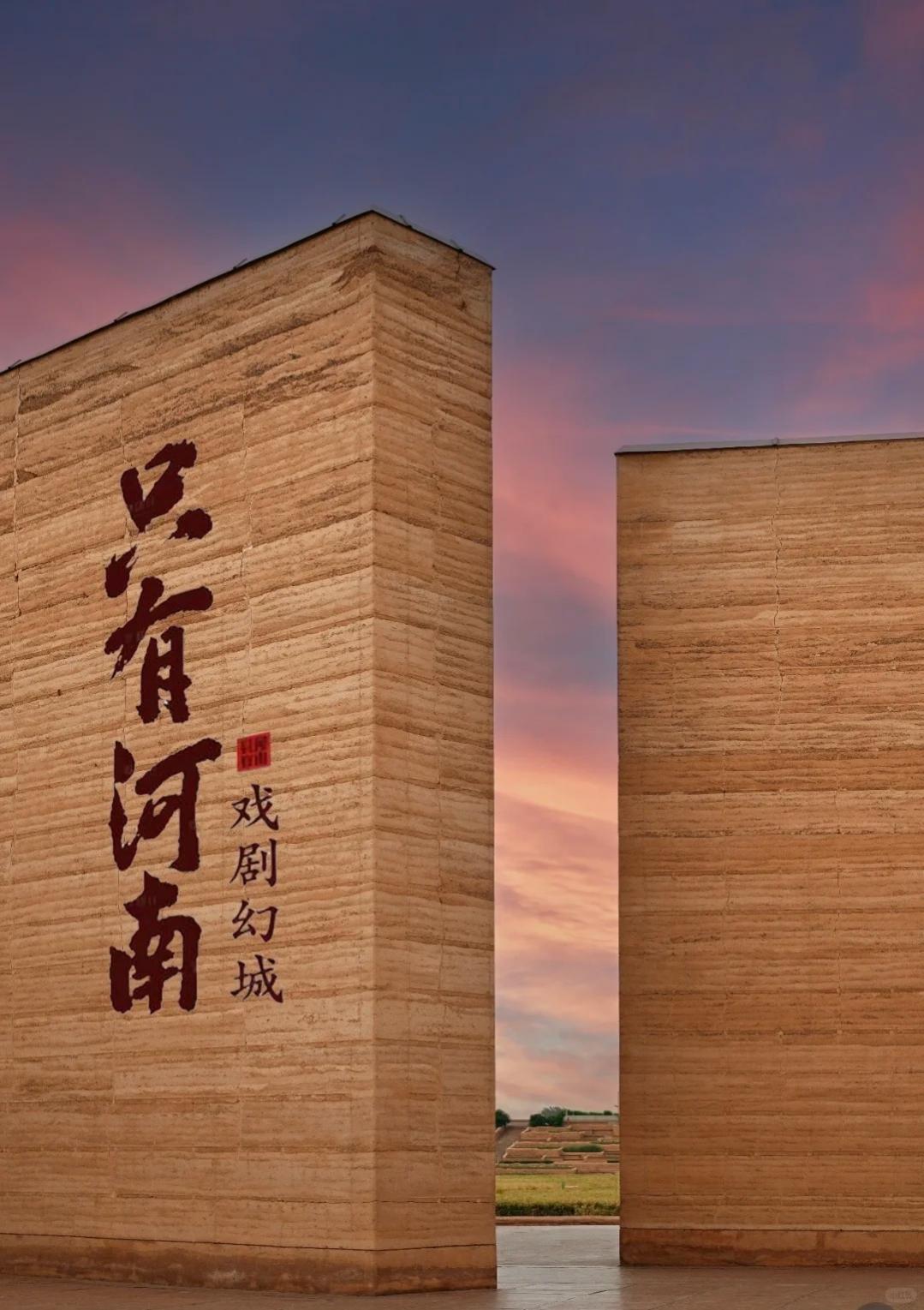
Even the well-reputed project "Only Henan" with a total investment of 6 billion yuan was sold in a package for 2.5 billion yuan.
Source: Xiaohongshu
A single incident may be a problem of its own operation, but when multiple cases are put together, it involves common problems existing in the industry.
The payback period for heavy cultural tourism assets generally takes 15-20 years, while real estate sales pursue rapid capital recovery within 1-2 years. Once real estate sales are sluggish, the whole project is very likely to face heavy debt pressure.
In the upward stage of the real estate industry, the financing cost is relatively low, and developers can use residential sales to feed back cultural tourism projects. But now, the residential market is undergoing in-depth adjustment, and cultural tourism projects have to support themselves and achieve profit and loss balance independently.
However, there is a ceiling for ticket revenue, hotel occupancy rate mainly relies on peak holidays, depreciation accumulates every day, and labor costs need to be paid every month. Without a continuously improving market situation, it is difficult to cover such a large amount of fixed expenses.
Capital is not unwilling to invest in cultural tourism, but refuses to continue to bet on the old model of "heavy asset construction + real estate feedback + ticket revenue". The current focus of hotel investment has shifted from "focusing on land value appreciation" to "focusing on cash flow returns".
The data from JLL also confirms this shift: in the first three quarters of this year, small and medium-sized projects with a volume of less than 500 million yuan are popular in the market, with the number of transactions surging 73.3% year on year. High-net-worth individuals account for 32.3% of the total transaction volume.
In other words, what investors want is "low upfront investment, controllable financial risks and short payback period".
For hotel investors, cultural tourism towns, art festivals and carnivals are at most customer acquisition methods, or levers to leverage profits, but the leverage has an upper limit. If the hotel's own business model is not viable, no matter how good the cultural tourism content is, it is difficult to save the project.
As for the intangible star traffic, in the eyes of hotel investors, these do not have much value on the hotel's balance sheet.
Just as Li Yapeng repeatedly emphasized that sentence when talking about this incident in the interview: Sentiment is beyond capacity. It's not that sentiment cannot bring premium, but the complexity of cultural tourism far exceeds what sentiment can bear.
Now, instead of discussing Li Yapeng's snow mountain dream, what is more worthy of attention is in what way the 761 million yuan creditor's rights of Snow Mountain Art Town will finally be traded, which is a more valuable signal for hotel investors.