Innovation · Interview | Chen Dakai of Corekai Life Sciences: From Catching Up to Breaking the Deadlock, Blazing His Own Unique Path of Valve Innovation
What does an excellent enterprise look like and what traits do successful entrepreneurs share? What are the pitfalls they need to avoid on their path of striving, and what is the most important change?
Creation · Question We have posed questions to a number of outstanding China Growth Capital alumni, investors and industry leaders, and hope to share their insights with you.
The protagonist of this issue is CHEN Dakai, Founder and Chairman of KOKAI Life Sciences. KOKAI (Nantong) Life Sciences Co., Ltd., founded in 2018, is a high-end biomedical technology enterprise integrating R&D, production and sales of medical devices focusing on the field of structural heart diseases, and develops systematic solutions for valvular diseases targeting different populations, different needs and different scenarios.
The company's technical team is mainly composed of R&D personnel returning from the United States and Germany as the core, who have many years of development and research experience in the field of cardiac medical treatment. Its technical level is leading in China and keeps pace with the world's advanced cutting-edge technologies in cardiac medical treatment.
In 2019, China Growth Capital invested in KOKAI Life Sciences' angel round, and continued to increase its investment in subsequent financing.
The beating of a heart depends on the opening and closing of four valves, which control the unidirectional flow of human blood. Once any of the "doors" cannot open fully or close tightly, the blood flow will be affected.
What KOKAI Life Sciences does is to repair the "heart doors" — without thoracotomy, through transcatheter interventional technology, it provides repair or replacement device products for these problematic valves.
The devices to be delivered to the heart have extremely high requirements, which need to withstand hundreds of millions of heartbeats. In the past, in this field, only foreign giant enterprises could produce top products for a long time.
However, after starting the business in 2018, CHEN Dakai, Founder and Chairman of KOKAI, was unwilling to move forward by following the footprints of giants. Instead, he chose a different technical route. Finally, the transcatheter mitral valve repair system (KOKACLIP®) developed by KOKAI became one of the first batches of products in China to enter the special review procedure for innovative medical devices of the National Medical Products Administration, breaking the monopoly of imported products.
After that, KOKAI developed two core products targeting aortic regurgitation and aortic stenosis, all of which obtained NMPA registration certificates this year. It caught up with the path that foreign companies took more than ten years in a very short time, filling the domestic clinical gap.
For KOKAI, the dense approval of three core products in the past two years is only a phased achievement. The more important goal next is to complete the leap from product R&D to commercialization, and gradually expand from the Chinese market to the global market.
CHEN Dakai believes that it is precisely because entrepreneurs of his generation are unwilling to blindly copy foreign practices, have their own understanding of products, and do not have too much burden when starting a business, that they can use new methods to create new things.
Therefore, his greater vision is to hope that in the future, there will also be a medical device enterprise with global market competitiveness in China, which can bring Chinese products and methodologies to the world, and stand on the other side of the giants with the same volume and status.
The full text is shared as follows:
Q: China Growth Capital
A: CHEN Dakai, Founder and Chairman of KOKAI Life Sciences
01
Do not follow blindly
China Growth Capital: After founding KOKAI in 2018, you shifted from following the route of giants to independent R&D. How did this transformation happen?
CHEN Dakai: When we started our business, we first chose the field of mitral valve repair system, targeting mitral regurgitation (MR), which is one of the most common heart valve diseases in China.
Abbott occupied the highest market share in that year. As a pioneer in the TEER field, its products have accumulated more than 100,000 clinical application experiences and took the lead in commercialization. Our original idea was to follow this path.
Such products are usually divided into mechanical clips and elastic clips. Abbott made the former, but later we considered factors such as product structural design, clinical data and patent risks, and decided to try the elastic clip route.
In the past, many Chinese medical devices blindly copied the West, but in recent years, people are more eager to have their own innovation and understanding, and we can also explore different technical routes by ourselves.
China Growth Capital: What is the difference between elastic clips and traditional mechanical clips, and what is the biggest technical challenge?
CHEN Dakai: The advantage of the mechanical clip is that the operation is predictable, the shape is fixed after the clip arm is closed, and the leaflet is clamped within the preset angle. However, it has poor compliance with the leaflet, just like a "foreign object", which does not match the natural movement rhythm of the leaflet.
In contrast, the clip arm of the elastic clip still retains a certain elastic deformation space after being closed, and can make slight shape adjustments with the tension change of the leaflet during the cardiac cycle. This means that the clip does not "lock" the leaflet, but "hugs" the leaflet, which greatly reduces the risk of leaflet tear and clip falling off.
So, it can be popularly understood that the mechanical clip is "clamping" while the elastic clip is "holding up".
When we decided to make elastic clips, there was only one American company in the world, plus us and another Chinese company doing this, and everyone's progress was almost synchronized.
Therefore, in addition to the R&D challenges of the product itself, we also need to solve the problem of market education. After all, the domestic doctors have been exposed to and used mechanical clips before, and we need to let the market understand and accept elastic clips, which takes time.
China Growth Capital: How did you promote this new technical route to enter clinical practice?
CHEN Dakai: We took the route of large hospitals and cooperated with doctors who want to be at the forefront of medical innovation. Because elastic clip is a new technical route both at home and abroad, our R&D progress is only half a year behind that of American enterprises. Chinese doctors no longer need to follow the mature clinical path abroad as they did in the past, but have the opportunity to carry out clinical exploration synchronously.
This means that many young scholars and doctors in large hospitals can use the latest technical routes and products for academic research, and publish the results in top international journals.
The close R&D progress between China and the United States also allows us to get rid of the shadow of imitation devices, and have the confidence and courage to carry out innovation promotion, which are the advantages that imitation products did not have in the past.
China Growth Capital: Since your R&D progress is close to that of the United States, how do you create differentiated advantages?
CHEN Dakai: We have great differences in material selection, but because domestic material research is relatively weak, we spent a lot of time and went to many places to find materials in the early stage.
Elastic clips require materials to be "both soft and rigid", but these two characteristics are contradictory. If the material is too soft, although the flexibility during surgery will be improved, the implant will have the risk of falling off when the patient's heart beats violently.
The American company uses a woven structure, which is relatively soft. We hope to find a material with balanced rigidity and flexibility. Finally, we adopted the full-spring self-locking elastic clip, which can realize independent locking and dynamic adjustment, protect the leaflet to the greatest extent, and prevent tearing and falling off.
China Growth Capital: This process also involves some interdisciplinary cooperation. As a start-up, how do you attract professionals to join you?
CHEN Dakai: The field of materials involves polymer materials, inorganic materials, metal materials and so on. It also requires structural innovation, so we need mechanical talents to work together.
In addition, when collecting sample sizes, we could not use many animals for experiments. First, it was too expensive, and second, it took too much time. We could only use simulation data for reasoning, and then use animal models for demonstration, so as to complete the rapid iteration of the R&D cycle.
If we followed the past imitation route, disassembling products and copying, the certainty of R&D would be very high. But for our R&D personnel, they hope to get more sense of achievement through innovation, and believe that they can make better products. Such positive feedback will bring unexpected results.
So after several years of efforts, our KOKACLIP® transcatheter mitral valve repair system was approved by NMPA in 2025 and officially launched on the market.
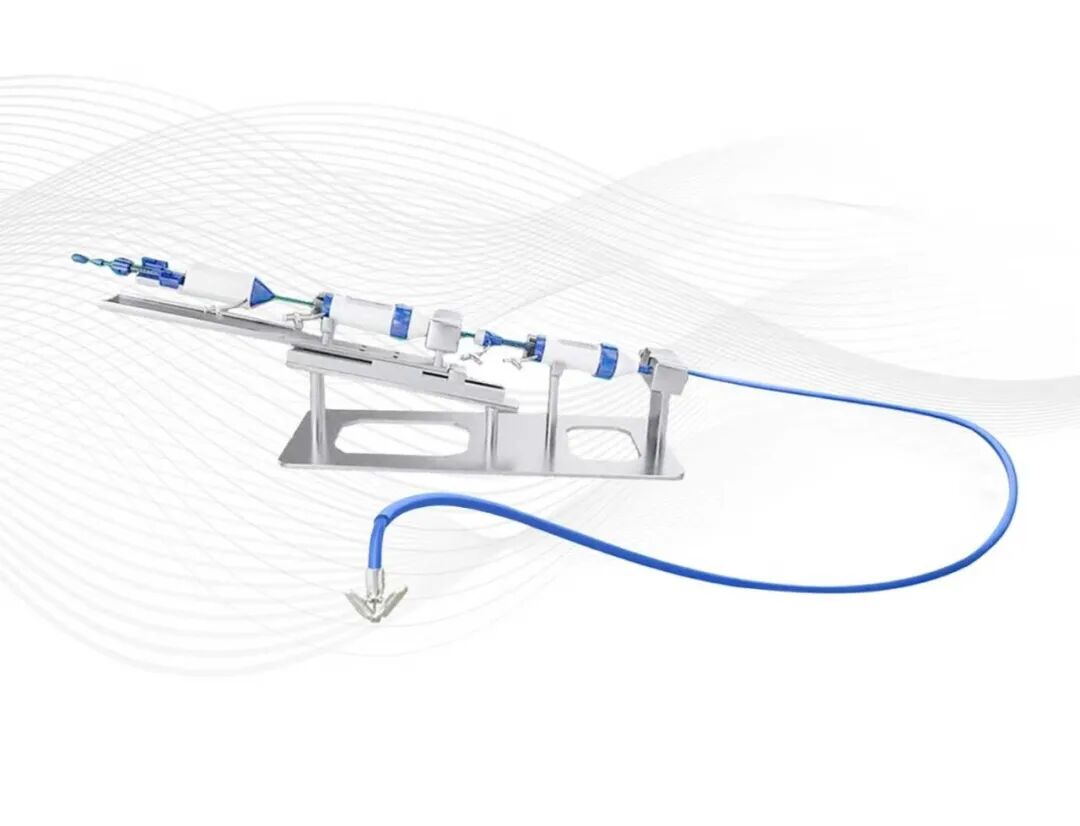
(KOKACLIP®)
02
Challenge impossible problems
China Growth Capital: You have been at the forefront of mitral valve repair. Why did you later expand to other product lines?
CHEN Dakai: Once I learned from an investor that a German company was making a medical device that had not existed in the world — an aortic regurgitation product, but it had not been developed after 15 years of R&D, and then moved to the United States to continue the research — which is hard to imagine in China.
Out of curiosity, I went to do research.
Aortic regurgitation (AR) and aortic stenosis (AS) are the most common aortic valve diseases. In 2019, there were 26.4 million patients with aortic regurgitation in the world, including 3.9 million in China. Up to now, the incidence rate is still rising.
During visits, doctors also told me that there are more AR patients than AS patients. About 60% to 70% of domestic aortic valve diseases are AR patients. However, due to the high difficulty of surgery and the lack of dedicated products, there has been no effective interventional treatment plan.
I was very confused. Why didn't manufacturers make products for such a large proportion of the market? The doctor asked me in reply: "Regurgitation products are definitely more difficult. Foreign companies haven't made them for more than ten years. Do you think you are smarter than them? Or do you have more abundant capital than them?"
We may not be better than them in these two aspects, but we still decided to have a try.
As a result, we finished it in three and a half years.
China Growth Capital: How did you find the breakthrough in such a short time?
CHEN Dakai: In fact, we didn't expect it to be so fast at the beginning. Because products for aortic regurgitation are extremely scarce in China, there are only three companies in the world participating in the research. In addition to us and the German company, there is another domestic company doing related surgical products.
When I worked in Germany and MicroPort in the past, I have been focusing on AS, so I could only start from scratch for AR products.
Fortunately, after our products were initially finalized, many doctors joined our R&D team and participated in the product design together.
For example, on the clinical side, we built a "medical-engineering collaboration" system, and worked with teams from West China Hospital, Fuwai Hospital, Zhongshan Hospital and other hospitals to polish the products, truly realizing the closed-loop R&D of "clinical pain points + engineering design + multi-center verification".
China Growth Capital: The "medical-engineering collaboration" model was rarely seen in the past. How did you build this system? What advantages does such cooperation bring?
CHEN Dakai: At first, many doctors came to help us do experiments for free. I was surprised at the beginning, but later I found that they were more eager to make products than our manufacturers.
AR patients have aortic insufficiency, which may lead to heart failure, arrhythmia and even sudden death in the long run. The patient may pass away in just two or three years. The earlier the product comes out, the more lives can be saved.
On the other hand, from the perspective of scientific research, the clinical data related to AR diseases are very precious. Doctors can publish articles in top international journals, making domestic research at the academic forefront.
All these accelerated our product iteration speed. Sometimes the structure of the stent alone may be changed three times within one day. When conducting clinical trials, the enrollment of all patients was completed in less than half a year. After each operation, many hospitals still applied for participation, and many patients could not wait. We were often very helpless and could only keep accelerating the R&D progress.
Finally, in February this year, this transcatheter aortic valve system (PIONEER TAVR®) was officially approved for marketing by NMPA.
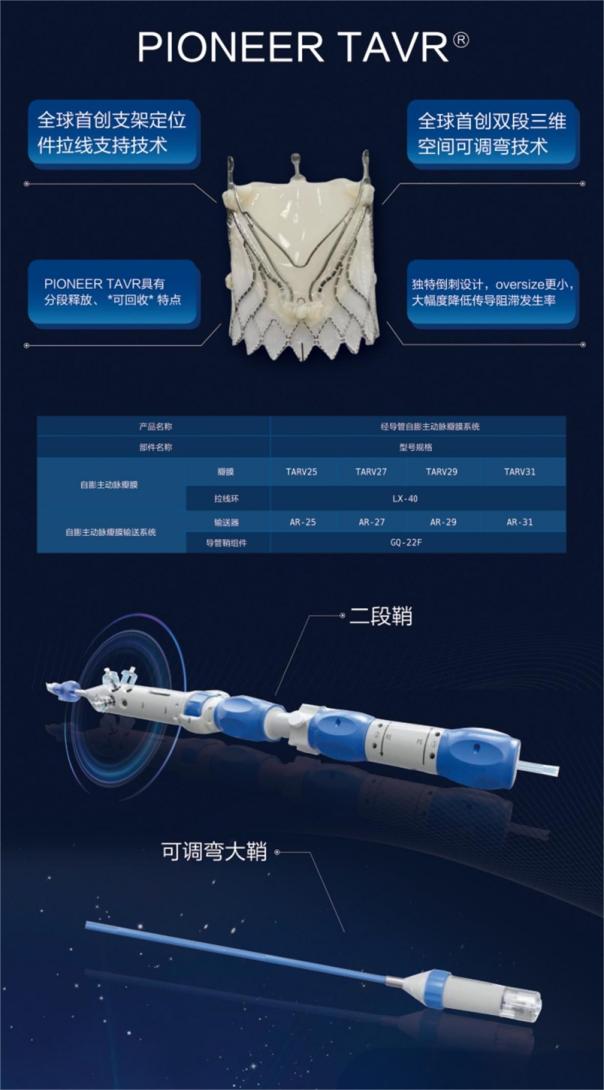
(PIONEER TAVR®)
China Growth Capital: What innovations have you achieved at the product level?
CHEN Dakai: There are mainly three aspects:
First, the world's first 3D spatial bend-adjustment delivery system. The traditional TAVR delivery system can only be adjusted in a two-dimensional plane, but the angle of the aortic arch varies greatly, especially for patients with transverse heart and large sinus, the two-dimensional adjustment cannot reach the target position at all. The 3D bend-adjustment is like giving doctors an extra hand, which can accurately deliver the valve to the designated position;
Second, the independent operation control system for positioning components. This design is very clever. Once the traditional valve is released, it is like water poured out, and you can only proceed even if the position is wrong. But the positioning component of PIONEER TAVR can be controlled independently, fixed first and then released, and the position can be adjusted if it is not correct, which greatly improves the controllability of the operation;
Third, low oversize combined with valve barb structure. The annulus of patients with aortic regurgitation is often relatively large. The traditional solution is to use a large valve to forcibly expand it, but this will compress the cardiac conduction system, leading to the need for pacemaker implantation. PIONEER TAVR uses the barb structure to provide fixing force, the valve size can be smaller, and the risk of pacemaker implantation is reduced.
03
Sustainable innovation capability