Does "double charging" truly exist when LPs invest in S funds?
A brief discussion on how the sub-fund fee structure affects the transaction pricing of S-shares.
Introduction
As financial advisors with years of in-depth experience in the private equity secondary market ("S-market"), we have found in our interactions with potential investors that clients, especially family office type clients, are often troubled by the double-layer charging of S funds. They are no strangers to the primary market, but lack an intuitive understanding of the fee structure of S-shares, and tend to directly apply the fee concept of traditional Fund of Funds ("FOF") to S-share investments.
On the surface, when an LP invests in an S fund or a special-purpose fund for S transactions, the investment vehicle charges fees, and the management fee and performance carried interest ("carry") of the underlying fund are still accrued, which seems to be a two-layer fee structure. However, the author believes that this only looks similar to the two-layer charging of FOF investment, but is completely different in essence. For FOF, the two layers of fees are simply superimposed on the newly contributed capital; while for S transactions, the buyer makes a one-time buyout of an existing share with historical performance and actual assets. The future impact of the underlying management fee and carry has been clearly calculated and discounted into the transaction consideration at the time of pricing. In other words, although the buyer is formally still in a fund that continues to charge fees, there is no duplicate charging in economic terms.
The author will break down the three most common scenarios below, using specific figures to illustrate why in S-share investment, the actual cost borne by the buyer and the return obtained are closer to direct investment, rather than traditional FOF investment.
A no fee/no carry scenario
First, let's look at a fund where the GP has entered the carry distribution stage.
We set a set of figures as follows:
- The initial paid-in capital of the fund is 500 million yuan;
- Now the DPI has reached 600 million yuan. The LP has not only recovered all the principal, but also obtained 100 million yuan of realized returns. The GP has started to accrue and distribute the performance carried interest;
- There is still 10% equity of the last remaining company in the fund's account. The company is now valued at 5 billion yuan, corresponding to book assets of 500 million yuan.
- To simplify the calculation, it is also assumed here that the working capital exactly covers the management fee corresponding to the unexited cost of this project, and the fund has no hurdle return.
The key point here is how the fund's capital account records this 500 million yuan. Since the GP has started to accrue performance carried interest, the statement will not simply record it at the gross value of 500 million yuan, but will first accrue 20% of the performance carried interest in advance, and present it at the net amount after deducting the carry:
Book value after deducting carry = 500 million × (1 − 20%) = 400 million yuan.
The subsequent negotiations and quotations of the buyer are all carried out around this 400 million yuan net capital account, and discounts will be made on this basis according to factors such as liquidity, exit time, and asset quality. In other words, that 20% of carry has been removed from the denominator of pricing before the buyer makes an offer.
From a more intuitive perspective, what is the economic equivalent for the buyer to purchase this share?
- The fund holds 10% equity of this company, but 20% of the economic benefits ultimately belong to the GP's carry;
- After deducting the carry, the LP share actually corresponds to 10% × (1 − 20%) = 8% of the company's equity;
- The buyer buys in at the net consideration of 400 million yuan (with further discount), and essentially obtains this 8% of "after-tax equity".
In this way, when the company finally exits, the buyer will get the full amount of the proceeds corresponding to this 8% equity, and does not need to pay an additional 20% carry for this part of the proceeds. Because the 2% company equity corresponding to the carry (20% of the 10% stake) is not included in the consideration from the very beginning. It can be simplified as a corresponding relationship:
Net input of the buyer (discounted on the basis of 400 million yuan) ↔ Net exit proceeds corresponding to 8% of the company's equity.
Both sides are net amounts, corresponding one-to-one, and there is no additional layer of carry in between. The cost denominator of the buyer is after deducting carry, and the return numerator is also after deducting carry, with exactly the same caliber.
So far, it can be seen that the buyer contributes capital at the net amount after deducting carry, and the impact of carry has been reflected in the price in advance; when the seller sells at a discount, it is equivalent to "prepaying" this part of the performance carried interest for the buyer.
Therefore, in the first scenario, the buyer does not pay additional performance carried interest for the exit proceeds of the underlying enterprise.
Hurdle return higher than neutral investment expectation
The first scenario discusses funds where carry has been triggered. A more common situation is that the fund has not reached the carry trigger point, and the buyer needs to judge: will a large part of the returns be eaten away by carry when exiting in the future?
Let's look at another common situation of S targets:
- The fund has been in existence for 7 years, the cumulative distributed DPI is 0.4, the value of remaining assets is 1.1, and the current TVPI = 0.4 + 1.1 = 1.5;
- The buyer acquires this share at a cost of 0.7 (relative to the paid-in principal caliber);
- The fund is expected to exit in the 10th year. The hurdle return agreed in the LPA is 8% annualized compound interest. The GP will not participate in the carry distribution until the LP recovers the principal and crosses the hurdle.
First, figure out at what position the GP's carry will appear.
Calculated at 8% compound interest for 10 years, the total hurdle amount for the LP is:
(1 + 8%)^10 ≈ 2.16x (relative to the paid-in principal; to simplify the calculation, assume that the 0.4 DPI is generated right before the transaction).
In other words, the fund as a whole must first distribute 2.16 times of the paid-in principal to the LP, and the excess returns after that will enter the carry distribution. The fund has already distributed 0.4, so the remaining assets still need to contribute:
2.16 − 0.4 = 1.76x,
before the LP just reaches the hurdle. However, the buyer's cost is only 0.7. Converted to the buyer's own caliber, the remaining assets need to rise to the following multiple on the basis of the buyer's cost:
1.76 ÷ 0.7 ≈ 2.51x,
before the GP starts to accrue carry.
A key point here is that the entire value-added range from 0.7 to 1.76 for the buyer does not bear any carry at all. The buyer enters at 0.7 and buys the remaining assets worth 1.1 now, while the carry trigger line is at 1.76 (2.16 hurdle minus 0.4 distributed DPI); the buyer will not start to pay carry until the remaining assets reach more than about 2.5 times during the holding period.
The remaining duration of S-shares is generally only 3–5 years. Based on the visible assets and exit paths for modeling, the buyer pursues a relatively certain return of medium multiple, rather than the high-multiple upside of blind pool funds. After substituting the exit value, exit time and discount rate into the DCF model, the buyer's target net return is often between 1.5–2 times, which is still a considerable safety margin away from the carry line of about 2.5 times.
In other words, in the return range that the buyer can actually earn, the GP will most likely not trigger carry at all; every penny of the buyer's gain from 0.7 to the target exit price falls below the carry hurdle and belongs entirely to the buyer. In the economic calculation of this investment, carry is more like a "contingency item" far beyond expectations, rather than a layer of fees that must be paid for sure.
Pricing has deducted future performance carried interest and management fees
Finally, let's look at a scenario that best reflects the pricing mechanism of S transactions. Assume that a fund has a structure of 5-year investment period and 5-year exit period, and the buyer acquires the share in the 4th year, and the transaction price is determined by discounting on the basis of the book value of assets.
First, clarify the position of management fees on the timeline. Before the buyer enters, the management fees for the first 4 years have been deducted from the paid-in scale, which has nothing to do with the buyer; the management fee for the 5th year (the last year of the investment period) will be deducted from the cash on the fund's account; after entering the exit period, according to industry practice, management fees are accrued based on the investment cost of unexited assets. This part of the fees, like the future performance carried interest, will be deducted from the future cash flow year by year in the DCF model.
Specifically, the DCF model first simulates the annual asset exit amount, deducts the management fee and performance carried interest year by year to get the net cash flow of each year, and then discounts it to the transaction time point at the rate of return required by the buyer to get the current price. A set of simplified figures is used for demonstration below (unit: 100 million yuan).
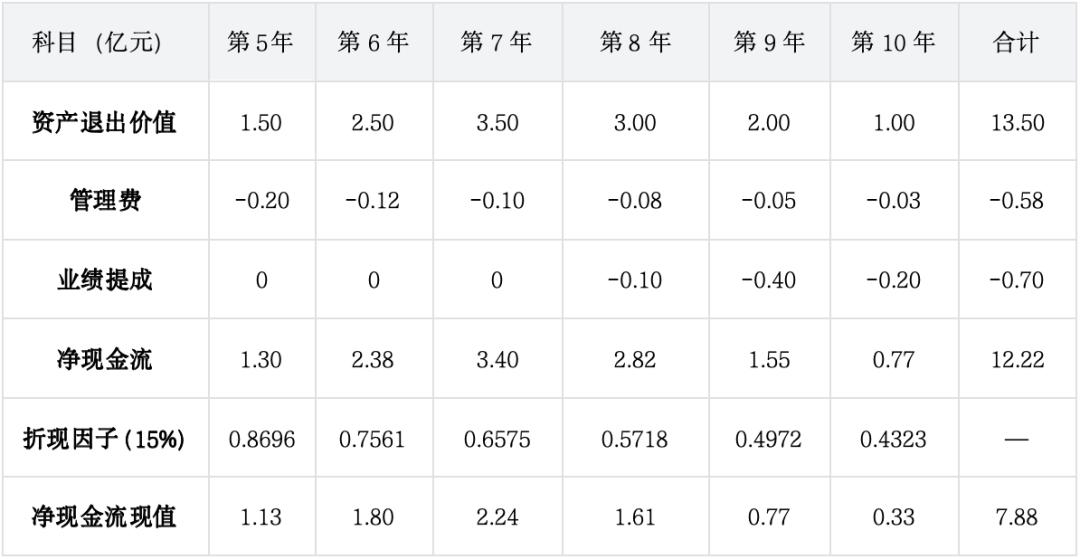
There are several points to note about this table.
- The calibre of performance carried interest is fully consistent. According to the whole-fund caliber, carry = (Total exit amount − Initial paid-in contribution) × 20% = (13.5 − 10) × 20% = 70 million yuan. In the model, cumulative exit does not cover the 1 billion yuan paid-in capital until the 8th year. After that, 20% of the excess part is accrued year by year: the excess of 0.5 in the 8th year corresponds to 0.10, and 0.40 and 0.20 are accrued in the 9th and 10th years respectively. The sum of the three years is exactly 70 million yuan.
- All fees are incurred before discounting. Whether it is the management fee (total 58 million yuan) or carry (70 million yuan), they are first deducted from the gross exit amount of each year, and then the net cash flow is discounted. The object of the buyer's discounting is the net amount that belongs to the buyer in the first place.
- 788 million yuan is the theoretical DCF price. Discounted at the 15% required rate of return for the buyer, the total present value of net cash flow is about 788 million yuan; the actual transaction consideration will be further adjusted on this basis by taking into account factors such as liquidity discount.
Therefore, in the third scenario, the buyer also does not need to pay additional management fees or performance carried interest beyond the price. These fees have been deducted year by year in the discounting process that forms the price. The buyer pays the net present value and recovers the net cash flow in the future, which is no different from the economic essence of direct investment.
Conclusion
Summarizing the three scenarios above, we can draw three conclusions.
First, S transactions are complex and there are many factors to consider. This includes not only the exit expectation of underlying assets, but also the current fee structure of the fund — what base the management fee is charged on, whether the carry has been triggered, and how much duration is left. The price of any share needs to comprehensively consider these factors, and there is no unified formula that can be applied. From another perspective, the management fee and performance carried interest paid by LPs to S funds are mainly used to find specific transaction opportunities, price and execute transactions, which is more complex than FOF investment and actually has extremely high cost-effectiveness.
Second, in essence, the entry price has generally fully considered these future fees and deducted them from the consideration in advance. Although formally, the S buyer is indeed in a fund that is still accruing management fees and carry, which seems to have two layers of charges. The buyer contributes capital at the net amount and recovers proceeds at the net amount. The economic essence of investment returns is closer to direct investment, rather than the FOF structure where two layers of fees are simply superimposed.
Third, the risk-return profile is even better, which is reflected in lower probability of loss and narrower return variance. This comes from several aspects: first, the clear pool effect. When the buyer enters in the middle and late stage of the fund's existence, the assets and exit paths are clearer than those of blind pools, and the buyer can also make better judgments with the help of the GP's internal information as a shareholder and board member; second, the buyer has pricing power, and can control the discounted value of fees and risks within their own expectations through discounts; third, S-share itself is an asset portfolio with mean reversion effect on returns, and the fluctuation of individual projects will be smoothed out by the portfolio.
Therefore, in general, when LPs invest in S funds or S transaction special-purpose funds, compared with direct investment funds, the fees are more cost-effective (usually S funds have lower fee rates than direct investment funds, and the impact of underlying sub-fund fees has been included in the price), and the risk-return profile is more balanced. China's S fund transactions and S market have just emerged. For investors with pure financial demands, compared with direct investment in projects or participating in blind pool funds, S funds provide a more cost-effective and better risk-return choice, which should not be mistakenly rejected due to a superficial stereotype or the mandatory requirement to avoid "double charging".
This article is from the WeChat Official Account "FOFWEEKLY", author: LIAO Yifan, published with authorization from 36Kr.