The optimal solution for growth lies in proactive customer referrals.
20% of new customers contribute 70% of the profits, and "existing customers bringing in new ones" has become the key to low-cost growth for enterprises.

ButcherBox, a high-end meat and seafood retailer with a subscription-based business model, saw its sales exceed 600 million U.S. dollars only 8 years after its founding.
Initially, the company mainly achieved growth through influencer marketing, but over time, it became increasingly reliant on digital ads to acquire new customer leads. Later, as paid influencers, social media platforms, and search websites kept raising their prices, ButcherBox's customer acquisition costs began to surge sharply. At the same time, the quality of customers brought by paid channels was declining: they not only spent less, but also chose less profitable products, and had a higher churn rate.
To find a new strategy that could revitalize the company, Mike Salguero, CEO of ButcherBox, began to focus on the concept of "earned growth", which refers to achieving high-quality revenue growth through repeat purchases and customer referrals. Since each customer has a limited amount of protein they can consume per month, customer referrals seemed to hold greater growth opportunities. Salguero categorized customers acquired via referrals as a separate channel and carefully studied its economic benefits, only to find that these customers were a "gold mine" — they generated far more profits than customers acquired through paid ads. As a result, the marketing team launched a customer referral program with a reward mechanism, successfully tapping into a new pool of customers. These new customers, through more frequent repeat purchases and word-of-mouth communication, sparked a new round of growth for the company. With this strategy, ButcherBox not only increased its customer referrals by 57% in the past year, but also cut its customer acquisition cost by half.
Enterprises have poured huge marketing funds and invested a great deal of time and energy into social media, digital ads, search bidding, promotional activities, influencer-driven sales, search engine optimization, and curated online reviews. However, for most companies, the highest-quality customers still come from referrals — this point was confirmed after Bain & Company analyzed data from more than 10 million users participating in referral programs on the word-of-mouth marketing platform Mention Me (Wojtek, one of the authors of this article, is the CEO of this platform). Across multiple industries including fashion, food, health and beauty, financial services, tourism, and telecommunications, we found that on average, although only 20% of new customers come from referrals, they contribute more than 70% of the profits from new customers (see the chart "The Real Source of New Customer Profits").
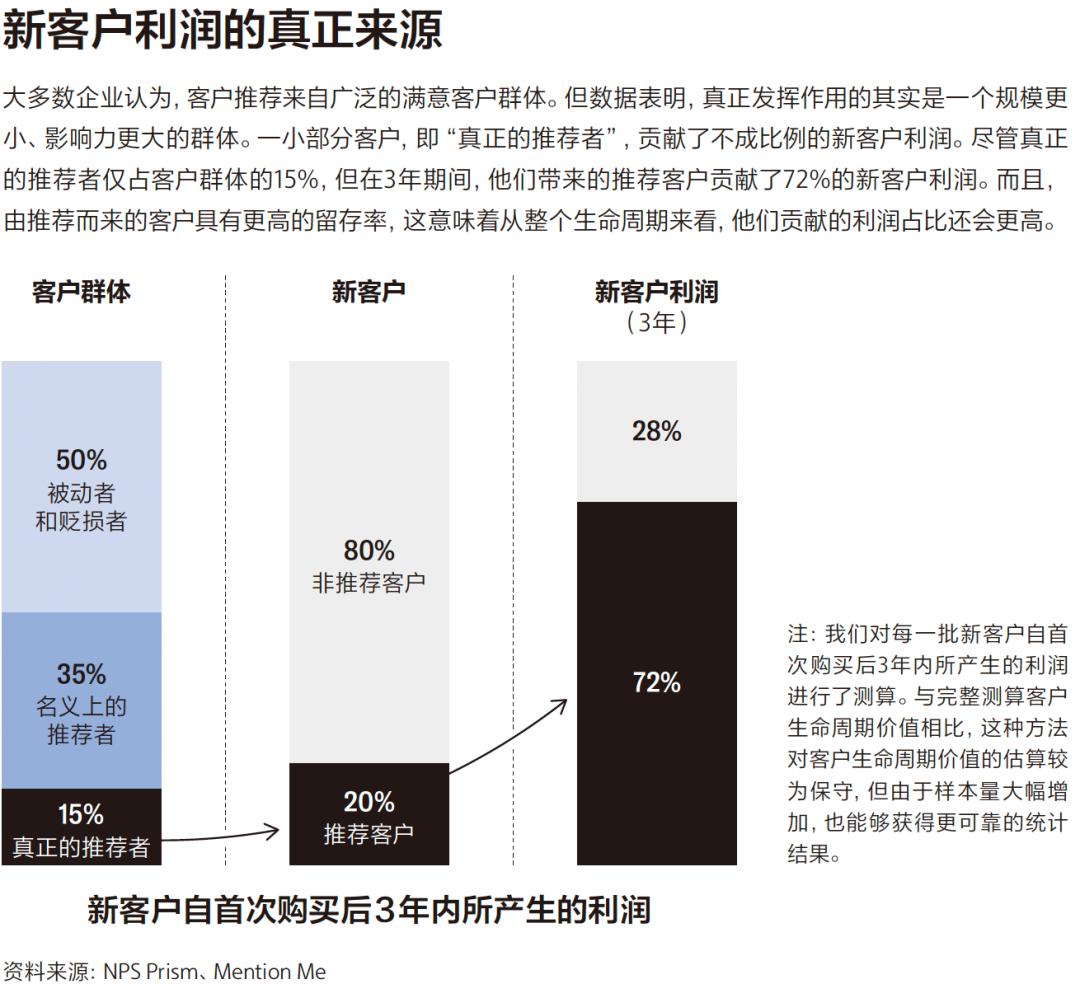
The reason why customer referrals generate excess profits is that they have multiple advantages: lower acquisition costs, longer retention periods, and higher willingness to recommend the brand to their family and friends. Meanwhile, these customers have higher per-transaction spending, and the products they choose bring more profits to the company.
Customer referrals also play a pivotal role in revenue growth. From dozens of Net Promoter Score (NPS) consulting projects, we learned that the average spending of "promoters" is 1.6 times that of "passives" (promoters refer to customers who give a score of 9 or 10 in response to the survey question "On a scale of 0 to 10, how likely are you to recommend us to a friend?"; passives give a score of 7 or 8).
However, for many years, due to inflated scores, the promoter category has accounted for half of all respondents, blurring the line between truly enthusiastic brand advocates and nominal promoters — the latter are only satisfied with the brand, but not passionate enough to actively promote it. Our research on Mention Me data (covering both rewarded and organic referrals) found that true promoters only account for 15% of all customers. A true promoter refers to someone who has successfully brought in at least one new customer through referral. The lifetime value created by these true promoters (including their own purchases and purchases brought by their direct and indirect referrals) is almost 3 times that of passives. Among true promoters, "superpromoters" who can refer multiple new customers generate 5 times more revenue than passives.
If enterprises only look at the impact of direct referrals, they will seriously underestimate the compound growth effect generated by true promoters, especially superpromoters. They refer friends, and those friends continue to refer their own friends. This fission effect of word-of-mouth spread is why a small increase in referral rate can lead to exponential growth.
Given the powerful force of referrals, why have many executives turned a blind eye to it for a long time? Part of the reason is insufficient visibility. Most companies do not systematically track customer referral behavior, so customers brought in via referrals are often mixed with customers acquired through other channels. As a result, financial accounting systems and marketing attribution models often attribute the credit to marketing activities, mistakenly believing that ads attracted these customers, when in fact these customers had already decided to make a purchase because of a friend's recommendation. This misalignment makes paid customer acquisition seem more effective than it actually is, while masking the real economic value behind referrals.
Many leaders are also used to focusing on the most easily measurable and manageable factors, such as advertising expenses and their correlation with the number of new customers, while ignoring what experiences can touch people's hearts or what social interactions can stimulate referral behavior. In addition, since traditional indicators usually cannot distinguish between short-term "fleeting" revenue driven by traffic and long-term sustainable growth won by word of mouth, executives may find it difficult to see the role of referral behavior in driving continuous growth and profitability.
In this article, we will deeply analyze the economic logic behind customer referrals, and explain why CEOs should ask their teams to start consciously measuring and managing referral behavior. We will explain why referral rate is an important indicator for predicting a company's financial success, which should not only attract the attention of marketing executives, but also become a key focus of the entire executive team and the board of directors. In addition, we will provide practical methods to help enterprises identify true promoters and design systems that can turn customer word of mouth into a stable growth engine.
Positive Economic Impacts
Referral behavior can significantly improve a company's cash flow. We believe this explains the seemingly abnormal cash-generating capabilities we observed in some NPS superstar enterprises, such as car rental company Enterprise Rent-A-Car, fast food chain Chick-fil-A, IKEA, and Apple. Enterprise started as a small family-run car rental company in St. Louis, USA, and has now developed into the world's largest car rental company with more than 2.4 million vehicles, without ever raising equity financing. Chick-fil-A has grown its total system revenue to nearly 23 billion U.S. dollars without issuing stocks, and has established more than 3,000 directly operated stores. Similarly, IKEA has grown into the world's largest furniture retailer without ever issuing stocks or bonds. As a pioneer of the NPS system, Apple, with its strong cash-generating ability, has repurchased more than 800 billion U.S. dollars worth of its own shares since 2013.
All these companies focus on delivering excellent products and services to stimulate active customer referrals, so they do not need to rely as heavily on expensive advertising or price promotions as their competitors to acquire new customers. How much cash flow advantage can this approach bring? To answer this question, we selected five industries with publicly available data and compared NPS-leading enterprises with their NPS-lagging peers. The five leading enterprises are Hermès, Costco, IKEA, Apple, and the chain restaurant Texas Roadhouse.
We compared the proportion of Selling, General and Administrative Expenses (SG&A) in revenue for each group of enterprises. The results show that the SG&A ratio of leading enterprises is only half that of lagging peers — accounting for 11% and 22% of revenue respectively. This means that for every dollar of sales, NPS-leading enterprises generate 11 cents more cash flow than lagging enterprises.
The reason why NPS-leading enterprises have lower costs is that they do not spend a lot of money to acquire customers with unclear long-term revenue potential and almost no referral intention (if only 20% of a company's customers come from referrals, the remaining 80% of customers should be viewed with a certain degree of prudence). Efficient growth relies on active referrals from existing satisfied customers.
Earning customer referrals requires continuous effort and innovation. Executives may be tempted to take shortcuts through all kinds of clever customer acquisition tactics, but unless a considerable number of these new customers eventually grow into true promoters, the returns are often not enough to cover the costs. This logic is particularly important with the rise of AI shopping bots. These bots are inherently not affected by search engine optimization, digital marketing, advertising, or influencer promotions. The more advanced an AI shopping bot is, the more it tends to refer to real customer reviews and referrals. As more and more consumer decisions are made through these bots, enterprises must pay more attention to customer referrals if they want to attract high-quality potential customers.
Launch the Customer Referral Engine
Enterprises that truly value customer referrals will establish a system to identify which customers are actively recommending their brand and why they are willing to do so. To do this well, questionnaires or the intuition of marketers are far from enough. Enterprises need to establish a complete set of operational processes to continuously track the flow of customer referrals, and make all teams take responsibility for converting satisfied customers into active promoters. Below, we will introduce several key measures that enterprises must take to truly benefit from the customer referral effect.
Identify newly acquired referred customers. First of all, you need to establish a systematic method to accurately identify which new customers are brought in via referrals. A case worth learning from is CertaPro, the largest residential painting company in North America. For more than a decade, the company has been continuously tracking NPS and customer referral leads. CertaPro asks every potential customer: "How did you hear about our company?" and then records the answer in its customer relationship management system. The company's customer lead registration process will not proceed until the potential customer answers this question, because in CertaPro's view, this information is as important as the customer's address and credit card number.
Mention Me has developed an online solution that allows new customers entering the website to easily click on one of the six most common reasons for choosing the brand, or fill in other reasons. As part of this process, the company can further ask customers: "Who referred us to you?" and ask customers to provide the contact information of the referrer, so that it can send thank-you messages or give gifts to these people. These people are true promoters and the most important strategic assets of the enterprise. Therefore, enterprises should not only identify them, but also deeply understand them, especially to figure out what exactly prompted them to make active referrals.
Identifying all customers brought in via referrals at the first contact can also help enterprises calculate the referral ratio (the proportion of new customers acquired through referrals in all new customers), and use it as a benchmark for continuous improvement. As mentioned earlier, the average referral rate for Mention Me's customers is about 20%, but there are large differences between different enterprises, ranging from single digits to more than 50%. Costco is an extreme case: it barely relies on advertising or promotions, and the vast majority of new customers are won through customer referrals.
The low-tech method adopted by CertaPro is very suitable for enterprises as an initial means to measure the flow of customer referrals. Once this system is established, enterprises can continuously carry out experiments, continuously optimize processes, reduce friction in the customer referral process, and improve data accuracy. Subsequently, they can further integrate the customer feedback system, loyalty management system and the enterprise's central customer database to establish a more complete customer referral management system.
Quantify the economic value of customer referrals. To determine how many resources an enterprise should invest in winning customer referrals, as well as in measuring and optimizing the referral system, it must first be able to quantify the value created by customer referrals and its impact on profits and growth. When ButcherBox accurately allocated costs such as advertising, promotions, and customer onboarding to its referred customers, it found that the customer acquisition cost of these customers was much lower than that of new customers from other channels. Then the company's finance team further calculated the value of referred customers after deducting customer acquisition costs, taking into account their purchase behavior, average order value, product mix and profit margin, purchase frequency, customer retention rate, and the profits brought by new customers subsequently referred by these customers. These measurements fully reveal the full value contained in continuously obtaining more referrals.
Another company that quantifies the economic value of customer referrals is Intuitive Health. The company cooperates with major medical groups in the United States to jointly build and operate innovative medical centers that integrate urgent care clinics and emergency rooms in the same facility, providing one-stop services for patients. In 2025, Intuitive Health received more than 1 million patient visits in total. The company's compound annual revenue growth rate exceeds 30%, and its profitability is also very outstanding (the most recent capital restructuring brought its original shareholders a 900% return on investment).
Intuitive Health strictly tracks the effect of customer referrals by region. The company found that in the Dallas-Fort Worth area, patients referred by others use more services, driving business growth, and their profit margin is 4 times that of other patients. The company also found that its long-term focus on customer referrals has reduced its overall customer acquisition cost from 57 U.S. dollars in 2015 to just over 20 U.S. dollars today. Customer referrals have become part of the business plan of every clinic under Intuitive, and the volume of business contributed by referrals is regarded as a key performance indicator for managers.
Find the experiences that truly surprise your core customers. Cultivating true promoters and stimulating their active referrals does not rely on clever marketing skills, but on continuously delivering impressive new experiences that make customers naturally willing to recommend products and services to their family and friends. To achieve this, enterprises must deeply understand what kind of experience will actually trigger customer referrals.
Intuitive Health uses the NPS feedback system to continuously learn which experiences make customers feel surprised and which experiences disappoint them. Clinic managers will strive to complete closed-loop communication within one or two days after customer feedback, and conduct in-depth exploration of any failures that fail to satisfy customers. They not only call dissatisfied detractors, but also contact all customers who give a score lower than 9 (out of 10). Their surveys are not only used to identify experiences that customers care about, but also to calibrate the performance thresholds of key operational indicators. For example, Intuitive found that a crucial indicator is the total time patients spend from registration, waiting, receiving treatment to walking out of the door. Therefore, operational turnaround time, that is, the proportion of patients who complete the entire diagnosis and treatment process and leave within one hour, has become one of the operational goals that the company focuses on managing.
Design reward mechanisms strategically. To manage and harvest the full economic value brought by customer referrals, most enterprises should reward customer referrals, but pay attention to avoiding common mistakes in the implementation process. Since many referral programs are not connected to financial systems that track their economic value, they cannot identify customers who actually initiated referrals, nor can they further analyze the root causes of referrals. As a result, referral rewards are only regarded as a low-cost customer acquisition marketing method, rather than a refined management mechanism to drive profitable growth.
There are many other factors that lead to poor performance of referral programs. For example, if the referral reward is too generous, people may act more out of their own interests than for the sake of their friends. Sometimes, improper setting of reward recipients or improper distribution of rewards will weaken their effectiveness. For example, a business travel membership program directly credited referral rewards to the accounts of corporate executives, while these affairs are usually handled uniformly by assistants, so the executives themselves may not even notice the rewards.
Enterprises should continuously experiment to find the most appropriate reward mechanism, membership system, prize redemption method, and recognition form, to truly motivate promoters and further quantify the referral chains they trigger. Practice shows that the most effective rewards usually require both the referrer and the referee to clearly understand the reward content, and the amount is moderate, which is enough to encourage promoters to use the referral mechanism, but not so high that people deviate from the real experience and refer just for the reward. Congstar, a mobile communications brand under Deutsche Telekom, is a good example. Its "Freundeskreis" (Friend Circle) membership program stipulates that as long as both the referrer and the referee remain active customers, both can enjoy a 10% discount on fees for a long time.
ButcherBox continuously optimizes its referral program, focusing on its most loyal customers. The company sends referral codes to these customers, who can forward them to friends, and friends can get a free box of products worth 170 U.S. dollars with the referral code, but need to pay 20 U.S. dollars for shipping. This design helps filter out potential customers who have real willingness to purchase. If the friend who received the free product eventually becomes a paid subscriber, the company will send another new product redemption code to the original referrer for them to continue referring. This mechanism encourages the highest-quality customers to continuously introduce more new customers to the brand, while ensuring that rewards are always linked to real customer conversions.