Why has novelty-seeking become Walmart's business strategy?
Whether retailers can take the lead in building a system for developing competitive new products and expand their channels as soon as possible has become the key to winning the next stage of competition.
"Where on earth did the R&D team of Walmart's private label Wo Ji Xian find a wizard?" Xiaonan, a white-collar worker working in Shenzhen, usually likes to go to the supermarket after work to buy some snacks to reward herself, such as the Walmart or Hema near her home, and occasionally visit Ole under China Resources Vanguard.
In recent months, she has found that among the continuous new products launched by Wo Ji Xian, Walmart's private label, some flavors are so bizarre that they are shocking.
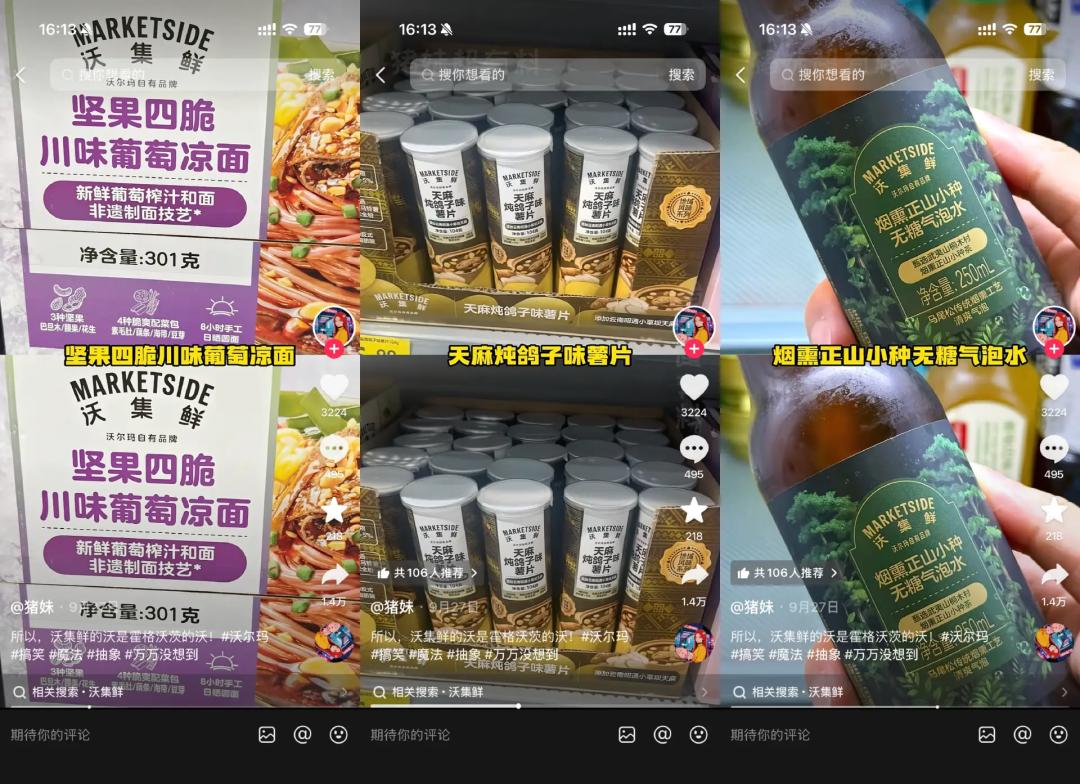
Apple chicken sausage, bitter melon ham sausage, and pineapple ham sausage can only be regarded as appetizers with a combination of salty and sweet flavors. The "Sichuan-style cold grape noodles with four crispy nuts" which is claimed to be made with fresh squeezed grape juice mixed into the dough, and the "Rosa roxburghii and wampee glutinous rice cake spicy chicken mixed noodles" made with original Rosa roxburghii juice, make people completely unable to imagine what the taste would be like. In comparison, the potato chips with the flavor of stewed pigeon with Gastrodia elata even make people feel that they seem somewhat nourishing?
"It seems that all the permutations and combinations of food in the world are listed, and then dozens of them are randomly selected and put on the shelves of Walmart," Xiaonan said in shock and confusion, but she felt that "this atmosphere is so weirdly addictive", "it makes people want to go and see what new tricks are there today".
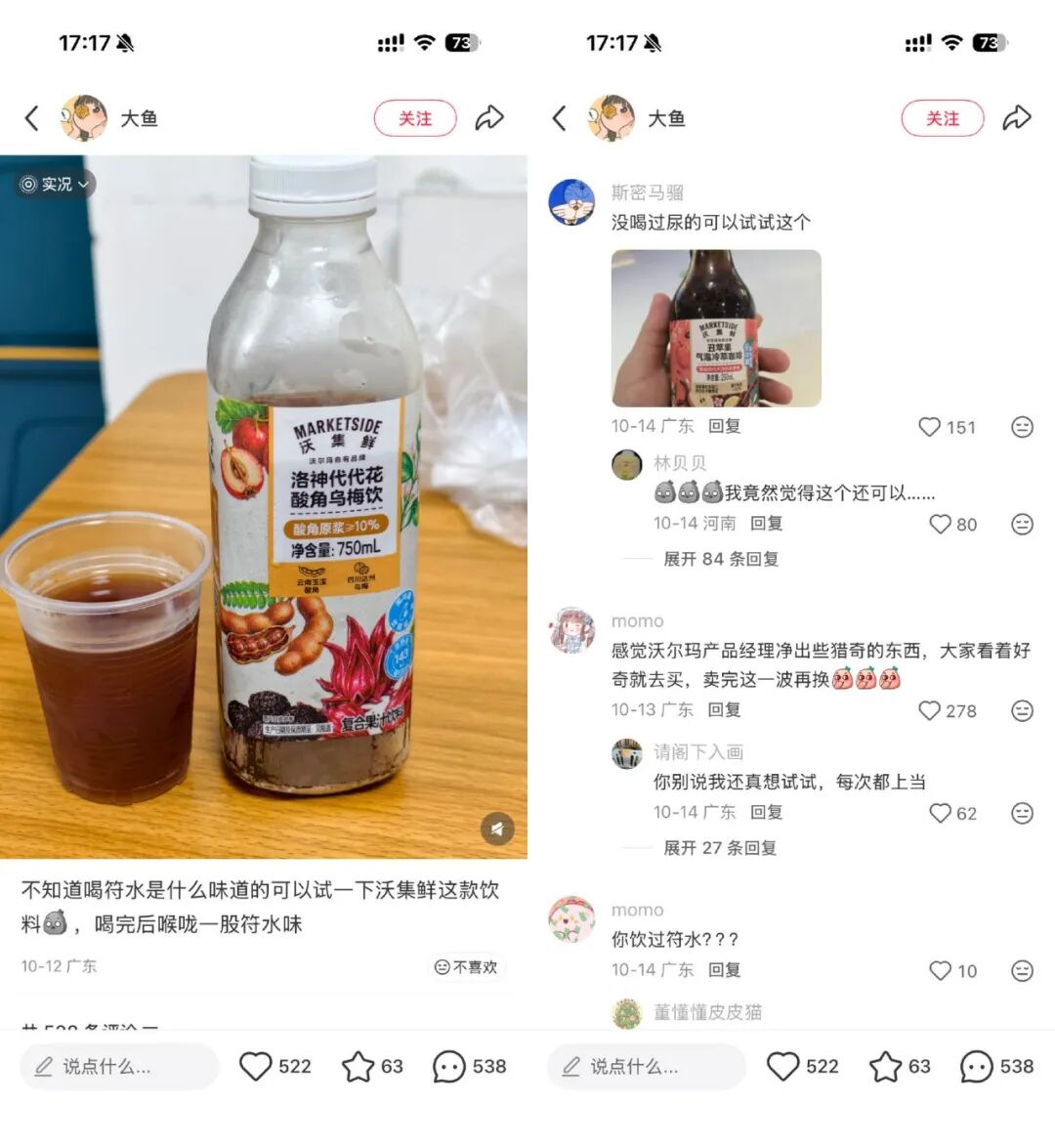
However, she is also very curious: when Wo Ji Xian launches new products in such a bizarre way, will there really be people who keep buying them all the time?
01
The most eye-catching star of Walmart
Since its brand refresh last November, Wo Ji Xian has occupied the most prominent position on the shelves of Walmart supermarkets. Xiaonan can clearly feel that Wo Ji Xian has expanded all the way from the bakery section to prepared food, fresh produce, snacks and other categories, and now its products can even be found in instant drinks, pet supplies and household cleaning products.
Before that, she might check the brand when buying things, but now if she has no specific demand, she will directly pick Wo Ji Xian products, which are "often the cheapest among similar products". Walmart also runs Sam's Club. She didn't buy products from Sam's Club before because she lives alone, and the portion of Sam's products is too large. Now Wo Ji Xian has launched some products similar to those sold at Sam's Club, and she subconsciously thinks that "the quality should not be too bad".
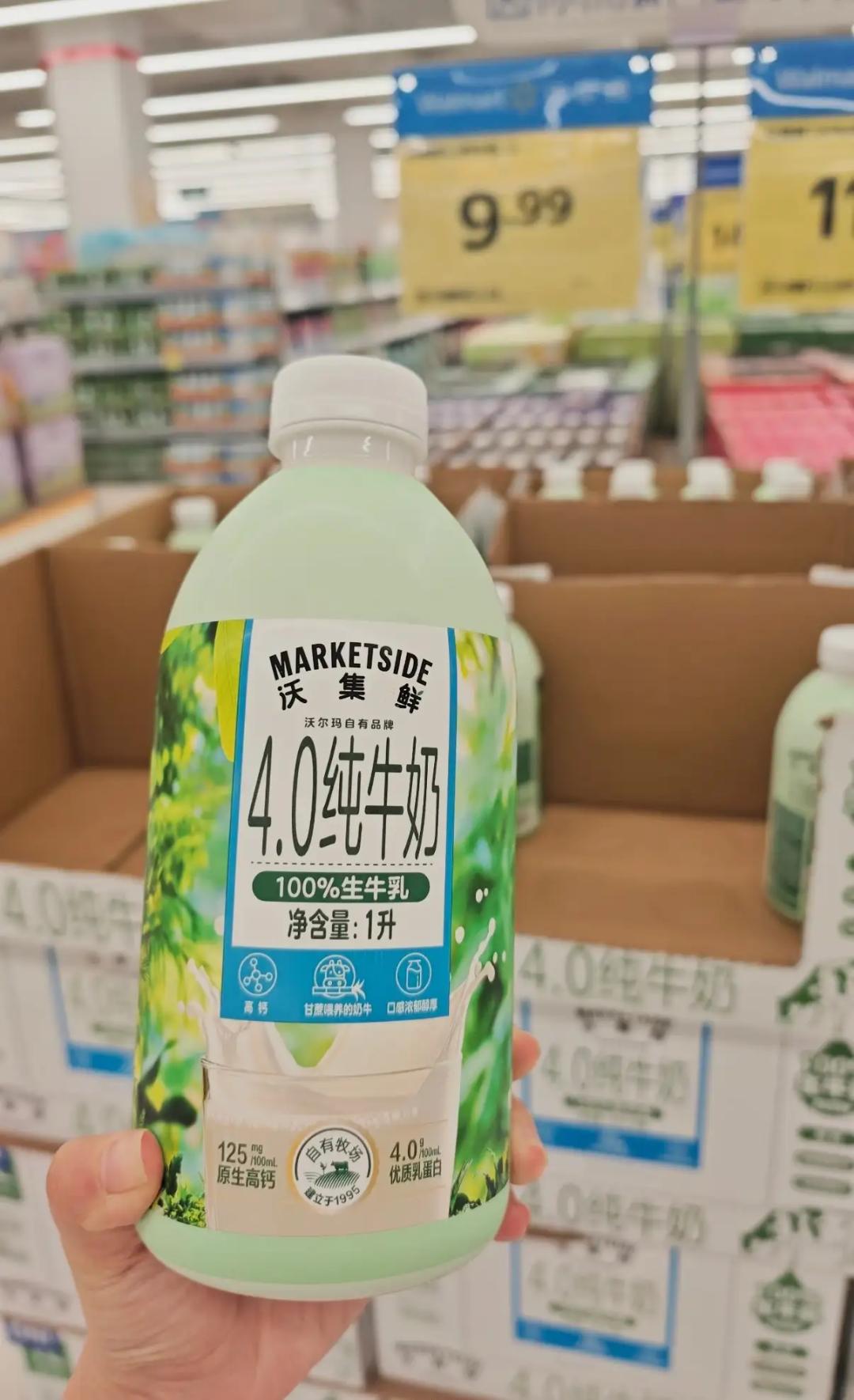
On Xiaohongshu, the earliest hit product of Wo Ji Xian is a 4.0 pure milk with particularly rich flavor. Just like grass-fed beef and high-quality high-frequency large standard products, its product selection style is very similar to that of Sam's Club: to provide the best choices for the daily consumption of Chinese middle-class families.
But just as mentioned at the beginning, Wo Ji Xian obviously does not stop here. It is like a non-mainstream younger brother who has a steady and reliable elder brother, going out on the street with colorful hairstyles to attract young people who still crave freshness.
In fact, Wo Ji Xian, which officially launched its brand refresh at the end of last year, has become an important business driving Walmart's double-digit growth. Zhu Jun, who is mainly responsible for promoting this business, was promoted in the middle of this year to become the President of Walmart China Commercial Formats.
In less than a year, Wo Ji Xian has launched nearly 1,000 SKUs. According to summaries from multiple media outlets, to launch so many new products in such a short period of time across so many different categories, the development basically follows the following logic.
The first logic is to turn inspirations from the Internet and user feedback into actual products.
Hubei Daily mentioned that the "young product managers" of Wo Ji Xian spend every day on social platforms, go through all user comments, work with suppliers to adjust formulas and develop new products. Ideas put forward by consumers online and pain points they complain about can be turned into products on the shelves very quickly. For example, making snacks with the flavor of dishes: popular tasty flavors like salted egg yolk and fried shredded pork with bitter melon can all be made into snacks.
At the same time, in accordance with the logic of seasons and festivals, Wo Ji Xian is also transforming and innovating the original "seasonal products" to create new products. For example, during the previous Mid-Autumn Festival, Walmart launched hundreds of Mid-Autumn Festival products, many of which are low-sugar formula mooncakes and simple-packaged mooncakes priced below 20 yuan, which accurately responded to the widespread consumer demand of "fearing overly sweet and greasy food and wanting to eat mooncakes in daily life".
The second logic is to follow the development route of "homology of medicine and food" that echoes the deep demand of Chinese consumers. Homology of medicine and food refers to ingredients that can be used as both food and are included in the "Catalogue of Substances That Are Traditionally Both Food and Chinese Medicinal Materials" released by the National Health Commission of the People's Republic of China, such as jujube, wolfberry, Chinese yam, coix seed and so on.
However, Walmart emphasized that it does not just stay at the common conceptual addition in the market. Instead, it gives full play to its supply chain management capabilities, and cooperates with time-honored traditional Chinese brands for joint development. From formula verification, raw material inspection, addition ratio control to finished product testing, the two sides work together to complete product development and quality management, so as to jointly establish new product standards.
Moreover, this concept of homology of medicine and food has, to some extent, become a broad health concept. Low GI, sugar control, precise nutrition, combining traditional Chinese elements and Western concepts, it can be said that all the health buzzwords that people most expect are integrated together, creating a brand new type of "healthy snack" (in fact, if you look closely, the calorie content is not low at all).
Another way is to co-brand with IP holders or licensors such as Xiaohongshu and Disney to produce products that are more interesting to their fans. This is similar to the co-branding activities that are extremely popular in China's coffee and tea chain industry, and it is also a new touchpoint to attract consumers to walk into supermarkets.
Different from Sam's Club, Walmart, as a hypermarket that has gradually faded out of the life of young people, itself needs to be updated. In the past, hypermarkets attracted as many customers as possible through large store space and rich product variety.
Now, these new products first promote the product renewal of hypermarkets at the system level, and recapture the market share snatched by fresh food e-commerce platforms such as Hema, Xiaoxiang, and Dingdong.
In addition, Walmart itself is carrying out store format upgrades. The new-generation stores have reduced their area by more than half to 3,000 square meters, and community stores are even only 500-1000 square meters. The number of SKUs will also be cut from more than 20,000 to more than 10,000, so that the stores can be opened in places with denser foot traffic.
02
Walmart's advantage does not lie in product R&D
In fact, apart from membership-based stores such as Sam's Club and Costco, the practice of supermarkets launching private label products with strange or novel flavors to attract consumers' attention is no longer new today.
Recently, players including Hema, Aldi, Xiaoxiang, Dingdong, and Pupu have all adopted this strategy, but the number of SKUs they launched is relatively limited, mainly focusing on bakery, prepared food, snacks, and some daily general merchandise.
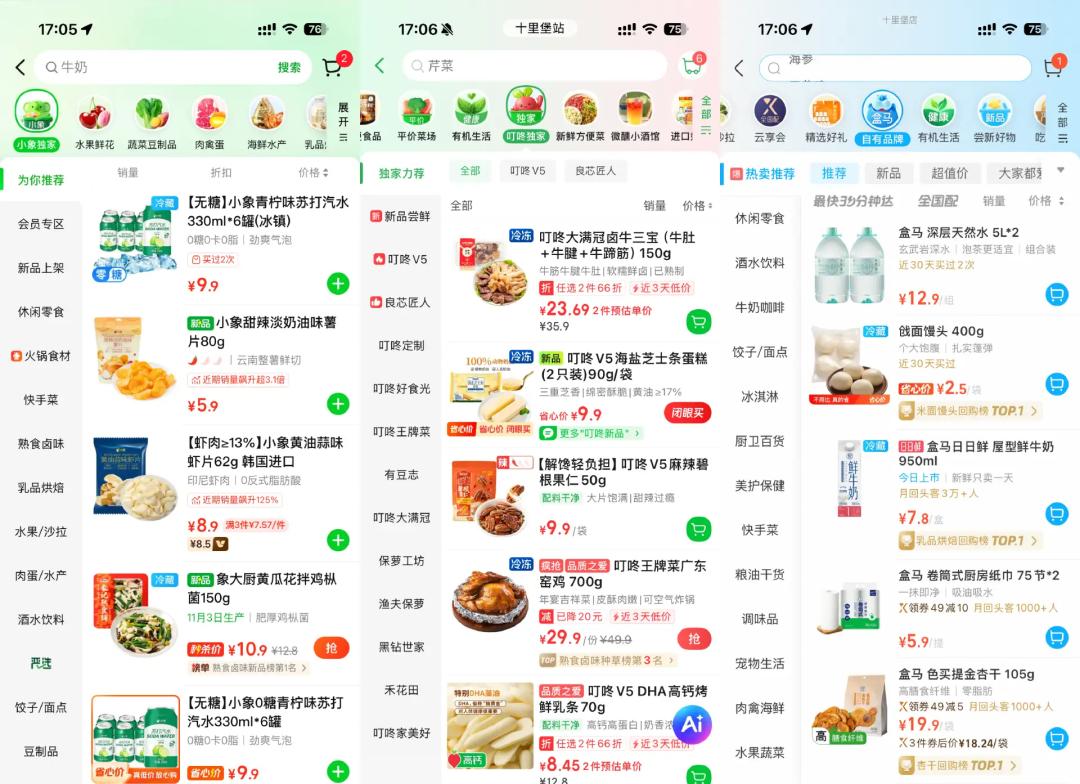
Xiaoxiang, Dingdong, and Hema have all gradually established mature private product systems
Hema is a local player that explored this practice relatively early and made a lot of splash. (They even once launched a series of products with Houttuynia cordata flavor!) Back in 2018, they claimed to build a "new retailer-supplier relationship", abolish entrance fees, fully adopt the buyer system, and carry out joint development.
But at that time, the "New Retail" concept was at its peak. The aggressive style of the Alibaba Group made Hema rely almost entirely on its in-house R&D team for private label product development; even to ensure the rapid iteration of short-shelf-life bakery and special products, Hema once chose to build its own factories, do R&D and manage production (for example, the Tanghe Bakery Factory). This brought heavy equipment depreciation, personnel management and fixed costs.
Therefore, later Hema chose to streamline its in-house R&D team, open part of the R&D work to strategic suppliers, and carry out joint development between the two sides. This can be regarded as a shift from the heavy asset top-down transformation operation to the light asset operation that relies more on suppliers' independent R&D.
In fact, heavy asset transformation may only be a short-term stage in the Chinese market, because the upstream supply chain quickly realized similar demands, and soon became mature to cooperate with the retail end for transformation.
This development direction just falls into Walmart's traditional strong area.
The fact that Walmart can launch so many new products at once does not mean that Walmart is particularly good at R&D. Instead, mature retailers are best at organizing the supply chain to carry out product development together, and even define new products and new categories. For example, the bitter melon ham sausage mentioned at the beginning is claimed to be "first jointly developed with suppliers".
In addition, with the accumulation of Sam's Club, one production line can serve two targets. According to 36Kr, brands such as Qiaqia, Jinmailang, Qianhe, and Sanyuan are actually on the OEM list for both Sam's Club and Wo Ji Xian. For the same mellow soymilk, Sam's Club makes it a 28-day short-shelf-life product with higher logistics and warehousing costs; while Wo Ji Xian can make it a 6-month normal temperature product.
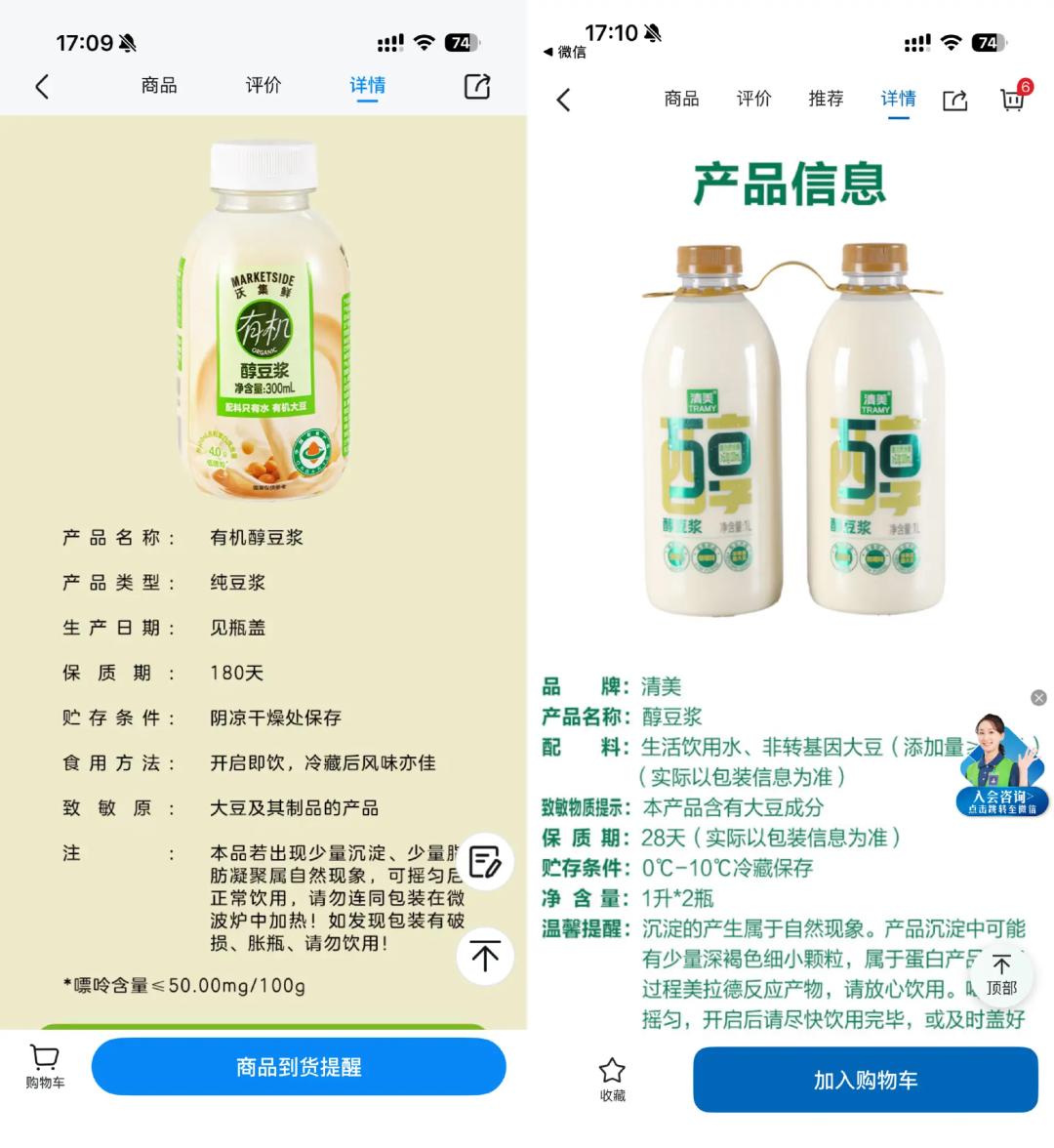
Of course, going back to the peculiar flavors of Wo Ji Xian, they are not necessarily designed to bet on a certain hit product. It is more like a product development method: use new flavors to attract attention, and then use small packaging, favorable prices, supply chain advantages and in-store scenarios to turn the attention into reasons for consumers to try new products and make daily purchases.
In addition, Walmart has also carried out more in-depth organizational structure transformation: the procurement staff who decide what to put on the shelves are responsible for both the overall performance of the categories they are in charge of and the performance of private label products. With unified KPIs, procurement staff have transformed from buyers to product managers.
Private label products are no longer just an independent development task. If the assessment covers the entire category, instead of only looking at the new product launch or sales proportion of private labels, procurement staff will be motivated to judge "when to develop private label products and when to introduce supplier brands". The supplier relationship may also shift from simple product supply to joint development.
Zhu Jun told 36Kr that in the past, traditional hypermarkets relied on large store space and rich product variety to attract as many people as possible. But today, Walmart aims at the general urban middle-class small families and single people, removes a large number of duplicate and inefficient products, and leaves the shelf space to products with better quality, small packaging, good taste and affordable prices.
Essentially, this is also because the above-mentioned groups are becoming the main structure of China's urban population. In the past, a family of five or six people needed to buy large barrels of oil and large bags of rice; now, the main consumers may be single white-collar workers, young couples, or even empty-nest elderly people, whose most frequent daily demand is to buy half a Chinese cabbage or a slice of white gourd. Moreover, people can no longer accept inferior products that are purely cheap, but expect "good products at low prices".
To achieve this, it is not only necessary for channel operators to lead the supply chain and cut off intermediate links. More importantly, the developer needs to clarify and identify consumers' desires and demands in advance, and launch new products that have never appeared before, so as to make people's lives more convenient and richer.
When entering this competitive landscape, whether retailers can take the lead in building a system for developing competitive new products and expand their channels as soon as possible has become the key to winning the next stage of competition.
This article is from the WeChat Official Account "20 She" (ID: quancaijing_20she), author: Luo Lixuan, published with authorization from 36Kr.