Fierce competition among the top three hard discount retailers: Freshippo takes the lead, ALDI speeds up its development, and Happy Monkey is catching up rapidly.
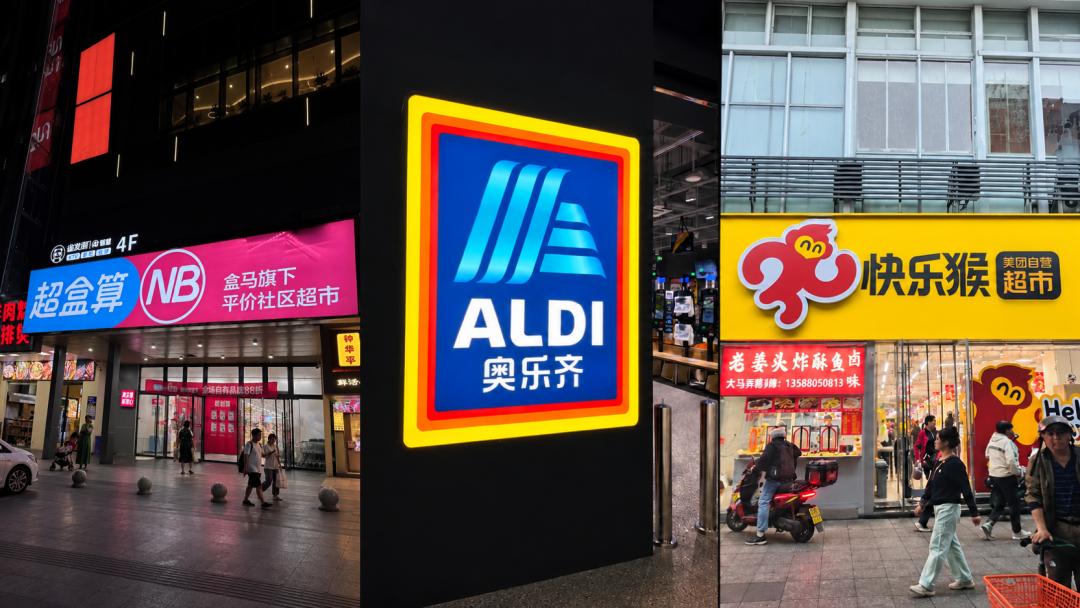
In 2026, the hard discount track has entered a period of concentrated explosive growth.
The aggressive expansion of Super Box Value NB, the affordable community supermarket under Hema, has accelerated significantly: it entered South China in January, Beijing in June, Chengdu in July, and Tianjin in October, basically completing the initial layout covering East China, South China, North China and Southwest China. As of late October, it has nearly 700 stores nationwide, with about 200 new stores added within the year, covering around 33 cities.
According to the official website of ALDI, as of October 30, it had 131 stores in China, with a year-end target of more than 150. Currently, its stores are mainly distributed in Shanghai and Jiangsu, and it will enter Anhui in November. It plans to open around 60 new stores this year, doubling the number of previous years.
As for Happy Monkey, the community supermarket brand under Meituan that was launched only 14 months ago, it had about 109 operating stores as of October 30, covering 18 cities, including 45 in Guangdong and 38 in Zhejiang, with more than 100 new stores added within the year.
However, large scale does not necessarily mean strong competitiveness. At present, Super Box Value NB and ALDI are in the first echelon, while Happy Monkey is still in the second echelon. The competition in this track is not about who becomes the scale leader first, but who first develops a replicable and profitable single-store model.
Three Genetic Backgrounds, Three Expansion Speeds
Super Box Value NB follows the "dilution by density" route. Its stores cover about 33 cities across the country. The high-density network formed by nearly 200 stores in Shanghai continuously narrows the warehouse distribution radius, which in turn reduces logistics costs and fresh food loss.
Super Box Value NB takes self-operated stores as the absolute main force, and franchising is only cautiously opened within the supply chain radius of the Yangtze River Delta. All commodities, prices and operations are strongly controlled by the headquarters, which is almost no different from directly operated stores.
A senior industry insider Wang Yu (pseudonym) believes that the opening of the franchising channel actually contributes to profitability: the headquarters' revenue is built on the scale effect of the supply chain, and the single-store investment return is clearer.
ALDI follows the "self-operated density" route. It builds its supply chain from scratch, deploys stores densely with Shanghai as the core area, establishes warehouse distribution centers for radial coverage, and dilutes fixed costs through store density. It benefits from the ALDI model of its parent company -- private brands, self-operation and high turnover build its moat.
In the view of Wang Guoping, member of the Senior Advisory Group of Lianshang, ALDI started slowly and steadily. After going through a period of boutique positioning, it returned to the discount track, and spent 6 years repeatedly verifying in Shanghai "whether community hard discount can be successfully operated".
Of course, slow pace does not mean low efficiency. The mature stores of ALDI China have a daily sales volume of about 130,000 yuan. Affected by the ramp-up of new stores, the overall average annual revenue per store is about 36 million yuan, and the per-square-meter efficiency is about 2.3 times that of traditional supermarkets, which precisely confirms the high quality of this single-store model.
This operation mode is resource-intensive, and funds, supply chain, and warehouse distribution must be in place first before the business can be expanded step by step from points to lines to surfaces, so it must advance steadily.
In October 2026, Chen Jia, CEO of ALDI China, confirmed in an interview: "The single-store model of ALDI in China has been successfully verified, and the business operation is stable." She also made it clear: "Private brand is not an independent project of ALDI, nor a single strategy. It is our business model."
This means that ALDI is reconstructing commodities, supply chain, cost and store operations based on private brands.
Relying on Meituan, Happy Monkey follows the "platform ecology" route. Apart from Super Box Value NB, it is the fastest expanding brand in the entire track this year, with stores spanning East China, North China and South China. It reuses the supply chain advantages that Meituan has built, integrates the integrated store-warehouse model into the rider network, and expands on a large scale with the support of capital.
Wang Guoping pointed out that Happy Monkey basically completed the preliminary model of commodity structure and store types covering first-tier, second-tier and sinking markets in Beijing, Hangzhou and Langfang last year, completed replication verification in the first half of this year, and started full-scale expansion in the second half of the year.
"In the Fujian market, Happy Monkey is more aggressive than Super Box Value NB. Now it is entering Fujian, and is preparing to expand simultaneously in Xiamen, Quanzhou, Zhangzhou and Fuzhou. Diluting costs through scale is its only viable way to survive."
Wang Yu said that when Happy Monkey opened its stores, the "hard discount" format had already been verified. ALDI in its early stage was in the "single-store model verification" phase, and the two are at different stages, so it is normal that there is a difference in store opening speed.
The difference in the three brands' store opening speed depends on the underlying business logic: Happy Monkey needs to open stores quickly to rapidly form supply scale and build price advantages. ALDI's strategy focuses more on long-term planning and steady scale expansion. The logic of Super Box Value NB is to build the model with self-operated stores, expand scale with franchised stores, and win through supply chain advantages.
In his view, "ALDI's advantage lies in its commodity planning and development capabilities; Super Box Value NB's advantage is its clear positioning, with very clear site selection and commodity strategies. Leading scale means strong commodity negotiation capabilities and guaranteed price advantages. Meanwhile, the product concepts verified by Hema can be replicated in Super Box Value NB; Happy Monkey's advantage is the rapid expansion and rapid trial and error of Internet companies with capital support."
Three Routes, Three Operation Methods
Specifically in terms of site selection paths, ALDI's route has distinct characteristics of "verification first, then contiguous expansion". From 2019 to 2025, it only operated in Shanghai, and did not expand out of Shanghai until April 2025, opening stores in Suzhou and Wuxi; after that, it increased density along southern Jiangsu and advanced to central Jiangsu.
Next, it will enter the Anhui market in November, with the first 6 stores in Hefei and Wuhu opening on November 21; for the Zhejiang market, the first 11 stores in Hangzhou are expected to open in batches in early January 2027.
Generally, before crossing provincial boundaries, ALDI is used to arranging the operating entity and supply chain first. On July 17, ALDI Commercial (Hangzhou) Co., Ltd. completed industrial and commercial registration with a registered capital of 10 million yuan.
In terms of supply chain, ALDI has a fresh food direct procurement base in Jiaxing, plus the East China regional distribution center in Putuo, Shanghai, the central kitchen in Jinshan, Shanghai, the cold chain warehouse in Kunshan, the Wuxi distribution center put into use in March 2026, and the Nanjing logistics center opened in October 2026. It is forming a Yangtze River Delta supply network with "Shanghai, Wuxi, Kunshan and Jiaxing" as the core nodes, and the Nanjing warehouse radiating north and west to Jiangsu and Anhui.
The route of Super Box Value NB is more like "warehouse network first, density priority". After more than two years of regional trial operation in East China, it began to accelerate its national expansion in 2026. Its expansion does not rely on the spillover of customer groups from a single core city, but advances according to the dual-layer structure of "warehouse network + store network": deploy warehouses first, then open stores, ensure that a region is "densely and well-operated" before continuing to expand to new regions.
Its core principle for site selection is "extreme convenience". Most of its stores are located on the ground floor of residential buildings, on community streets and in neighborhood centers, serving the daily three meals of families within a 3-kilometer radius. On the cost side, it reduces costs through direct procurement from the source, minimalist decoration, digital restocking and integrated store-warehouse fulfillment.
In terms of franchising, Super Box Value NB is relatively restrained. It first piloted in Shanghai, Hangzhou, Jiaxing and Huzhou in November 2025, and expanded to 11 cities in the Yangtze River Delta in October 2026; franchising is not yet open in cities such as Beijing and Guangzhou, and self-operation is still the mainstream overall.
This means that the national expansion speed of Super Box Value NB ultimately depends on whether the warehouse network radius, local supply chain and single-store profit model can keep pace synchronously.
Happy Monkey's expansion map is drawn in a different way. It opened its first national store in Hangzhou in August 2025, and there were only 7 stores by the end of 2025; the pace accelerated after entering 2026: there were about 51 stores by the end of July, 58 by mid-August, 68 by late August, and more than 100 by September 30.
Happy Monkey's urgency essentially comes from Meituan's need to exchange density for supply chain bargaining power and instant retail synergy, rather than a good-looking single-store profit statement. This explains why it has to develop private brands and why it is willing to continue to accelerate expansion when it reaches the scale of 100 stores.
Which Format Is More Suitable for Shopping Malls?
All three brands will enter shopping malls. Malls exchange rent discounts for foot traffic during the opening period, and brands exchange low-cost store locations for exposure, so both sides get what they need.
Wang Guoping pointed out that brands that follow the low-cost high cost-performance route usually have higher operating costs when entering shopping malls; some shopping malls are willing to exchange rent discounts for the first-round trial consumption dividend, but cost-performance merchants bring "cost-performance foot traffic", which is more difficult to realize secondary monetization.
At present, ALDI has the highest proportion of stores in shopping malls. Wang Yu believes that ALDI's brand positioning, target customer groups and profit model are relatively more suitable for shopping malls. Most of its stores cover an area of 500-1200 square meters, with SKUs controlled within 2000. This type of store is easier to negotiate with property owners.
ALDI prefers mature community-based shopping malls, commercial complexes above subway stations and stock renovation projects. It does not enter high-end shopping malls or new urban areas with low residential occupancy. Its stores are usually located on B1 and F1 floors, and it is willing to take over the store locations vacated by fast fashion brands or traditional supermarkets. The soon-to-open Hangzhou Intime Department Store (Qingchun) store is renovated from the former UNIQLO store.
The site selection logic of Super Box Value NB is more close to "right at your doorstep". It gives priority to the street-facing ground-floor stores of mature old residential communities, community neighborhood centers, the first floor or B1 floor of community shopping malls, and mixed areas of residences and industrial parks, avoiding core CBDs and high-rent prime locations in commercial districts.
Its stores are divided into compact street-side stores of 500-650 square meters and standard neighborhood center stores of 700-800 square meters. It calculates passenger flow around the 500-meter walking circle, 500-1500-meter cycling circle and 1.5-3km extended circle, requiring a permanent resident population of more than 40,000 within 1 kilometer around, and strictly controls the rent ceiling.
Happy Monkey's stores are divided into three types: community stores (700-800 square meters), mall stores (700-900 square meters), and street-side stores (600-700 square meters), with more than 1500 SKUs.
Its site selection obviously avoids high-end shopping malls and high-end communities, highly relies on Meituan's consumption heat map and AI site selection, and prefers community street-side stores unless the mall offers favorable commercial terms. The combination of Foshan Hengfu GOGOPARK flagship store and Hujingwan community store is a sample of the "mall + community" implementation.
For shopping malls, the value propositions of the three brands have different focuses: ALDI revitalizes idle store locations at low cost, keeping daily procurement consumption inside the mall; Super Box Value NB is better at turning deserted stock commercial spaces into daily community foot traffic entrances, driving other merchants on the same floor; in addition to offline foot traffic, Happy Monkey can also undertake Meituan instant retail orders, turning one store location into a fulfillment node covering a 3-5km radius.
During the investment promotion phase of Zhijiangli in Zhuantang, Hangzhou, residents were invited to vote for their preferred brand, and ALDI won by a high margin, which also reflects the preference of community-based businesses for high-frequency rigid-demand brands.
If you spread out the site selection maps of the three brands, their core frameworks are highly consistent -- all of them start from the Yangtze River Delta where the supply chain and consumption power are the most mature, all anchor the community high-frequency repurchase scenarios, and all tacitly avoid entering high-end shopping malls.
The Hard Discount Track Competes on Scale First
The general financial feature of hard discount is "three lows and one high": low SKUs, low gross margin, low expenses and high turnover.
Industry estimates show that its gross margin is about 15%. The same model can achieve a net profit of around 5% in ALDI's mature global markets, but in China, squeezed layer by layer by price wars and the more capital-intensive and highly competitive fresh food business, the net profit margin after deducting headquarters expenses and miscellaneous fees is only about 2%, and the sum of rent and labor costs must be controlled within 10% of sales revenue.
According to the estimate of Lianshang.com, ALDI's comprehensive gross margin is about 20%, which is not low in the hard discount sector, and its net profit margin is about 3%. It balances its business with a three-tier commodity structure: fresh food and value series products attract customers with low gross margin, the middle tier stabilizes the basic customer base, and categories such as 3R (ready-to-eat, ready-to-heat, ready-to-cook) products, beauty and personal care provide higher gross margin. The mature stores have a daily sales volume of about 130,000 yuan.
Super Box Value NB has a comprehensive gross margin of about 19%, lower than ALDI, and a net profit margin of about 3%. Its profitability depends on density: the denser the stores, the shorter the warehouse distribution radius, and the more controllable logistics costs and product loss. Its mature stores also have a daily sales volume of about 130,000 yuan. This model works in the high-density areas of the Yangtze River Delta, but whether it can maintain the same level of loss control and turnover when expanding across regions remains to be seen.
Happy Monkey has a comprehensive gross margin of about 15%, the lowest among the three, with an average daily sales volume of about 100,000 yuan per store. Wang Guoping pointed out that Happy Monkey may be operating at a loss to capture market share, but it revitalizes Meituan's idle delivery capacity, which is positive for Meituan as a whole. The back-end costs will be quickly diluted when the scale grows, "we can't just look at the single-store profit, we have to see how it balances the internal financials."
The proportion of private brands is the most critical indicator for hard discount. ALDI has about 2000 SKUs, with private brands accounting for more than 90%. It has developed 15 private brands, with more than 600 SKUs priced at 9.9 yuan or