Pop Mart, the card company invested by HSG, intends to acquire a listed photovoltaic enterprise.
Since Agibot acquired Swancor New Materials last July, it has no longer been a novelty for primary market companies to buy A-share listed companies. Dreame Technology, Tanjian Technology and CoreIntelli have all launched similar transactions.
According to incomplete statistics from ChinaVenture Jiachuan, there have been 20 relevant M&A cases since last year, including 11 disclosed this year and 9 disclosed last year.
One more deal was added this week. Trading card and collectibles company Qixing Network plans to acquire the controlling stake of Yamaton, a listed photovoltaic glass manufacturer.
Few details of this transaction have been disclosed so far, and I have listed the key points as follows:
Yamaton Technology has signed the Share Transfer Intent Agreement with Shanghai Qixing Network, intending to transfer 20% of the shares (38.6125 million shares) of the listed company it holds to Qixing Network through agreement-based transfer.
After the transaction is completed, Qixing Network will become the controlling shareholder of the listed company through direct shareholding, and the actual controller will be changed.
The specific price, payment method and delivery conditions have not been disclosed, which will be determined through negotiations after due diligence. If calculated statically based on the 10% up limit closing price of 19.28 yuan on November 2 and the total market value of 3.722 billion yuan, the 20% stake corresponds to 744 million yuan. Of course, the actual price will have to wait for subsequent announcements.
The buyer will pay a 50 million yuan contractual deposit and deposit it into the jointly managed account of Bank of Jiangsu. The agreement stipulates that due diligence shall be completed within 20 days, with a two-month exclusivity period.
Compared with Agibot's acquisition of Swancor New Materials, the alliance between Yamaton and Qixing Network seems to be a completely unrelated business, after all, the two companies have vastly different businesses.
Yamaton's main business is photovoltaic glass. Its founder Lin Jinxi is 67 years old this year, and he was a technician at Changzhou Glass Factory before starting his business. Qixing Network makes collectible cards. Its founder Zhao Yunpeng, born in 1996, is a serial entrepreneur in the new consumer track.
The fact that the two companies can sit at the same table may be because both have reached a point where there is no way back.
There is no need to elaborate on the photovoltaic industry. The industrial chain is severely involuted, and the market has not yet been cleared. Yamaton has suffered consecutive losses in 2024 and 2025, and lost another 145 million yuan in the first three quarters of this year. The gross profit margin of its main photovoltaic glass business is negative, which means the more it sells, the more it loses. The external shareholder, the SZVC Manufacturing Transformation and Upgrading New Materials Fund, which has held shares for more than five years, has a floating loss of 123 million yuan.
On the side of Qixing Network, it has completed 8 rounds of financing successively, with Pop Mart, HSG, and China Literature all on its shareholder list. However, the exit is nowhere in sight. Last September, there were reports that it was pushing for an IPO, but in January this year, rumors spread that there was no substantial progress.
In short, one is the first-generation entrepreneur who wants to retire successfully, and the other is the new-generation entrepreneur who wants to realize capital circulation.
01. The trading card company backed by Pop Mart and HSG
Let's first look at the buyer.
The initiator of this acquisition is a trading card company, Shanghai Qixing, whose brand is called Hitcard.
Founded in 2016, the company's core team all came from the campus group-buying project "ZhaiMi" around 2015. Zhao Yunpeng, the chairman, majored in digital media at Communication University of China. He dropped out of school after finishing his freshman year and joined ZhaiMi, responsible for warehousing and logistics, distribution and market expansion in 16 northern provinces. Zhou Zhanyang, the co-founder, graduated from Northeast Forestry University and also joined ZhaiMi during his university years.
At first, they were not in the trading card business, but operated offline entertainment spaces, and they transformed only when offline business stagnated in 2021.
At present, the company has three product lines: TV drama series cards, celebrity cards and Chinese animation cards. The IPs they cooperate with are basically a directory of China's content industry: *The King's Avatar*, *Notes on Tomb Raiders*, *Joy of Life*, *Mysterious Lotus Casebook*, *Hidden Love*, *The Fragrance of Orchid* and so on, plus international IPs such as Disney and *Naruto*.
The best-selling series is the *The King's Avatar* "Glory Appointment" series, which is called "My Little Pony for adults" in the industry. The *Joy of Life* series sold 20 million yuan in 2024, and the first batch of 800 boxes of the *Mysterious Lotus Casebook* "On the Rivers and Lakes" series was sold out in the Douyin live stream, with the total sales of the whole series exceeding 6 million yuan.
In 2025, Zhao Yunpeng once shared the operating data: the revenue in 2024 was about 400 million yuan, a year-on-year increase of 600%, and the company was already profitable. Although no operating data has been released since then, nearly half of the nearly 100 domestic film, television and variety show trading card projects in 2025 were issued by it. From 2026 to mid-October, more than 50 new TV dramas announced to launch collectible cards, 35 of which were launched by Qixing Network, accounting for 70% of the total.
Moreover, different from the ecological niche of Kayou, which focuses on "social currency for primary school students", more than 60% of Qixing's paying customers are young women aged 18 to 35 in first- and second-tier cities. The purchasing power of this group of consumers is at the upper-middle level in the industry.
When Qixing entered the trading card business, it received capital support from the very beginning. According to data from ChinaVenture Jiachuan CVSource, it has completed 8 rounds of financing since 2016. Investors include institutions such as Pop Mart, HSG Seed Fund, and China Literature (see the table below).
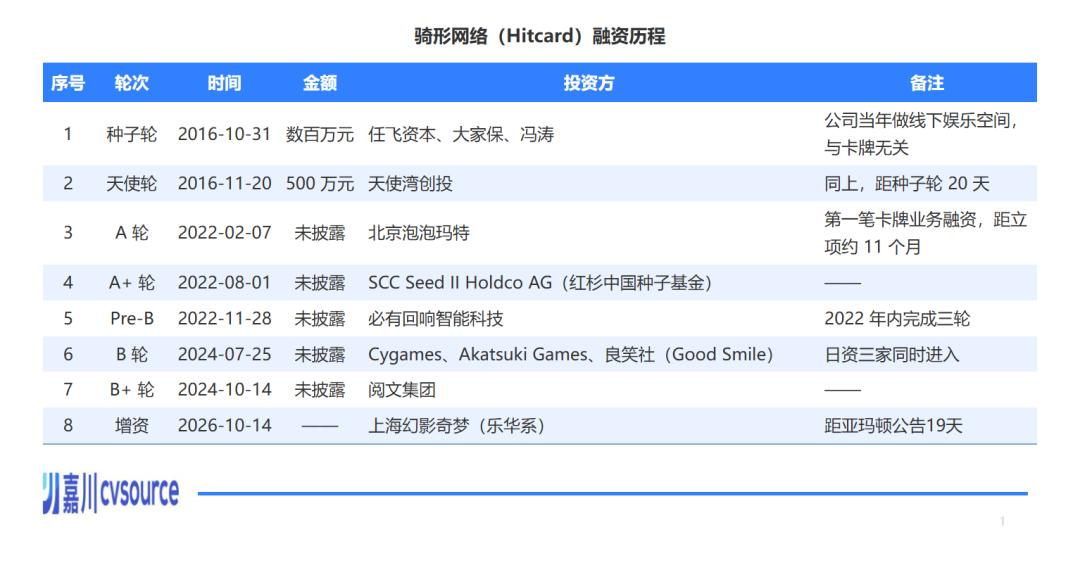
Up to now, Pop Mart holds 10.84% of the shares and is the largest institutional shareholder; China Literature holds 9.30%, and HSG holds 7.74%.
Originally, these investors were counting on an IPO. In September 2025, multiple media reported that Hitcard was pushing for a public listing. But in January this year, rumors spread that "no substantial progress has been made". The situation of peers can better illustrate the problem. Kayou submitted listing applications twice in January 2024 and April 2025, and passed the hearing in June 2025 but did not start public offering. Moreover, if the listing fails, Kayou will fulfill the listing repurchase obligation agreed with HSG and Tencent.
Even the leading company is cornered, and the IPO of the second-tier companies is even more out of sight.
Therefore, acquiring an A-share platform has become a choice to increase the certainty of exit at the moment.
What is more noteworthy is a transaction in October this year.
On October 14, Shanghai Phantom Dream Capital took shares in Qixing Network and currently holds 7% of the shares. This institution also has a strong background. Industrial and commercial information shows that Phantom Dream Capital is 71.42% owned by Tianjin Yihua, which is controlled by YH Entertainment. YH Entertainment is a well-known domestic entertainment company founded by Du Hua, whose artists include Wang Yibo, Han Geng, Meng Meiqi and others.
Earlier this year, Du Hua set the tone for YH Entertainment, saying that YH Entertainment not only creates stars, but also builds a technology entertainment company that combines robots, artificial intelligence and trendy toys. Taking shares in Qixing and participating in Qixing's acquisition of the controlling stake in Yamaton seems to be part of Du Hua's layout in the trendy toy business. And its shareholding may also provide more capital ammunition for this M&A.
So we can summarize the profile of the buyer: A trading card company managed by a post-90s entrepreneur, backed by top industrial players and investment institutions such as Pop Mart, China Literature, YH Entertainment and HSG. However, since the company has no hope for an IPO, acquiring the controlling stake of an A-share listed company has become a choice to increase the certainty of exit and operation.
02. The photovoltaic enterprise that trapped the fund under SZVC
Now let's look at the seller.
Yamaton's decision to sell the controlling stake was not a last-minute move. Perhaps the foreshadowing was laid as early as 2021, and the path got narrower year by year.
Let's first understand the actual controller behind this company.
Lin Jinxi, born in 1959, graduated from Changzhou Institute of Technology in 1980 with a major in industrial automation. He entered Changzhou Glass Factory as a technician, responsible for installing automatic weighing systems for glass batching, and once won the Science and Technology Award of the Ministry of Light Industry. In 1996, he founded Changzhou Yamaton Technology Co., Ltd. on his own. In 2006, he entered the photovoltaic glass industry together with Changzhou Venture Capital, and in October 2011, he led the company to successfully list on the Shenzhen Stock Exchange.
As we all know, the photovoltaic industry is a cyclical industry with ups and downs. Driven by the "Dual Carbon" policy in 2021, there was a sharp rise. But then came endless involution. Up to now, the entire photovoltaic industrial chain is still mired in overcapacity.
Looking at the company's operating data, we can see clearly. In 2023, Yamaton's revenue was 3.628 billion yuan, and the net profit attributable to shareholders was 84 million yuan. In 2024, the revenue dropped to 2.893 billion yuan, a decrease of 20%, and the net profit attributable to shareholders turned negative, with a loss of 127 million yuan. It also suffered losses in 2025. In the first three quarters of 2026, the revenue was 1.13 billion yuan, and the non-recurring profit and loss deducted loss was 162 million yuan. Up to now, there is no sign of turning losses into profits. The gross profit margin of its main photovoltaic glass business is -2.71%, which means the more it sells, the more it loses.
When the market was booming in 2021, it launched a private placement of 1 billion yuan to expand its business aggressively. As a result, none of the shareholders who still hold shares in it now are not losing money.
Among them, the SZVC Manufacturing Transformation and Upgrading New Materials Fund is the largest shareholder, which subscribed for 500 million yuan and was allocated 19.53125 million shares, becoming the second largest shareholder in one move. As a result, it has held the shares for five and a half years without reducing any position. According to the recent stock price, the floating loss is 24.7%, equivalent to a loss of about 123 million yuan.
No matter how you "be a friend of time", you can't resist the industry cycle.
Although Yamaton later suspended the capacity expansion project and launched two acquisitions of the upstream company Fengyang Silicon, both attempts failed and did not help. The company is still losing money, and it is difficult to turn losses into profits in the future. It still has 1.14 billion yuan of short-term loans, and the 40 million pledged shares have not been released for more than two months after maturity. All external major shareholders are trapped. The 67-year-old Lin Jinxi has indeed reached the retirement age.
Therefore, selling the controlling stake has become an active choice. Of course, whether this acquisition can finally be successful remains to be seen.
03. How far has the "primary market acquiring secondary market" trend gone?
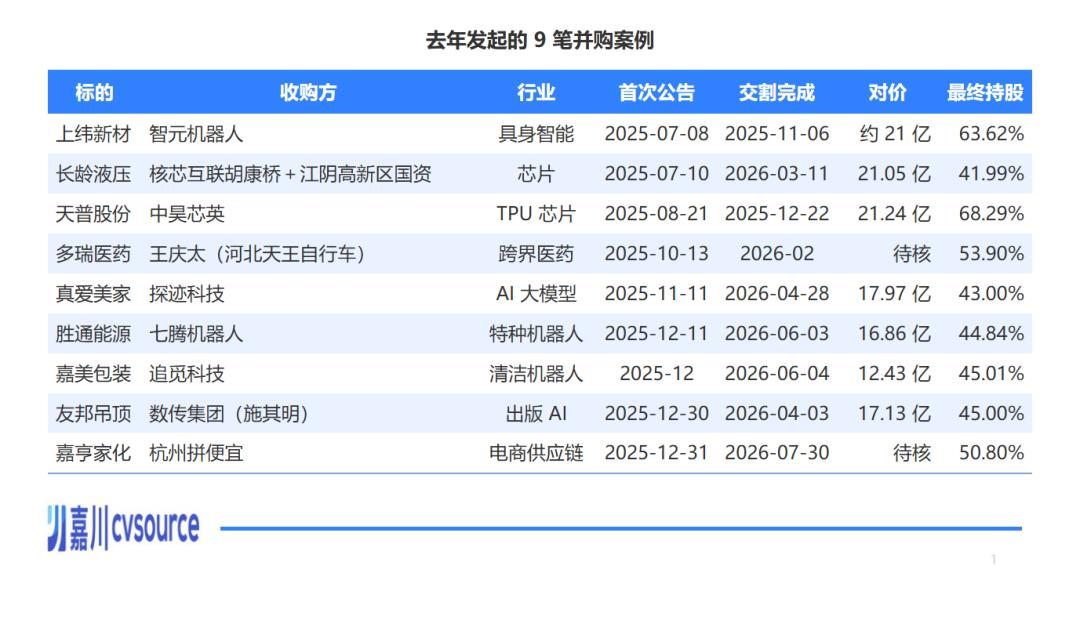
According to incomplete statistics from ChinaVenture Jiachuan, since last year, there have been at least 20 transactions in which primary market companies acquired the controlling stake of A-share listed companies, including 11 launched within this year and 9 launched last year.
The fastest progress is naturally Agibot, which set a precedent last year.
The share transfer was completed on September 22 last year, and the tender offer was completed on November 6. At present, Peng Zhihui, the co-founder of Agibot, has served as the chairman of Swancor New Materials, and the company has made robots its second main business. The brand is called "Shangwei Qiyuan", and the two products Q1 and T1 have started delivery in the past two months.
Let's take a look at the 11 deals announced this year. Among the relevant cases, in addition to trading card and collectibles companies, there are also star companies in multiple tracks such as energy storage batteries, embodied intelligence, new materials, AI computing equipment, low-altitude economy, automotive lightweighting, and media IP (see the table below).
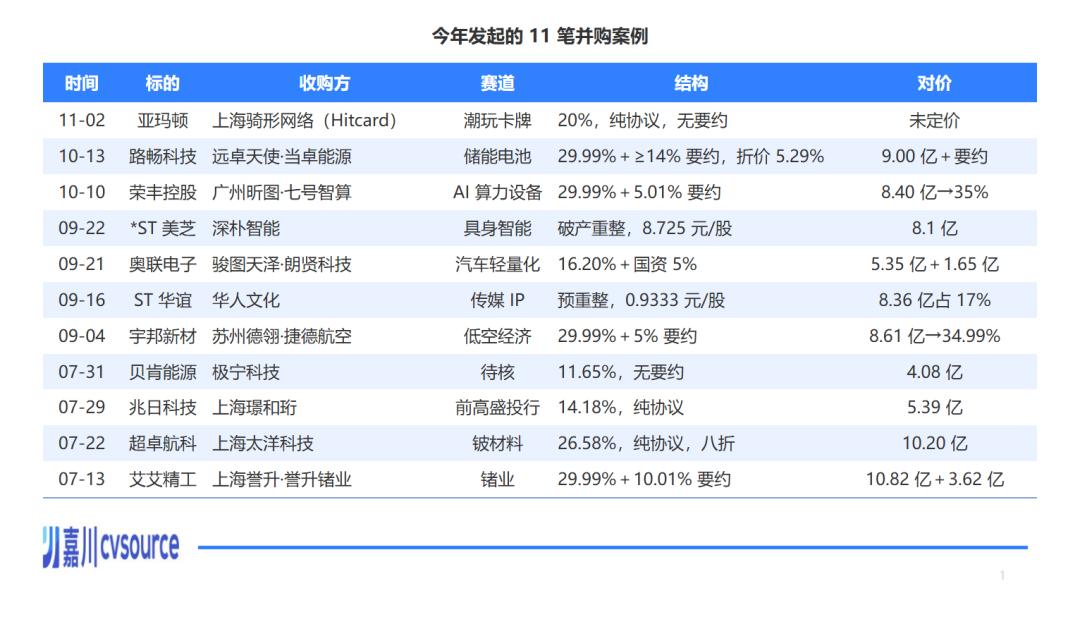
Let's elaborate on two cases.
Shenpu Intelligence, an embodied intelligence company, led a consortium in September to obtain the out-of-court restructuring and subsequent judicial reorganization of *ST Meizhi, planning to contribute about 810 million yuan to subscribe for the transferred shares at 8.725 yuan per share, and will become the controlling shareholder after the reorganization is successfully completed.
This company was only established in October 2024, much younger than Qixing Network. Its founder Li Xiaofei is a PhD from Tsinghua University, studied under Academician Li Keqiang, and was previously the co-founder of IDriverPlus.
The company has completed 5 rounds of financing since its establishment. Its backers include institutions such as Shunwei Capital, Creation Ventures, Baidu Ventures, Didi, Keli Sensing, and the intellectual property fund under Shanghai Tech & Innovation Capital.
Another new material company, Shanghai Taiyang Technology, signed an agreement on July 22 to acquire 26.58% of Chaoyang Hangke for 1.02 billion yuan, and the share transfer was completed earlier this month. Taiyang is the world's second beryllium full industrial chain company. It has completed 11 rounds of financing in 8 years, with SMC Capital, China Merchants Capital, Jiyu Capital, Huaying Capital, and Zhejiang Venture Capital all on its shareholder list.
One is an embodied intelligence company, and the other is a new material enterprise. In the current market environment, taking the traditional IPO path means a long cycle and high uncertainty. This should be a common problem faced by many enterprises.
This article is from the WeChat official account "ChinaVenture Jiachuan", author: Yang Boyu, published with authorization from 36Kr.