Pershing Square Ackman Interview: AI Makes the Market Increasingly Short-term Oriented, Why We Are Bullish on Microsoft, Meta and Amazon
Microsoft (MSFT.US) saw a sharp reversal in its stock price over the past week. On October 28, Microsoft closed at $531.01, then trended downward consecutively. On November 2, it dropped to $507.12, marking a roughly 4.5% decline over three trading days; it rebounded for two consecutive days on November 3 and 4, closing at $555.80 on the 4th, about 4.7% higher than a week earlier.
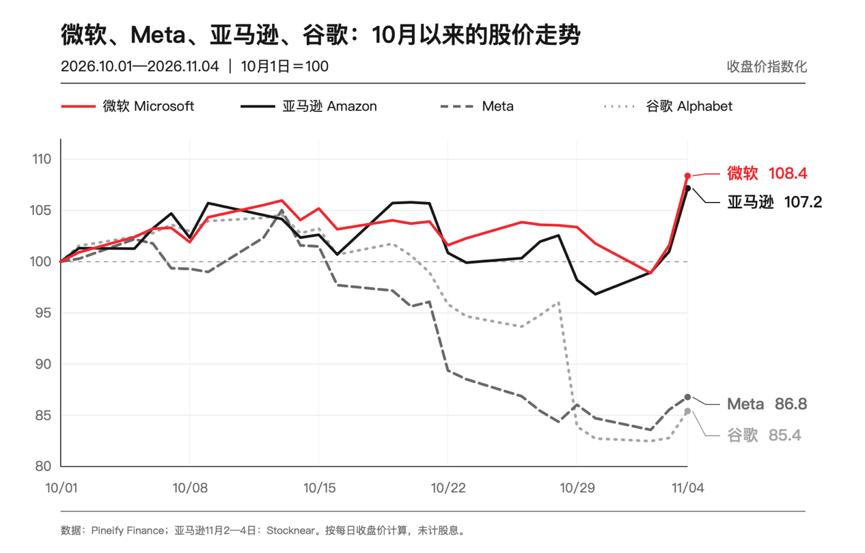
The discussions around Hyperscaler also brought Pershing Square and its founder and CEO Bill Ackman to the spotlight.
"Such Bright Company" previously sorted out its Q3 positions and performance and found that as of September 30, Microsoft was its largest position, accounting for 15% of net assets; Meta and Amazon each accounted for 11.2%, with the three companies combining for 37.4%. Pershing Square's net value rose 3.5% in Q3, but still fell 9.6% from the start of the year to the end of September.
Pershing Square believes that the market has already factored in the increased capital expenditure of hyperscale cloud vendors into valuation models, but has not fully accounted for the potential returns these investments may bring. It values Microsoft's two existing monetization channels: Azure cloud services and Microsoft 365 applications. The report states that paid Copilot seats have exceeded 30 million, but returns from new capital expenditure will still be realized in subsequent revenue and profits.
Not long ago, Nicolai Tangen, head of Norges Bank Investment Management, interviewed Bill Ackman on the podcast *In Good Company*. The two started the conversation with "what makes a great company", then discussed concentrated positions, permanent capital, AI investments, and how shareholders can supervise enterprises.
Bill Ackman believes that if a company increases AI capital expenditure due to rising customer demand, but its stock price falls accordingly, long-term investors should re-research the company.
Ackman said that Amazon, Meta and Microsoft held by Pershing Square together accounted for roughly one third of the investment portfolio at that time. His entry points for buying Meta and Microsoft were both related to market concerns that they would raise capital expenditure. In his view, simply seeing increased spending is not enough. Investors need to figure out why the company is investing and whether customer demand is real, before judging the price.
This approach relies on a prerequisite: funds cannot be withdrawn at any time when the market fluctuates. Taking Warren Buffett's abandonment of hedge funds and shift to Berkshire Hathaway as an example, Ackman explained the value of permanent capital. He also talked about how Pershing Square lets nine investment professionals collectively review a concentrated portfolio, as well as Howard Hughes' plan to transform into an insurance business.
The second half of the interview turned to public expression and personal experience. Ackman talked about why he listens to opposing opinions on X, and his new focus on brain rehabilitation, brain-computer interfaces and AI after his daughter suffered a cerebral hemorrhage.
The following is the translated interview content compiled by "Such Bright Company" (abridged):
Nicolai: Nicolai Tangen, Head of Norges Bank Investment Management, Host of *In Good Company*
Bill: Bill Ackman, Founder and CEO of Pershing Square
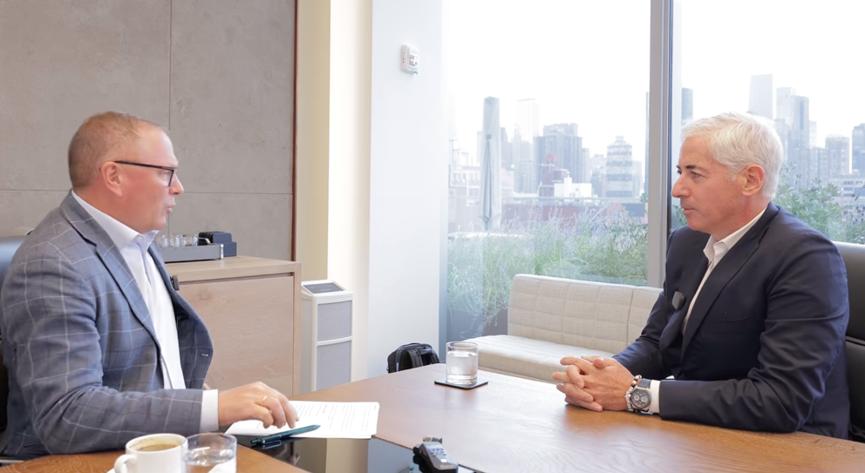
Nicolai Tangen (left) and Bill Ackman
Why Great Companies Rarely Make Good Investments
Nicolai: How do you define a great company?
Bill: Suppose you buy it today, and the market closes for the next 20 years, you can still judge with high confidence that it will be extremely valuable in 10 or 20 years.
Nicolai: What industries are such companies usually in?
Bill: The key lies not so much in the industry as in the structure of the company. Many industries have outstanding enterprises.
Nicolai: What kind of structure do you want?
Bill: We like businesses that operate like collecting royalties or annuities. You can be confident that this continuous inflow of revenue will grow relatively fast for a very long time, and the cash the company earns does not need to be heavily reinvested in its original business. In fact, Pershing Square is also such a business — I can take this chance to promote it a little.
Nicolai: We will talk about it later. How many such companies do you think exist in the world?
Bill: There are not many of sufficient scale. Given the size of Pershing Square's capital, each of our investments is not small, so our portfolio is very concentrated. There may be two or three hundred truly outstanding companies, but great companies rarely appear at a good enough price. Only when both conditions are met can it be a good investment. That is why we hold concentrated positions.
Nicolai: Where do you find your investment ideas?
Bill: We love researching enterprises and also read news. Over the years, we have built a list of companies we admire: with good economic characteristics, fast growth and excellent management. However, these companies are rarely sold at a price that can meet our return requirements.
Nicolai: Your approach is very clear, Chris Hohn (founder of TCI) and Warren Buffett have similar ideas, why so few people actually do it?
Bill: On the one hand, it is a structural problem, on the other hand, many people want to get rich quickly, and this approach requires a long-term perspective. Most of the capital in the asset management industry is inherently short-term, and investors may redeem at any time, daily, quarterly or annually. When others evaluate you based on short-term performance, it is very difficult for you to truly make long-term investments. Institutions like Citadel and Millennium focus on the short term and use high leverage, and this structure cannot tolerate large fluctuations. Buffett has permanent capital; Chris Hohn has operated for many years and also cultivated a group of investors who are willing to support him for the long term. To execute this strategy, you need this kind of capital, and it is very scarce.
Nicolai: Where do you get information? What do you usually read?
Bill: I read *The Wall Street Journal*, *Financial Times*, *The Economist*, and sometimes *The New York Times* — if I can get through it that day. Just kidding, it is a good newspaper, but all media have biases. I also spend quite a lot of time on X. It has probably become my most important source of information, because for the same issue, you can see people with completely different positions speak at the same time. I think this helps a lot to get closer to the truth. I follow about a thousand people, and my interests are very broad. Some of the company's good investments, and some of my personal good ideas, all originated from some personal interest.
For example, I have always paid attention to health. When the COVID-19 pandemic first emerged, I noticed it earlier because of this interest and began to worry about a pandemic. It was not for investment at first, but later it did generate investment opportunities. Now, an unfortunate event in my family has made me spend a lot of time learning about AI and brain-computer interfaces, which may also bring new investment ideas. However, once we find something worth researching, due diligence is still the norm: reading public documents, communicating with industry people through expert networks.
Nicolai: We will talk about your family later. How much time do you spend on X every day?
Bill: My wife would probably say too much. I haven't counted, usually in the morning and evening, not during working hours. It also depends on what happens that day. But the interesting thing is that people who use X frequently often feel that they know certain news a week or two in advance compared to people who only watch traditional media. When the news comes out officially, you may have heard of it long ago. It is a real-time source of information.
Nicolai: You made a lot of money in the catering industry. Why is it a good investment?
Bill: We value simple, predictable enterprises that can generate free cash flow, most of which adopt a franchise model and are businesses that generate continuous revenue. Long-term research in a field will also accumulate professional knowledge.
Nicolai: My daughter runs a cocktail bar, that is not an easy business.
Bill: It is indeed not easy. So the focus is still on the business structure. McDonald's is excellent. People always see it as a catering enterprise, which it certainly is; but it is also a real estate enterprise and a franchising enterprise.
Nicolai: To what extent do you rely on experience-based pattern recognition, or intuition?
Bill: Having experienced many market events is certainly valuable. But for us, what is more important is to turn core investment principles into a checklist — do you see that board over there? We have a framework. It allows us to look at the world in a specific way, and occasionally we find opportunities from it.
The most important rule is, can we predict this company with high confidence. The value of a financial asset is the present value of its future cash flows over its entire lifespan. If you cannot build a reasonable model for the company for the next 10, 15, 20 years, I don't think you can judge its value.
A lot of capital bets on short-term stock prices: will this company beat, meet or miss earnings expectations? Will a certain news push the stock price in a certain direction? We basically don't make such judgments. We try to build long-term financial models, so we must be able to predict the enterprise itself. We cannot judge the value of many companies, so we don't look at them at all. Predictable revenue and cash flow usually mean it has some kind of competitive moat.
Therefore, business quality and durability are extremely important. We also hope that enterprises are less affected by uncontrollable external factors, and we rarely invest in businesses that are highly sensitive to commodity prices, interest rates or regulatory changes. We try to keep things simple.
Nicolai: At least your principles are carved in stone.
Bill: That was the original plan. I asked the team to make it a stone slab, but what they brought back was a very heavy plastic board.
How Nine People Decide on a Concentrated Investment
Nicolai: How do you use analysts? The company has less than 50 people, right?
Bill: We have 48 people, nine of whom are investment professionals. But this is not a structure of "me plus a group of analysts", but an investment team. Ryan Israel became chief investment officer about four years ago. A typical hedge fund will have portfolio managers allocate capital to analysts covering different sectors, and personal compensation is also tied to their respective profits and losses. We are not like that. We only have one portfolio with about 12 to 14 investments, and no one gets paid based on the profit or loss of their individual investments; everyone's compensation ultimately depends on the performance of the entire portfolio. In this way, everyone cares not about how much capital they can get allocated, but about how the company's and investors' money should be allocated most reasonably.
Nicolai: How does it work specifically? Do you all sit around this table and discuss?
Bill: No. We have an investment team conference room, which is about half the size of this one.
Nicolai: Do you have meetings every week?
Bill: We have one formal meeting a week, but almost the whole team has lunch together every day, so communication is very frequent. Usually someone finds an opportunity worth researching, it could be me, Ryan, or someone else. For example, a company we have tracked for many years suddenly trades at a 40% discount because it missed earnings expectations. We will reopen the file and update the research. The two colleagues most familiar with this company will dive deep into the investigation; Ryan or I will participate in guiding and also do part of the work. I will read annual reports, proxy statements, earnings call transcripts and news. The person leading the research will also talk to industry experts to do more in-depth due diligence.
Nicolai: Will the whole team research the same idea at the same time?
Bill: Two people will dig very deep, another two people — such as Ryan and me — do part of the research, and others may not have spent any time looking at this company before. The team responsible for the research will make a presentation to explain the investment rationale to everyone. Then everyone forms a collective judgment.
Analysts at a typical hedge fund have incentives to fight for capital allocation, and they will inevitably tend to push their own ideas into the portfolio. Here, only two people have invested a lot of time, two people know part of the situation, and others have no time invested in this area. This structure helps the team ask truly independent questions.
Nicolai: Do you have to reach a consensus?
Bill: If someone objects, or raises doubts, we will continue to investigate until the issue is clarified. The final decision is mine, but I cannot think of any investment in the past ten years that was not made after the team essentially formed a shared view.
Nicolai: Take Brookfield as an example. How long did it take you from starting to pay attention to it to investing?
Bill: I got to know Bruce Flatt and Brookfield's executive team in a transaction.
Nicolai: Explain to the audience, Brookfield is a Canadian investment group.
Bill: Right. Back when General Growth went bankrupt and restructured, we partnered with Brookfield, so we got to know them very well. I have great respect for Bruce, Cyrus and the group of members who are still managing the company to this day. But we did not invest in Brookfield at that time. Later, it gradually restructured and shifted to a more asset-light, continuous revenue collection model. A few years ago, we began formal due diligence. Brookfield is very complex, and complexity is also one of the reasons why its valuation is relatively attractive. It has been simplifying its business. We spent about several months researching this investment.
Nicolai: Is it harder to beat the market now than when you first started your career?
Bill: I don't think so. We don't aim to beat the market every month, every quarter, or even every year. We manage a concentrated portfolio and have the ability to look further ahead, which is a huge advantage in the long run. Of course, the index itself is also a very strong competitor.
AI Capital Expenditure Pushes Down Stock Prices, Why We Bought Microsoft and Meta
Nicolai: How is AI changing the market?
Bill: It makes market participants look shorter and shorter. As soon as a company releases its 10-K annual report, AI can finish reading it immediately. A large amount of capital is already looking for short-term information advantages, and AI further enhances this capability.
Nicolai: What AI-related investments do you hold? You have AWS, what else?
Bill: Meta is of course investing heavily in AI. I would say that every company today is either related to AI, or should be related to AI, or will be impacted by AI. You have to judge each one individually. After Trump announced the so-called "Liberation Day" tariffs, we bought Amazon. When Meta promised to spend a lot of capital expenditure and the market was disappointed, we bought Meta. The same goes for Microsoft.
This is a very interesting environment: companies publicly say that demand for their services is huge, and to meet customers, capital expenditure must far exceed original expectations; then their stock prices fall. That's how Microsoft ended up in our portfolio. These three companies currently account for roughly one third of our combined portfolio.
Nicolai: How will AI change the world?
Bill: It will allow