Sam's baby biscuits look like plastic, KFC fried chicken looks like chunks of corpse, and a growing number of "AI food advertisement images" are making people feel extremely nauseous.
The "fakes" nowadays are generated with one click by AI, while the "fakes" in the past were created by shooting with other items that could better highlight the product features, which required far more time for meticulous polishing.
Sam's Club members pay 260 yuan for a membership card, thinking they are paying for high-quality products, but now they can't even see what the actual food looks like?
Recently, a Sam's Club Premium Member posted online that they wanted to buy small carrot biscuits made by Jiangzhong Dietary Therapy for their 1-year-old baby. A box of 600 biscuits is priced at 79.9 yuan, but after scrolling through the details page on the Sam's Club APP, they found the entire page was filled with AI-generated images (which have now been replaced). The biscuits in the previous promotional images were so smooth that they looked like plastic specimens, without a single crumb from baking, and even the shadows were perfectly symmetrical as if measured by a ruler. "Why are there no real product photos for such an expensive product?"
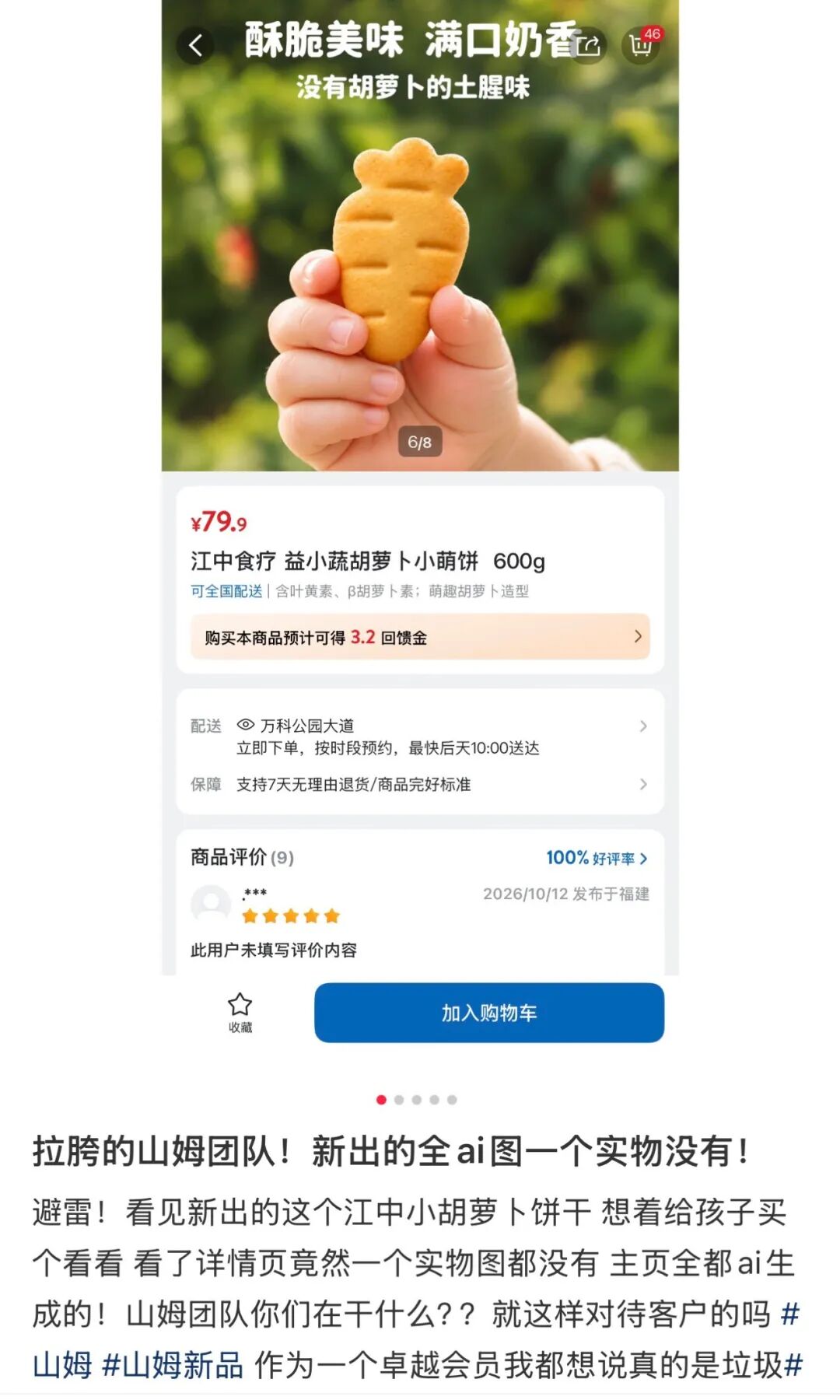
When buying clothes and encountering heavily edited photos, consumers at most fall for a "photo scam" and can just return the goods for a refund. But for food that goes into children's mouths, merchants only use "AI-generated images" created purely by algorithms to display the products. This not only creates a visual blind spot for consumers, but also directly deprives them of the right to know to verify the authenticity of the food.
Why do AI-generated images pop up on the Sam's Club APP from time to time? What kind of hidden account is behind this phenomenon?
"I paid 260 yuan for a Sam's Club membership, why can't I see what the real food looks like?"
"AI-generated food images are everywhere now, why are people only targeting Sam's Club?"
When netizens complained that the small carrot biscuits looked as smooth as plastic, many people actually spoke up for Sam's Club. To see the real appearance of the small biscuits clearly, Hydrogen Business recently paid an offline visit to Sam's Club in Beijing. The promotional image of Sam's Club shows a baby's hand, as smooth as a wax figure, holding a carrot-shaped biscuit without any crumbs. Netizens complained about the "plastic feel", not knowing that this was already the result of Sam's Club's efforts.
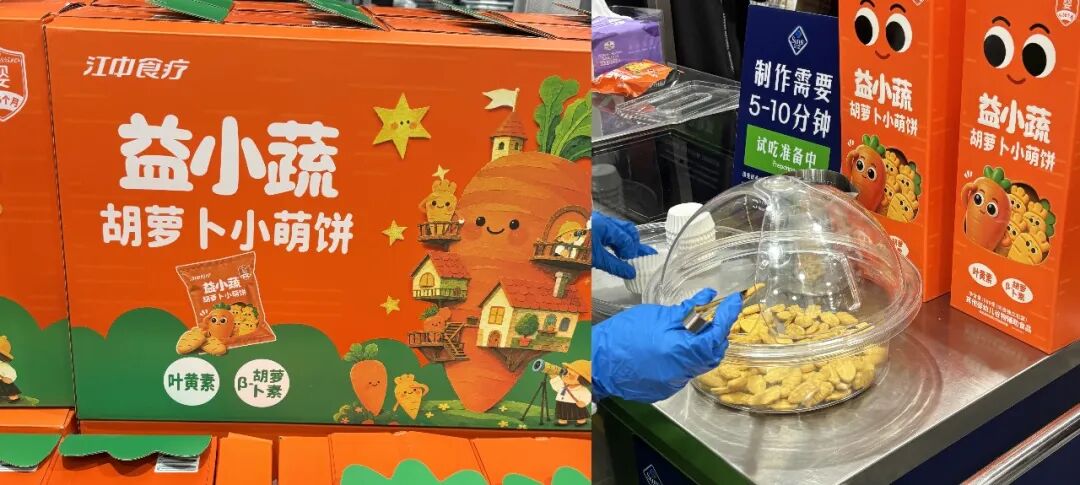
Photo taken by Hydrogen Business
The packaging of Jiangzhong Dietary Therapy is even more surreal. Each small packaging bag has 7 carrots, one orange one with wide staring eyes, four biscuit-shaped ones that are completely smooth, and only the two plain biscuits in the front look slightly normal. The whole design looks like it just walked out of a comic, with smooth biscuit skin full of plastic feel. The real small biscuits are already cute enough, and taste like baby complementary food.
After looking through all these, Sam's Club has at least made some modifications on the original AI-generated biscuit images, but the lack of authenticity still makes the middle class miss the simple Sam's Club in the past.
Probably starting from last year, many middle-class people opened the Sam's Club APP and suspected that they had mistakenly entered a "Cyber Food Awards".
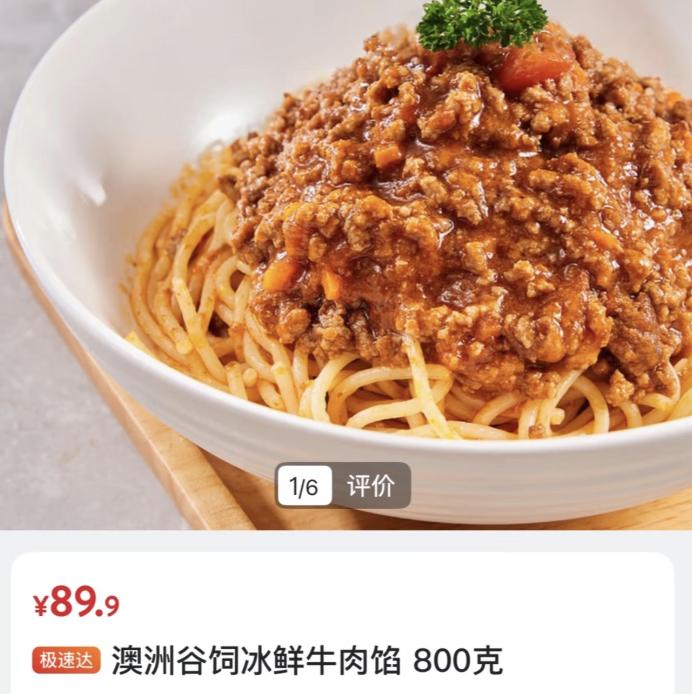
Source: Xiaohongshu @Stellaaaaaa🍓
The first thing that confuses people is the main product image. Some people wanted to buy beef filling, and were about to click the product image to learn more about the real appearance of "Australian grain-fed chilled beef", but unexpectedly the cover image was a plate of prepared bolognese pasta; the matching image for raw chestnuts was a large handful of shiny sugar-fried chestnuts, and the product sold as hot pot base was paired with an image of a large pot of rolling red oil. Raw food is presented as if it is already cooked, "It looks like the AI is so hungry that it directly cooks the meal."
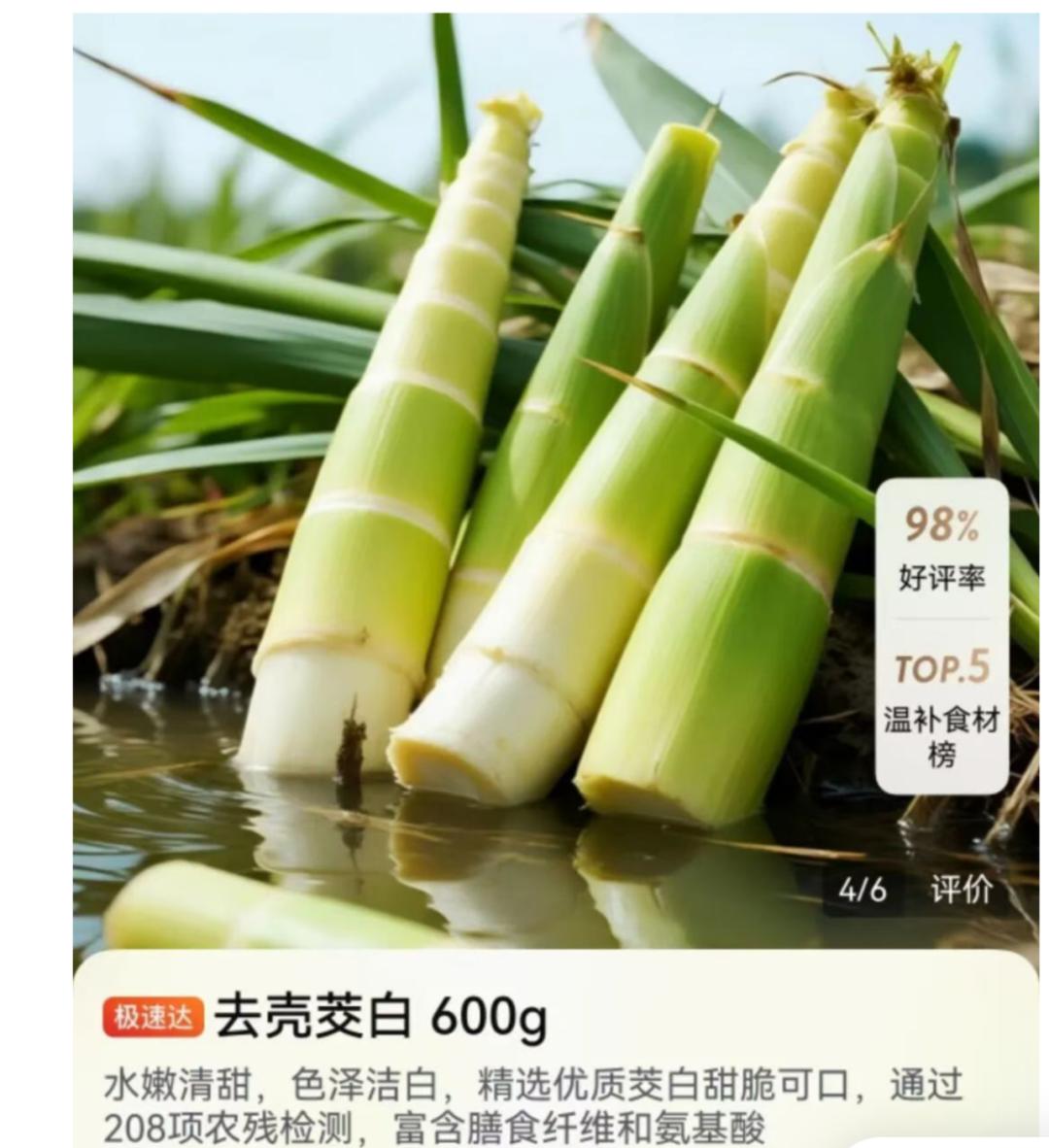
What is even more ironic is the "botanical miracle" brought by AI. For example, the wild rice stem that was complained by netizens, which is originally white, short and thick, was drawn as a "bamboo shoot" growing by the water with a sharp top, and was directly transformed into a completely different vegetable.
Some other netizens shared the image of small waxy corn, where the corn kernels are golden and shiny, but a large sticky mass of stretched substance appears out of nowhere in the middle of the corn cob, looking like a failed plastic model of candied floss, completely separated from the original physical form of the food.
Not only food, but even daily necessities on the shelves of Sam's Club have not escaped the impact of AI creation.
In the poster of the 169.9-yuan Songfa underglaze color cold water cup, an old craftsman is bowing his head to hand-paint patterns on the cup body, and the painting style looks warm. But if you zoom in and look carefully, the cup handle on the right side of the picture looks like a floating stick that is not connected to the cup body at all; the hand of the craftsman holding the cup has fused and deformed finger structures, and even has reversed joints.
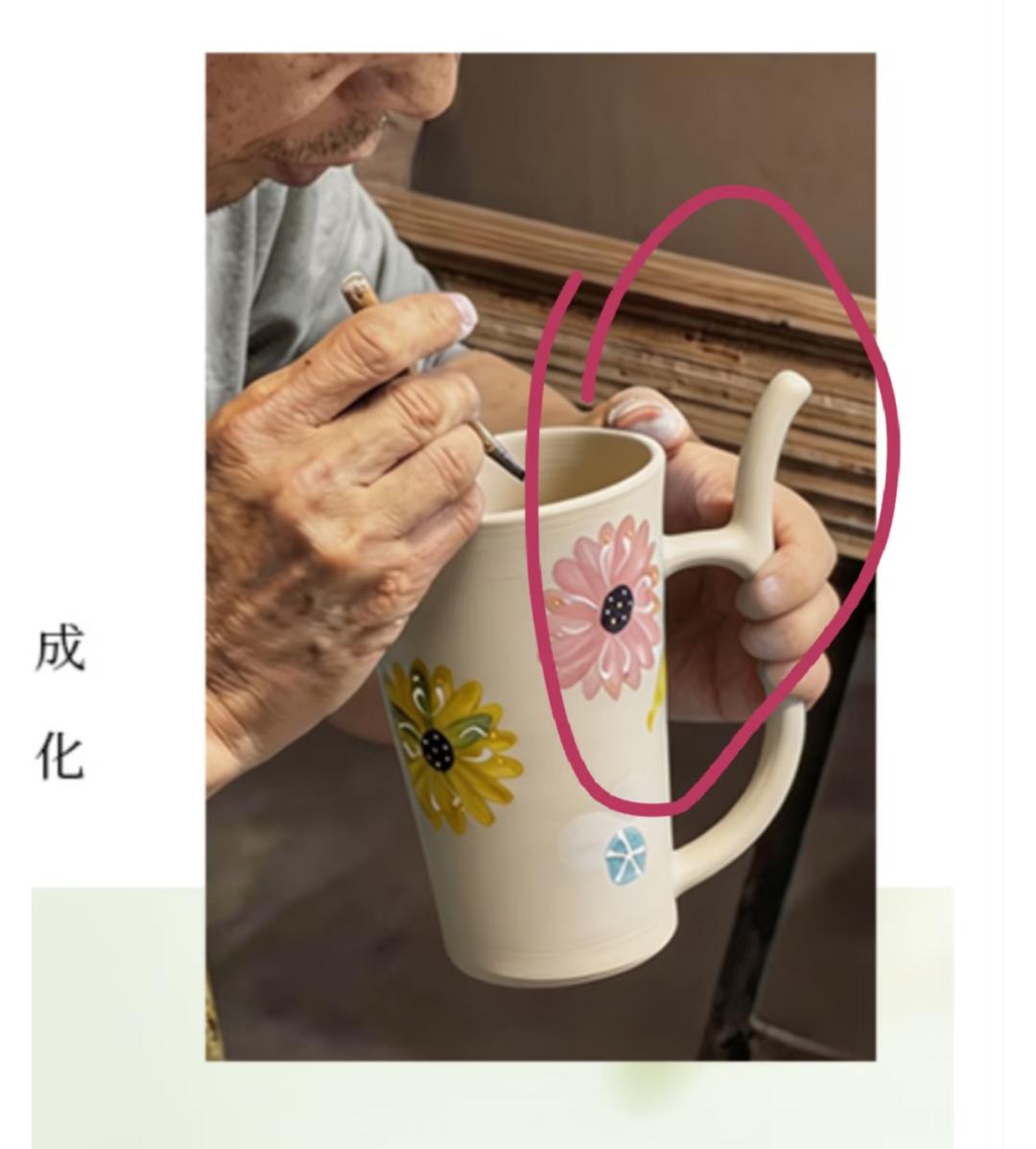
A "find the difference" game in AI version is unfolding between Sam's Club and the middle class. However, as soon as the middle class finds the weird AI images, Sam's Club will modify them quickly. The relationship among the middle class, Sam's Club and AI-generated images seems to have become a game of a donkey pulling a mill: every time the middle class gives a whip, a weird-looking AI-generated image on the APP will disappear.
In November 2025, a large number of complaints about Sam's Club's AI-generated product images appeared on the Internet. At that time, the designers obviously "did not communicate well with AI", so the generated images had a large number of anti-human designs, such as that cross-species wild rice stem. In response to netizens' dissatisfaction at that time, Sam's Club responded urgently, saying that the APP modification started testing at the end of August, and promised to continue to improve to show the real form of the products.
A year has passed now, and Sam's Club has indeed made changes. Designers now understand AI better, and have produced a set of more exquisite and hidden "AI-generated images". From AI images that do not conform to common sense to images that increasingly have the texture of heavily edited blockbusters, although these visuals are gradually becoming "more high-end", the "accuracy" of product information has dropped sharply. When middle-class mothers spend 79.9 yuan but still cannot see the real appearance of the biscuits, it is still unacceptable for them.
Just when the middle class expressed their dissatisfaction with Sam's Club's AI-generated images, Sam's Club took countermeasures and filed a complaint against AI. Some time ago, Sam's Club pointed out that some accounts use AI generation, material splicing and other methods to attract traffic for profit, and the company has completed evidence fixation and filed complaints and reports to platforms and regulatory authorities. It can be seen that no one likes the surreal feeling and false information brought by AI.
At the same time, at the end of September this year, Sam's Club's parent company Walmart updated its internal regulations, requiring all global stores not to display logos and posters made with AI tools, and defining them as "junk content that damages brand standards".
Of course, Sam's Club is not the first enterprise to use AI on a large scale in product images.
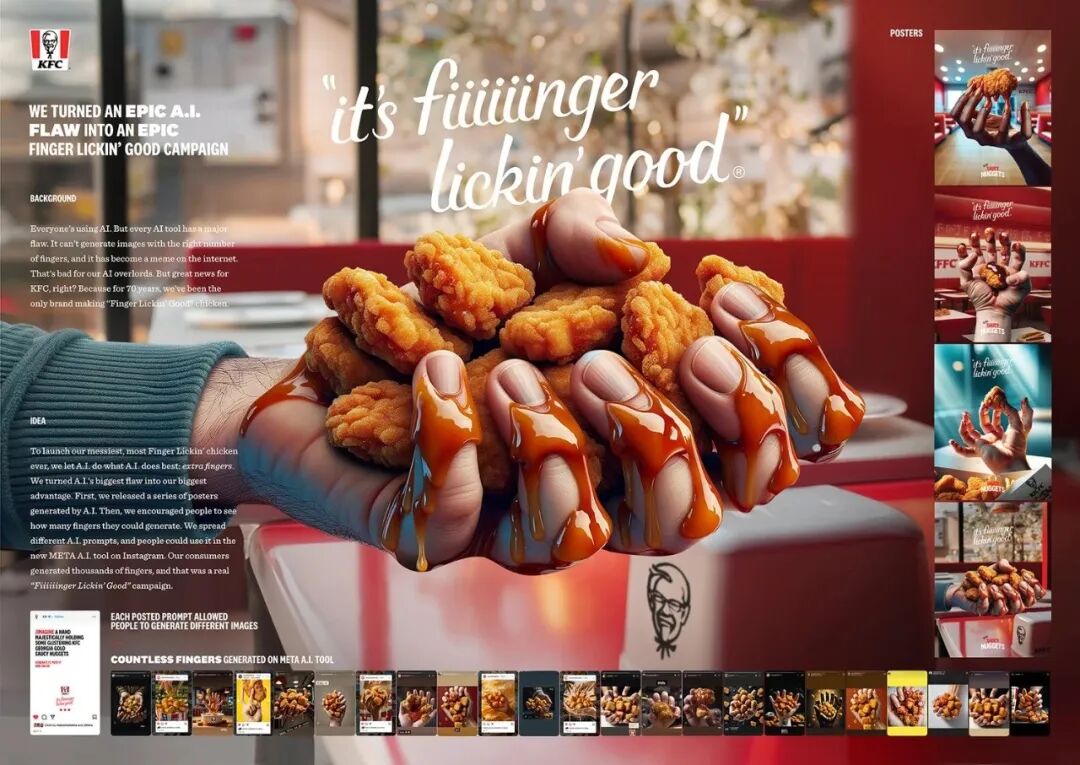
AI has invaded dining tables all over the world. KFC and McDonald's were criticized as early as 2 years ago for their "weird AI advertisements", in which a hand with 7 extra fingers was holding a sauced chicken nugget, making American workers "unable to take a bite, feeling like it was a body part".
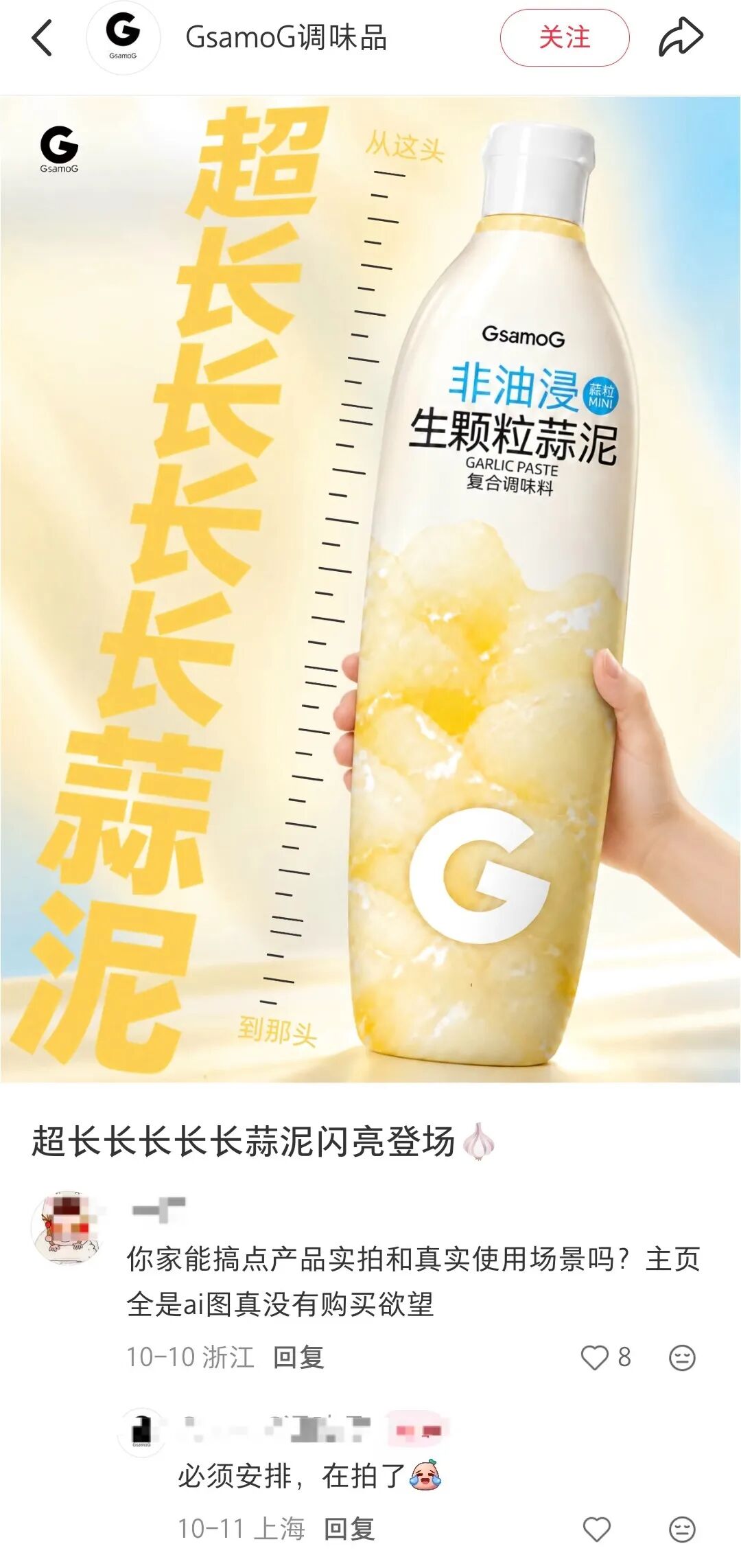
Now with the help of AI, merchants have even reached the point of putting products on shelves before they even take real product photos. Some brands launched super-long mashed garlic following the trend of super-long egg tarts, with posters promoting "from this end to that end" and "squeeze as long as you want", which left netizens confused: they boasted so much about the mashed garlic, but what on earth does the real product look like?
At the same time, some netizens complained that the AI-generated product images of Korean restaurants are " the beef looks like it is pieced together from bug scraps", which is exactly the same as the food in low-budget comics. The false highlight "shines" on the food and gives people a greasy feeling, which no one would expect that someone really moved the comic food into reality; Japanese AI generation is as "well-behaved" as Japanese people, all AI food posters are high-saturation food images with large bold fonts, so that netizens complained that "the AI templates are surprisingly unified".
This makes people can't help but think: AI is undoubtedly a tool to improve efficiency, but is it really applicable to all scenarios? Why do other platforms not cause such a big backlash when using AI images, but Sam's Club is met with widespread ridicule?
You can understand that unbranded products use AI to reduce costs and increase efficiency, but the premise of becoming a Sam's Club member is: at least 260 yuan of membership fee per year. The middle class are willing to pay this money, because Sam's Club acts as a "judgment outsourcing company". In this era of excessive products, Sam's Club uses clear real-shot photos to help members avoid the choice exhaustion of comparing origins and studying ingredients, and realizes the real "buy with eyes closed".
However, AI-generated product images have forcibly downgraded this smooth experience into a blind box opening game.
Brands save the cost of shooting photos, but pass on the energy cost of identifying authenticity to consumers. The transaction based on trust has changed its flavor: people not only lose the confidence to choose with their eyes closed, but now even taking a look at the real food has become a luxury.
AI-generated fake images at 0.04 yuan per piece are draining the last "human touch" out of food
The trend of reducing costs and increasing efficiency has finally blown to Sam's Club with a strong cyber flavor.
If you want to figure out why Sam's Club did this, you have to first understand how troublesome it was to shoot an appetizing food advertisement image in the past. After checking the accounts with several commercial photography practitioners, Hydrogen Business found that traditional food photography is not only an art, but also an extremely physically demanding manual work.
A single photographer cannot handle food shooting. A standard commercial shooting team, in addition to the lead photographer, also needs to be equipped with photography assistants, lighting engineers, prop masters, and the most core "food stylist". Taking the first-tier market in China as an example, a senior photographer charges 800 to 2000 yuan per day, a lighting engineer charges 600 to 1200 yuan per day, plus assistants and stylists, the labor cost alone costs thousands of yuan per day.
In addition, the team also needs to rent venues and studios, equip with high-power professional studio flashes, macro lenses of various focal lengths, softboxes, reflectors, and even use fog machines to create the effect of "steaming hot".
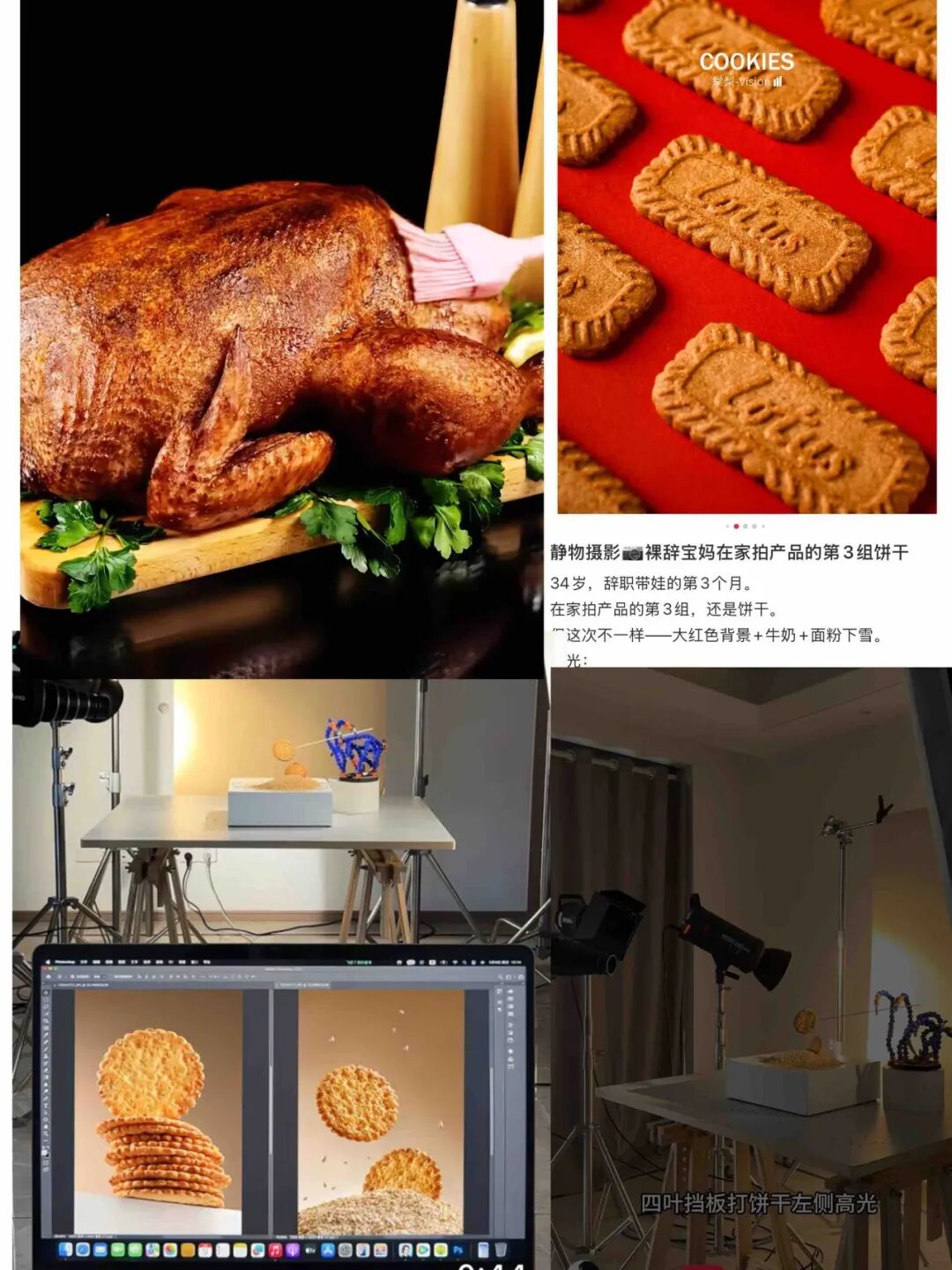
(Image source: Xiaohongshu)
The charge for commercial shooting is never calculated by the second of "pressing the shutter".
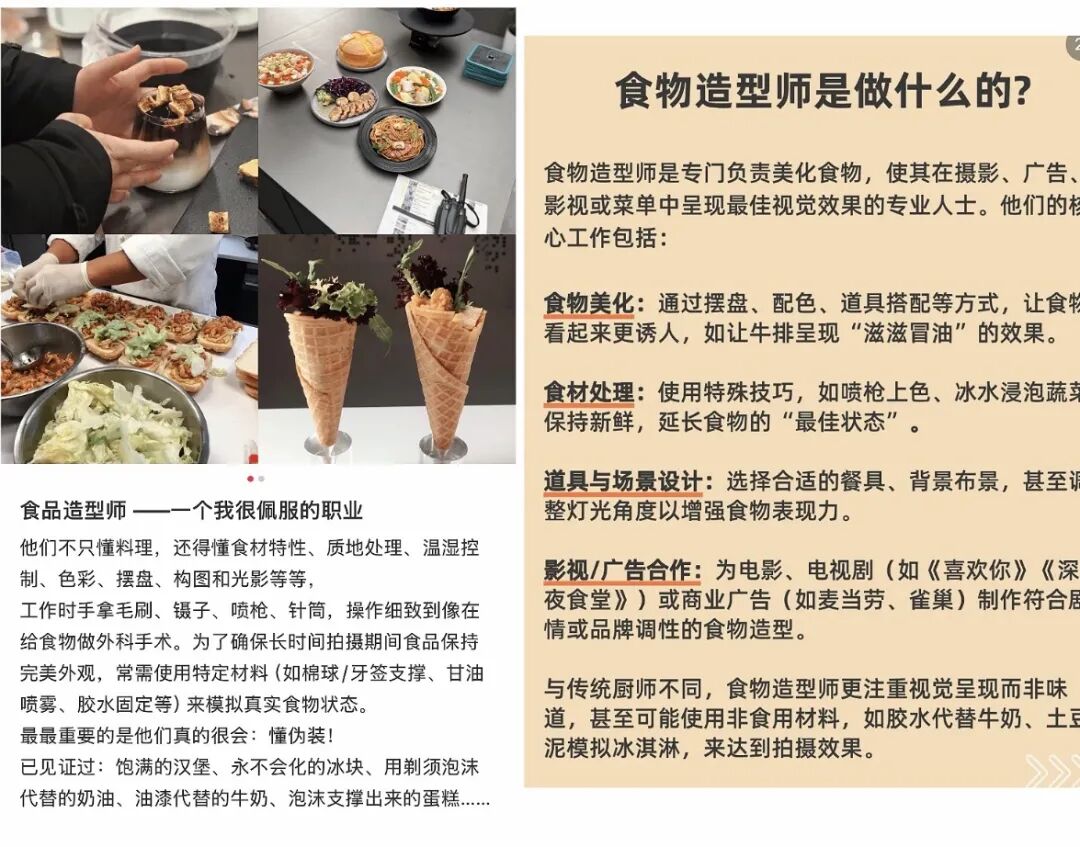
Even if you are just shooting a few biscuits, you have to adjust the lighting repeatedly, manually stack small towers, and sprinkle flour to pretend it is snowing. If you want to capture a dynamic moment of splashing milk, you can't do it without the help of an assistant. In order to wait for the most perfect state of a dish, many chefs even have to make the same dish more than a dozen times in the hot studio.
(Image source: Xiaohongshu)
In this dream-making studio, real food is fragile, and the whole picture relies entirely on the craftsmen's manual "faking".
The burger doesn't look thick enough? The stylist will prop it up with toothpicks and cotton pads; the pizza can't pull out an attractive long cheese string? There are screws and strong glue hidden under it to forcibly create a waterfall-like effect; the fresh cream is about to collapse, and the ice cream is about to melt? They will immediately replace them with a tube of fluffy shaving cream and a ball of dyed mashed potato.
The "fakes" nowadays are generated with one click by AI, while the "fakes" in the past were created by shooting with other items that could better highlight the product features, which required far more time for meticulous polishing.
In 2014, McDonald's released a video revealing how its advertisements were