For every 13 newly opened coffee shops, 12 will go out of business, and the growth focus of the coffee industry will shift northward in 2026.
The coffee market is witnessing a brutal knockout round.
Nearly 80,319 new coffee shops opened across the country in the past year, with a net growth of only 6,250. For every 13 new stores opened, around 12 are squeezed out of the market.
While the growth rate of mature markets is slowing down, a group of long-underrated cities are quietly increasing their "coffee density".
Let's take a look at this map of China's coffee industry. (Special note: Data source is Zhaimen Canyan, as of October 13, 2026)
1
There are more than 260,000 coffee stores nationwide
12 out of every 13 new stores get eliminated
First, look at the overall market data: Data from Zhaimen Canyan shows that as of October 13, 2026, the total number of coffee stores across the country reaches 262,095, with a chain operation rate of 43.02%.
By provincial administrative region, Guangdong, Zhejiang and Jiangsu rank top 3, with the number of stores reaching 42,770, 22,940 and 20,339 respectively. This ranking is not unexpected. Backed by large coastal consumption provinces, both the store opening density of chain brands and the activity of local brands have long been leading the country.
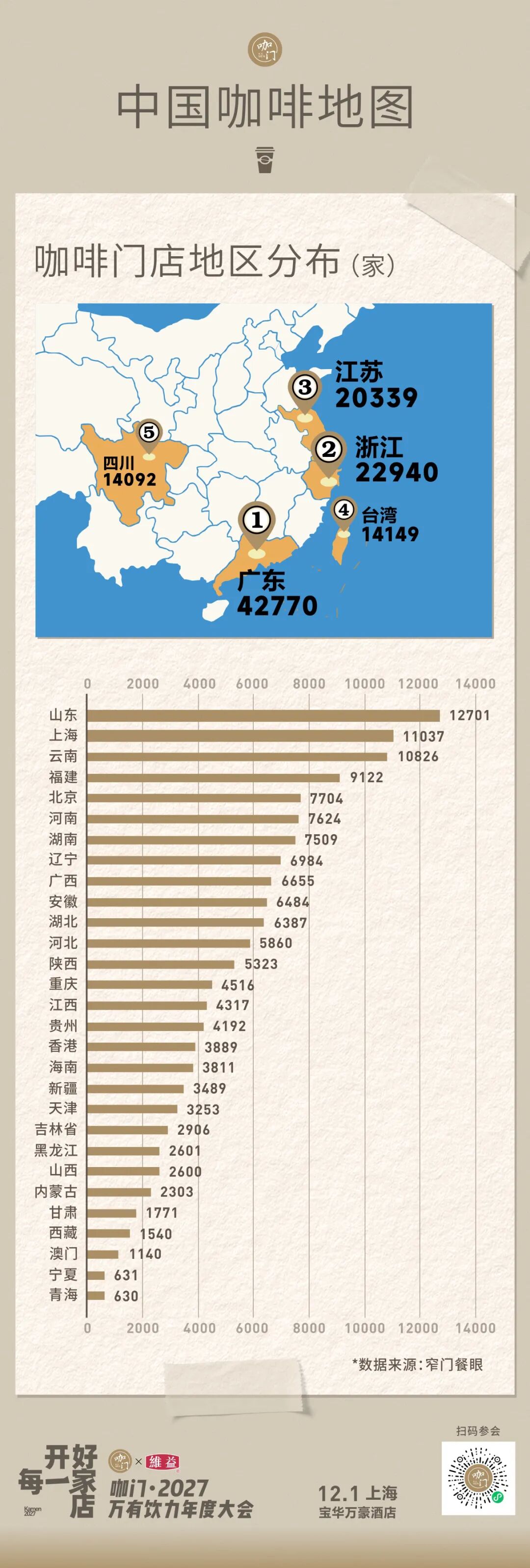
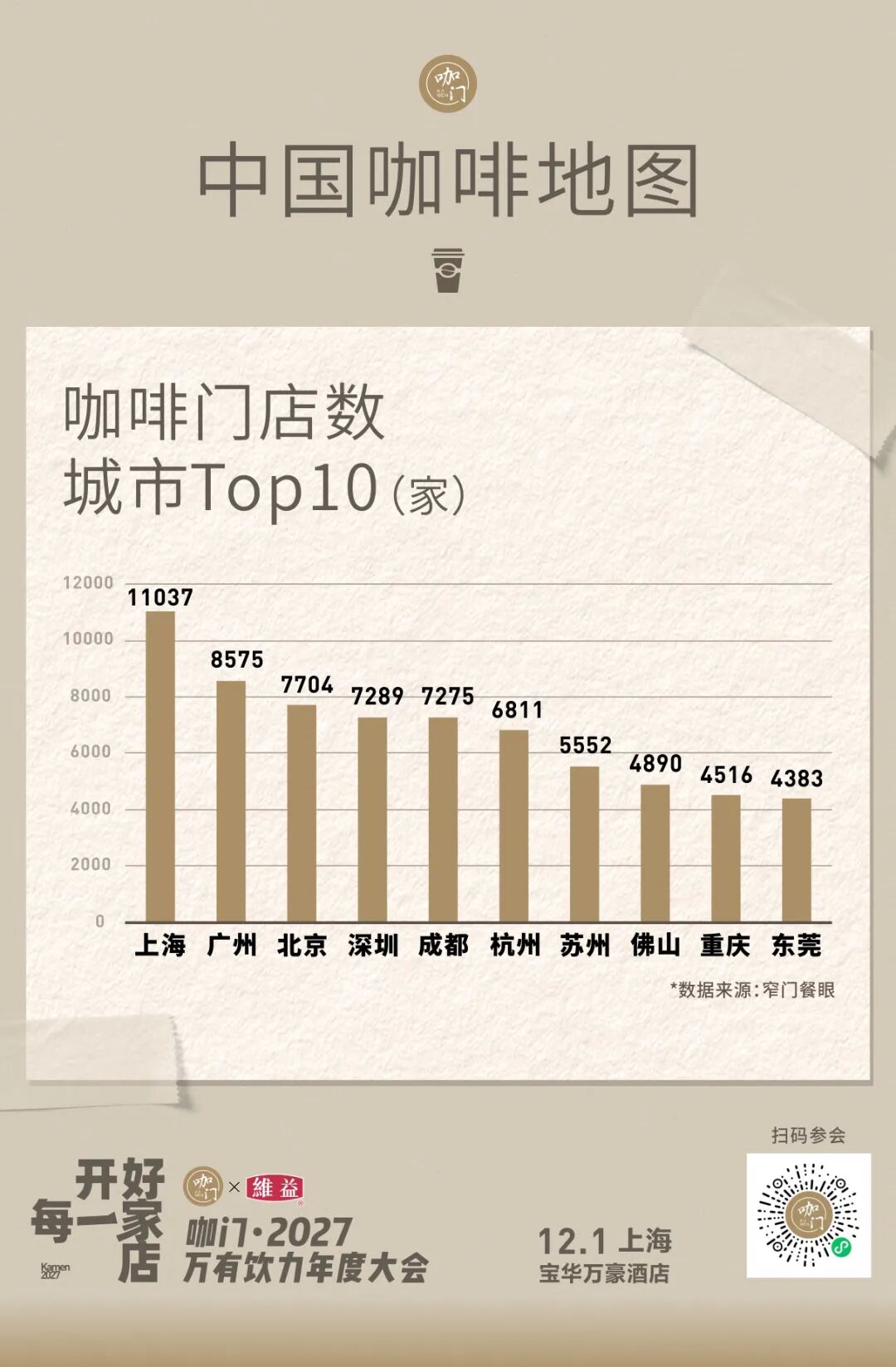
In the city ranking, Shanghai is still the only city in China with more than 10,000 coffee shops, topping the list with 11,037 stores. Guangzhou and Beijing rank second and third with 8,575 and 7,704 stores respectively. The top 10 seats are all occupied by first-tier and new first-tier cities, and the fundamental base of the traditional core market remains solid.
It is worth noting that the number of newly opened stores nationwide in the past year is 80,319, but the net growth in the same period is only 6,250. That means in the past year, the coffee industry was opening a large number of stores while closing a large number of stores at the same time. For every about 13 new stores opened, around 12 will be eliminated in the competition.
It is obvious that after the traffic dividend fades, consumers' choices are becoming more and more rational, and the access threshold of the industry is rising rapidly.
2
Growth center shifts north
New first-tier and strong second-tier cities hold huge opportunities
If we look at the cities with net store growth in the past year, a very obvious trend can be found:
The Yangtze River Delta and Pearl River Delta, which were once considered the most mature coffee consumption regions, are no longer the fastest growing areas. The top six cities in terms of net growth are Jinan (332 stores), Xi'an (297 stores), Shanghai (285 stores), Qingdao (259 stores), Zhengzhou (243 stores), and Changsha (233 stores).
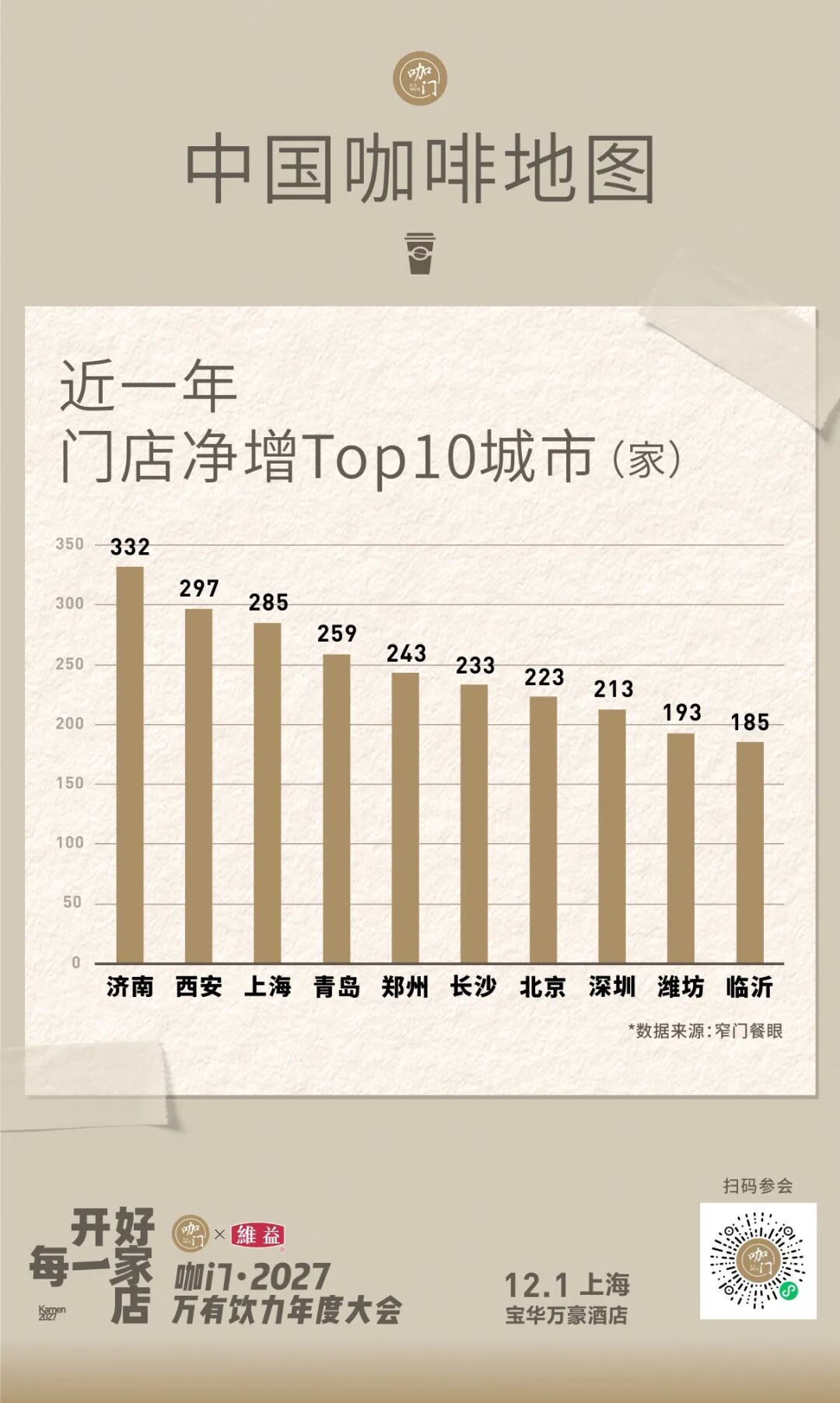
Except for Shanghai, the other five cities are all new first-tier and strong second-tier cities outside the Yangtze River Delta and Pearl River Delta. The growth of the northern market is more obvious, especially in Shandong Province. In addition to Jinan and Qingdao, Weifang and Linyi also rank in the top 10, with four seats occupied by one province.
The northward shift of coffee growth center is driven by a combination of multiple factors.
The first is the inevitable demand of coffee consumption upgrading. The incremental space for coffee in first-tier markets is narrowing; while new first-tier and strong second-tier cities have a large population base, and coffee consumption habits are being developed, scenarios that were not fully covered in the past are being filled rapidly.
At the same time, after leading brands complete store densification in first-tier cities, they will inevitably expand to new first-tier and strong second-tier cities with solid consumption power, using mature single-store models to make coffee a daily choice for the public.

In addition, various cities are leveraging their own strengths to attract coffee traffic, combining characteristic industries such as cultural tourism and import and export trade to develop diverse coffee ecosystems.
1. Jinan: Make coffee with spring water, open stores in subways and fast food restaurants
Many people's impression of Jinan's coffee scene still stays at artistic independent coffee shops. Now in this city, coffee shops have spread into every corner of the daily life of local residents.
The local Jinan coffee brand metro JN coffee opens stores directly in subway stations, so that office workers can buy a cup conveniently while swiping their cards to exit the station; in terms of products, it uses local "spring water" as the core raw material, and the Baiquan Americano is priced at only 5.9 yuan per cup after discount.

Chaoyixing, a local Chinese fast food brand that has been operating for decades, relying on its community stores covering the whole city and its people-friendly attributes, has cross-launched its coffee sub-brand "Xingyika", pushing the price of a cup of coffee to single digits and bringing coffee to more people's daily dining tables.
One of them cuts the price down, the other opens stores along people's travel routes, allowing coffee to penetrate into more life scenarios.
2. Xi'an: Integrate Chang'an culture and grow with the support of cultural tourism traffic
As an important city in northwest China, Xi'an has always been the first stop for chain brands to open up the northwest market. As early as 2022, the first northwest stores of brands including %Arabica, M Stand and Manner all started here, laying a foundation for the city's coffee consumption.
Today's Xi'an, backed by its developed tourism industry, has made coffee a new way to experience Chang'an culture. Take a city walk along the ancient city wall, and you can run into a stylish coffee shop around the corner. Local brands including Oops Coffee, Hepingxi, and Laida Coffee... integrate the hustle and bustle of the ancient city into their coffee cups.
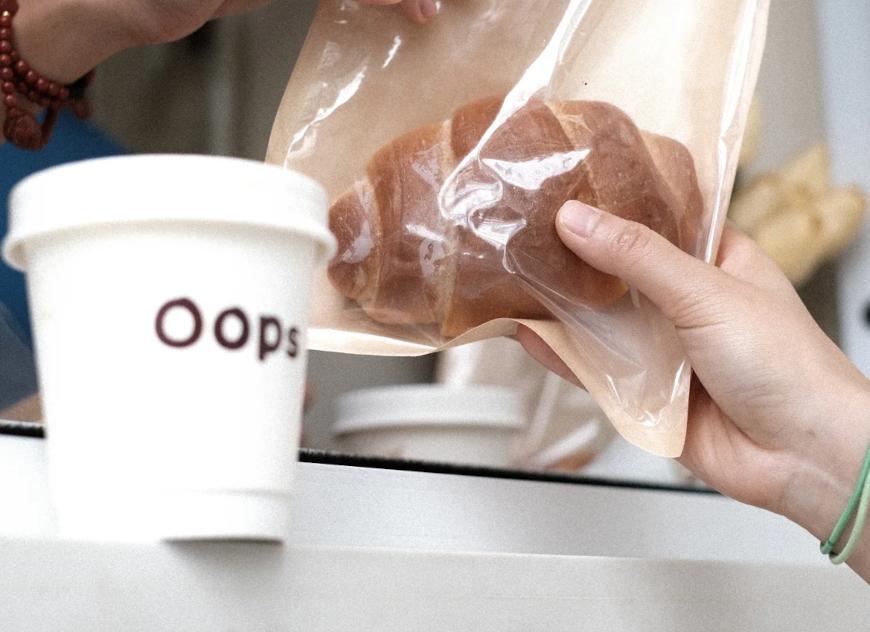
Earlier this year, Joy Coffee opened five Tang poetry themed stores in Xi'an, integrating "Tang poetry + cultural tourism" elements, selecting locations in core areas such as East Avenue and Grand Tang Mall, creating immersive scenarios, making drinking coffee part of the travel experience.
3. Qingdao: "Seaview coffee" is booming, with obvious advantages in the industrial end
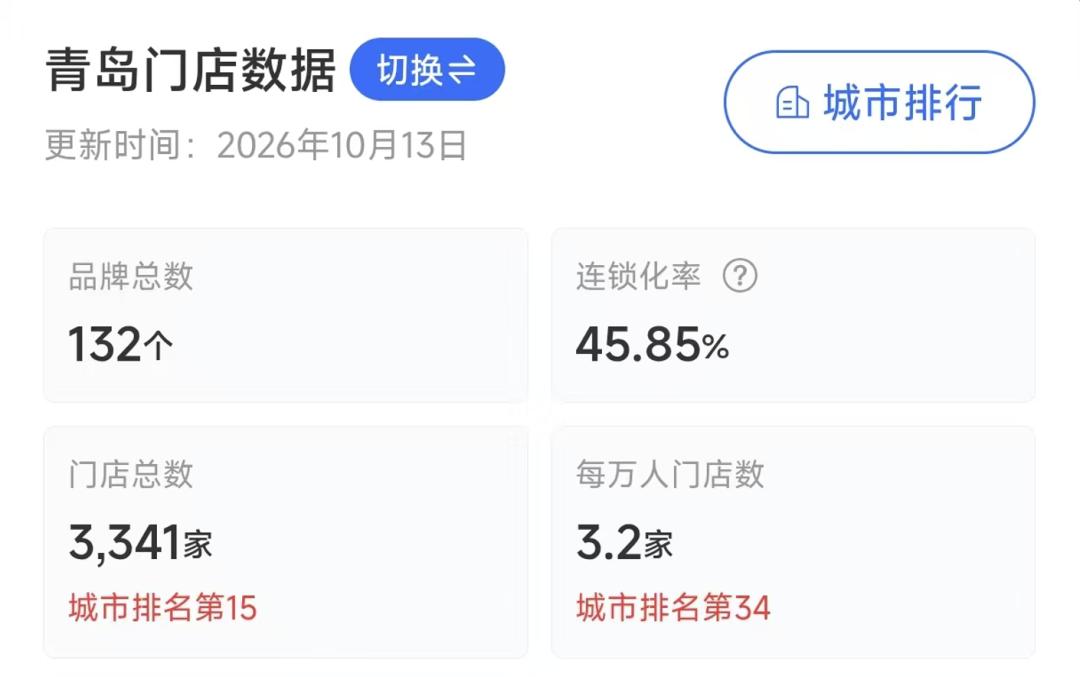
Data from Zhaimen Canyan shows that Qingdao now has 3341 coffee shops, ranking second among northern cities after Beijing (7704 stores) and Xi'an (3551 stores). Affected by historical factors, Qingdao is also one of the earliest cities in China to get access to coffee, and local consumers have always had high acceptance of coffee.
In the local coffee market, on the one hand, chain brands are intensively deploying stores, on the other hand, a large number of independent coffee shops are built along the coast. Taking seaview as a selling point is a unique consumption scenario of this city.
The coffee density of Qingdao is not only reflected in the consumption end. According to data from West Coast Media and Qingdao Municipal Government official website, Qingdao Port handles 13% of China's total coffee import volume, ranking firmly as the largest coffee import portal in northern China.
In addition, Luckin Coffee's innovative production center with a total investment of about 3 billion yuan, an annual roasting capacity of over 55,000 tons, and a land area of over 100 mu, also started construction and put into operation in Qingdao this year.
4. Zhengzhou: Premium chains including %Arabica and Grid Coffee enter the market in clusters
As a city developed along railway networks, Zhengzhou has a huge population base and well-connected transportation networks, and the popularity of coffee consumption has been continuously rising.
The local brand Lucky Coffee has spread its stores all over the streets and alleys of the city, allowing many consumers who rarely drank coffee before to walk into coffee shops frequently.

In the second half of this year, %Arabica and Grid Coffee successively settled in Zhengzhou, and the first textile industry themed store created by Starbucks in China also officially opened to the public.
Chain brands enter the market in clusters, while local affordable brands hold their positions, Zhengzhou's coffee landscape is being rapidly completed.
3
Coffee penetration is accelerating
The core of competition still lies in single-store value
What this map reflects is that coffee has truly completed daily penetration across the vast land of China.
Few days ago, Luckin Coffee released its financial report for the third quarter of 2026. Guo Jinyi, co-founder and CEO, mentioned:
"Referring to the coffee development history of mature countries, China still has huge room for improvement in terms of population penetration rate and drinking frequency. With the gradual development of coffee drinking habits and the continuous growth of consumer demand, the space for healthy store opening will continue to expand."

In today's coffee market, affordable chains have cut down the price, and more scenarios including office buildings, subways, fast food restaurants and convenience stores have expanded the distribution channels. Coffee consumption in more and more regions has changed from a novelty-seeking check-in behavior to a daily habit.
The 2026 China Urban Coffee Development Report shows that the scale of China's coffee industry reached 354.9 billion yuan in 2025, with a year-on-year growth rate of 13.3%. The per capita coffee consumption nationwide reaches 28.57 cups, a new step up from 22.24 cups in the previous year.
The acceleration of coffee penetration does not mean every opened store can survive. A long-lasting coffee business will eventually fall back to single-store value.
This article is from WeChat Official Account "Kamen" (ID: KamenClub), written by Zhang Jin, authorized to be released by 36Kr.