From youth employment to consumption scenario innovation, what does "AI+" bring to the coffee industry ecosystem?
The "freshness period" of new consumption scenarios is getting increasingly shorter.
A pop-up event, a co-branding collaboration, or a new concept may bring several months of new customer flow to a consumer brand, but after the novelty fades, how can the brand retain its users?
This has been a common feeling shared by players ranging from consumer brands to commercial property and block operators over the past few years. It was also a topic repeatedly discussed by store operators, investors and entrepreneurs at the "AiPartner, March to the Frontline with AI — Ningbo Coffee Life Week Scenario Innovation Exchange" co-hosted by the Ningbo Yinzhou District Development and Reform Bureau and 36Kr at Yunchuang Zheli Youth Kingdom at the end of last month.
Taking Yinzhou as an example, the local area boasts a rich manufacturing ecosystem, abundant consumption scenarios and a large group of young people. When the three elements of scenarios, equipment and talents converge within the same geographic radius, what kind of "new species" of consumption scenario innovation can be spawned?
01 The Industrial Chain Is Changing, So Are Opportunities for Young People
Located in the Higher Education Park of Shounan Sub-district, Yinzhou District, Yunchuang Zheli Youth Kingdom is a well-known commercial block north of NingboTech University, covering an area of 40,000 square meters. "We are exploring new digital consumption business forms such as smart coffee retail to keep the commercial space here vibrant," said Zhang Hua, project lead of Zhejiang Yunchuang Weilai Group, at the just-concluded Ningbo Coffee Life Week Exchange.
Building new digital consumption business forms represented by coffee is the original intention of Yunchuang Weilai to host the Coffee Life Week for 7 consecutive years. As AI capabilities penetrate the entire industrial chain of coffee from production to consumption, the "entry" of equipment brings visible efficiency improvement and scenario changes. The continuous iteration of the coffee consumption business form also poses new challenges for practitioners, such as high equipment investment costs, troublesome operation and maintenance, and a lack of supporting training and professional talents.
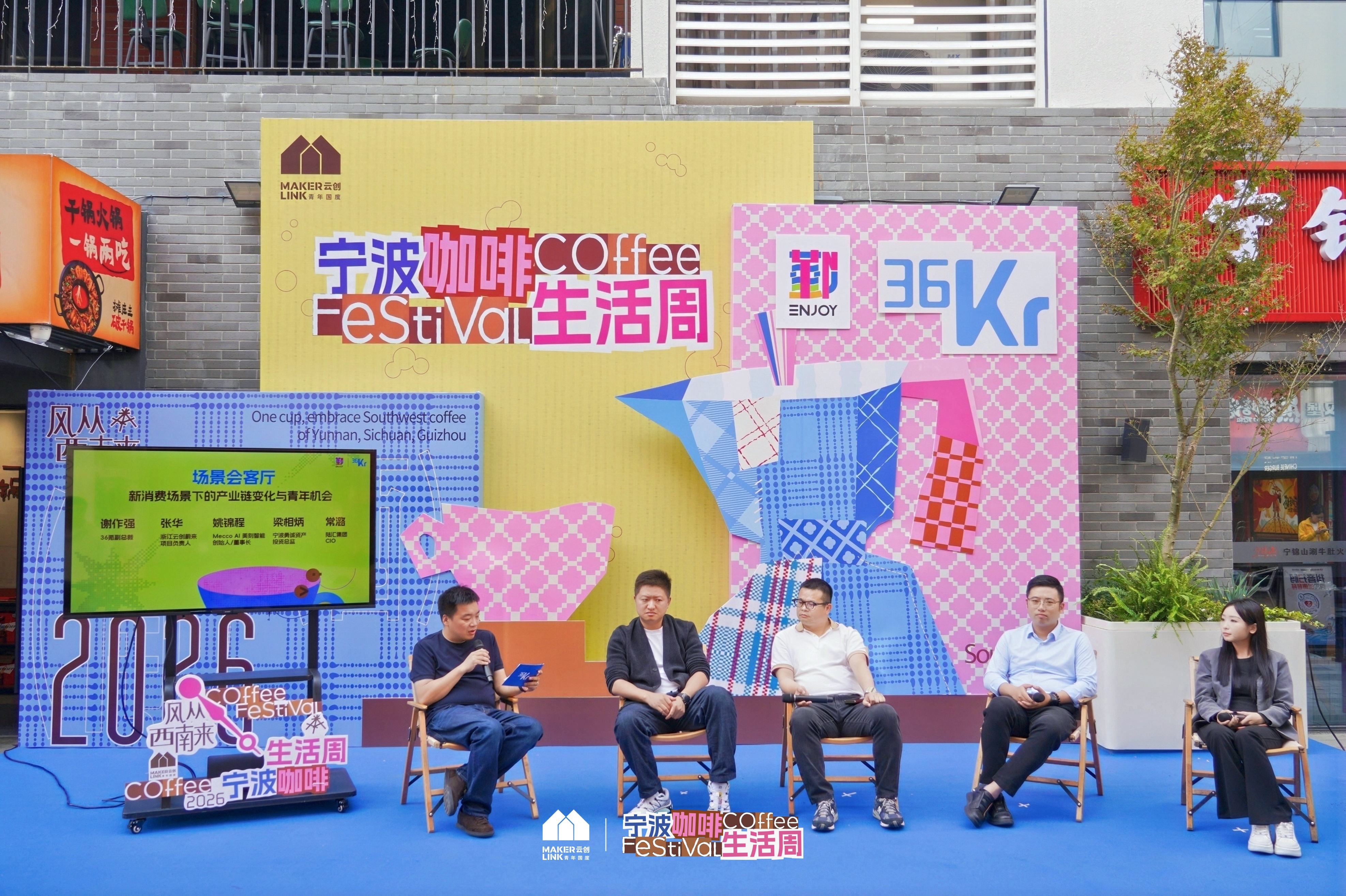
Meke is an enterprise that develops AI flexible multi-category unmanned beverage robots. Yao Jincheng, initiator of its AI project, believes that the entry of AI into the coffee industrial chain essentially uses technology to restructure the relationship between "people, goods and scenarios". A 1.4-square-meter device that supports 7×24 hours unattended operation and delivers products in 60 seconds solves the cost structure and scenario blind spots that traditional stores cannot cover.
"What AI does is not to replace baristas, but to liberate baristas from repetitive labor, so that high-quality beverages can be infinitely close to consumers," said Yao Jincheng. AI is redefining baristas. At present, the "AI + coffee" market is most short of three types of interdisciplinary talents who "understand coffee, technology and operation at the same time" — coffee robot operation and maintenance engineers, AI beverage R&D specialists, and unmanned retail operation specialists. Such talents are "almost blank" at the moment, and cannot be covered by the traditional barista training system and traditional equipment engineer training system. They are new professions "created" by AI equipment.
The demand of the new consumption scenario of "AI + coffee" for new professional talents exactly coincides with another line: youth employment. For young people, "AI + coffee" is creating a new set of career entry points.
As an enterprise focusing on the training of technical and skilled talents, Luhui Group does not provide barista training, but focuses on the manufacturing end of the coffee industrial chain — talent training for technical positions related to coffee machine assembly, equipment operation and maintenance debugging, and industrial robots. Chang Lu, CIO of Luhui Group, believes that stores need operation-oriented interdisciplinary talents, while the production line side focuses on technical and skilled talents. The two paths intersect at "equipment operation and maintenance", but their capability structures and training paths are different, corresponding to different youth employment directions. For example, the current core skill system of numerical control CNC and industrial robot courses can be partially migrated to the coffee machine production field, and new courses need to be developed in a targeted and customized manner in combination with the employment needs of enterprises in the coffee industrial chain.
From the perspective of investment institutions, what they pay attention to is not the breakthrough of a single point of technology, but whether the three elements of scenarios, equipment and talents can form a sustainable business model. Because whether young talents engaged in new professions can effectively integrate into the industry and play a positive role also requires the smooth connection of all links in the industrial chain. Liang Xiangbing, Investment Director of Yongcheng Asset Management, values people with industrial experience more in team composition. "People who only understand technology are not as good as those who understand the industry. A coffee team must understand the rules of the coffee industry." Whether it can truly reduce costs and increase efficiency, and whether the scenario is replicable, profitable and sustainable is what investors really care about.
Specifically for the proposition of consumption scenario innovation in Yinzhou District, it means whether new business forms can be implemented in commercial blocks like Yunchuang Zheli Youth Kingdom through individual projects, connecting all links of the industrial chain to form local supporting facilities — retaining talents, realizing continuous equipment operation and maintenance, and improving the vitality of scenarios. The Ningbo Coffee Life Week Scenario Innovation Exchange co-hosted by the Yinzhou District Development and Reform Bureau and 36Kr this time is exactly providing a "test field" for the interconnection of all ends of the industrial chain behind the coffee consumption scenario.
02 The Key to New Consumption Scenario Innovation Lies in "Sustainability" Rather Than "Construction"
After the industrial chain is upgraded and new-type talents join, whether the whole industry can continue to generate benefits still needs to return to the real frontline consumption scenarios. The Water Street of the Southern Business District is the area with the highest density of coffee consumption in Yinzhou, gathering 40 coffee brand stores including Starbucks, Luckin Coffee and CRUST.
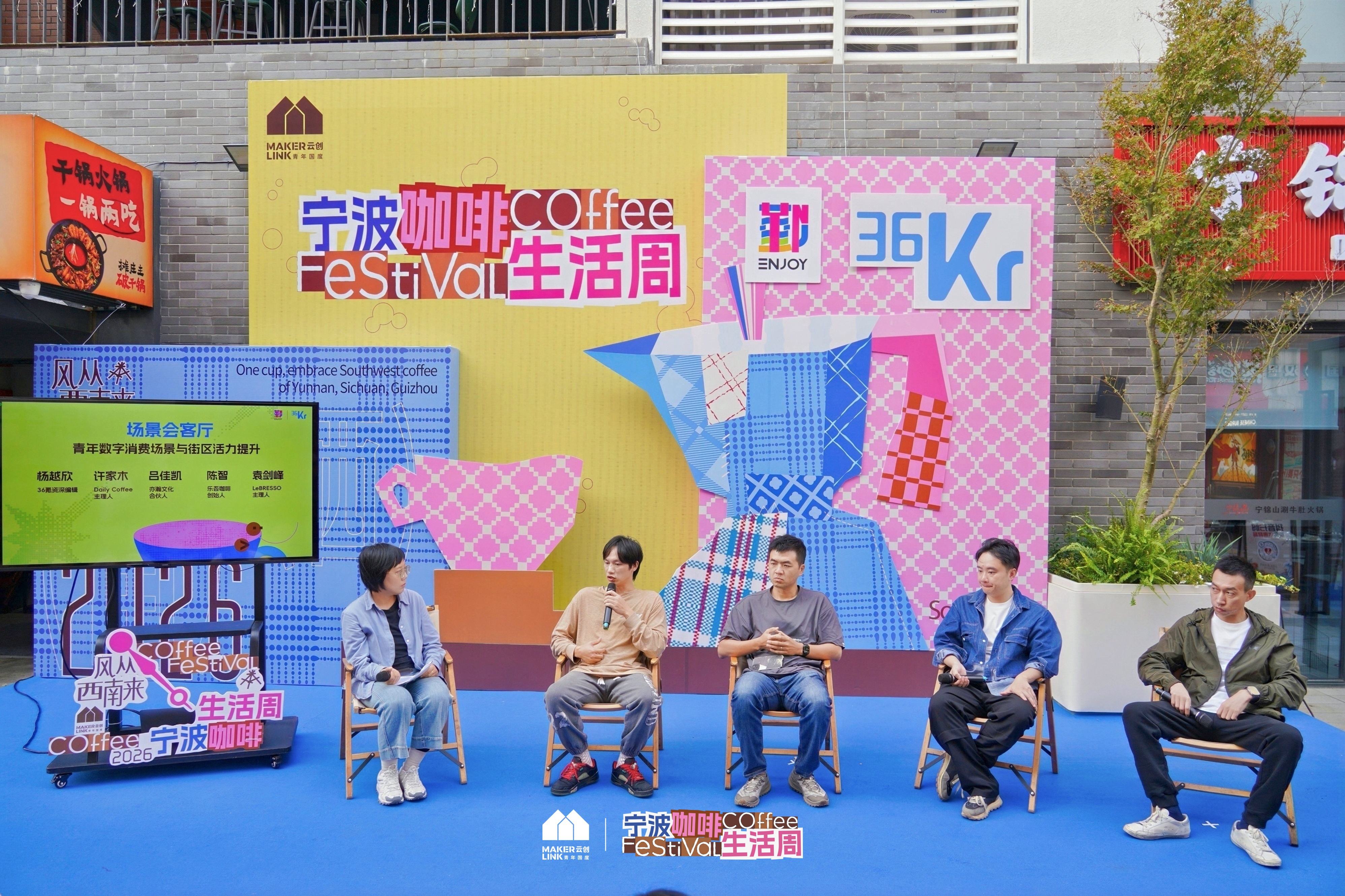
Xu Jiamu, owner of Daily Coffee, opened an office building coffee shop here in 2015, providing 7-yuan American coffee and 9-yuan latte for white-collar employees in the building. "At that time, Luckin Coffee had not even appeared."
After ten years of development, the coffee consumption in the Southern Business District has now achieved full-scenario coverage, including business coffee, community coffee, specialty coffee shops... All types of consumers can find coffee scenarios that suit them. In such a dense space, how to win repeat customers is a more difficult question to answer than introducing "AI + coffee" equipment.
In Xu Jiamu's view, "AI + coffee" does have certain drainage value, and the mechanical arms and coffee robots placed in the shop window can bring customer flow, "just like a tourist attraction"; but when the curiosity for novelty fades, how can daily repurchase be guaranteed? Xu Jiamu believes that the logic of AI improving cup output efficiency is more suitable for office buildings and industrial parks, but not fully compatible with artistic style coffee shops.
In other words, the threshold of scenario innovation does not lie in "construction", but in "sustainability". Curiosity can bring the first wave of customer flow, but forming continuous repurchase requires brands to provide more product value. Zhang Hua said that when Yunchuang Zheli Youth Kingdom carries out new consumption investment attraction for youth-oriented scenarios, it does not simply pursue the increase in the number of stores, but expects brands with excellent product content, strong brand plasticity, distinctive store operator characteristics and strong community attributes to join, which can not only provide space, but also carry emotional companionship value, attract customer flow for the block and retain visitors.
Chen Zhi, founder of Zhonglele Coffee Art Festival, emphasized that the content design of the coffee festival should have "orderly aesthetics", "all brands coming to the scene serve the same group of guests who pursue a better life". He introduced that in order to continuously bring new ideas to consumers, the coffee festival will cooperate with different platforms and invite brand spokesperson stars to the scene for interaction, "by providing a better experience, more people are willing to travel thousands of miles to the coffee festival, not just for a cup of coffee made by the store operator."
Beyond a cup of coffee, what Yinzhou is trying to do is not to see whether new scenarios are created, but how new scenarios can maintain continuous vitality. When the industrial chain is reshaped by AI and youth opportunities change, can the four links of products, talents, scenarios and markets "connect seamlessly" in the same geographic space? The scenario innovation sample of Ningbo Coffee Life Week in Yinzhou District is exactly an answer to this question.