Why did Caitong Fund fully liquidate all its positions in the two funds managed by Jin Zicai?
A series of signals including controversies over own capital reduction, senior management reshuffle and position holding style adjustment have emerged one after another, indicating that after experiencing sharp fluctuations in product performance, high on-market premium turmoil and regulatory attention, Caitong Fund is undergoing an in-depth adjustment covering capital allocation, management team and investment style.
During the disclosure window of the three quarterly reports, the own capital transactions of Caitong Fund have drawn market attention: from the end of July to the beginning of August 2026, the company's own capital concentratedly redeemed active equity funds managed by many fund managers including Jin Zicai and Shen Li.
Among them, all open-end funds under Jin Zicai were fully redeemed, only Caitong Multi-Strategy Fuxin Regular Open Fund was not completely liquidated, but the fund previously had a high on-market premium, and only 100 shares were symbolically sold in the third quarter.
On one hand, the fund managers still wrote in the quarterly reports that they "will continue to be optimistic about the long-term development prospect of the AI (artificial intelligence) industry", on the other hand, the manager concentratedly cashed out the gains from the end of July to the beginning of August, and the contrast is thus highlighted.
This contrast is particularly noticeable because Caitong Fund and Jin Zicai are one of the most high-profile star combinations in the public offering fund industry over the past year. As the company's deputy general manager and director of equity investment, Jin Zicai's AUM (Assets Under Management) surged from 8.9 billion yuan to 56.5 billion yuan in the second quarter alone, and was once labeled as a "stock god" by some investors; the AI computing power chain he heavily invested in delivered centralized returns, and the on-market increase of Caitong Fuxin LOF (Listed Open-ended Fund) once approached 8 times in the past year, with the highest premium rate nearly reaching 50%, making it a "internet-famous fund" chased by retail investors. Therefore, when the manager concentratedly redeemed its holdings in its own star product, the market's astonishment and controversy were particularly intense.
Apart from capital operations, changes are also taking place inside the company. In terms of personnel, on the evening of October 28, Caitong Fund issued an announcement on the change of general manager: former general manager Xu Chunting left his post due to organizational transfer, and Jin Yun took over as the new general manager.
In terms of investment research, according to the three quarterly reports, some funds under Jin Zicai have seen lower position concentration and reduced position aggressiveness, which may be related to the recent regulatory constraints on style drift in the fund industry.
A series of signals including controversies over own capital reduction, senior management reshuffle and position holding style adjustment have emerged one after another, indicating that after experiencing sharp fluctuations in product performance, high on-market premium turmoil and regulatory attention, Caitong Fund is undergoing an in-depth adjustment covering capital allocation, management team and investment style.
Redeem Active Equity Funds, Purchase Bond Funds and Money Market Funds
According to statistics from the regular reports of funds by *Caijing*, since 2026, Caitong Fund has cumulatively redeemed 8 equity-containing products under its management (including partial equity hybrid funds, partial bond hybrid funds, secondary bond funds and index enhancement funds), totaling 269 million yuan.
Among the products redeemed in this round, in addition to Caitong Growth Select and Caitong Value Momentum managed by Jin Zicai, it also includes Caitong Prosperous Industry, Caitong New Vision and Caitong Anying managed by Shen Li, Caitong Emerging Blue Chip managed by Tang Jiawei, as well as the secondary bond fund Caitong Income Enhancement, etc.
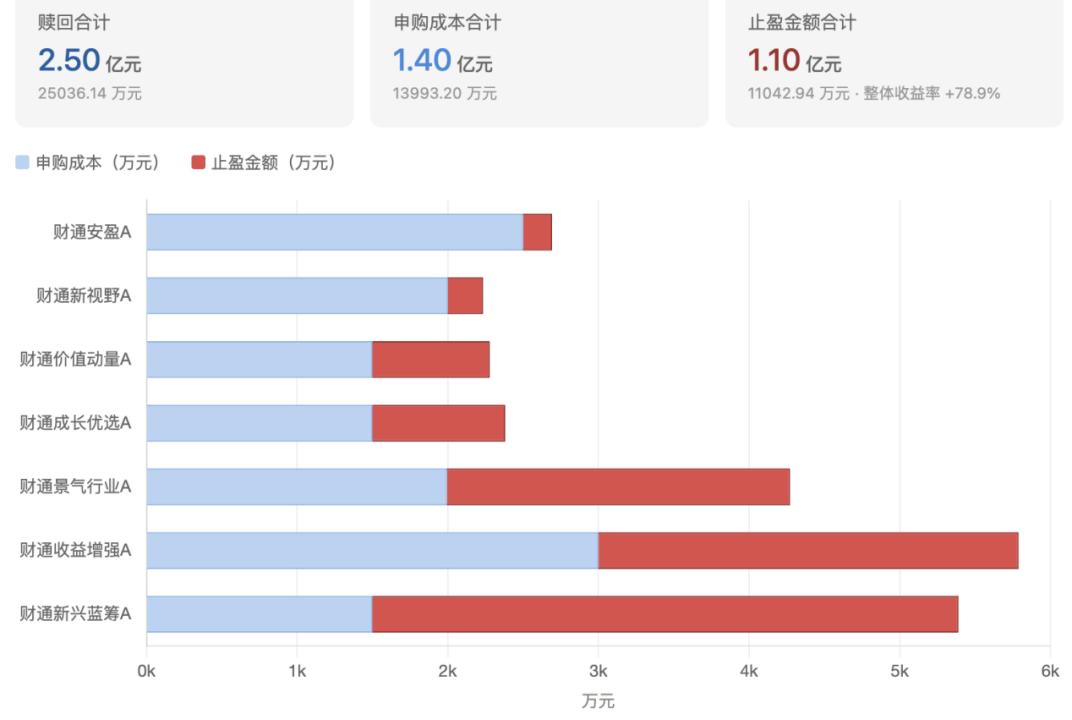
*Caijing* estimates that the six redemptions of Caitong Fund have generated a total profit of about 82.547 million yuan. The returns of two long-term bottom positions are particularly prominent: the subscription cost of Caitong Emerging Blue Chip A is 15 million yuan, and the redemption proceeds are 53.8988 million yuan, with a profit of 38.8988 million yuan and a rate of return of 259.33%; the total investment in Caitong Prosperous Industry A is 19.942 million yuan, and the redemption proceeds are 42.7157 million yuan, with a profit of 22.7737 million yuan and a rate of return of 114.20%.
While redeeming active equity funds, Caitong Fund subscribed 50 million yuan for the secondary bond fund Caitong Fengyue Return A (026221). In addition, for the money market fund Caitong Caitongbao A (002957), it has subscribed 2.287 billion yuan and redeemed 1.746 billion yuan during the year, with a net increase of 540 million yuan.
Deploying equity assets at the beginning of the year, withdrawing from equity assets in the middle of the year and shifting back to fixed income and cash constitute the main line of Caitong Fund's own capital position adjustment.
What is the effect of this round of timing operation of Caitong's own capital? According to public data calculated by *Caijing*, taking Caitong Value Momentum as an example, the two redemption prices are 31.6% lower than the high point of the year; but on October 29, the net value of the fund has fallen to 4.9230 yuan, which is another 18% lower than the redemption price. It can be seen that the redemption timing is not the optimal, but it avoided a deeper decline in the AI sector since September.
On the other hand, the fund managers whose positions were reduced have not changed their judgment on AI.
Shen Li wrote in the three quarterly reports of Caitong New Vision and Caitong Prosperous Industry that artificial intelligence is iterating rapidly, its capabilities are continuously improving, and the downstream penetration rate is extending from the field of code generation to other fields. The gap between China's open-source large model technology and overseas leading players has narrowed; at the same time, he also mentioned concerns and divergences such as downstream entities borrowing heavily to expand hardware, pushing up macro interest rates, and challenges facing cybersecurity governance, arguing that "different voices will help pull the industry back to a reasonable growth track and avoid irrational overheating".
Jin Zicai's statement is more resolute: "The tight supply situation in many upstream links of the AI industry chain will continue, and the capital market may take some time to gradually digest the reality that the product prices in these links are difficult to fall back. We believe that as long as the high growth of AI demand continues, these prices may still be difficult to fall back in the short term. At the same time, we expect that the AI industry is still expected to maintain high growth in the future, and this round of growth may be supported by real customer demand."
Jin Zicai believes that the underlying logic of the AI industry has been continuously strengthened in the third quarter, but affected by the overall weak liquidity of A-shares, the sector's performance is under pressure in stages, and he said that he only made minor adjustments to the individual stocks in his positions, and the overall sector allocation remains relatively stable.
Why Did Caitong Fund Make the Redemptions?
The motives behind the own capital redemption operation are multiple, and the primary motive is usually to take profits.
Calculated based on the end of the semi-annual report period, the floating book profit of Caitong Growth Select held by Caitong Fund reached 145.5% on June 30, and the floating book profit of Caitong Value Momentum was 124.1%.
"Such returns have obviously allowed Caitong Fund to achieve its goals in advance. After the own capital accumulates high floating profits, cashing out returns and controlling drawdowns during the period of increasing volatility is a normal operation in itself," a senior fund observer said, "But public offering funds are carriers of inclusive finance. Caitong Fund has achieved substantial growth in scale and performance by riding the industry trend, but its own capital liquidated and left the market during the sensitive period when investor confidence is fragile. To some extent, this is also a manifestation of the fund manager's lack of overall perspective."
"In addition to the need to take profits, the reduction of own capital may also consider the internal control line," a person from a fund company told *Caijing*. Some fund companies set an upper limit on the proportion of their own capital invested in equity assets, and his company stipulates that the proportion cannot exceed 20%. "The sharp rise in the net value of equity products in the first half of the year passively increased this proportion, and selling equity products may also be to bring the position back within the limit."
The third consideration is resource allocation. "Small and medium-sized fund companies have limited own capital, and sometimes they need to sell some products to prepare for more important matters, such as self-purchase of newly issued funds," an industry insider said.
*Caijing* learned from the industry that the focus of Caitong Fund's resource allocation may be Caitong Multi-Strategy Fuxin, the LOF fund whose premium rate remained at a high level before.
Caitong Fuxin is one of the most high-profile and controversial products in the on-market market this year. This fund is a regular open-end fund with a 18-month closed period. Generally speaking, such funds are mostly traded at a discount during the closed period due to the inability of off-market subscription and redemption and the failure of the arbitrage mechanism. However, under the combined influence of multiple factors such as the chasing sentiment driven by outstanding performance, the closed period cutting off the supply of off-market arbitrage, and the on-market floating chips being easily manipulated by capital, the premium rate of Fuxin has remained high for a long time, once breaking through 50% at the highest point.
How to effectively cool down the frenzied on-market funds? Some fund observers said that first, increase the on-market selling force, for example, guide off-market funds to transfer to the on-market market for sale to stabilize the premium; second, change investor expectations, for example, adjust fund managers or investment strategies; third, promote the product to be converted into an open-end LOF that can be subscribed and redeemed on a daily basis to restore the arbitrage mechanism.
Judging from the subsequent actions, Caitong Fund partially responded to the above ideas, but the rhythm was obviously too late.
The company announced on October 13 that Caitong Fuxin would open for subscription and redemption from October 20. As new shares can flow into the on-market market through off-market subscription and then cross-system transfer and custody, the premium quickly converged. On October 22, the premium dropped to 2.42%, and it turned to discount for two consecutive days on October 27 and 28. On October 20, the fund also added Wang Jingxuan as co-manager with Jin Zicai.
Opening subscription and redemption corresponds to restoring arbitrage and increasing on-market supply, while adding a co-manager implies changing investor expectations. However, both of these two actions took place after the market cooled down and the premium fell back.
From June to August when the premium was at its highest, the company did not take any substantive actions to increase on-market supply except continuously issuing risk warnings and suspension announcements. It was not until September 18 that a symbolic sale of own capital appeared. The number of shares sold was only 100, with a transaction amount of about 1,134 yuan and a unit price of about 11 yuan, which was more like a test operation with no effect on stabilizing the premium. As of the end of the third quarter, the own capital still held nearly 5 million shares of Caitong Fuxin.
After the Surge in Scale, Caitong Fund Appoints New General Manager
In addition to the waves caused by the own capital operations, changes are also taking place inside Caitong Fund.
On the evening of October 28, the company announced the change of senior management: General Manager Xu Chunting left his post, and Jin Yun took over, with the appointment and departure date both on October 28.
Xu Chunting has long been deeply involved in the Caitong system. He took office as general manager on April 8, 2022, with a term of more than four and a half years. Jin Yun once served as Managing Director of the Institutional Department of Guotai Fund and Deputy General Manager of UBS SDIC Fund. He joined Caitong Fund in September 2026 and currently serves as the company's director and general manager.
Caitong Fund achieved a substantial growth in AUM in 2026. Data shows that at the end of March 2022, the AUM of Caitong Fund was less than 60 billion yuan, exceeded 100 billion yuan at the end of 2024, and stood at 86.947 billion yuan at the end of March 2026. With the acceleration of the AI market in the second quarter, the AUM of Caitong Fund surged to 167.084 billion yuan at the end of June. As of September 30, the public offering AUM of Caitong Fund exceeded 152.9 billion yuan, and the non-money market fund AUM was 138.858 billion yuan.
After Caitong Fund experienced a short-term surge in scale, problems emerged one after another: excessive reliance on a single fund manager, brewing controversies over the high premium of its flagship product, concentrated withdrawal of own capital from the equity side, and increasingly strict regulatory constraints on style drift.
Some industry insiders believe that under multiple pressures, the company's choice to appoint a new general manager at this time may mean that Caitong Fund is trying to bid farewell to the extensive growth that relies on a single fund manager and a single track, and turn to a "quality improvement" stage that prioritizes platformization, balanced development and compliance risk control.
"The new general manager has profound industry accumulation and forward-looking management vision, which can effectively improve the company's strategic execution," Caitong Fund stated. In the next step, the company will build on its existing characteristic businesses, make up for business shortcomings, strengthen its long-term advantages, continuously consolidate the core competitiveness of investment research, and enrich the product and strategy matrix; at the same time, it will continue to improve the layout of institutional channels, build a solid line of compliance and risk control, steadily implement the development strategy guided by long-term performance and investor returns, and start a new stage of high-quality development.
With Scale Shrinking by Over 10 Billion Yuan, How Does Jin Zicai Adjust His Positions?
In the third quarter, the AI sector entered a headwind period, and Jin Zicai's AUM shrank. The three quarterly reports show that at the end of the third quarter, he managed 7 funds with a total scale of 43.664 billion yuan, which is 12.884 billion yuan less than the 56.548 billion yuan at the end of the second quarter, but still ranks first among active equity fund managers in terms of AUM.
In terms of shareholding concentration, taking Caitong Growth Select as an example, the proportion of stock investment in net value at the end of the third quarter is about 84.35%, which is basically the same as 84.25% at the end of the second quarter, but the proportion of the top ten heavyweight stocks in net value dropped from 72.32% to 64.00%.
In terms of position changes, the reduction of position aggressiveness is also reflected in the expansion from a single subdivided link to a wider scope. Previously, Jin Zicai's portfolio was highly concentrated in the upstream chain of PCB (Printed Circuit Board) where both volume and price rose. In the second quarterly report, he clearly stated that "the limited portfolio positions will be further allocated to industries with tight supply", including MLCC (Multilayer Ceramic Capacitors), upstream of PCB, etc. Judging from the adjustments in the third quarter, the price increase main line has been transformed into an AI hardware multi-link portfolio covering materials, optical chips, optical devices and optical modules.
This portfolio adjustment also echoes the regulatory orientation. On June 12, the Asset Management Association of China issued the *Guidelines for the Management of Thematic Investment Style of Publicly Offered Securities Investment Funds*, which will come into effect on December 1, requiring thematic investment funds to establish a style library, "comply with the basic principles of portfolio management, diversified investment and long-term investment", and establish an internal management system for investment concentration to "prevent funds from concentrating on a single subdivided industry or field in the investment direction".
In addition, the revised draft for comments of the *Measures for the Operation and Management of Publicly Offered Securities Investment Funds* also proposes that funds whose names indicate investment directions should invest more than 80% of the total fund assets