Japan is seeking the European Union to adjust its preferential policies for EVs, but faces huge resistance.
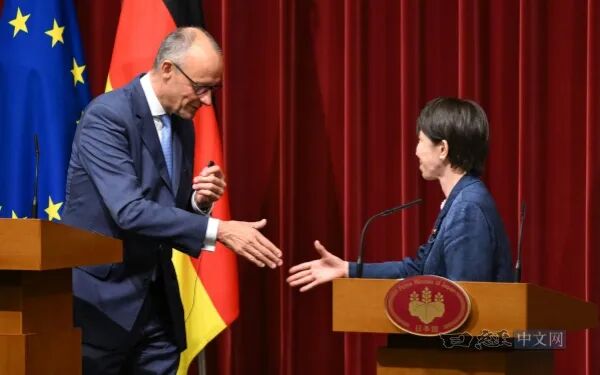
Japanese Prime Minister Sanae Takaichi shakes hands with German Chancellor Merz after their joint press conference following the talks at the Prime Minister's Official Residence on October 28
After the EU's Industrial Acceleration Act was unveiled, Japan has developed a sense of crisis, believing that the act will inevitably impact the automotive industry. The Japanese government and enterprises are stepping up efforts to lobby the governments of Germany, France and other member states, as well as members of the European Parliament...
On October 28, Japanese Prime Minister Sanae Takaichi held talks with German Chancellor Merz, demanding revisions to the European Union (EU) preferential policies for pure electric vehicles (EVs). If the current plan that excludes Japanese-made cars is finally passed, the sales volume of Japanese automakers will inevitably drop sharply. Although this policy affects the strategic layout of Japanese automakers in Europe, it is very difficult to revise the policy.
Japan argues that Japan should also be included in the scope of preferential targets
The European Commission, the executive body of the EU, unveiled the Industrial Acceleration Act (IAA) in March. The act requires automakers to assemble vehicles and produce components within the EU territory in exchange for EV subsidies and public support.
On October 16, Germany and France clearly defined the definition of "within the EU territory", pointing out that in addition to the 27 EU member states, under certain conditions, it also includes "partner countries that participated in the EU single market as of January 1, 2020". The UK is expected to be included in the scope of EU territory, but Japan and South Korea are not mentioned.
After the IAA was unveiled, both the Japanese government and the business community have developed a sense of crisis, believing that the act will inevitably impact the automotive industry. In particular, Toyota's EV sales in Europe (including the UK) exceed 50,000 units, accounting for about 5% of its total sales. Japanese automakers including Toyota have been calling on the Japanese government to include Japan in the scope of application of relevant policies.
During the G7 Summit held in Evian, a city in eastern France in June 2026, Sanae Takaichi held talks with European Commission President von der Leyen, directly expressing concerns that the IAA draft excludes Japanese automobiles.
In May, Japanese Minister of Economy, Trade and Industry Ryozo Akazawa met with the European Commission's Executive Vice President in charge of industrial strategy (French national) in Brussels, demanding that the contents of the act be revised.
Japanese automakers failed to form a united front
However, the pre-lobbying did not work. Except for Toyota, other Japanese automakers have a small sales scale in Europe, and private enterprises have failed to form a united front, which is also a major issue.
This is especially true for France, which insists on pursuing "Made in Europe". Compared with Germany, French automakers such as Renault focus their business on domestic demand within Europe, and France is more inclined to protect local industries within the EU. In the future, in addition to Germany, Japan must also exert corresponding influence on France.
In Europe, there is a convention called "company car". Enterprises provide leased vehicles to employees as benefits in kind, which are counted as part of their salaries. Such vehicles can also enjoy tax incentives and purchase subsidies. This type of vehicle accounts for 60% of the European market and is also the main sales force of Japanese automakers.
Forecasts say more than 90% of the European market will be EVs
Toyota plans to produce EVs at its Czech factory in 2028, but currently it mainly relies on exports from Japan. Forecasts suggest that by the 2030s, more than 90% of new cars in the European market will be EVs.
Yoshihiro Nakata, CEO of Toyota Europe, emphasized: "Toyota is not a 'guest' in Europe, but an important contributor to the European automotive industry."
Japanese automakers have been exporting cars to Europe since the 1960s. As early as 1968, Toyota cooperated with local Portuguese enterprises to start assembling and producing the Corolla. In the 1980s and 1990s, Toyota, Nissan and Honda successively built factories in the UK, while Suzuki set up a factory in Hungary.
Japanese automakers have created a total of about 170,000 jobs in Europe, with more than 50 years of accumulated supply chains and sales networks.
The impact may spread to the entire supply chain cooperation
The cooperation between Japan and Europe is not limited to the automotive field. Japan and the European Union reached a consensus in July 2025 to launch a cooperation framework called the "Japan-EU Competitiveness Alliance".
Based on the Economic Partnership Agreement (EPA) which entered into force in 2019, this framework will jointly promote investment and trade and strengthen supply chains. Both sides believe that it is necessary to act in unison to cope with the US's protectionist tendencies and China's overcapacity and other issues.
On the basis of the consensus reached by Germany and France, the core institutions of the EU will next work to finalize the final plan. In addition to the European Commission, the legislative body the European Parliament and the Council of the European Union composed of member states will also officially start consultations. In this process, there is still the possibility of partial amendments to the act.
The Japanese government and enterprises are stepping up efforts to lobby the governments of Germany, France and other member states, as well as members of the European Parliament. However, Germany and France have a strong say within the EU, and it is extremely difficult to overturn the consensus that the two sides have reached, and the final result remains unclear. Once it is confirmed that Japanese products are excluded, it is very likely to have an impact on Japan-EU cooperation in the supply chain field.
This article is from the WeChat Official Account "Nikkei Chinese Net" (ID: rijingzhongwenwang), the authors are Yusuke Doji, Takashi Tsuji, Ryo Asayama, Takako Gakuto, and it is authorized to be released by 36Kr.