Hype is ruining the frozen baking industry.
A number of frozen bakery specialty stores are attracting consumers with "factory prices" and hundreds of product categories, and drawing franchisees to invest hundreds of thousands of yuan to expand their store footprint from Shanghai all the way to Qinghai.
While back kitchens and on-site bakers are eliminated, the expenses on freezers, distribution and customer acquisition remain considerable. Brands are still exploring proper operation models before they open up franchising opportunities, and supermarkets and street-side bakeries are also joining the competition.
Hype has brought in first-time customers out of curiosity, but it does not necessarily generate the sustained repeat purchases that a specialty store needs to support its operation.
01 Cheap Bread in the Freezer
If it weren't for Lupian Pipi, Panpan, who visits Shanghai Metro City two or three times a month, would never have known that the shopping mall has an eighth floor.
This frozen bakery store is very different from the bakeries she usually frequents. It features a minimalist industrial style with large blank spaces. There is no scent of freshly baked goods, only rows of freezers cooled to minus 18 degrees Celsius, as well as posters displaying products, prices and slogans.
Carrying a hand basket, Panpan picked up the rock-hard frozen pastries, feeling as if she had traveled to the frozen section of a supermarket hypermarket.
She was a little worried about product quality at first, but the price list put her hesitation at rest.
Bagels at 2.9 yuan, frozen bread at 4.9 yuan, and sliced durian mille crepe cake at 9.9 yuan. Thinking that she had already come all the way, she picked out several products that she considered unlikely to be unsatisfactory, and accidentally spent 50 to 60 yuan.
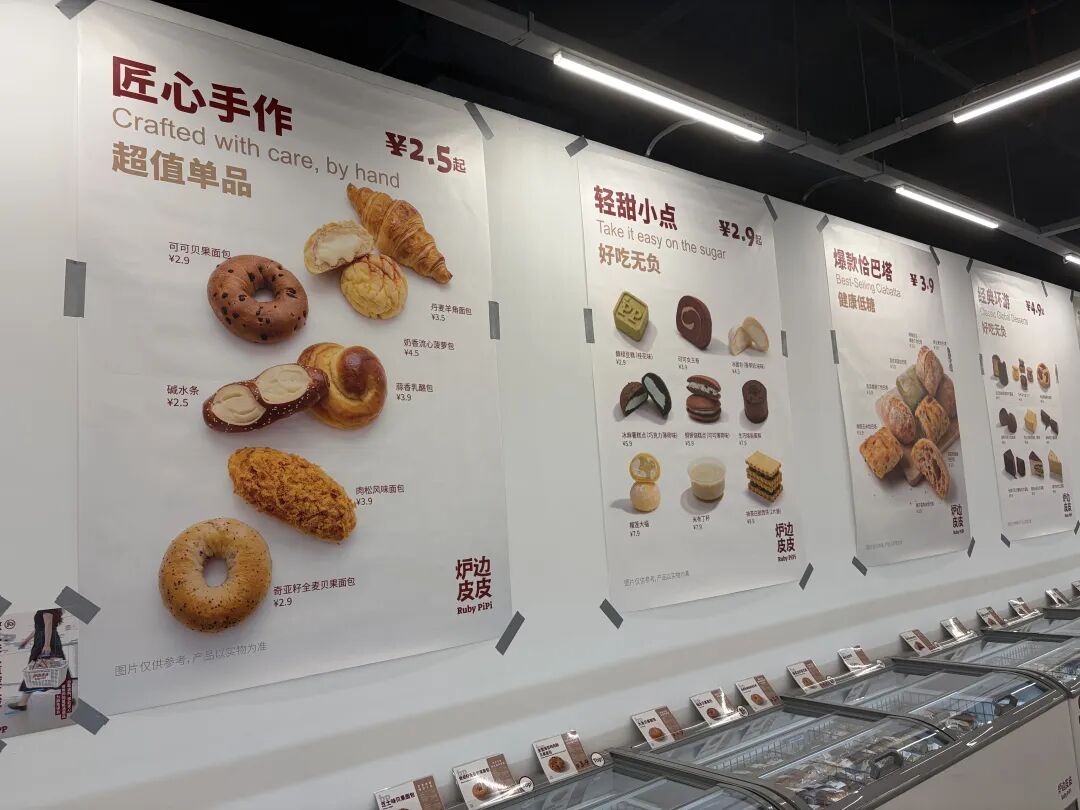
Photo | Poster of Lupian Pipi
The secret behind the price cut is hidden in the freezers in front of Panpan. Products are mass-produced in a standardized way in factories, frozen and then delivered to stores. There is no need to configure back kitchens, professional bakers and complete sets of production equipment in the store. Some frozen products can be stored for 3 to 6 months, which also reduces the pressure of write-offs for unsold goods.
Low prices and massive SKUs are the labels of frozen bakery specialty stores. According to the brand's vision, office workers who are used to eating bread for breakfast, families that make bulk purchases, and bread lovers who like to stock up on different flavors can all become regular customers: they can buy several days of food in advance, put it in the refrigerator, and thaw or reheat it before eating.
However, the bustle in the stores has not yet shown a clear group of rigid-demand customers. Many consumers are first attracted by social media content and advertisements, then persuaded by low prices, and fill a basket of products with a try-it-out mentality.
Lower prices have reduced the purchase threshold, but they may not change people's eating habits. The pastries Panpan bought home were put in the refrigerator, and she almost forgot about them after a week when the holiday came. She said she still prefers bread that can be eaten directly right after purchase.
Different from Panpan, Hu Nan specially cleared half of his refrigerator before going to Lupian Pipi.
Hu Nan usually likes to buy affordable baked goods from Sam's Club and Freshippo, and gradually learned about concepts such as frozen dough and frozen-to-fresh products. In his view, some fresh bakery stores also use frozen dough made in central kitchens, and only complete the final shaping and baking in the stores. He is not willing to pay a premium for these last few steps in the store.
"Sam's Swiss roll is a frozen bakery product, and sometimes there are still ice residues when it is delivered by instant delivery. The shelf life will be shortened after thawing before sale, so it is actually better to buy frozen products directly."
The elevators in the mall are hard to find. He followed the signs and took the freight elevator outside the mall to go upstairs, and the residual paint smell inside made him feel unwell.
After entering the store, the prices did not impress him. "In fact, they are not much cheaper than Aldi and the cost-effective products in Freshippo." He flipped through the production information of ten products at random and found that they came from seven OEMs, including Toly Bread, Moker Food, Weisimei, Maidou Bakery and others.
Hu Nan didn't buy anything in the end, but had a new question: "It is said that suppliers opened stores by themselves, why are all the products made through commissioned processing?"
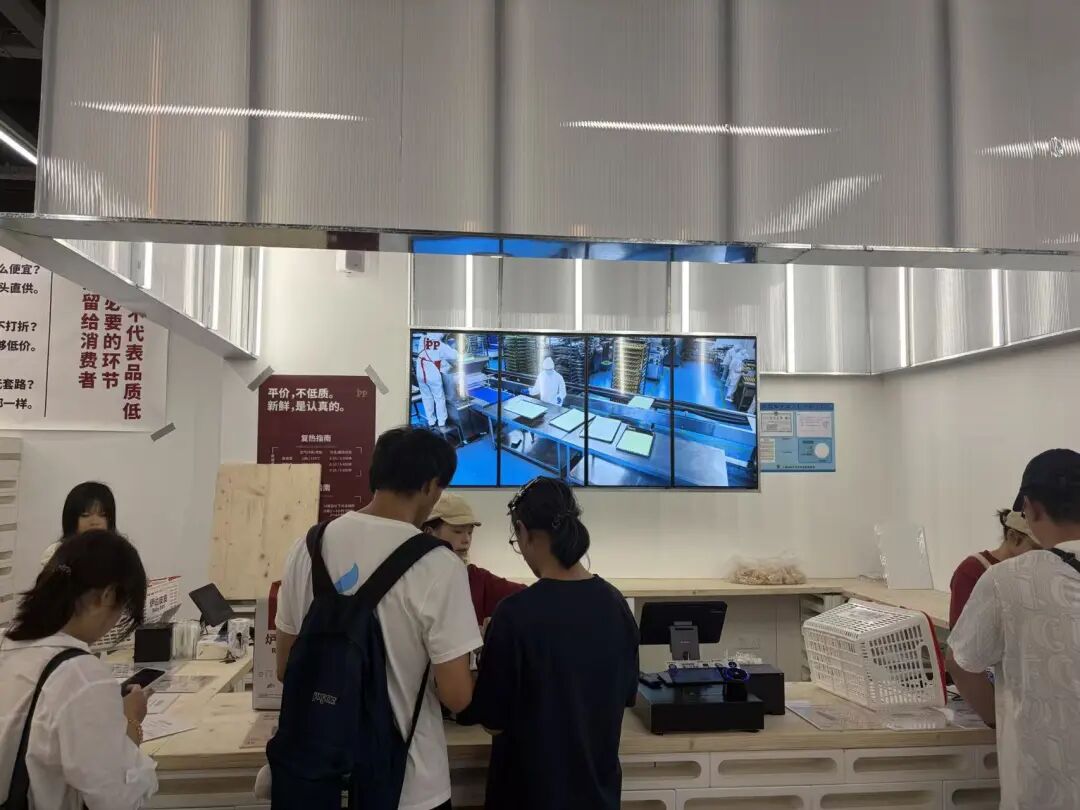
Photo | The screen at the checkout counter is playing footage from a factory, no one knows which one it is
02 The Business Behind "Factory Price"
The first store of Lupian Pipi now has put up the sign of "Laisaibubu".
This store is located next to Pingu Food Factory, which has long supplied frozen bakery products to brands such as Starbucks, 85°C, and FamilyMart. After the name change, Laisaibubu stated in its statement that it "has never carried out brand authorization" and has not opened franchising investment promotion.
Shanghai Langxing Dingsheng continues to operate "Lupian Pipi". This company has previously incubated brands such as Yee 3 No.3 Coconut and Puxialongjiu. The brand manual provided by the investment promotion staff still writes "own factory" and "self-research and self-production".
But according to its introduction, Lupian Pipi no longer cooperates with Pingu Food. The "factory store" understood by consumers now supplies stores through centralized procurement from multiple factories in Shandong, Henan, Shanghai, Jiangsu and other regions.
Good Morning Dongdong also has a multi-brand operation group behind it. Weixin Holdings also owns brands such as Haoxingfu, Nanyang Master Fu, Coconut No.2, and Mama Pu, and has a 6,000-square-meter self-owned factory. In addition to frozen bakery products, Good Morning Dongdong stores also sell some fresh snacks and hand-made original leaf milk tea from Mama Pu.
Good Morning Dongdong and Lupian Pipi are expanding to more cities through franchising.
Good Morning Dongdong opened its first store in Ningbo in September 2025, and now has 7 stores on its mini-program. The first store of Lupian Pipi opened in April 2026. Its mini-program has listed 14 stores, which have entered Zhengzhou, Guiyang and Xining, Qinghai in addition to Shanghai.
The initial investment given by Good Morning Dongdong is about 300,000 yuan, and the estimated store opening investment of Lupian Pipi is 560,000 yuan, excluding store rent, deposit and the first batch of payment for goods. Calculated based on the first batch of purchase of about 130,000 yuan given by the investment promotion staff, the estimated investment and the first batch of payment for goods alone reach 690,000 yuan.
In the words of the investment promotion staff, this is a business that has made a lot of subtractions, and the benefits in the brand manual are also very attractive. A Changzhou store displayed by Good Morning Dongdong has an average turnover of about 500,000 yuan in three months, with an average monthly profit of about 115,000 yuan.
For newly opened franchised stores, whether the sales volume can be replicated remains to be verified, but the expenses that need to be paid continuously have already been placed in front of them.
Franchisees have to pay another sum of cost for "frozen" operation.
Even though ovens are eliminated, the store still has a number of equipment that need to run continuously. The 150-square-meter standard store of Lupian Pipi needs about 15 freezers, and Good Morning Dongdong stores are usually equipped with 18 to 20 freezers. The aforementioned Changzhou model store has a monthly electricity bill of 15,000 yuan, which is the same as the total salary of three employees.
The cost of cold chain transportation is also a considerable expenditure. The goods of Lupian Pipi are uniformly sent to the Shanghai central warehouse, and franchisees usually contact the logistics to pick up the goods and bear the freight by themselves. Good Morning Dongdong provides free shipping: free shipping is available for purchasing about 20,000 yuan of goods in Jiangsu, Zhejiang and Shanghai, 80,000 yuan is required for Nanchang, and an estimated 100,000 to 150,000 yuan is required for Guangdong.
Subsequent restocking is more difficult to arrange. In order to spread the cold chain freight, stores often need to purchase more goods at one time, but hundreds of products will not be sold out at the same time. Best-selling products need more frequent restocking, while other goods may still occupy the freezer, so additional cold storage often needs to be configured.
Ordinary bakeries can seize the impulse consumption of passing customers by relying on the scent of freshly baked goods and attractive displays. Frozen bakery lacks this attraction, and it also needs to cultivate customers' habit of stocking up in advance and reheating at home. All these require continuous marketing investment.
Good Morning Dongdong suggests that franchisees prepare about 50,000 yuan for opening marketing, and then continuously invest 3% of the turnover every month. The headquarters provides plans, and franchisees cooperate in implementation. The investment promotion staff repeatedly emphasized that they cannot just wait for business to come after opening the store.
03 Can Cheap Bread Support a Whole Store?
The Foshan store of Good Morning Dongdong had a turnover of more than 40,000 yuan on the opening day, but it has been closed now.
The staff in charge of investment promotion said that this store was opened next to a wet market, and its performance was good in the first month, but the bustle did not last. "There will be customers if you put in advertising, and no customers if you don't."
He attributed the problem to site selection first: although there are residents around, the location of the store lacks natural passenger flow, and there is no continuous drainage afterwards. The franchisee then transferred the employees to other stores, leaving only one person to look after the store, and the operation fell into a vicious circle. The brand side, which once participated in the investment, finally decided to close the store and readjust the site selection standards.
The Foshan store was once regarded as an example of the community model. Some analysis believes that frozen bakery encourages stocking, and there is no need to open in prime locations with dense flow of people. Locations such as community streets and industrial parks are also suitable, and this store was cited as an example.
But now, the investment promotion staff of both Good Morning Dongdong and Lupian Pipi suggest giving priority to shopping malls. The investment promotion staff of Lupian Pipi even said bluntly that the flow of people in the community is difficult to support the normal operation of their stores.
What the store needs is a group of customers who have developed the habit of consuming frozen bakery and come back to restock regularly. High-potential shopping malls can gather these consumers from a wider range. If it is located in a community, relying only on the surrounding passenger flow, it may not be able to gather enough customers.
Finding these customers does not mean being able to retain them.
Factory production, long shelf life and cold chain distribution constitute the cost and storage advantages of frozen bakery, but these capabilities do not exclusively belong to a certain brand. The mature supply chain has lowered the threshold for opening specialty stores, and also made it easier for similar competitors to emerge.
Rows of freezers, hundreds of bread and pastries, single-digit prices and stocking promotion have become the common labels of such stores. When products and shopping experiences become more and more similar, competition will easily turn into price wars and marketing wars.
Opening stores in advance and occupying business districts has become a path for brands to gain advantages, which also pushes them to rush to open up franchising before the model is polished and mature. The investment promotion staff of Good Morning Dongdong confessed that all brands have "flocked into the market" since May this year, but the market is "definitely not particularly mature, because it has just started".
And the customers that specialty stores are fighting for have more places to buy frozen bakery products.
Apple Garden, a long-established local bakery brand in Shanghai, has added freezers next to the original fresh-baked and normal-temperature bread shelves in some of its stores, and has started selling frozen bakery products. Laikaer also cooperates with Aldi, and its frozen bakery products have entered Aldi's special sale. Guoquan, which has more than 10,000 stores, has also launched more than 30 frozen bakery products.
Traditional bakeries, supermarkets and community grocery stores can all select popular frozen bakery items and add them to their original shelves. Customers can take a few pieces away by the way when buying vegetables and daily necessities. If the products don't sell well, they can also adjust the product selection.
Specialty stores, however, turn a single category into a whole store. It not only needs to arrange freezers, inventory and restocking for hundreds of products, but also find enough customers who are willing to come to buy regularly. Rich product selection can attract customers, but if only a few kinds of bread are bought repeatedly in daily life, a small area of shelves in the nearby supermarket may meet the demand.
Relying on low prices and rich product selection, frozen bakery specialty stores are still far from becoming a good business. The production process is simplified, but the operation does not become easier accordingly; the supply chain allows it to sell at low prices, and also makes it easy for competitors to enter; marketing can bring first-time customers, but cannot guarantee sustained repeat purchases. Even if stocking and reheating become habits, consumers have closer and cheaper channels to choose from.
The frozen bakery market can grow bigger and bigger, but it may not be worth opening a separate store for it.
This article is from WeChat Official Account "Zhenggu Research Lab" (ID: zhengulab), written by Lu Jianguo, edited by Zhang Duo, and released with authorization from 36Kr.