With the user growth standing at only 0.4%, why can the esports market still exceed 200 billion yuan?
Abstract
In 2025, the number of esports users in China reached approximately 513 million, representing a 0.4% year-on-year increase. Over the same period, the esports market size hit 1.96 trillion yuan, up 9.5% year-on-year, and is expected to exceed 2 trillion yuan in 2026. While user growth is gradually slowing down, the market scale continues to expand. With the innovation of esports game categories, the extension of the tournament system to more cities, and the continuous enrichment of the commercial ecosystem covering live streaming, events and derivative sectors, China's esports industry is stepping into a new stage that shifts from user scale expansion to industrial value enhancement.
China's esports market is currently presenting two distinct growth rates.
In 2025, the number of esports users in China stood at around 513 million, with a year-on-year growth of only 0.4%, and the user penetration rate has reached a relatively high level. Meanwhile, the esports market size reached 1.96 trillion yuan, up 9.5% year-on-year, with the growth rate rebounding from the previous year, and it is projected to surpass 2 trillion yuan in 2026.
On one hand, the user scale is stabilizing, on the other hand, the market volume is still expanding. When the growth of user scale gradually slows down, what remaining development space is there for China's esports industry?
From the innovation of game categories to the expansion of the tournament system, and then to the continuous enrichment of the commercial ecosystem, iResearch's 2026 China Esports Industry Research Report provides a new perspective for observing the growth logic of the esports industry.
User Growth Slows Down While Market Scale Continues to Expand
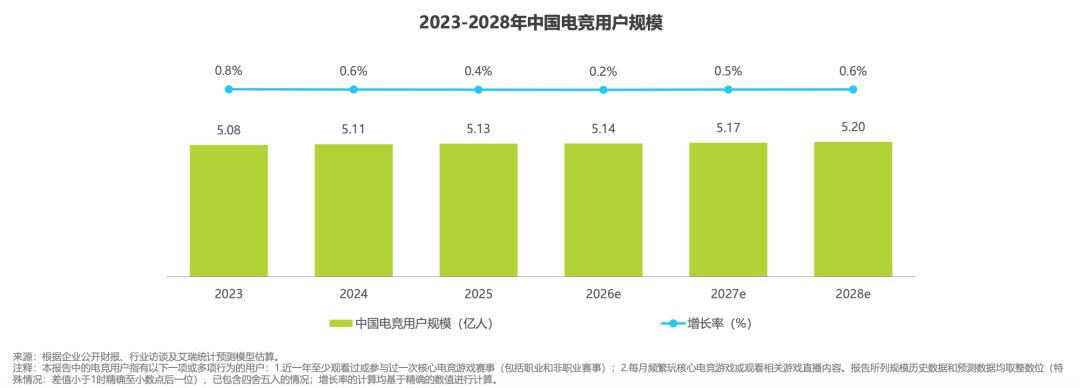
Over the past few years, the scale of esports users in China has gradually entered a stage of steady growth. From 2023 to 2025, the number of esports users increased from 508 million to 513 million, with the growth rate dropping from 0.8% to 0.4%. It is estimated that by 2028, the number of esports users in China will reach approximately 520 million, maintaining a low growth rate in the coming years.
In contrast, the esports market size maintains a more noticeable growth momentum. In 2025, the industry's growth rate rebounded compared with the previous year. The market size is expected to reach 209.6 billion yuan in 2026, and further grow to 231 billion yuan in 2028.
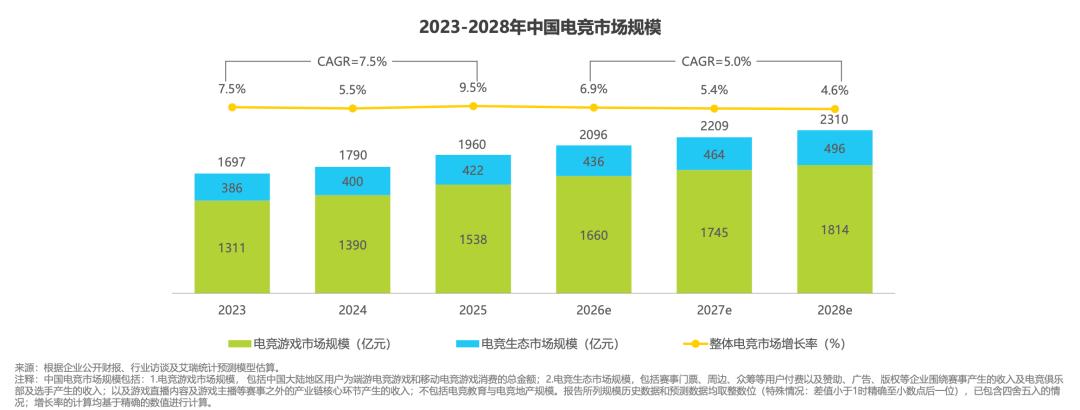
With the growth of user scale slowing down and the market size continuing to expand, the development focus of the esports industry is gradually shifting to in-depth development and value enhancement of the existing market.
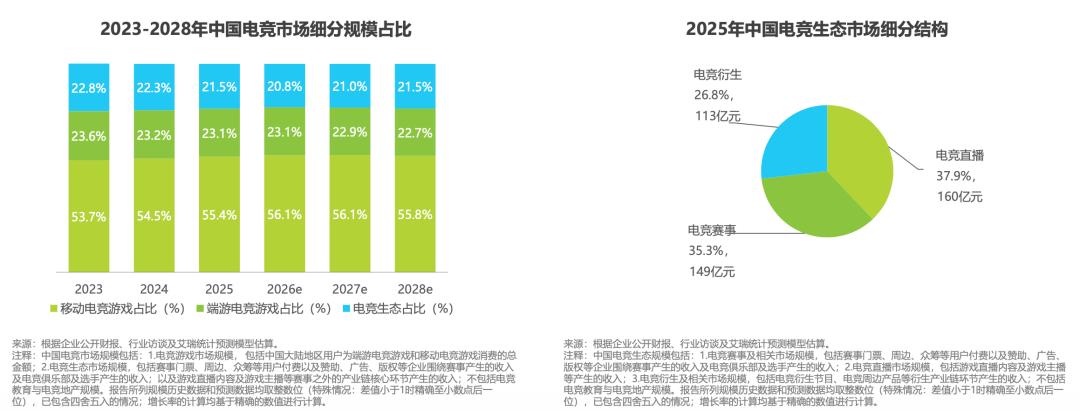
From the perspective of market structure, esports games remain the core foundation of the industry. In 2025, mobile esports games account for 55.4% of the overall market, while PC esports games account for 23.1%, and the two together support the main revenue of the esports industry.
On this basis, the esports industry has also formed a commercial ecosystem covering events, live streaming, derivatives and other businesses. As the user scale gradually stabilizes, the importance of product innovation, event operation and commercial ecosystem construction in industrial development has been further highlighted.
New Categories and New Tournaments Broaden Industrial Space
Continuous innovation of game categories is one of the important directions for the esports industry to expand its future growth space.
Shooter esports has long been an important track in China's esports market. From traditional tactical shooters, battle royales to hero shooters, different gameplay modes have continuously enriched the supply of esports products. In recent years, the "search-fight-exit" category represented by products such as *Delta Action* and *Arena Breakout* has further expanded the competitive forms of shooter esports.
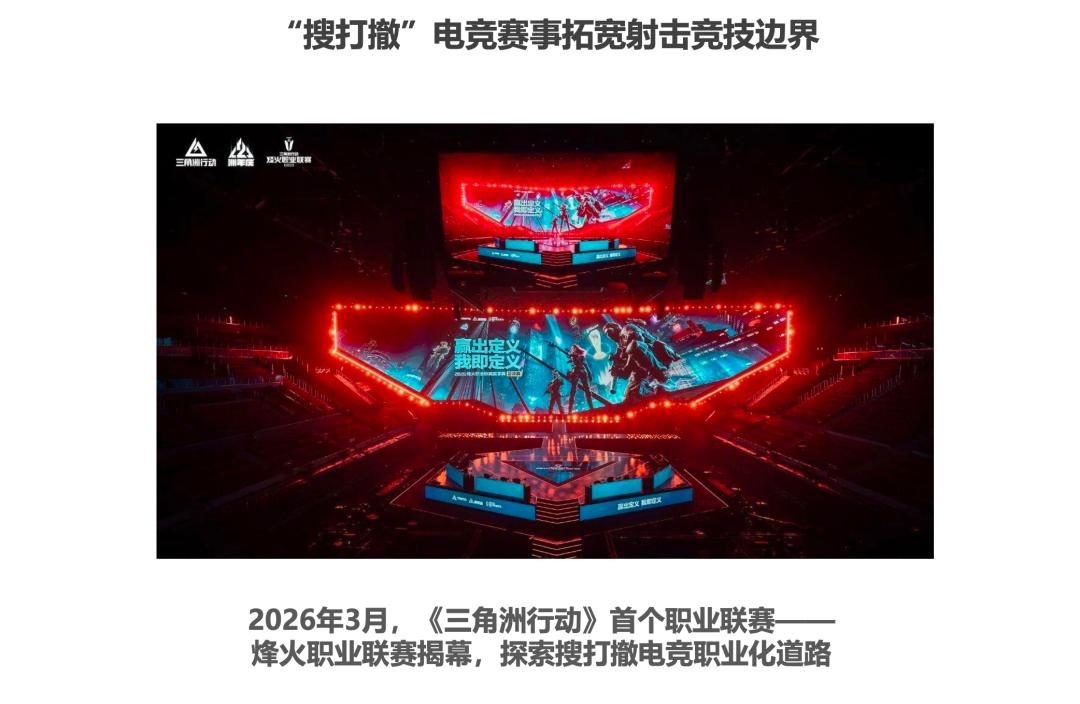
In March 2026, the first professional league of *Delta Action* — the Fenghuo Professional League kicked off, marking that this emerging category has started to build a professional tournament system. The innovation of game categories enriches the supply of esports products, and also provides new development space for event content and related commercial activities. As emerging gameplay enters the stage of professional development, the content forms of esports events are further enriched, and the development foundation of the industry continues to expand.
At the same time, esports events are extending to more cities. Since 2026, provincial-level city events represented by Jiangsu Provincial City Esports League "Esports Su Chao" and Guangdong Esports Super League "Esports Yue Chao" have been launched one after another. Compared with top professional events, such events take cities as the participating subjects, combine regional culture and urban identity with esports competitions, and bring new participation scenarios to the esports industry.
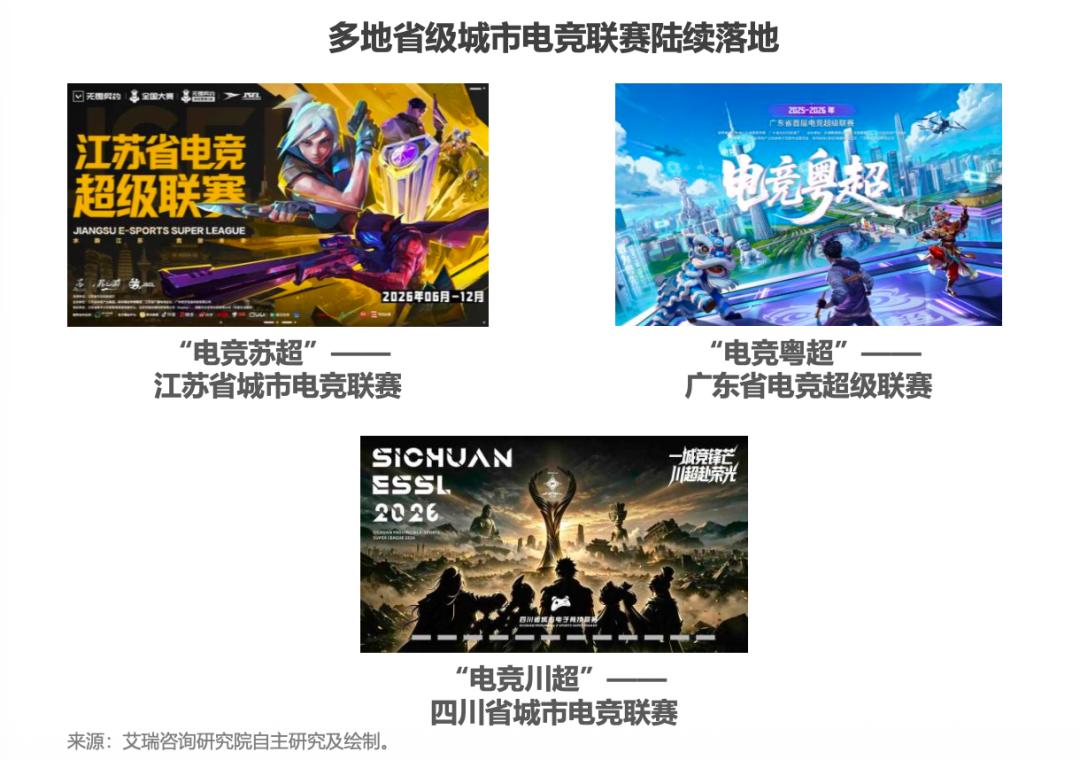
On the one hand, provincial-level city leagues help fill the hierarchical gap between top professional events and mass events, and improve the esports talent training and tournament system. On the other hand, the integration of events with local cultural tourism, venues, retail and other formats also provides a new carrier for regional consumption and urban culture dissemination.
The professional development of emerging game categories enriches the content supply of esports events; the rise of provincial-level city leagues promotes the extension of events to more cities and mass groups. The simultaneous expansion of content and coverage is driving the esports tournament system to develop in a more diversified direction, and also creating new development space for the industry.
Diversified Commercial Ecosystem Drives Value Extension
The continuous enrichment of game categories and tournament systems also provides broader development space for the diversified commercialization of the esports industry.
In 2025, the scale of China's esports ecosystem market reached 42.2 billion yuan, forming a pattern of joint development of three major sectors: esports live streaming, esports events and esports derivatives. Among them, the scale of the esports live streaming market is about 16 billion yuan, accounting for 37.9% of the esports ecosystem market; the scale of the esports event market is about 14.9 billion yuan, accounting for 35.3%; the scale of the esports derivative market is about 11.3 billion yuan, accounting for 26.8%.
This structure shows that around esports games and event content, the industry has formed a diversified commercial system covering content dissemination, event operation and derivative consumption.
Esports live streaming forms dissemination and commercialization channels relying on games and event content, esports events generate revenue through tickets, sponsorship, advertising and copyright, and businesses such as esports peripherals and derivative programs further expand the consumption scenarios of event and game IPs.
At the same time, the development of AI technology also provides a new path for improving the operational efficiency of the esports industry. In the event operation link, technologies such as intelligent directing, real-time tactical data visualization and automatic highlight clip generation help improve the efficiency of event production and dissemination; in the content production link, applications such as intelligent editing, multi-language automatic dubbing and translation, and marketing content generation provide a new technical path for reducing production costs and enriching content supply.
From event operation to content dissemination, and then to derivative consumption, the commercial value of the esports industry is extending to more links. Games are still the main source of revenue for the market, while the development of a diversified commercial ecosystem provides new space for the further release of industrial value.
Conclusion
The slowdown in user growth is pushing China's esports industry to pay more attention to the in-depth development of the existing market. Game category innovation, improvement of the tournament system and expansion of the commercial ecosystem together form an important path for the industry to shift from scale expansion to value enhancement.
In the future, with the continuous advancement of sports-oriented and mass-oriented development, the accelerated globalization of domestic esports IPs, and the deepening of the "esports +" integration model, China's esports industry is expected to further expand its commercial value and social value.
This article is from the WeChat official account "iResearch" (ID: iresearch-), author: iResearch, published by 36Kr with authorization.