Pica loves Walmart to death.
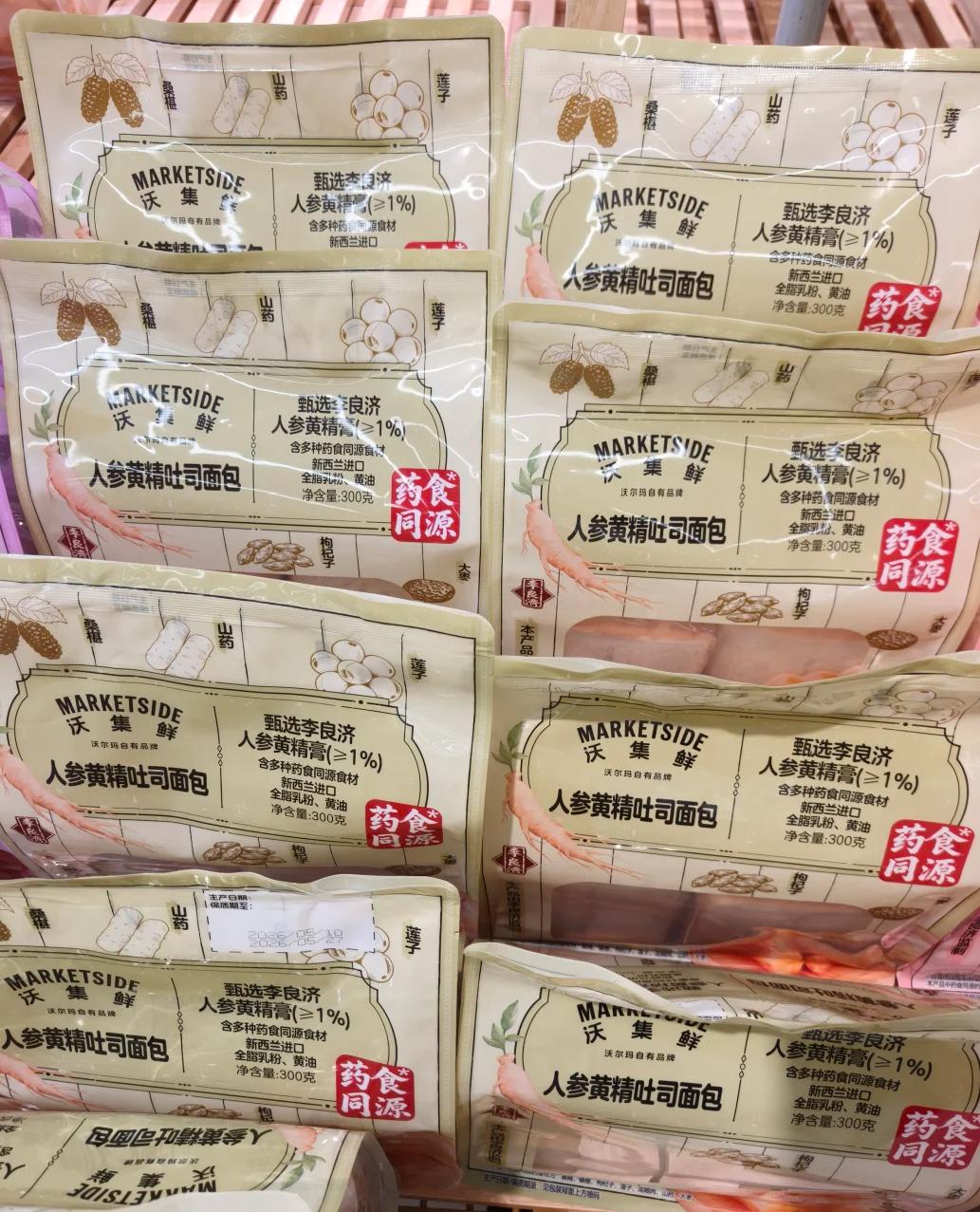
The first time I saw the "Ginseng and Polygonatum Toast" on the Walmart shelf, the first thought that popped into my mind was: Did the R&D department get into a fight with the purchasing department, and the loser was tasked with moving the traditional Chinese medicine pharmacy into the snack aisle?
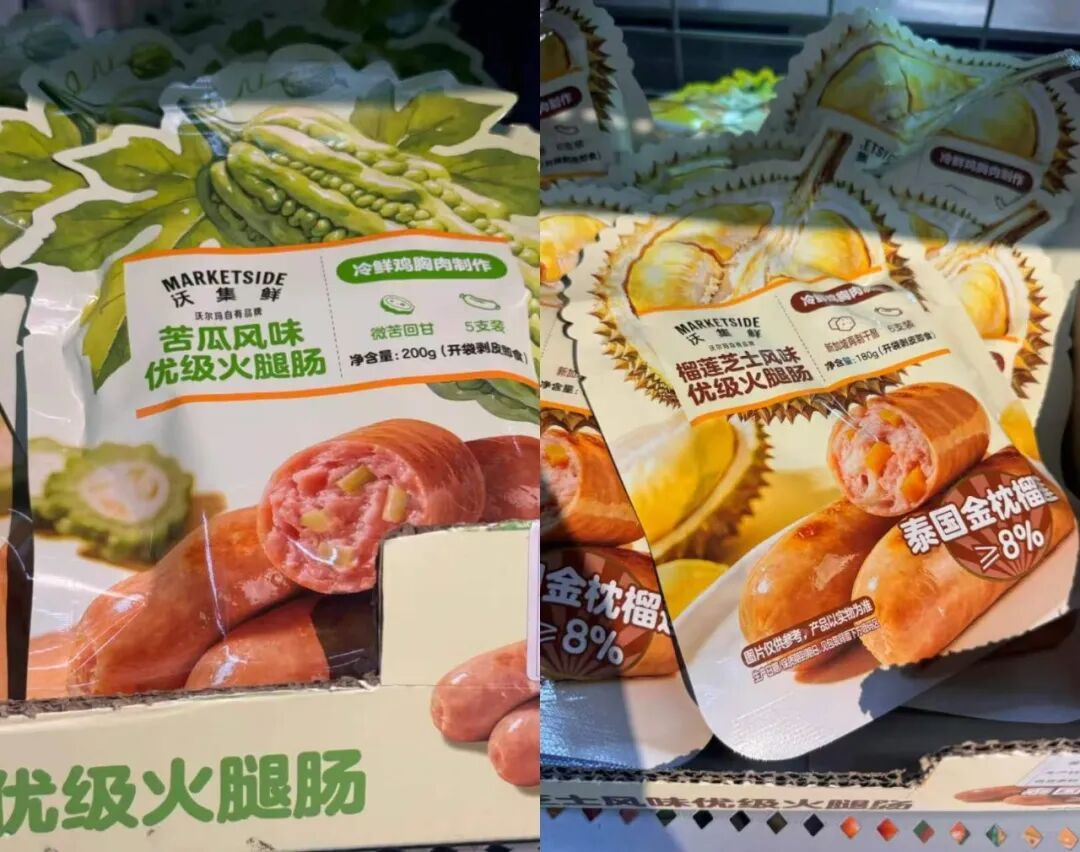
Next to it lay bitter melon flavored ham sausage and pineapple flavored ham sausage, looking like a pair of bickering twins. A few steps further, grape flavored dried noodles and grape flavored cold noodles hung side by side, while black pork and Isatis root pies lay quietly in the freezer. My expression kept switching back and forth between "Did I see that wrong?" and "Since I'm already here, might as well check it out".
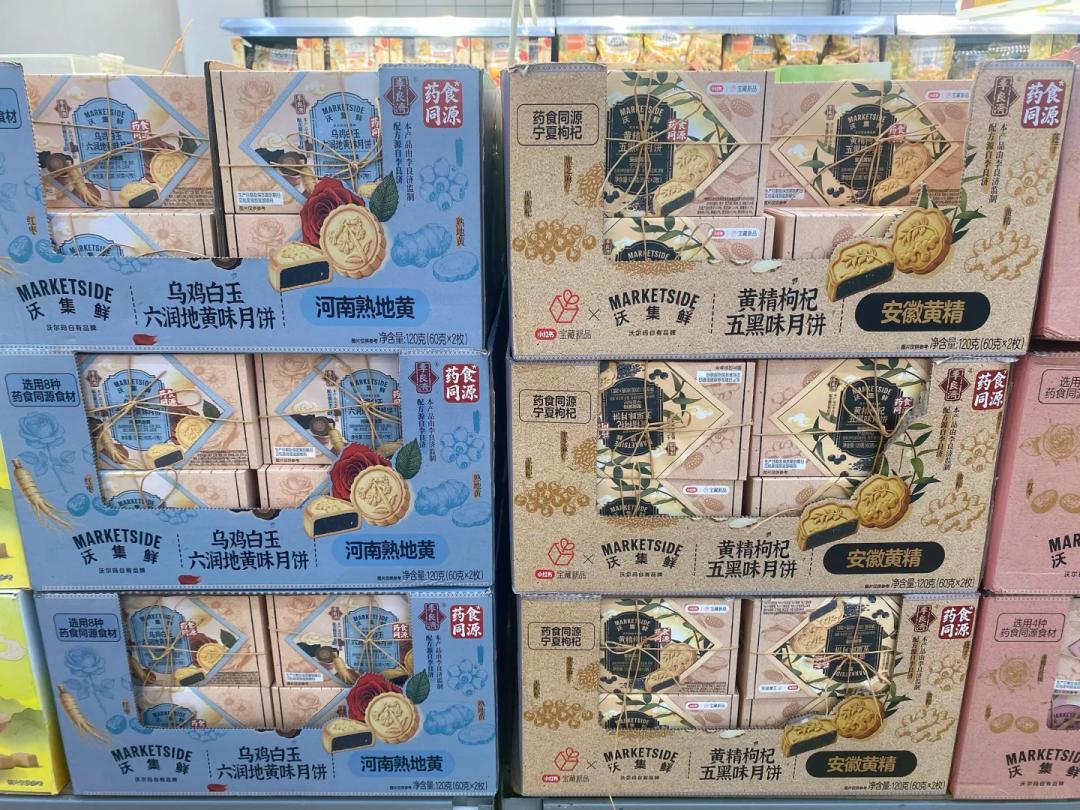
What left me most speechless was the mooncake section. There were flavors like Black-bone Chicken White Mushroom Six-nourishing Rehmannia, Polygonatum and Wolfberry Five-Black, and American Ginseng Yuling Paste. After reading the names once, I felt my throat was already starting to produce a sweet aftertaste automatically.
But let's be real, the #GreatValue hashtag on Douyin has reached 7 billion views, with over 30,000 participants. Some people complain that "Reading the product names once can prevent Alzheimer's disease", while others honestly admit "I'm exactly the target audience for these weird items". Most likely, the people who criticize these products and the people who buy them are the same group.
The great Picasso never said that "Good retailers copy, but geniuses go straight for absolute absurdity!"
If you only look at the surface of this matter, it really looks like a performance art piece in the retail industry. But if you cross-reference financial reports, personnel arrangements and organizational structures, you will find that the weird flavors are responsible for drawing people in, the food-medicine homology concept makes people pay, and what is actually being broken down and restructured is the increasingly difficult traffic business of large hypermarkets.
01 Weird Flavors Are Hooks, Not Menus
The pricing of these weird flavored products itself hints at their real purpose. Most of the new single-serve products are priced between 5 and 10 yuan. A pack of Gastrodia elata stewed pigeon flavored potato chips won't make you lose money or get scammed, but it's enough to make you stop in front of the shelf, take a photo, send it to a group chat, and caption it with "Walmart has gone crazy again".
Xiao Han, who works in the retail industry, told Super Focus that these products do not necessarily have high sales volume individually. Their core value is not to sell goods, but to attract foot traffic. Discount stores, bulk snack stores and instant retail platforms have gradually siphoned off customers who used to "drop by Walmart for a casual visit", so hypermarkets need a reason for people to "make a special trip there".
Novelty-seeking new products are exactly that reason. Even if you don't buy anything, you will open the app or detour into the store out of curiosity to take a look, and that glance increases the probability that you will pick up other items on a whim.
For the aforementioned traditional Chinese medicine mooncakes, some people have done special taste tests and shared their reviews: The black-bone chicken and white mushroom flavor has a distinct angelica smell, and the sweet lotus seed paste flavor does not match well with the angelica flavor; some people said the Six-nourishing Rehmannia flavor tastes terrible, but it turns out this one barely has any medicinal taste, it's just a sweet lotus seed paste mooncake; in addition to the basic lotus seed paste flavor, the Polygonatum and Wolfberry one has a faint fatty aroma that is a bit like chocolate and a bit like sesame; the Five-Red Ganoderma filling contains red beans and white kidney beans, with a faint milky aftertaste.
I thought you were pranking me, but it turns out you didn't prank me — isn't that pranking me anyway?
Some people sigh that Walmart's product team has become so creative in naming products that they have lost all sense of normality. They suggest that you bring your kids to GreatValue to hang out from time to time, read these extra-long product names, and promote the Nth development of their brains.
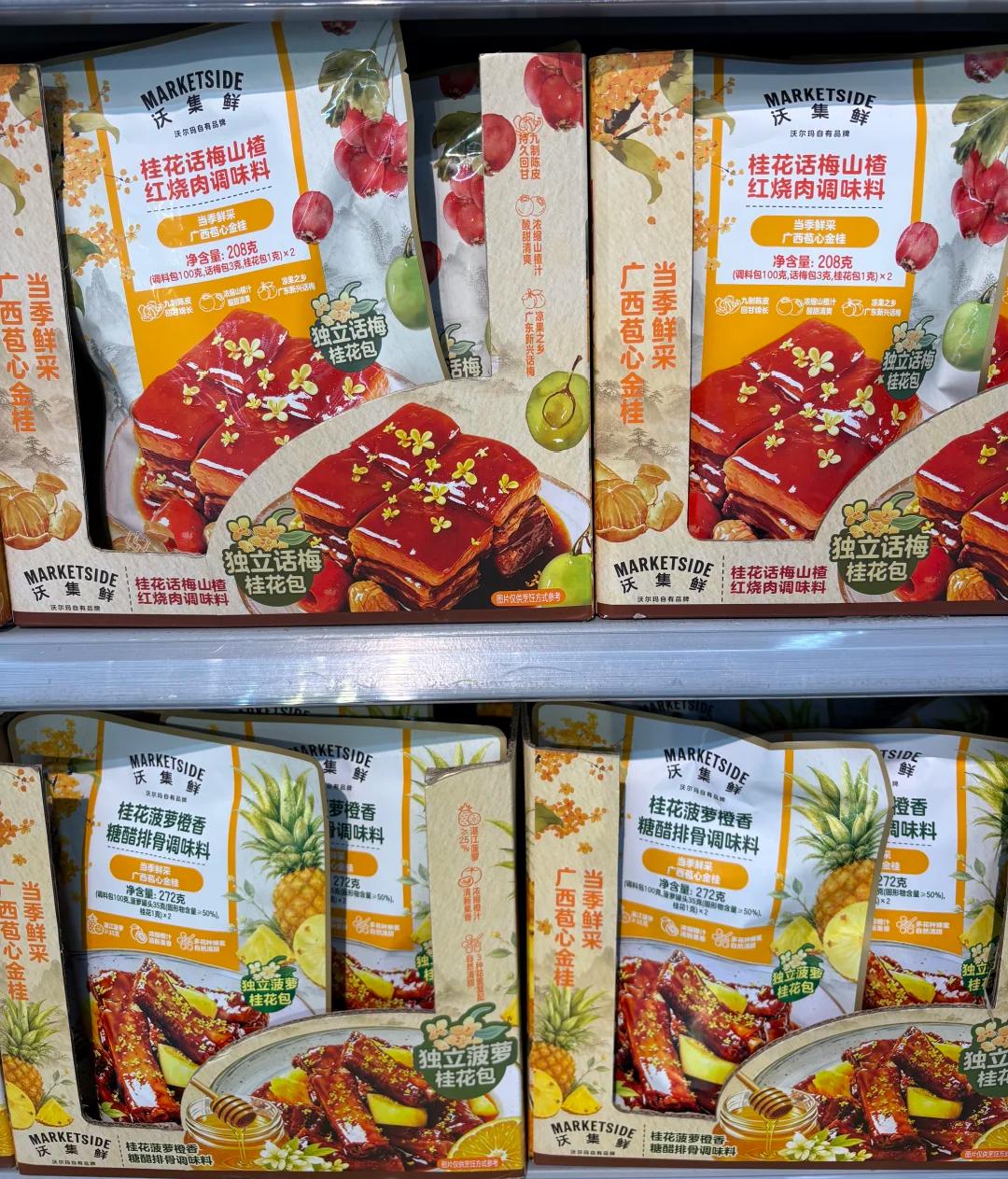
Zhao Zhao from Beijing said he was tricked by these fancy product names, bought several snacks that didn't taste very good, but still wants to try new products when he sees them online. "To put it nicely, I have a spirit of adventure; to put it bluntly, I definitely have some kind of pica."
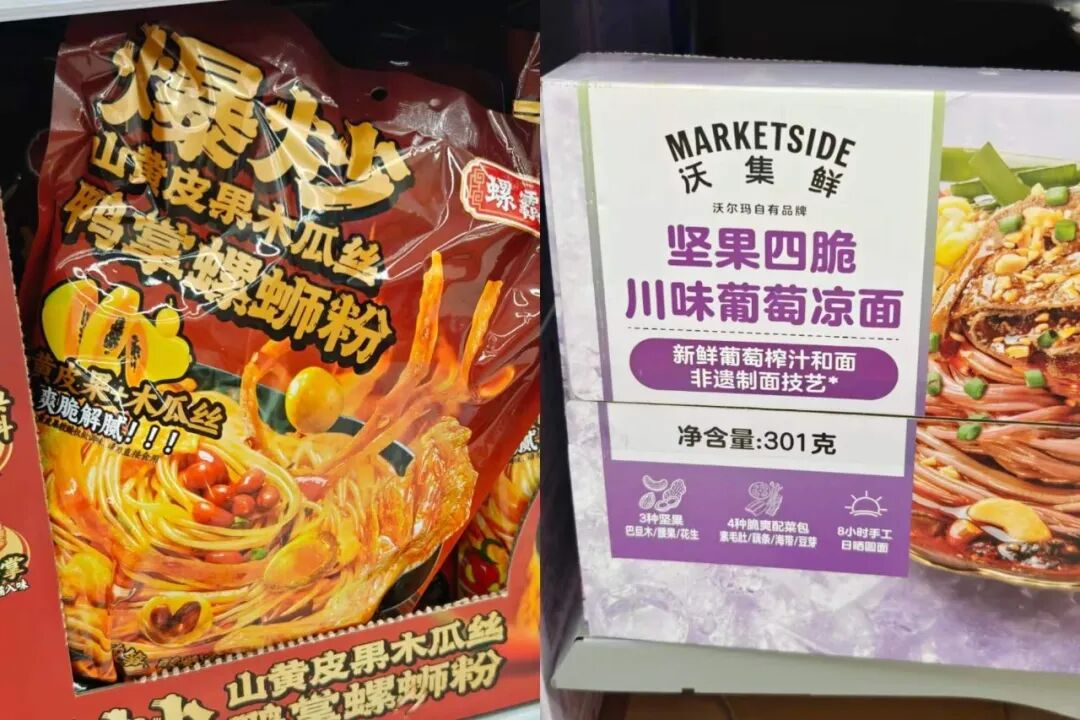
The R&D and trial-and-error cost of a pack of weird flavored potato chips is almost negligible in Walmart's procurement budget; but the social spread and store visit frequency it brings, if converted into advertising investment, would cost far more. What's more, negative reviews themselves are traffic. Evaluations like "Bitter melon and pineapple ham sausage tastes like vomit" have a transmission efficiency several orders of magnitude higher than normal positive product recommendations.
The food-medicine homology series follows a different logic. It's not just about novelty-seeking, it's a category bet with clear track judgment. In 2025, the domestic food-medicine homology end market size exceeded 370 billion yuan, and the total industry chain valuation exceeded 2 trillion yuan. According to the forecast from the China Research and Industrialization Development Institute, the core market size is expected to reach 450 billion yuan in 2026.
GreatValue has cooperated with time-honored brands such as Li Liangji, and developed formulas based on classic ancient prescriptions including Sishen Dampness-removing Formula, Ginseng and Astragalus Formula, and Ejiao Five-Red Formula, establishing a dual quality control system. Its raw materials are sourced from producing regions such as Changbai Mountain for ginseng, Dingxi in Gansu for astragalus, and Deqing in Zhejiang for Dendrobium officinale, covering over 100 SKUs across drinks, baked goods, snacks and dairy products.
Mooncakes are the "pilot" of this strategy. GreatValue stuffed astragalus, angelica, poria, polygonatum, ganoderma, American ginseng and prepared rehmannia root into the fillings, and placed the two categories of low-sugar and food-medicine homology products directly on the core display positions. Market feedback is divided: some people think it's "novel but not jarring", while others regret taking a single bite.
But the division itself shows that it hits real demand. Consumers around the age of 35 have started checking ingredient lists, wanting the psychological comfort of health preservation, but not willing to go back to the experience of traditional tonics that "take two hours to boil and make you frown when you take a sip".
Weird flavored snacks and food-medicine homology mooncakes, on the surface two different products, are actually putting the six characters of "Walmart private brand" into the information flow of young people at an extremely low decision-making cost.
Novel flavors are responsible for creating topics, food-medicine homology undertakes the "ingredient list anxiety" and health preservation budget. The two lines run in parallel, one for user acquisition, the other for repurchase.
02 The Chinese Medicine Pharmacy on the Shelf, the Second Growth Engine in Financial Reports
GreatValue being pushed to the forefront is actually a long-prepared "conspiracy" by Walmart China.
Walmart China's net sales in the first quarter of fiscal 2027 reached 8 billion US dollars, a year-on-year increase of 22.3%. Among them, Sam's Club contributed over 80% of China's revenue in fiscal 2026, with omni-channel sales exceeding 140 billion yuan; while the hypermarket and community store business that serves mass consumers has long hovered around 30 billion yuan in annual sales.
On one side Sam's is advancing rapidly, on the other side the hypermarket business is losing momentum. Walmart needs a second growth engine, and GreatValue is exactly that engine. Private brands have stronger differentiation, higher gross profit margins, and cannot be easily copied by competitors.
In the transformed traditional hypermarkets, GreatValue accounts for about 1/8 of total SKUs, but its sales proportion has reached around 40%; in the community store format, GreatValue's sales proportion exceeds 60%. With less than 1000 SKUs, it drives 40% of total sales, and the output efficiency per SKU is far higher than that of well-known brands on the shelf with paper-thin gross margins.
The supply chain is the underlying support for GreatValue to operate smoothly. Instead of looking for OEMs all over the world from scratch, it systematically "deploys" Sam's already repeatedly verified top supplier system. The same OEM for hawthorn strips, similar mineral water sources, overlapping dairy partners serve both brands at the same time.
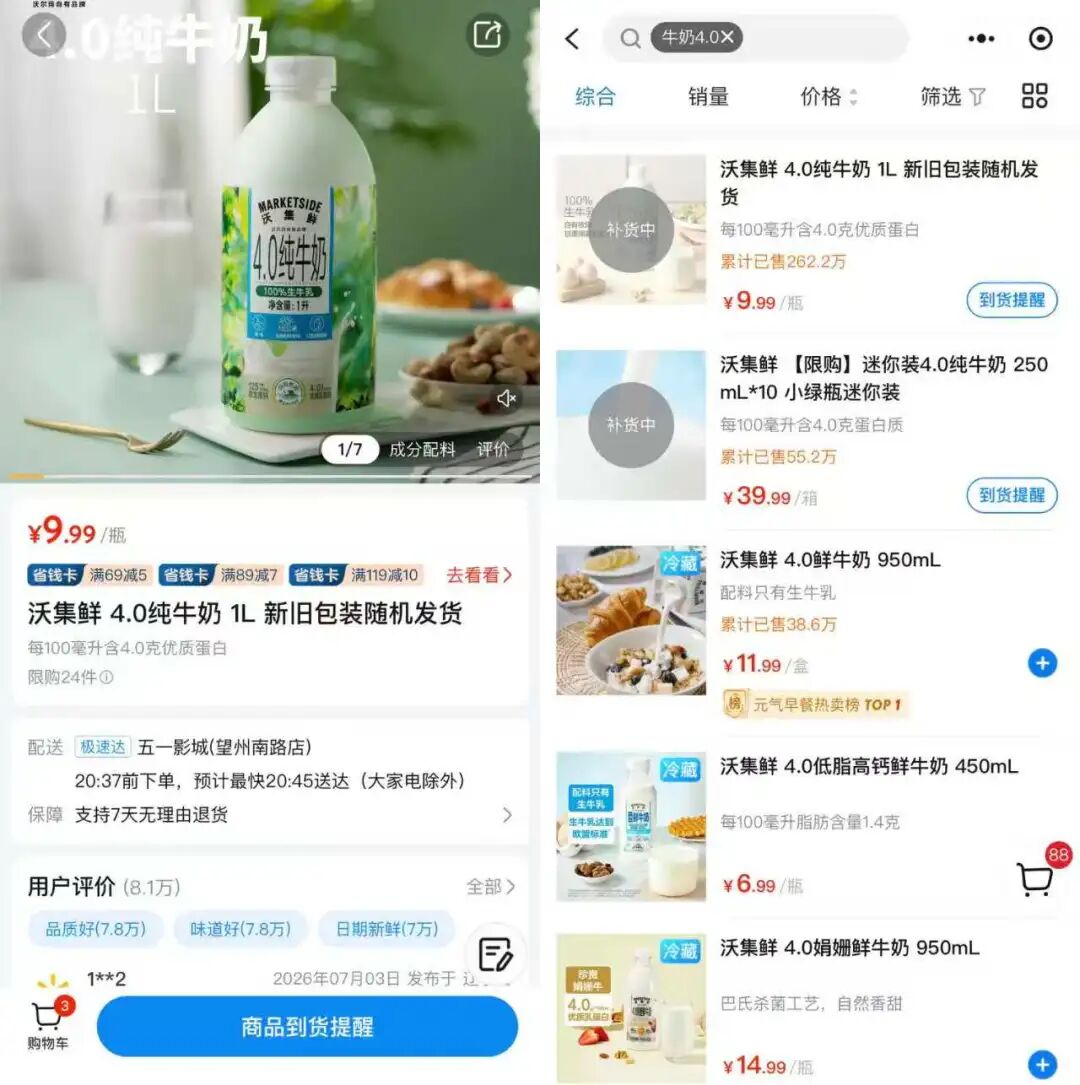
The quality perception that Sam's Club filters out through large packaging and membership fees is translated by GreatValue into a daily version with small packaging, zero threshold and 9.99 yuan price range. The fact that the small green bottle 4.0 pure milk is limited to 10 bottles per purchase on the app and resellers mark up its price proves that this strategy of "downward compatibility of quality" is valid.
But the reason why GreatValue suddenly became so bold after 2025 is related to one person and one organizational restructuring.
In June 2026, Zhang Qing, Chief Merchandising Officer of Sam's China, left his post, and Walmart China changed its core management for the third time in less than a year and a half. In the same round of adjustment, Zhu Jun, President of Walmart Store Format, expanded his scope of responsibilities, and his other identity is Walmart Format Chief Merchandising Officer, who is directly in charge of the GreatValue project.
Walmart merged the category procurement function and private brand procurement function. Procurement staff are no longer just "ordering buyers", if the private brands do not sell well, their performance will be directly affected. In other words, GreatValue is no longer a marginalized "R&D interest group" next to the procurement department, it has been included in the core KPI system.
With organizational support, GreatValue's product selection has a clear sense of direction. One line is to reuse Sam's supply chain assets: GreatValue uses a large number of OEMs that share the supplier system with Sam's, including Qiaqia, Jinmailang, Qianhe Condiment and other brands, with the same factory but different labels, different specifications, and different target customer groups. The quality foundation verified by Sam's is split by GreatValue into small-packaged, low-threshold daily supplies, which are placed in hypermarkets and community stores.
Of course, this strategy does not come without a price. New novelty products are launched quickly, which narrows the quality control window; with a wide range of OEMs, the management radius becomes longer.
More direct pressure comes from outside the shelves. Aldi's private brand proportion exceeds 90%, the number of Hema's "Super Hema Great Value" stores has exceeded 600, and Meituan Elephant Supermarket and instant retail continue to split the in-home consumption scenario. Only about a quarter of GreatValue stores have completed the transformation so far. The deeper the transformation goes, the higher the difficulty of refined supply chain matching, and the marginal benefit of Sam's and GreatValue sharing the supply chain will be gradually diluted.
GreatValue does not expect a small number of "pica" customers to support its operation. It uses a few packs of weird flavored potato chips to open the door, uses the food-medicine homology concept to raise the average transaction value, and uses the gross profit structure of private brands to revitalize the 30-billion-yuan hypermarket and community store business.
What Walmart really wants is those ordinary people with "normal taste", who one day detour into the Walmart store they haven't visited specially for years, just to take a look at "what weird new stuff they've launched".
This article is from the WeChat official account "Super Focus foci", written by Fang Wensan, authorized for release by 36Kr.