How can each medicine-food homologous product leverage its first batch of early adopter seed users?
In 2025, the terminal market size of the homology of medicine and food in China exceeded 3.7 trillion yuan, the valuation of the entire industrial chain exceeded 2 trillion yuan, and the annual growth rate of the industry remained stably above 30%. It is expected that the market size will exceed 450 billion yuan in 2026, with a year-on-year growth rate remaining above 21%.
The annual sales of products related to the homology of medicine and food on mainstream e-commerce platforms reached 1266.3 billion yuan, a year-on-year increase of 28.9%. Generation Z and the post-90s generation have become the main consumer force, accounting for more than 60%.
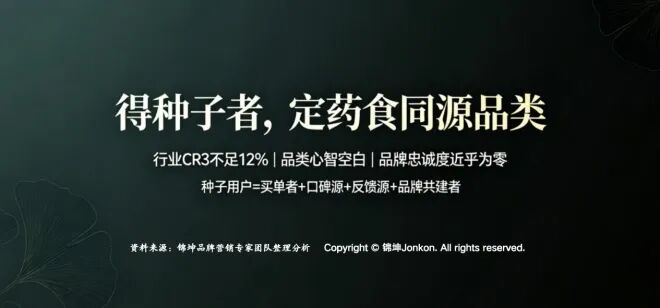
However, the prosperity of figures conceals a cruel reality: the CR3 of the medicine-food homology industry is only 11.24%, CR5 is about 14%, and CR10 is less than 20%.
This means that the market concentration of leading enterprises in the industry is extremely low, no brand has built consumer mental monopoly, and brand loyalty is almost zero.
As industry observers pointed out: "Chinese people spend hundreds of billions of yuan on medicine-food homology products every year, but when asked 'which brand to buy', most people's answer is — 'goji berries are fine, I don't really care about the brand'."
What is more noteworthy is that in August 2025, the National Health Commission of the People's Republic of China and the State Administration for Market Regulation jointly issued the new version of the Catalogue of Substances That Are Traditionally Both Food and Chinese Medicinal Materials, which officially expanded the number of medicine-food homologous substances to 106, adding classic medicinal materials such as Rehmanniae Radix, Ophiopogonis Radix, Asparagi Radix, and Exocarpium Citri Grandis.
The continuous expansion of the raw material library means that the possibility of product innovation is growing exponentially, and the industry is entering the standardized dividend period from "unregulated growth".
In this trillion-level track "with categories but no brands", every new brand and every new product faces the same dilemma of cold start:
How to find the first batch of "crab customers" (seed users) who are willing to try, share and make repeat purchases?
Crab customers and seed users are the lifeline for medicine-food homology brands to grow from 0 to 1.
As an industry observer said: "99% of entrepreneurs are doomed to fail, and they fail because they have no seed users. Revenue = conversion rate × traffic × customer unit price.
It can be said that getting seed users means getting 99% of the entrepreneurial success rate."
As the leading national well-known brand service provider for industry-city-park enterprises and medicine-food homology brand operator, Shi Zhangqiang, founder of Jinkun Brand, expert committee member of Xinhua News Agency Brand Project, nominee and final judge of National Business Card, has originally put forward brand ideological methodologies such as "How to build a 1-billion-yuan enterprise and a 100-billion-yuan industry for each medicine-food homology product?", "How to detonate a 10-million-yuan single product and a trillion-yuan category for each medicine-food homology product?", "How to cut into a 10-million-outlet and trillion-yuan channel for each medicine-food homology product?".
Based on nearly 20 years of front-line practice of Jinkun in tutoring and serving more than 30 Fortune Global 500 enterprises, more than 50 Fortune China 500 enterprises, more than 100 city brands, more than 200 listed companies, more than 300 industry-leading brands, more than 400 "specialized, refined, differential and innovative" enterprises, and more than 500 landmark delicacies, characteristic snacks and medicine-food homology products, as well as the professional accumulation of nearly 1000 brand customers, this paper systematically deconstructs and breaks through the methodology, tactics, tools and implementation of "how to leverage the first batch of crab customers and seed users for each medicine-food homology product" from six dimensions: market insight, product strategy, customer acquisition path, trust building, private domain operation and case analysis.
Up to this point —
"How to build a 1-billion-yuan enterprise and a 100-billion-yuan industry for each medicine-food homology product?"
"How to detonate a 10-million-yuan single product and a trillion-yuan category for each medicine-food homology product?"
"How to cut into a 10-million-outlet and trillion-yuan channel for each medicine-food homology product?"
"How to leverage the first batch of crab customers and seed users for each medicine-food homology product?"
The methodology of "four-step process on how to build, detonate, cut in and leverage for each medicine-food homology product" exclusively and originally created by Jinkun Brand has been fully released.
Who exactly are the "seed users" in the medicine-food homology market?
Before talking about "how to find", we must first figure out "who to find".
1. Structural changes in consumer groups
Profound structural changes are taking place in the consumer groups of the medicine-food homology market.
Although people over 50 years old are still the core of traditional consumption, the participation of the 30-50-year-old young and middle-aged group is increasing significantly. What is more noteworthy is that Generation Z is replacing the middle-aged and elderly groups and becoming the main consumer force of medicine-food homology products.
Data shows that nearly 60% of Generation Z spends 1000-5000 yuan on health every year.
A social survey by China Youth Daily shows that 97.2% of the interviewed young people have tried "light health preservation", and dietary therapy health preservation (59.8%) is the most popular "light health preservation" method among the interviewed young people.
Among young groups, 47% of young people "frequently buy" health products/services and have formed stable consumption habits. Their focus on efficacy is highly concentrated: dehumidification (red bean and job's tears), liver protection (stay-up drink), sleep aid (wild jujube seed), etc.
Tmall data shows that one third of paste prescriptions are bought by the post-95s and post-00s, and the post-00s have become the group with the fastest growth rate among paste prescription consumers.
This batch of new users is no longer satisfied with the traditional boiling form, but pursues diversified scenarios — from daily breakfast to overtime decompression, from pre-sleep soothing to hangover relief after dinner parties. Scenario-based consumption and portable products are replacing the single cognition of nourishing, and becoming the traffic code for brands to reach young people.
Medicine-food homology is no longer an exclusive label for the middle-aged and elderly groups, but has been redefined by Generation Z as a consumption symbol integrating health, emotion and social attributes.
According to data from iiMedia Research, the market size of China's "pan-health preservation" food market exceeded 430 billion yuan in 2024, of which 18-35-year-old consumers contributed nearly 60% of the increment.
2. Accurate portrait of seed users
Based on the above insights, the seed users of medicine-food homology products are not "everyone", but three core groups:
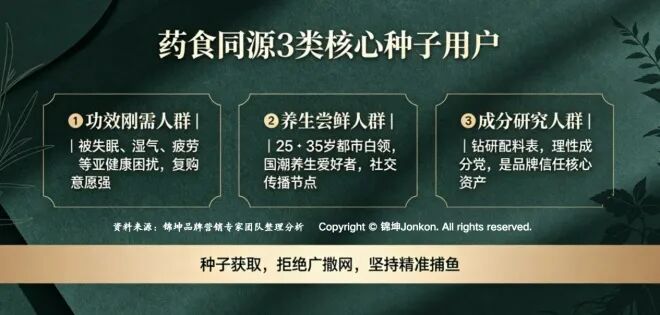
Category 1: People with rigid demand for efficacy.
They have clear health problems (insomnia, hair loss, heavy dampness, easy fatigue, etc.) and are actively looking for solutions.
By 2025, the number of sub-health people in China has exceeded 900 million, and the number of people with chronic diseases is about 800 million.
Under such a huge number, the traditional "focus on treatment" model is unsustainable. With its unique advantage of "preventing future diseases", medicine-food homology has become a key starting point to alleviate medical pressure and improve the health literacy of the whole people.
The purchase decision chain of this group is relatively short. Once the product experience is effective, the willingness to repurchase and recommend is extremely high.
Category 2: Health preservation trend chasers.
They are mainly urban white-collar workers aged 25-35, who have a natural affection for "national trend health preservation" and "new Chinese style", and are willing to pay for appearance and concepts. They are natural nodes for social media communication.
Among white-collar workers working in first-tier cities, more than half of them set aside a fixed "health fund" every month to buy functional food, tonics or fitness courses.
This kind of consumption is not a whim, but a habitual expenditure like paying for water and electricity.
Category 3: Component researchers.
They are the "health preservation component fanatics" who pay attention to the ingredient list, study functional components, and are willing to learn in depth.
Their word-of-mouth is the most convincing and is the core asset of brand trust building. When walking into a convenience store, young people will spend time studying the ingredient list of water to see which one "dehumidifies" and which one "replenishes qi".
This consumption habit of "component fanatics" is spreading from skin care products to the food and beverage field.
The acquisition of seed users is not "casting a wide net", but "fishing accurately".
Medicine-food homology brands must find their "first-degree users" among these three groups.
Product as a hook: How to make seed users "fall in love at first sight"?
In the medicine-food homology track, the product itself is the best customer acquisition tool.
Seed users usually only need one reason to try a new product. This reason is the "hook" of the product.
1. Golden single product: from "wanting everything" to "focusing on one point"
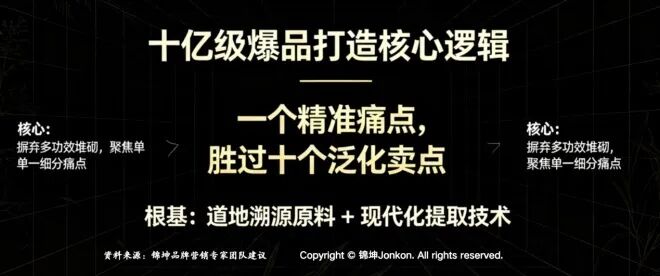
The 4th Functional Food and Health Conference on Medicine-Food Homology put forward the "1-billion-yuan hit product creation formula": based on authentic traceable raw materials and modern extraction technology, abandon the misunderstanding of stacking multiple efficacies of traditional products, and focus on a single segmented pain point.
The "small iron box hangover-relief candy" of Herbal Future is a perfect example of this logic.
When the two Cornell University graduates founded the brand, they did not do "full-category health preservation", but accurately targeted the segmented scenario of "hangover relief at drinking parties". The product adds medicine-food homologous ingredients such as Puerariae Radix and Hoveniae Semen, and the package is designed as a trendy candy box instead of a medicine bottle, so that consumers can naturally take it out at drinking parties. Since its launch in 2021, the sales of the "small iron box" have increased by more than 200% for many consecutive years, and the revenue reached nearly 100 million yuan in 2024.
The "Liuwei Dihuang Tea" of Sannuo Dietary Therapy is another textbook-level hit product case.
In August 2025, Sannuo Dietary Therapy launched "Liuwei Dihuang Tea" priced at 6 yuan, achieving a record of breaking 100 million yuan in sales in five months. The key to its success lies in: the core raw material "Rehmanniae Radix" was officially included in the national medicine-food homology catalogue in 2024, and Sannuo completed a series of preparations such as product planning, compliance demonstration and efficacy demonstration before the product was launched. In addition, Sannuo is not only a member unit of the China Dietary Therapy Research Association, but also led the drafting of the group standard Chinese-style Healthy Drinks Containing Medicine-Food Homologous Raw Materials (Ingredients). In terms of industrial construction, Sannuo is located in Jiaozuo, the origin of the four major Huai medicinal materials, and has the natural raw material advantage of authentic medicinal materials. Time-honored brand Zhang Zhongjing followed closely, attracting more than 5000 visiting distributors during the Nanjing Autumn Sugar and Wine Fair with "Liuwei Dihuang Drink". Taking advantage of the market popularity of Liuwei Dihuang drinks, various consumer brands have entered the market one after another, and products such as "Liuwei Dihuang +" sesame paste, crispy biscuit, ginseng or goji berry puree have emerged in endlessly, expanding the innovation boundary of the classic ancient prescription "Liuwei Dihuang" through the form of mass consumer goods.
One accurate pain point is better than ten generalized selling points.
Seed users will not pay for "health preservation", but will pay for "solving my insomnia" and "alleviating my embarrassment at drinking parties".
2. Form as experience: from "looking like medicine" to "looking like snack"
What is the biggest problem with traditional tonics?
Too heavy, too slow, too troublesome.
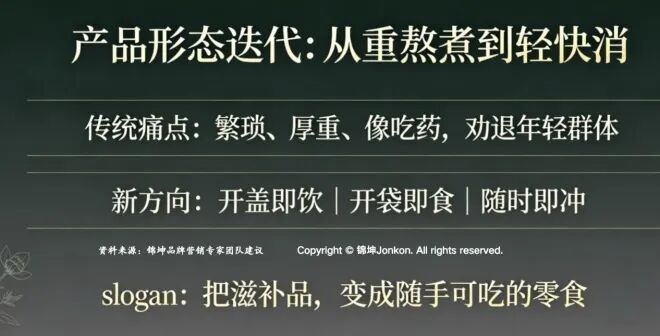
Donkey-hide gelatin that takes several hours to boil, ginseng slices that need to be brewed, and large bottles and cans of paste prescriptions — these forms naturally repel young users.
The form innovation of medicine-food homology products is subverting this pattern.
The industry is undergoing a qualitative change from "heavy boiling" to "light, fast and convenient consumption".
Product forms are evolving in the direction of open lid for immediate drinking, open bag for immediate eating, and ready to brew at any time.
The success of Xichun is a model of form innovation. This brand focusing on Chinese-style tonic has standardized and ready-to-eat transformed traditional products such as Yuling paste and Fushi paste, targeted young female users on Douyin, and promoted health food priced at 100-300 yuan. Its hit product Xichun Yuling paste is estimated to have a monthly sales of 25 million to 50 million yuan. 60 days after the store opened, the monthly sales exceeded 10 million yuan. In March 2025, the brand's sales exceeded 100 million yuan, ranking 6th in the Douyin e-commerce medical health track, an increase of more than 300 times compared with the same period last year.
Form innovation lowers the threshold of trial.
When the product changes from a "tonic that needs to be taken consistently" to a "snack that can be eaten casually", the first trial cost of seed users is greatly reduced. The Huangjing cake of Zhang Dasu is another typical case — the first Huangjing cake was almost unsalable when it was launched in 2020, and now the medicine-food homology series contributes more than two-thirds of the revenue. A piece of Huangjing cake was once unsalable due to the price of 4 yuan, and now the private domain repurchase rate exceeds 90%. Zhang Guangxi, founder of Zhang Dasu, shared his experience: "After 2023, we found that the performance of medicine