How to build a high-profit digital product (only 7 steps)
Shenyi Ju is a translation team under 36Kr, focusing on technology, business, workplace, life and other fields, with a focus on introducing new technologies, new perspectives and new trends from abroad.
Editor's note: The $1 billion "one-person company" that Sam Altman bet big on is accelerating its arrival. The "waste" left behind from your daily work, combined with AI, is a high-margin digital product that can generate millions in annual revenue. Stop working for others. This is a practical 7-step guide for ordinary people to monetize their skills. The article is translated and compiled.
I have a small group chat with several CEO friends of tech companies, where we have a bet on which year the first $1 billion "one-person company" will emerge. Without AI, this would be completely unimaginable, but now it is bound to happen.
—— Sam Altman
The future of entrepreneurship belongs to micro-entrepreneurship.
One founder, with a laptop, an audience, an army of robots at his disposal, plus a set of high-value skill combinations, to solve truly meaningful problems in society, earning $100,000 to $1 million a year.
No boss, no conference calls, no employees.
Enjoy ultimate freedom, sense of achievement and meaning of life.
There are nearly 7 billion people on this planet. I hope one day there will be nearly 7 billion companies.
—— Naval
It has taken humans centuries to get to where we are today, and we are in the era with the strongest leverage effect, where opportunities are infinite.
We are living in the most interesting era in human history.
You no longer need to spend four years and take on hundreds of thousands of dollars in student loans to get a degree just to learn a new skill.
AI has leveled the playing field.
You have the smartest, most talented and hardest-working employees in the world at your disposal.
Ordinary people with no programming experience at all can now build multi-million dollar startups through "vibe coding".
Combining the internet, AI and digital products, anyone can now build a profitable "one-person company".
I have seen many people achieve this. Justin Welsh and Dan Koe are the most well-known creators among them, and their one-person companies earn $3 million to $5 million a year.
I myself have grown my one-person company to a six-figure annual revenue in US dollars.
Why is all this possible now?
1. Real risks no longer exist
Humans have done a pretty good job of eliminating real life-threatening physical dangers.
When you walk on the road, you don't have to worry about a tiger pouncing on you out of nowhere.
We have subdued, domesticated or eliminated almost all other species on this planet.
The riskiest thing you can do now is nothing more than losing $500.
Or you quit your job to start a business and fail. But even then, you can always find another job at any time, and the problem is solved.
As long as you don't lose your life, it's not a big risk.
2. Extreme abundance of opportunities
I don't want to turn the whole article into a discussion about AI, but you have to understand that the world we live in is completely different now.
We have never had such a wealth of opportunities in our hands.
Every unmet desire of human beings is a problem that can be solved with new business or new product ideas.
The best part is that human desires are endless. Everyone has their own unique personality and interests, which means the products we can build are also endless.
Every problem existing in society is an opportunity for entrepreneurship.
Business is about solving social problems. It is also the way you create, contribute and deliver your own value to the world.
3. Leverage effect
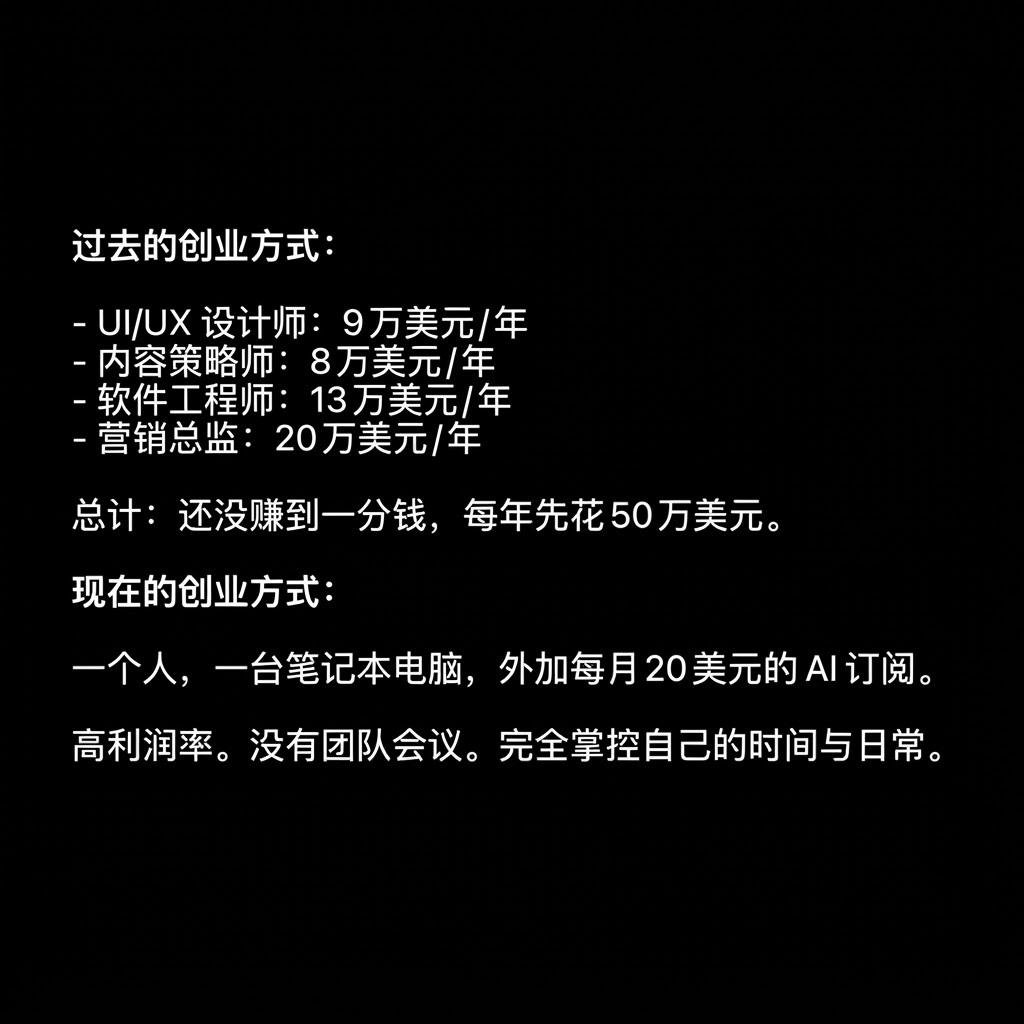
The leverage that humans have now is the strongest in history.
Work that used to require 2 senior engineers, 1 product designer, 5 marketers and 1 manager to complete can now be done independently by one person with just a laptop, AI and no-code tools.
The leverage you hold now is stronger than you can imagine.
AI can write any application you want for you; no-code tools can help you automate your work; digital products have a marginal cost close to zero and can be delivered instantly (which means extremely high profit margins). Then you go to social media to attract audiences, let others see your work, and acquire customers for your business.
These three factors (along with many others) have together brought us to an era where you can build a profitable one-person company with nothing more than a laptop, your unique combination of interests and skills, and a group of like-minded audiences.
Part I – How to build a simple (yet extremely profitable) digital product
Smart people make money just by being themselves.
—— Alan Watts
As long as you have a job, you already have a skill that you can monetize.
The very fact that you are working for others means that someone else knows better than you how to use your skills to create value.
If you knew exactly how valuable your skills are, you would no longer work for others.
When it comes to "courses", people often have deep prejudices.
When most people hear the word "course", the first thing that pops into their mind is those business gurus who want to cut leeks from others.
But my own experience is not like that.
I have bought some courses that have truly changed the trajectory of my life.
Spending $150 on a course to learn a high-value skill is much more cost-effective than taking a regular university course.
The reason why most people can't see the value of such courses is that their thinking is still bound by the established concepts of society.
In universities, professors with no practical experience teach you theories, and the assessment method only tests your memory.
But creator courses are completely different.
They are taught by creators who have personally practiced and have a direct stake in the content. You can (quickly) learn practical skills, work on real projects, bring them to the market, and let the free market test them.
In this way, you not only master high-value skills, accumulate practical experience, but also earn a living for yourself in the process.
So what is the only problem with courses?
They are static.
You have to figure out on your own how to apply the steps in the course to your specific situation, and you can't directly talk to the creator to ask for feedback.
But with AI, the situation is different.
As a creator, you can now launch AI-guided courses to help customers truly implement what you teach.
This AI is built on your knowledge, with your thinking framework and speaking style. This not only enhances the value of the product itself, but also helps users get more benefits from it.
The following are the steps to build your own digital product and earn your first $10,000 (I used this process to earn $150,000 in the past year and a half):
1. Sell your "sawdust" (the by-product generated in the process of doing things)
There is actually a $100,000 digital product stuck in your mind.
Or on your hard drive.
Or in your workbench.
The easiest products to sell are often the things you use every day without even realizing it.
The creator economy is essentially a "system economy".
Everyone has their own unique systems and processes to achieve a certain goal.
If you are a music producer, you have your own exclusive drum kit sound pack.
If you are a photo retoucher or video editor, you have a set of light and shadow presets that you often use.
If you are an email marketer, you have your own unique way of writing emails.
If you are a writer, you have your own way of finding inspiration and bringing in novel perspectives.
If you are an athlete, you have your own pre-competition routine that helps you get into your best state.
If you are keen on personal finance, you may have your own way of budgeting, investing and recording all kinds of expenses.
These are all products that you can sort out and sell right now.
What's the best part?
They already exist.
This is an example of several personal brand courses I made when running training camps.
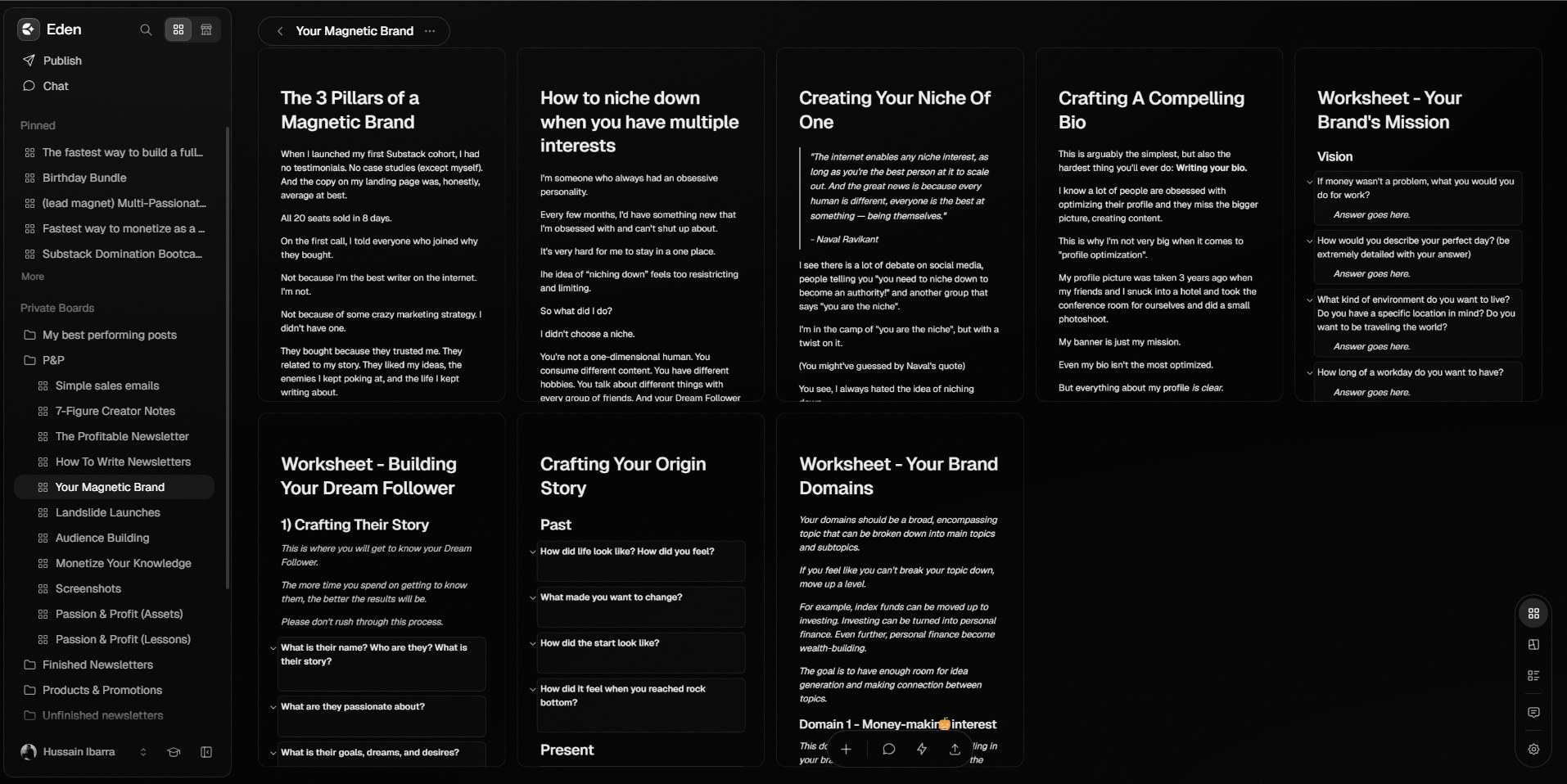
Next, you just need to open that dashboard, and you can turn it into a product with built-in AI to help customers implement the content you teach.
If you have other course content in other dashboards, you can also easily add it to your product.
2. Shape your "ideal customer"
To sell products, you must first know exactly who you are selling to.
Here's a spoiler: your product is not for everyone.
If you try to sell your product to everyone, no one will end up buying it.
You have to accept the fact that not everyone will buy your product.
You need a clear "Customer Avatar".
Even if you follow the advice of many people and plan to "sell the product to your past self", you still need a clear ideal customer avatar.
Because there are actually several different versions of "your past self".
Let me take myself as an example.
4 years ago, I was a poor student.
3 years ago, I was struggling to build up my audience.
2 years ago, I was a ghostwriter earning $4,000 a month, but I hated the job.
Last year, I had my own product plan, but sales were unstable, with good and bad periods.
At each stage, I faced different problems, had different skill combinations, and could afford and was willing to buy different levels of products.
3. Write down your value proposition
The more specific it is, the easier it is to sell.
No exceptions.
I have seen too many creators hide behind vague promises because they are afraid they cannot deliver on them.
But the truth is: the vaguer the promise, the fewer people will buy.
It sounds counterintuitive at first, but it's not.
Just think about this scenario.
Suppose you are planning a trip and you have two options in front of you.
Option 1) A $1000 "blind box trip".
It could be the best trip of your life, or the worst one: the destination is an underdeveloped country, you stay in a one-star hotel, take the worst airline, the food is unpalatable, and you can't even take a hot shower.
All the bad results you can think of are possible.
There are no guarantees.
Or...
Option 2) A $10000 trip.
You are going to your favorite country, taking the best airline, staying in a five-star hotel, eating at the best restaurants, and all transportation is arranged properly.
You don't have to worry about anything during the trip, because everything is arranged before you leave, and you know exactly what you will do every hour.
Which trip do you think will sell better?
The second one.
The reason is simple: it is specific enough and eliminates uncertainty.
Your promise should do the same.
It lets people know exactly what they are buying.
Don't write "grow your audience", it's too general.
A better promise is like this: "Use the MAGNET framework to gain 1000 new followers every month."
I'm not good at naming frameworks, but you get the idea.
You can directly apply the following formula:
Value Proposition Formula:
Help [target group] move from [hell (pain point status quo)] to [heaven (ideal state)], so as to obtain [specific benefits]
The following is an example of the promise of a training camp I bought last year:
Example:
Turn your knowledge into high-quality products, and unlock more freedom and influence for your business.
4. Design your course outline
The course outline is every step the customer takes to achieve the transformation.
The problem with courses is that they are static.
If a buyer gets stuck on a concept, or encounters difficulties when trying to apply what they have learned, they cannot get feedback.
They can't ask the creator at any time and expect a reply.
But you can import your own knowledge and let the "AI version of you" teach the students this course.
This has two benefits:
Improve the perceived value of the product, because your product now has an additional AI interaction part.
Help buyers correctly apply what they have learned to achieve better results. This means you can get better user reviews, which in turn attracts more buyers (because your product actually works).
So how to design the course outline?
Go back to your promise and ask yourself:
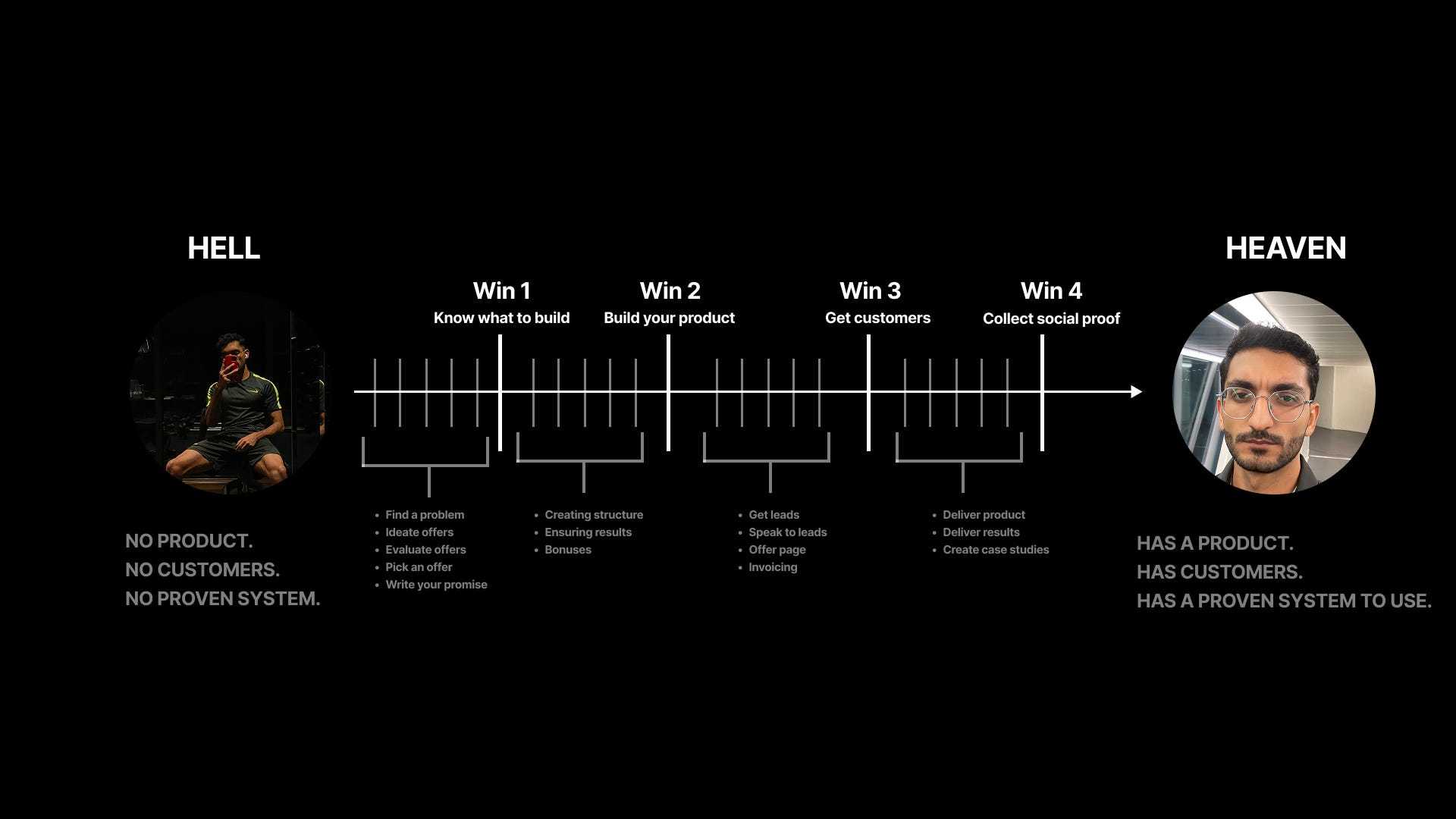
What 3 to 5 key milestones do customers need to reach to achieve the transformation? They are your course modules.
For each milestone, what 3 to 5 action steps do they need to take? They are the lessons under each module.
The following is an example of my own course:
Important tips:
There is only a fine line between "over-delivering" and "overwhelming customers".
Over-delivering means fully fulfilling your promise, not stuffing more things beyond the promise.
If you do too much, you will overwhelm the customers.
5. Make yourself the best case study
Contrary to popular belief:
If you can first achieve impressive results on yourself, you can skip the step of "working for customers for free".
When I first started doing ghostwriting, I had no relevant experience.
I didn't have a wall of glowing customer reviews either.
I only had the posts I published myself