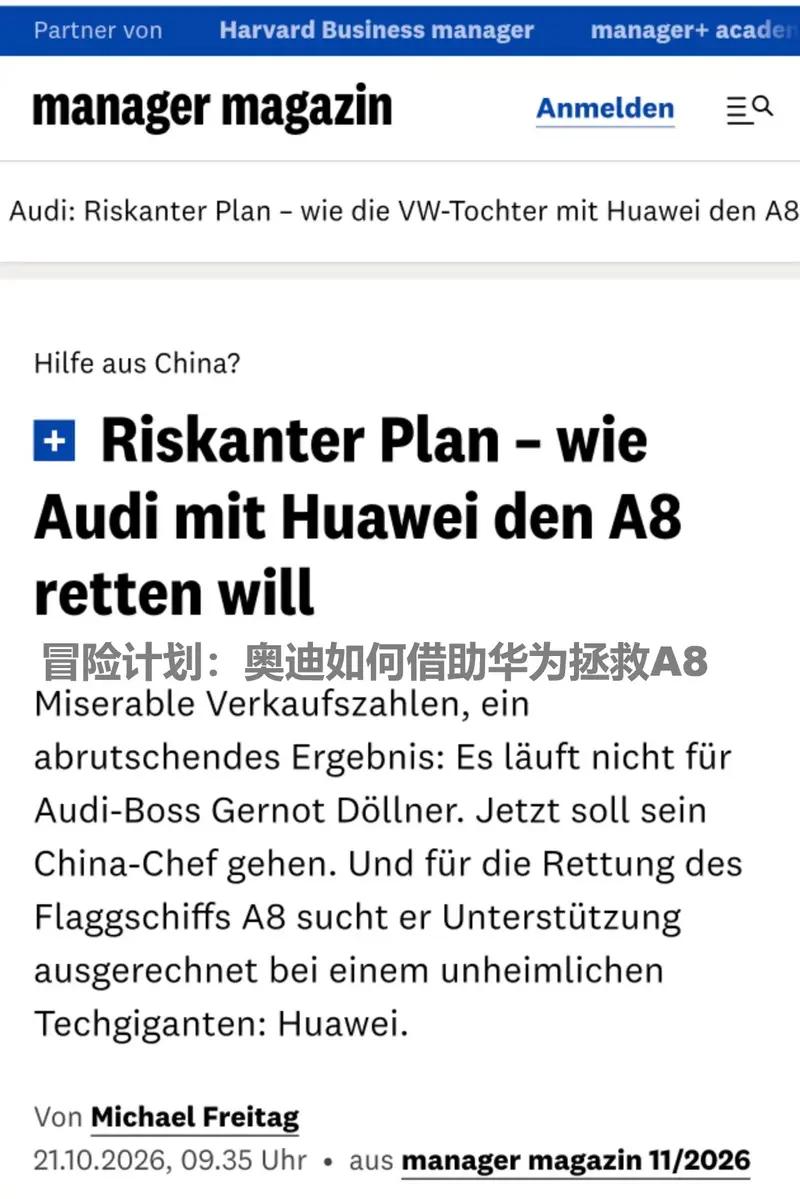
Audi's latest reform plan has been revealed: the Chinese-spec A8 will abandon the import mode and adopt Huawei's architecture.
According to a scoop from German magazine *Manager Magazin*, Gernot Döllner, Global CEO of Audi, is currently in negotiations with Huawei. The next-generation China-spec Audi A8 will switch to Huawei's architecture, be manufactured directly in Changchun, and will no longer be imported from Germany.
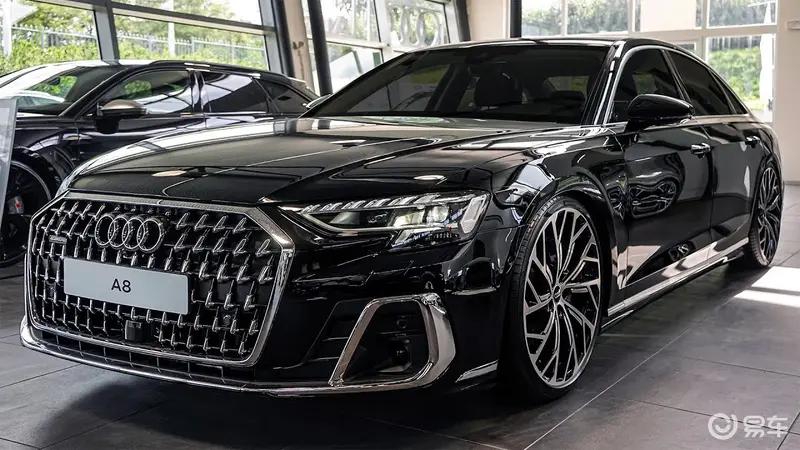
Overseas, the new generation Audi A8 will very likely abandon its original platform and be produced on Porsche's MSB platform. Its production base will also be relocated from the Neckarsulm plant that has been in operation for 34 years to Porsche's Leipzig plant, where it will share a production line with the next-generation Panamera.
This November, the relevant adjustment plan will be discussed at the high-level meeting of the Volkswagen Group. If it is approved smoothly, it means that the China-made Audi A8 and the Germany-made Audi A8 will no longer share the same origin, and there will be huge differences in product experience.
In addition, according to Gernot Döllner's vision, if the progress goes well, in the future, in addition to the A8, multiple Audi models based on Huawei's architecture will also be produced at the Changchun plant.
German media refer to these plans of Gernot Döllner as "Audi China's adventure plan", and there are many opposing voices within the group.
Opponents believe that although FAW Audi and Huawei have a long history of cooperation, installing a Huawei intelligent system is a completely different concept from adopting Huawei's architecture. If Audi really takes this step, the style and brand value of Audi will be severely eroded.
Despite numerous obstacles, in the face of huge pressure on profitability and sales, this "risky move" currently seems to be the fastest way to achieve results.
According to the report of *Manager Magazin*, at the end of last month, the Finance Department of the Volkswagen Group had issued a severe early warning on Audi's profitability this year.
In the first half of this year, the Audi Group's global sales reached 736,900 units, a year-on-year decrease of 7.2%; the net profit attributable to shareholders was 1.123 billion euros, a year-on-year decline of 16.6%. In the second half of this year, the situation has not improved. Audi's internal forecast puts this year's global sales at around 1.4 million units, the lowest in the past 15 years.
For the Chinese market, Audi's internal forecast puts 2026 sales at about 420,000 units, a year-on-year decrease of about 30%. Sales of imported Audi models such as the Audi A8 and RS series have stagnated; sales of the two pure electric models on the PPE platform, the Audi Q6L e-tron and A6L e-tron, are dismal. The average monthly sales of the Q6L e-tron from January to September this year is only 527 units, and the cumulative sales of the A6L e-tron since its launch in April have not yet exceeded 1,000 units.
In the first half of the year, Audi has launched a series of cost reduction measures. The annual production capacity of the Neckarsulm plant has been cut to 225,000 units, and night shifts have been cancelled. If the platform and production line switching of the next-generation Audi A8 is completed as expected, the cost can be significantly reduced.
In the Chinese market, the Changchun production base of Audi FAW New Energy Vehicles Co., Ltd., which is used to produce models on the PPE platform, has a planned annual production capacity of 150,000 units. However, due to the dismal sales of the Q6L e-tron and A6L e-tron, its capacity utilization rate is severely insufficient.
While the four-ring Audi's new energy business is struggling, the AUDI brand, which is deeply co-created by SAIC and Audi and built based on SAIC's three-electric technology, has shown stronger product competitiveness. After the launch of its second model, the AUDI E7X, its sales have also picked up.
This successful demonstration, to a certain extent, prompted Gernot Döllner to make up his mind to upgrade the cooperation with Huawei from the application layer to the architecture layer.
Through the performance of brands such as AITO and Zhijie, Huawei has fully demonstrated its influence and brand endorsement capability in the high-end market. If the two sides can smoothly take this step forward, the market expectation for the domestic Audi A8 will be raised to an unprecedented level.
Of course, everything is still just a hypothesis so far. Such a bold reform measure is bound to encounter heavy internal resistance. But no matter what the result is, getting closer to the Chinese market has become an unavoidable strategic direction.
On November 1, Audi China will welcome its first Chinese president in history — Zhang Jun. From 2018 to 2020, he once served in a senior management position at Audi China, responsible for forming the SAIC Audi sales team.
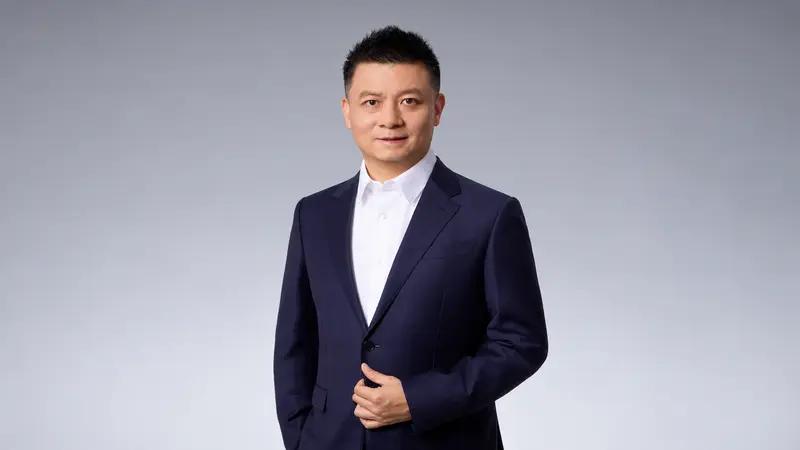
Before taking the new position, he served as Vice President of Chery International, leading the entry of Chery, Omoda and Jaecoo brands into the European market, and participating in the preparation for the establishment of Chery's European regional headquarters.
In addition, he once served as a member of the Executive Committee of Stellantis Group's China region, leading the China business of Alfa Romeo and DS brands; he also worked at Nissan Motor, responsible for the management of supply chain, dealer operation and other work in the Japanese and North American markets.
As a comprehensive talent who is not only familiar with Audi's internal system, but also has practical experience in local Chinese automakers and overseas expansion vision for the European market, he is a very suitable candidate for this position.
Once the strategic intention of Gernot Döllner to deepen cooperation with Huawei is implemented, he also has the ability and resources to efficiently promote the implementation of the strategy.
This article is from the WeChat official account "AutoReport Auto Industry & Economy", written by Gan Meng and Xu Chenxi, and is authorized for release by 36Kr.