Food Delivery: A Growth Engine That Should Not Be Underestimated in the Transformation of the Catering Industry
The National Library of China houses a treasured book titled One Hundred Pictures of Beijing Folk Customs, which depicts the lifestyles of people from all walks of life in Beijing in the late Qing Dynasty through a street-style picture album. In the book, the catering and dining business is playfully referred to as the "diligent trade".
The word "diligent" itself is a commendatory term, but in the context of the commercial society, it actually represents the business model of the catering industry: a "low-return" business that requires more labor to obtain remuneration. From ancient times to the present, the commercial society's evaluation of the catering industry has hardly changed. Duan Yongping also categorized the catering sector as a "tough business" in his personal comments.
The main reason why the catering business is tough lies in its low asset utilization efficiency, where the dining space and table turnover rate almost set a hard cap on its revenue ceiling.
Contrary to common intuition, however, the catering industry has become one of the few sectors in China's consumer market that has seen long-term structural growth over the past decade. By the end of 2025, the compound annual growth rate of the catering industry over the past ten years reached 6.7%, higher than the overall growth rate of total retail sales of consumer goods. The engine driving this growth is a new model for this time-honored industry: food delivery. Over the past 5 years, the annual growth rate of the food delivery industry has remained above 20%, far higher than the overall growth rate of the catering sector.
The phrase "fish never sees water" could not be more appropriate to describe the food delivery industry. Precisely because food delivery as a business model has long been integrated into every aspect of social consumption, the market turns a blind eye to the incremental value brought by food delivery itself.
Today, from three dimensions — the common characteristics of the current catering industry, its underlying operating principles, and the industrial value at the macro level, we will conduct an in-depth analysis of how the industrial and economic value of food delivery to a country has been seriously underestimated.
01
Signal: Chinese and foreign catering brands are collectively betting on food delivery
In 2023, Popeyes, the world's second-largest fried chicken brand, opened its first outlet in Shanghai, officially marking its return to the Chinese market. Since it first entered the Chinese market in 1999, Popeyes has experienced three entries and two exits. This time, the pace of its store expansion has accelerated significantly, with 82 outlets already in operation so far.
For its return to the Chinese market, Popeyes has adopted a localized strategy: the model of "steady store expansion" + "food delivery breakthrough", and has settled on the Meituan Waimai platform. In fact, Popeyes' choice is not an isolated case. Shake Shack has also begun to promote light-weight store formats that only provide food delivery services in China, and after the burger brand FIVE GUYS landed in Beijing, it also stated that it is stepping up preparations for its food delivery business.
In August, the Briefing on the Development of Chain Catering Enterprises in the First Half of 2026 released by the China Chain Store & Franchise Association shows that 54.4% of the sampled enterprises have food delivery orders accounting for more than 30% of their total orders, and food delivery has occupied an important position in the operations of a considerable number of catering enterprises. More and more international big brands are beginning to attach importance to the food delivery channel.
In fact, it is not only international big brands. According to statistics from Weidian Data, the proportion of revenue from food delivery channels of listed catering brands has increased significantly over the past year.
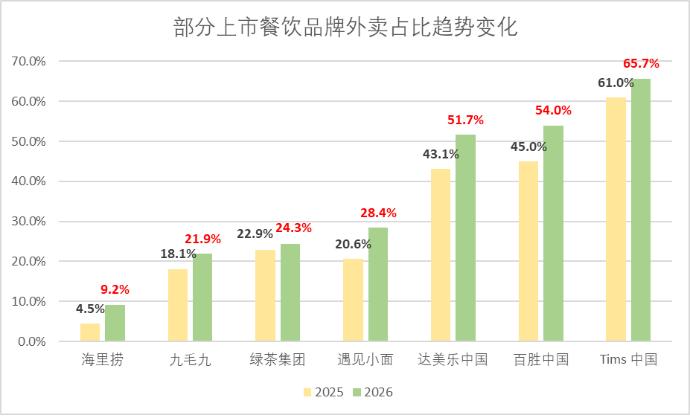
Figure: Changes in the proportion of food delivery disclosed by some listed catering brands, Source: Weidian Data
The collective choice of so many experienced market players is not without reason. Whether it is international big brands with sufficient market experience, or traditional catering brands deeply rooted in the Chinese market, they all regard "food delivery" as the core breakthrough point of the industry, mainly because food delivery has two irreplaceable core advantages at the current stage:
(1) Food delivery helps catering enterprises expand consumption scenarios, and is one of the few incremental growth narratives at the current stage
Going back to the logic at the beginning of this article, for the catering industry, the restriction of consumption scenarios is absolutely the primary factor that restricts the development of the industry. In addition, consumption habits are also undergoing subtle changes. According to reverse calculation based on data from the Guosen Securities Research Institute, NetEase E-Commerce Research Center and total retail sales of consumer goods, the online penetration rate of the catering industry has increased by 20 percentage points over the past 8 years.
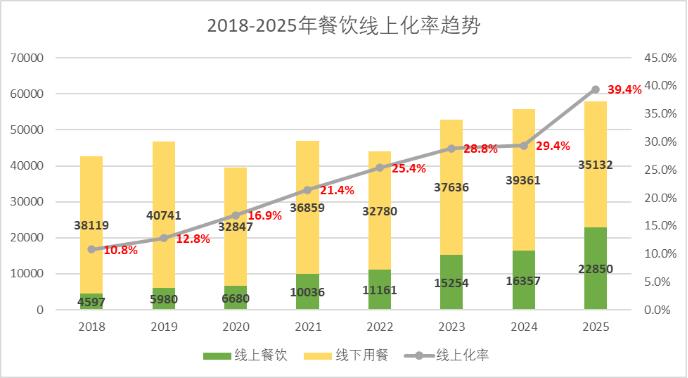
Figure: Trend of online penetration rate of the catering industry, Source: Guosen Securities Research Institute, the 2025 figure is calculated based on data from NetEase E-Commerce Research Center
In terms of absolute scale, from 2018 to 2025, the growth rate of in-store dining has basically remained at a low single-digit level, and even showed a decline if we take the relatively low point in 2025 as a reference. In the past eight years when food delivery has grown rapidly, the compound annual growth rate of online catering has reached 25.7%.
In other words, the current incremental growth of the catering industry is concentrated in food delivery. Mature catering brands with sharper business acumen clearly understand this point, and have all increased their investment in food delivery channels by coincidence.
(2) Food delivery helps catering enterprises adapt to the market faster and iterate their products
Another factor that hinders the expansion of catering brands is that it is difficult to meet the differentiated demands on the demand side. After all, no matter how delicious a product is, consumers will get tired of it one day. By the time the demand change is transmitted from consumers to the supply side of merchants, it has often already become a real loss figure on the bill.
However, the data quantification and data feedback link of food delivery is shorter, and the feedback cycle is compressed from "calculated by month" to "calculated by week". Therefore, merchants can launch products that are more suitable for consumers.
In September this year, Dicos jointly launched the "Rice Warms Chinese Stomach" campaign with Meituan Waimai. For the new product "Spicy Cheese Golden Rice Burger" jointly developed by the two parties, some stores saw sell-out and restock situations in the first three days after its launch. The order proportion of the new "Rice Burger" series broke the historical peak record of Dicos' food delivery channel.
It is obvious that the cooperation between Dicos and Meituan Waimai has entered the "deep zone" beyond simple traffic cooperation. Centering on user search, reviews and order feedback, it helps the brand identify users' preferences for taste, price and portion faster, and reduces the risk of mismatch between new products and real market demand.
The new product "Spicy Chicken Burger" customized by Burger King and Meituan drove the orders of Burger King's "Pin Hao Fan" channel to increase by nearly 40% month-on-month in the first week after its launch. The starting point of the R&D came from more than 100,000 real user reviews on the platform: young users aged 18 to 35, price range of 10 to 20 yuan, preference for strong spicy flavor, and demand for "large and filling portions". These data directly defined the category, taste and portion of the product, and quickly pushed it to the top of the bestseller list.
Data from Burger King shows that since its cooperation with Meituan, the launch efficiency of new products has increased by 30%, and merchant costs have decreased by 10%.
As food delivery can drive industry incremental growth and optimize product structure, catering brands will naturally flock to the food delivery channel. So what is the underlying principle behind how food delivery drives incremental growth?
02
Logic: Streamline the "tough business" and lighten the "heavy assets"
Behind the digital characteristics of all business models, there are actually simple principles. The reason why the food delivery channel can improve the current pain points and problems faced by the catering industry lies in only one essential logic: breaking physical boundaries, lightening "heavy assets" and streamlining the "tough business".
First, leverage operating leverage through a more optimized business model
Most analyses of the business advantages of food delivery focus on the physical level. The most obvious advantage is that the business scope of traditional catering merchants generally does not exceed 500 meters, while food delivery can expand the business scope by more than ten times, which is self-evident.
In fact, starting from the business model itself, the advantages of food delivery are also very prominent. For example, all industries that want to expand need to find operating leverage. So what exactly is operating leverage?
From the origin of economics, operating leverage comes from the existence of fixed costs. When an enterprise has a large number of fixed costs (such as necessary expenses like rent and labor), it must reach the minimum effective scale to cover the cost expenses. Most fixed costs are directly linked to output. For example, the number of dine-in seats directly determines the reception capacity, making fixed costs a hard constraint with a threshold on the revenue side.
However, when the link between fixed costs and output is reduced, and variable costs (costs that do not occur if no transaction is made) increase, the flexibility of business operations will be greatly enhanced, which is the so-called operating leverage.
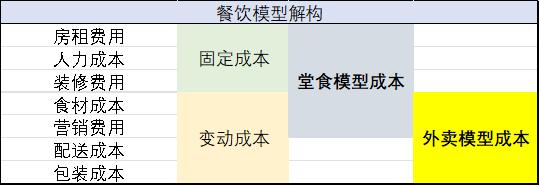
Back to the catering industry, food delivery and dine-in are essentially two completely different business models. Compared with dine-in, food delivery has essential differences in cost structure, supply and cost performance.
For dine-in, the main costs are rent, labor, decoration, hardware and so on. For food delivery, the main costs are distribution, packaging, marketing and so on. The profit models of the two are completely different. Food delivery has higher cost flexibility: commission is charged per order, while fixed costs such as rent and labor are spent as soon as the store opens every day. In addition, the incremental business brought by food delivery can also help catering enterprises effectively dilute their fixed costs.
All business activities will always have peaks and troughs. A business model with more variable costs can easily cope with business cycles, which will form a very obvious cost advantage when calculated uniformly over a long period. Survey data from Huatai Securities shows that 90% of merchants that settled in the "Pin Hao Fan" platform have achieved a sales increase of more than 30%, and the improvement of meal preparation efficiency has driven a cost reduction of more than 20%.
There is no doubt that food delivery is the most prominent operating leverage in the catering industry, which gradually lightens the "heavy asset" business that relies on physical consumption space.
Second, reduce operational difficulty through stronger data feedback
For thousands of years of development of the catering industry, the constraint on large-scale operation has always been operational capability. In the book Profit from 10,000 Stores by Mr. Chen Zhiqiang, it is mentioned that one of the core reasons why China's catering industry can produce brands with 10,000 stores is that after the popularization of digitalization, traditional manual ledgers have been transformed into digital online systems, which greatly reduces the management difficulty of large-scale operations.
If digitalization is version 1.0 of operational technological progress in the catering industry, then food delivery is more like version 2.0 of operational technological progress. In the past, catering business decisions were entirely based on feelings, relying on the boss's experience and luck. The food delivery backend precipitates the data of every order and calculates it clearly, so that catering merchants have an operational dashboard for the first time.
Over the past year, not only at the digital level, but also at the operational level, catering brands are gradually embracing food delivery. Haidilao has developed food delivery products suitable for single-person meals and built food delivery stations; Jiumaojiu has expanded its single-person meal product line; Yum China continues to develop delivery menus, adjust store delivery ranges, and operate its own app and membership system. Tea drink brands have also connected mini-programs, membership systems, in-store pickup and third-party delivery into their store operation systems.
The business model of food delivery determines its current advantages. For this reason, the value of food delivery has gradually extended from revenue proportion to product R&D, store design, digital channels and brand operation.
When thousands of catering merchants complete this cost structure transformation, the capacity utilization rate of the entire industry will be redefined, and finally converge into the resilience of the macro consumer base.
03
Significance: The sponge value of food delivery in buffering economic cycles is far greater than imagined
As a sponge that buffers economic cycles, food delivery actually has two layers of value.
For a very long time in the past, discussions on the macroeconomic value of the food delivery industry often focused on the labor force level. As China's largest flexible employment reservoir at present, the ability of food delivery to regulate the job market is self-evident. But under the halo, it also plays the same role in the commodity cycle.
For the catering industry, what can bring incremental growth is actually food delivery. Looking at the mid-year report season this year, among the catering brands listed on the Hong Kong Stock Exchange, if we split the source of net incremental growth, we will find that the food delivery channel occupies an absolute core position, and the lowest incremental contribution exceeds 30%.
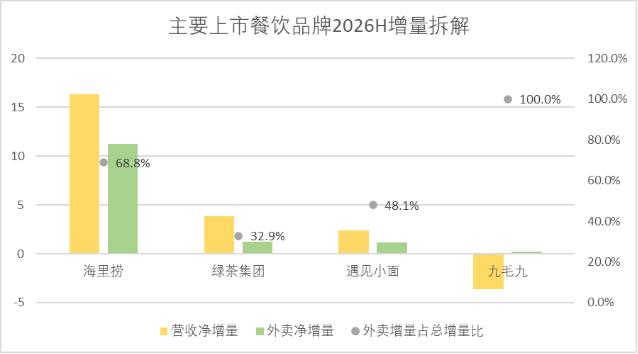
From this perspective, the value of food delivery deserves more attention. Consumers' catering demand is directly reflected in the incremental growth of food delivery. The revenue of merchants, the procurement orders of upstream ingredients, and the income of food delivery riders are all part of the highest-frequency gears of the domestic demand economy.
The sponge effect of food delivery on the economic cycle is far more than just employment. The "diligent trade" business is now the most frequently rotating part in China's domestic demand machine.
04
Conclusion: A skillful fighter wins without any noticeable feat
Going back to the proposition at the beginning of this article, as a business model, food delivery has long been integrated into every aspect of social consumption, leading the capital market to turn a blind eye to the incremental value of food delivery itself.
This can be confirmed by numbers alone. Before food delivery as a business model was widely embedded in the catering market, there were only a handful of catering brands in China's capital market. In the Hong Kong stock market, Ajisen listed in 2007, Daoxiang Holdings followed in the same year, and Xiabu Xiabu did not get a listing seat until the end of 2014.
After