Revenue hits 28 billion U.S. dollars, Tesla accelerates to abandon its "old narrative"
Tesla is undergoing a transformation: devoting growing resources to autonomous driving, humanoid robots and AI.
On October 21 local time in the United States, Tesla released its financial report for the third quarter of 2026, posting revenue of 28.046 billion US dollars, which was roughly on par with the 28.095 billion US dollars in the same period last year, slightly higher than the average analyst expectation of 27.9 billion US dollars.
Net profit stood at 787 million US dollars, down 43% year on year and lower than the analyst expectation of 815 million US dollars. Diluted earnings per share reached 0.22 US dollars, while Non-GAAP earnings per share hit 0.48 US dollars, exceeding the market expectation of 0.45 US dollars.
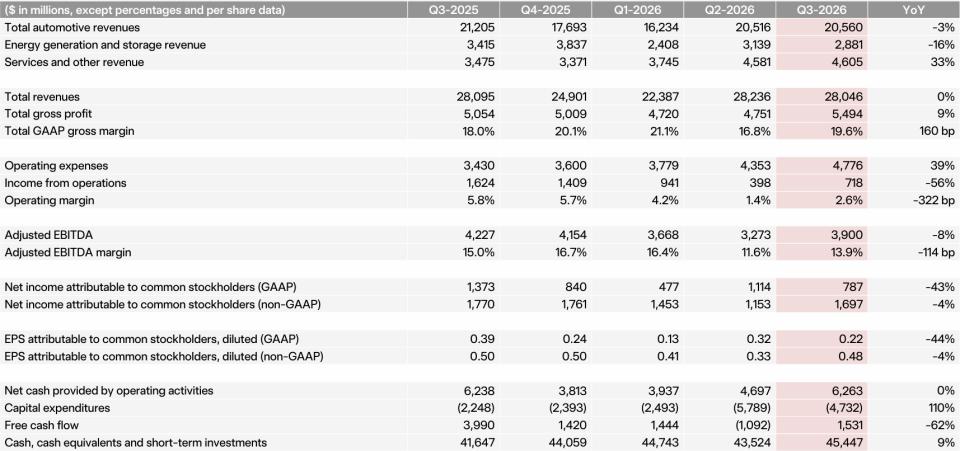
In the third quarter, Tesla's gross margin reached 19.6%, up 1.6 percentage points from 18.0% in the same period last year. Its operating margin was 2.6%, rebounding 1.2 percentage points from 1.4% in the previous quarter, but still 3.22 percentage points lower than that in the same period last year. Operating profit came in at 718 million US dollars, down 56% year on year.
Meanwhile, operating expenses reached 4.776 billion US dollars, up 39% year on year. R&D expenses alone surged 69% to 2.76 billion US dollars, and the expense side ate up most of the gross margin improvement.
Despite the profit pressure, Tesla's cash flow position improved in the quarter. In the third quarter, Tesla's free cash flow stood at 1.531 billion US dollars, and cash and short-term investments at the end of the period reached 45.447 billion US dollars. Capital expenditures rose to 4.732 billion US dollars, more than doubling from 2.25 billion US dollars in the same period last year, but significantly lower than the market expectation of about 7.5 billion US dollars.
By revenue breakdown, the automotive business remains the revenue foundation of Tesla, while FSD subscriptions continue to rise, Robotaxi has started to provide services with Cybercab, and the Semi electric truck and Optimus humanoid robot are also advancing in production, with the growth momentum changing. Elon Musk expects these businesses, together with AI computing and self-developed chips, to form Tesla's future growth engine.
The problem is that the commercialization progress of new businesses is not yet sufficient to change the company's current financial structure, which may be a relatively long "pain period" of transformation.
On the day the financial report was released, Tesla's share price closed up 3.41% at 386.47 US dollars, but the after-hours share price fell back, dropping by more than 3% at one point.
01 Deliveries fail to keep pace with revenue growth
Tesla's automotive business generated 20.560 billion US dollars in revenue in the third quarter, down 3% year on year. The company produced 464,391 vehicles globally and delivered 486,532 units in the quarter, up 4% and down 2% year on year respectively.
Deliveries outpaced production, and the global days of vehicle inventory supply dropped from 15 days in the second quarter to 11 days, indicating that vehicle sales speed has improved to some extent.
Model 3 and Model Y remain the mainstay models. In the third quarter, the two models produced a total of 457,387 units, up 5% year on year; deliveries reached 478,237 units, down 1% year on year.
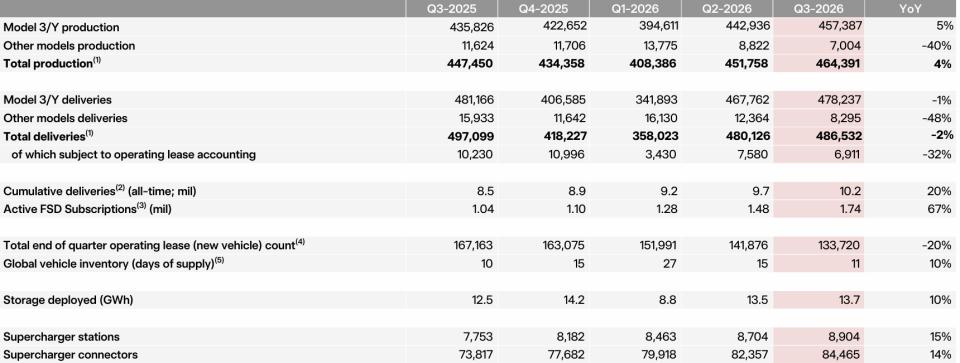
At present, Tesla's cumulative global deliveries have exceeded 10 million units.
Tesla said that the backlog of passenger car orders has reached the highest level in four years, the company is expanding battery supply and prioritizing the improvement of capacity utilization of existing factories.
Tesla mentioned in its financial report that the decline in the average selling price of vehicles, the reduction in deliveries and the drop in regulatory credit revenue all affected the revenue performance.
In the third quarter, automotive regulatory credit revenue was only 113 million US dollars, down 73% year on year. This revenue once brought additional profits to Tesla, but its support for overall performance has weakened significantly now.
Gross margin of automotive business excluding regulatory credits rose to 18.1%, higher than 16.3% in the second quarter and 15.4% in the same period last year. Tesla attributed the improvement to regional and product structure optimization and the growth of FSD subscription revenue, but the decline in average selling price is still offsetting part of the earnings.
In terms of production capacity, the installed annual capacity of Model 3/Y at the Fremont plant in California and Shanghai plant exceeds 550,000 units and 950,000 units respectively, and the installed annual capacity of Model Y at the Berlin and Texas plants both exceeds 375,000 units. The Texas plant is also responsible for producing Cybertruck and Cybercab, and the installed annual capacity of both models exceeds 125,000 units.
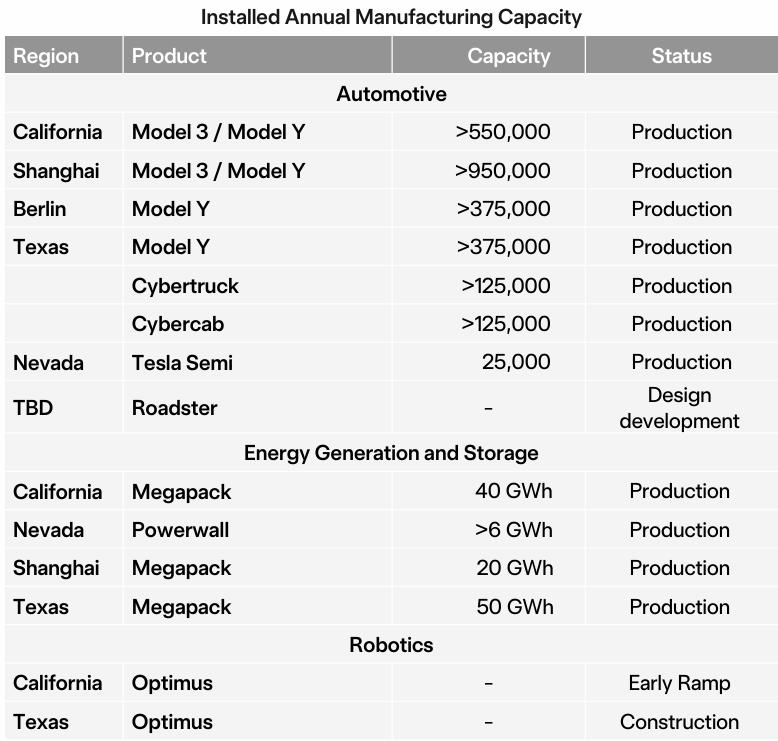
In terms of commercial vehicles, Tesla has started producing the Semi electric truck on high-yield production lines in Nevada.
It can be said that the automotive business is still the foundation of Tesla's cash flow and revenue. However, under the circumstances of limited delivery growth and pressure on average selling price, the company needs new products and revenue sources to support a larger-scale investment plan.
02 FSD grows, Robotaxi enters a new stage
Autonomous driving is one of the clear growth points for Tesla in the third quarter.
The number of active FSD (supervised version) subscriptions reached 1.74 million, up 67% year on year. In the North American market, more than 75% of new car deliveries include FSD subscriptions, up nearly 20 percentage points from the second quarter. Tesla said that FSD is driving demand in its open markets, and it continues to communicate with regulators to seek approval in more regions.
Four new countries including Croatia, Slovenia, the Czech Republic and Slovakia have approved FSD in the European market. At present, FSD is available in 9 EU countries with more than 100,000 users, and the cumulative driving mileage since the first approval has exceeded 160 million kilometers.
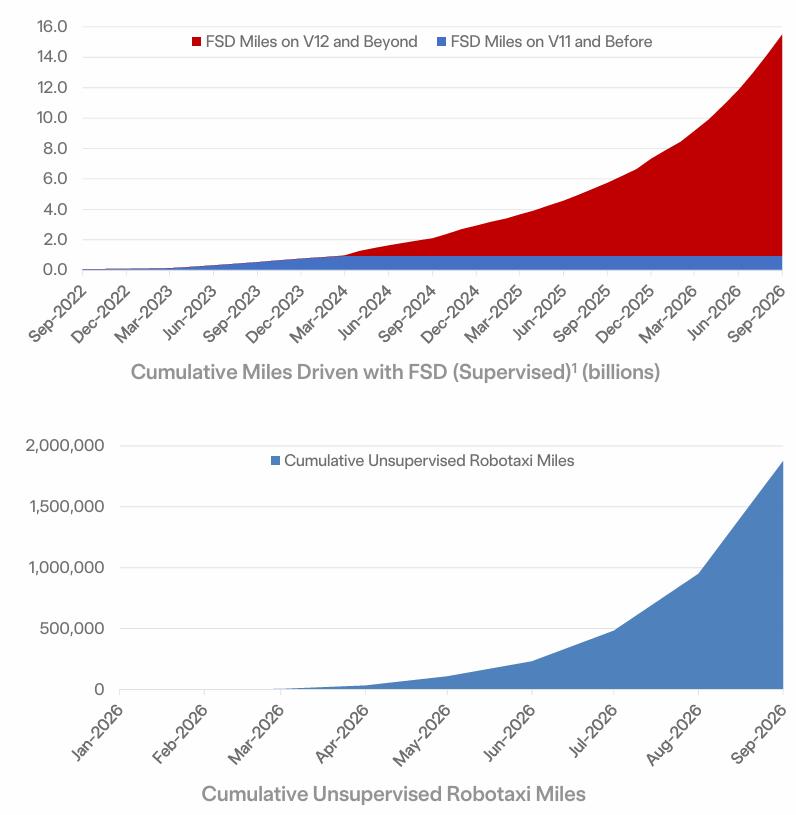
The growth of subscriptions indicates that the commercialization of the software is advancing, but its long-term revenue scale still depends on the growth of paying users, service pricing and the degree of regulatory opening.
Tesla launched Cybercab to provide Robotaxi services in Austin on September 3. As of the end of the third quarter, the cumulative fully driverless mileage of Robotaxi was close to 3.2 million kilometers, 8 times higher than the previous quarter, maintaining a double-digit weekly growth rate.
Cybercab is also connected to Grok and related connectors. Tesla hopes to use vehicles in scenarios such as transportation, work and entertainment, but whether the service can generate stable revenue still depends on fleet size, utilization rate, operating cost and regulatory conditions.
Regulatorily, the National Highway Traffic Safety Administration (NHTSA) of the United States put forward 21 requirements on how Cybercab can self-certify to meet federal safety standards. Tesla applied for an extension of the reply period, and the regulator only approved a 30-day extension, with the relevant reply deadline set on October 30.
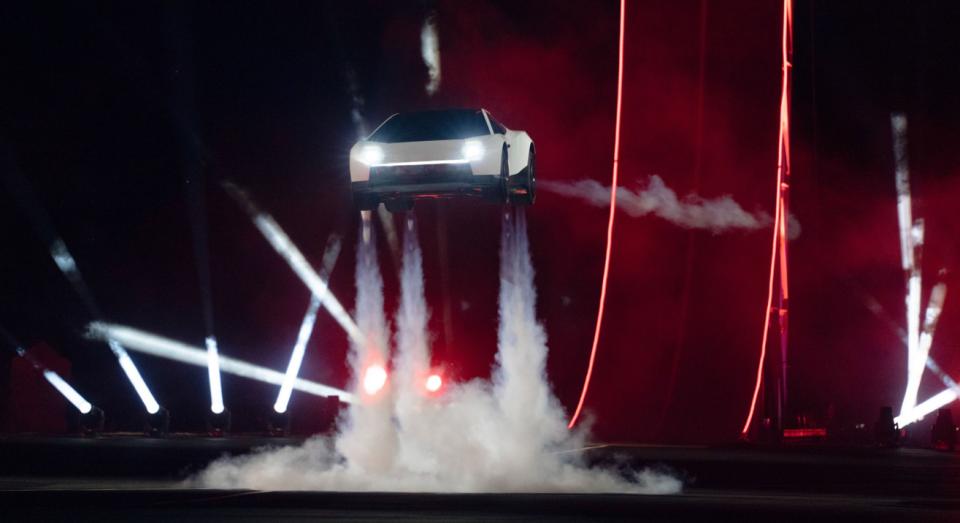
The Roadster has added another topic to Tesla's product lineup. On October 15, Tesla showcased the next-generation Roadster in Texas and plans to start mass production in 2028. The vehicle equipped with cold air thrusters was displayed at the launch site, and Tesla also announced the acceleration performance in testing.
Analysts generally hold a reserved attitude towards this limited-edition sports car priced at hundreds of thousands of US dollars.
The lead analyst at Forrester said that in its current form, the Roadster is a distracting product and makes no meaningful contribution to Tesla's product portfolio. Gene Munster, Managing Partner of Deepwater Asset Management, called it "engineering flair", and Morningstar expects its annual sales volume to be less than 2,000 units.
03 Optimus rolls off production lines, AI computing power continues to expand
Tesla started the production of Optimus humanoid robots on high-yield production lines at the Fremont plant in the third quarter. The robots will be used for internal operations at Tesla in the initial stage, and collect training data through actual operation.
The company said that the robots that have rolled off the production line are the first batch of products that meet mass production quality standards, and the existing manufacturing process is applicable to commercial products, but the hardware and production process will continue to be improved.
At present, the Fremont project has entered the early ramp-up stage, and the Texas project is still under construction. However, Tesla still needs to solve the problems of robot stability in complex environments, task adaptability, manufacturing cost and maintenance before further expanding deployment.
Computing power is another key investment area.
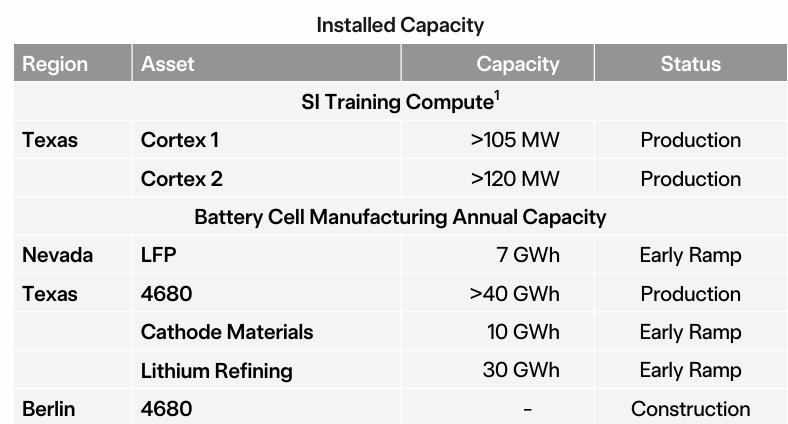
Tesla plans to increase its super-intelligent training computing power to 400 megawatts by the end of the year to support autonomous software development for vehicles and humanoid robots. At present, Cortex 1 in Texas has been put into production with an installed computing power of over 105 megawatts; Cortex 2 has an installed computing power of over 120 megawatts and has also entered the production stage.
Tesla is also continuing to build the Austin chip manufacturing facility Terafab, and plans to start equipment commissioning in 2027.
The Terafab semiconductor and AI computing project aims to provide advanced chips for Tesla's autonomous driving vehicles and Optimus robots, as well as for SpaceX's AI and data center needs. Elon Musk hopes to strengthen the collaboration between the two companies in fields such as chip design, computing infrastructure and robots.
Meanwhile, the two companies are evaluating potential merger plans. Elon Musk said at SpaceX's financial report call that "merger is a good idea", and there is synergy space between the two sides in SI software, chip design, Terafab, robots, orbital data centers and Starlink communications.
However, the merger is still in the discussion stage at present.
For Tesla, both Terafab and the potential merger are long-term strategic layouts, which cannot be directly counted into the commercial returns of current businesses.
04 Scissors gap between energy storage deployment and revenue
The revenue of energy generation and storage business in the third quarter was 2.881 billion US dollars, down 16% year on year. The energy storage deployment volume reached 13.7 GWh, up 10% year on year.
The revenue and deployment volume moved in opposite directions, and Tesla attributed part of the reason to tariff-related customer refunds.
The gross margin of the energy business rose to 33%, higher than 20% in the second quarter, but the gross profit still dropped from 1.073 billion US dollars in the same period last year to 954 million US dollars.
Nevertheless, Tesla remains optimistic about the demand for the energy storage business. The company said that both the order rate and order backlog of energy storage in the third quarter hit new highs, and believes that the growth of power consumption in data centers will continue to drive the demand for Megapack.
In terms of capacity expansion, the Texas Megafactory has started production with a planned annual capacity of 50 GWh; the Shanghai Megafactory has an annual capacity of 20 GWh; the California Megapack plant has an annual capacity of 40 GWh.
Tesla shipped the first batch of Megapacks fully using self-produced LFP battery cells from the Nevada plant this quarter. At the same time, it is also advancing the 4680 battery, cathode material and lithium refining projects in Texas to support the production of vehicles and energy storage products.
In the third quarter, Tesla added more than 2,100 new Supercharger stations net, up 14% year on year; the total number of global Supercharger stations reached 84,465, up 14% year on year.
05 Capital expenditure cools down, investment continues
In the third quarter, Tesla's capital expenditure was 4.732 billion US dollars, down about 18% month on month but up 110% year on year. The lower-than-market-expected expenditure helped the company achieve positive free cash flow, but also raised a question: will the planned investment advance at the original pace?
Tesla did not give a clear full-year capital expenditure guidance of 25 billion US dollars in its third quarter update, so it is impossible to judge how much funds need to be invested in the fourth quarter based on this at present.
The company said it will prioritize improving the capacity utilization of existing factories, while maintaining sufficient liquidity to support long-term capacity expansion. For Tesla, how to arrange the investment pace is not only related to cash reserves, but also related to the advancement speed of new projects.
At the same time, the potential SpaceX merger adds another layer of uncertainty to this investment plan.
Both companies are involved in large-scale infrastructure construction, and the merger may bring business synergy, but it also involves issues such as share swap pricing, shareholder interests and corporate governance. Elon Musk emphasized at the conference call that the merger should not be assumed to be confirmed. Even if the transaction is finally advanced, its specific conditions and impact on Tesla's shareholders remain to be clarified.
Tesla needs to handle two things at the same time next: control the investment pace and improve the use efficiency of existing assets on the one hand, and reserve sufficient funds for long-term projects on the other. The company expects that the profits of hardware businesses will be accompanied by the growth of profits from superintelligence, software and fleet operations in the future, but it has not given a specific timetable for when these new businesses will reach the corresponding scale.
The cash flow improvement in the third quarter provides a buffer for Tesla to continue to promote investment; the significant year-on-year growth of capital expenditure indicates that the construction cycle is far from over. Next, the market needs to observe