Profit has skyrocketed by 750%, is Dian Diagnostics staging a dominant comeback?
On the evening of October 19, Dian Diagnostics released its 2026 Q3 financial report.
At first glance, one data point stands out remarkably.
The net profit attributable to shareholders for the first three quarters reached 482 million yuan, surging 750.28% year-on-year.
It gives a strong impression of a dominant player making a full comeback.
However, when looking at operating revenue, the figure dropped from 7.566 billion yuan in the same period of 2025 to 7.409 billion yuan, representing a 2.07% year-on-year decline.
Revenue is still sliding, while profits are skyrocketing at a rapid pace.
What is the reason behind this phenomenon?
01
Breakdown of Accounts:
Where does the 750% profit increment come from?
Looking through Dian Diagnostics' latest financial report, the year-on-year growth of net profit attributable to shareholders is exceptionally notable.
With profit growing by more than 7 times, Dian Diagnostics seems to have ushered in a strong performance rebound.
But the question is, are these extra profits earned through business growth, or do they come from other factors?
To answer this question, we need to break down this 750% high growth rate.
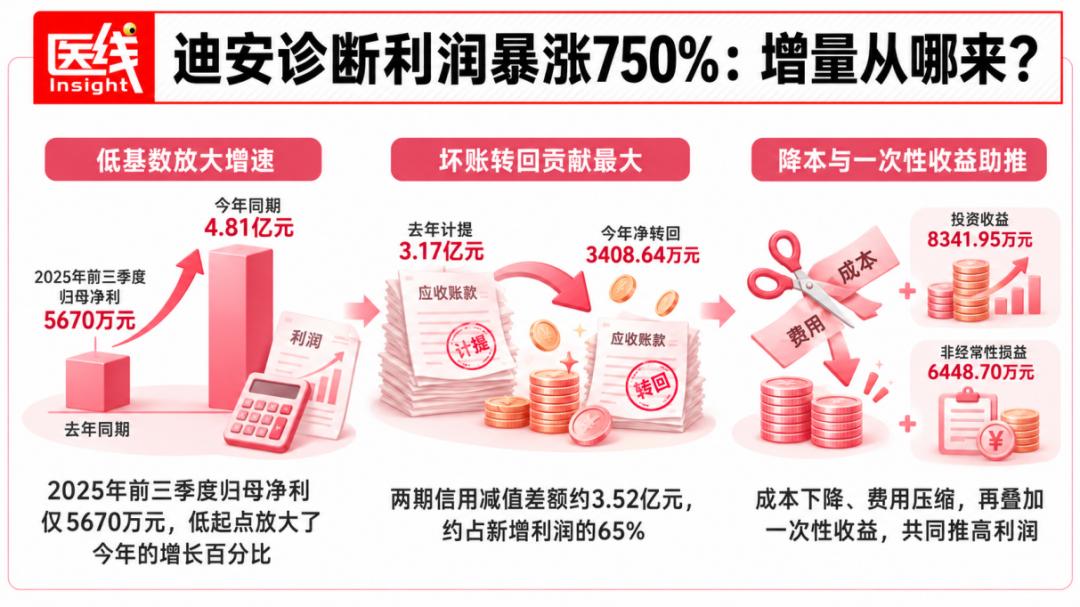
First of all, it should be noted that Dian Diagnostics' profit base last year was not high.
In the same period of 2025, the company's net profit attributable to shareholders was only 56.7048 million yuan.
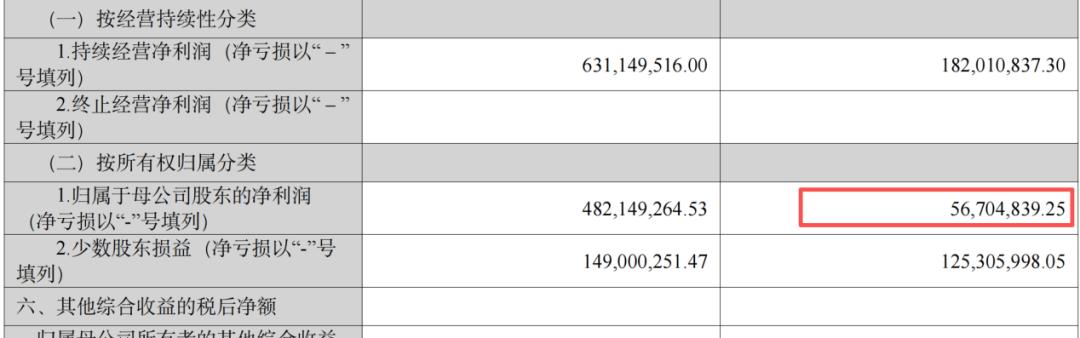
Image source: Dian Diagnostics financial report
Due to the low starting point, as long as profits rebound significantly this year, it is easy to get an astonishing growth percentage.
However, the low base can only explain why the growth rate is so high, but cannot explain where the profits actually come from.
What really needs attention is another set of data: in the first three quarters of this year, Dian Diagnostics achieved a total profit of 814 million yuan, compared with 276 million yuan in the same period last year.
In other words, the company has generated about 538 million yuan more profit than last year.
This 538 million yuan is the key to understanding the changes in Dian Diagnostics' performance.
The largest contributing part does not come from business expansion, but the previously accrued bad debt losses have been partially reversed.
This sounds a bit technical, but it is not difficult to understand in essence.
After Dian Diagnostics provides testing services to customers such as hospitals, it does not necessarily receive payment immediately.
For money that has been in arrears for a long time and may not be recovered, the company needs to confirm part of the loss on the books in advance, which is called accruing credit impairment. Accruing losses will reduce current period profits.
But if the customer pays back the money later, or the possibility of recovering the arrears increases, the company can reverse part of the previously confirmed losses, and profits will increase accordingly.
This year, Dian Diagnostics has exactly experienced such a change.
The financial report shows that in the first three quarters of this year, the company's net reversal of credit impairment losses amounted to 34.0864 million yuan, while 317 million yuan was accrued in the same period last year.
The difference between the two periods creates a profit gap of about 352 million yuan.
This single change alone accounts for about 65% of the new increment in total profit this year.
The explanation given in the financial report is that the company has recovered part of the long-age accounts receivable.
This is certainly good news, indicating that part of the backlogged payment from the past is being recovered, and the related bad debt pressure has been reduced.
However, it should be noted that this part of the profit increase does not come from the company doing significantly more testing business this year, but from the reduction of previously confirmed losses, and even part of them being reversed.
In addition to bad debt reversal, Dian Diagnostics also obtained a considerable amount of investment income this year.
In the first three quarters, the company's investment income reached 83.4195 million yuan, a year-on-year increase of 525.31%.
This income mainly comes from a corporate merger and acquisition.
According to the explanation in the financial report, when the company acquires an enterprise, it needs to re-evaluate the value of the equity it previously held in that enterprise, thus recognizing a gain.
Simply put, this sum of money is book income generated by the revaluation of equity during the corporate M&A process.
Such income is usually not sustainable, and cannot be simply understood as money the company can earn every year in the future.
Reflected in the non-recurring profit and loss statement, including the above M&A revaluation and other items, the company recognized a total of 57.819 million yuan of profit or loss from non-current asset disposal in the first three quarters, in addition to 17.1106 million yuan of government subsidies, and 9.3482 million yuan of debt restructuring profit or loss.
After comprehensively deducting the impact of other non-operating income and expenses, fair value changes, taxes and minority shareholders' profits, the total non-recurring profit and loss of the company in the first three quarters amounted to 64.487 million yuan.
Particular attention should be paid to the third quarter. In this single quarter alone, Dian Diagnostics' non-recurring profit and loss reached 70.925 million yuan, accounting for about 28% of the 250 million yuan net profit attributable to shareholders for the quarter.
Of course, Dian Diagnostics' profit growth cannot be entirely attributed to these accounting factors.
Another important reason is that the company is indeed working hard to reduce expenses.
In the first three quarters of this year, Dian Diagnostics' operating revenue decreased by about 157 million yuan year-on-year, but operating costs decreased even more, with a decline of 211 million yuan.
Although revenue has decreased slightly, costs have fallen faster, which means that for every yuan of revenue the company earns, the gross profit it can retain is actually more than last year.
Reflected in the financial report, the overall gross profit margin increased by 1.35 percentage points.
In addition to operating costs, the company is also compressing various expenses.
In the first three quarters, sales expenses amounted to 792 million yuan, administrative expenses 480 million yuan, and R&D expenses 155 million yuan. The sum of these three expenses is about 92.19 million yuan less than the same period last year.
Personnel-related expenditures are also decreasing. The cash flow statement shows that the cash paid to and for employees decreased from 1.408 billion yuan in the same period last year to 1.257 billion yuan, a reduction of 151 million yuan.
It should be noted that the decline in cash expenditure for employees is not exactly equivalent to layoffs or wage cuts, but at least it shows that the company has stricter control over manpower-related expenditures.
This also gives more specific embodiment to the "continuous optimization of organizational efficiency" mentioned in the financial report. Even interest expenses decreased from 109 million yuan in the same period last year to 90.36 million yuan.
From costs to expenses, to personnel expenditures and interest burdens, Dian Diagnostics is trying its best to save money.
These changes show that even without significant revenue growth, the company can improve its profitability by cutting costs and improving efficiency.
So, after excluding those one-off gains, has Dian Diagnostics' profitability actually improved?
There is another noteworthy data point in the financial report: in the first three quarters, the company's net profit attributable to shareholders after deducting non-recurring gains and losses reached 418 million yuan, a year-on-year increase of 1074.80%. This growth rate even exceeds the 750.28% growth rate of net profit attributable to shareholders.
This at least shows that Dian Diagnostics' profit recovery does not rely entirely on one-off gains such as equity revaluation and asset disposal.
But there is still an easily overlooked detail here. The credit impairment reversal mentioned earlier has not been completely excluded when calculating the non-recurring profit and loss deducted net profit.
To truly judge the recovery degree of the main business, we need to take the impact of bad debt reversal into consideration separately.
Therefore, a more accurate understanding of Dian Diagnostics' financial report is that profits have indeed increased significantly, but the driving forces for growth include not only the improvement of main business, but also bad debt reversal, one-off gains, and cost reduction and efficiency improvement.
These several sources of growth do not have the same significance.
This is not only the key to judging the quality of Dian Diagnostics' performance, but also an important clue to understanding the current operating situation of the entire medical diagnostic industry.
02
Warmth and Coldness:
Profits are booming, why is revenue declining?
The story on the profit statement is over, and the revenue side presents a different picture.
Year-on-year revenue in the first three quarters decreased by 2.07%, while Q3 single-quarter revenue increased slightly by 0.23%. The financial report states that "operating revenue is improving quarter by quarter, and the trend of business restoration is steadily emerging".
It is true that the performance is improving quarter by quarter, but a 0.23% single-quarter growth rate can be described as "bottoming out", while it is too early to call it a "reversal" — for a company with an annual revenue of tens of billions of yuan, a 0.23% single-quarter growth means that revenue has basically stayed in place, the restoration quality is entirely on the profit side, and the revenue side has not yet gained momentum.
Breaking down the three business segments, the differences in performance are clear at a glance.
Revenue from channel products reached 4.71 billion yuan, down 4.47% year-on-year, accounting for about 64% of total revenue.
Dian Diagnostics started by acting as an agent for diagnostic reagents and equipment of foreign brands. The channel business is a cash cow, but also a burden: its continuous contraction directly determines the overall trend of the market.
The agency business earns the circulation spread. In an environment where hospitals are fully controlling costs and testing prices are under pressure, the spread will only get thinner and thinner.
Revenue from diagnostic services reached 2.645 billion yuan, a year-on-year increase of 0.87%, almost flat.
Terminal testing demand is still weak, and the pie of hospital testing outsourcing has not grown larger.
This is the most alarming signal: profit recovery can rely on cost reduction and reversal, but the ceiling of testing volume determines the long-term growth center of this business.
Revenue from self-owned products reached 300 million yuan, a year-on-year increase of 5.70%, which is the fastest growth rate among the three business segments, pointing to the strategic direction of "discipline commercialization and technology marketization".
There are two more details on the balance sheet that can confirm the "revenue under pressure" situation.
Notes receivable increased from 282 million yuan to 350 million yuan, and more and more customers are using notes instead of cash for settlement; inventory reached 1.521 billion yuan, which is basically the same as the beginning of the year, and the goods from channel agencies are still lying quietly in the warehouse.
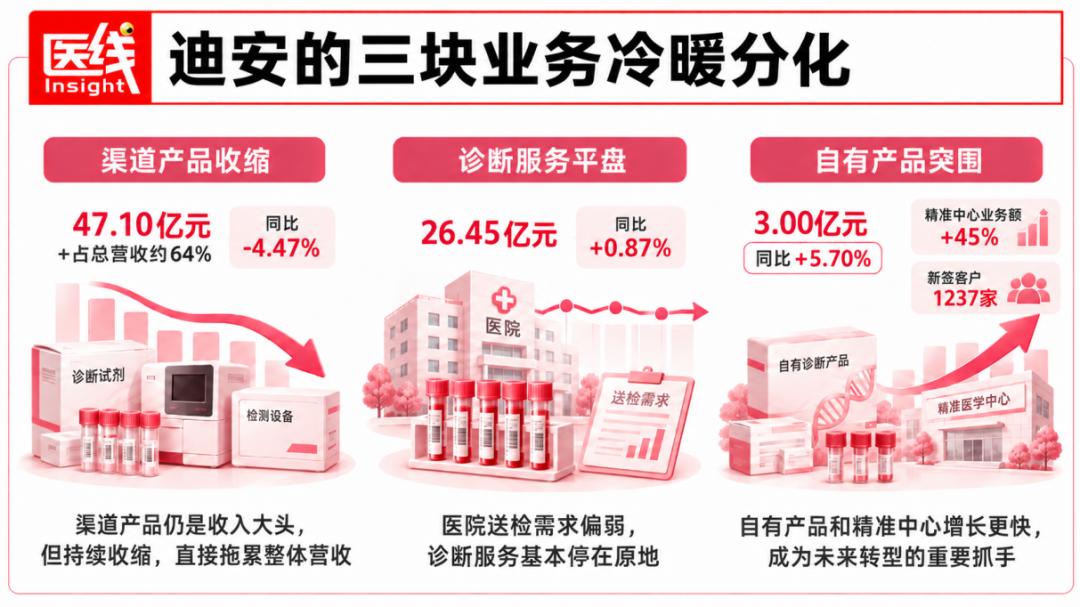
There are certainly bright spots. The number of precision centers increased by 10 in the first three quarters, reaching a total of 120, and the related business volume increased by 45% year-on-year; 1237 new customers were signed, and the company stated that "market share has further increased".
The precision center is Dian Diagnostics' tool for embedding testing services into hospitals, carrying its ambition to upgrade from general testing to special testing and high-value projects.
Of course, the different performance of the three business segments has long gone beyond Dian Diagnostics' own experience, and it is more like a thermometer for the entire ICL industry.
03
Reference:
A leading enterprise's Q3 financial report
Reflects three changes in the ICL industry
As an industry leader, Dian Diagnostics' financial report reflects three major changes facing the third-party medical testing industry.
The first is the difficulty of payment collection: nearly half of the assets are money owed by customers.
As of the end of the reporting period, Dian Diagnostics' accounts receivable reached as high as 6.124 billion yuan, accounting for 44.6% of total assets, an increase of 185 million yuan over the beginning of the year.
This means that nearly half of the company's assets are reflected in uncollected payments.
What is more noteworthy is that Dian Diagnostics' profits have rebounded sharply in this period, partly because it has recovered old debts from the past, thus writing back the previously accrued bad debt provisions.
Even the industry leader has to rely on collecting old debts to improve profits, which shows how great the payment pressure of downstream customers such as hospitals is.
Moreover, operating revenue decreased by 2.07% year-on-year, but accounts receivable increased by about 3.1% compared with the beginning of the year.
Business has shrunk somewhat, but arrears are still increasing, and the pressure of payment collection has not been truly alleviated.
Cash flow can also illustrate this problem.
In the first three quarters, Dian Diagnostics' net profit attributable to shareholders increased by about 750%, but the net cash flow from operating activities decreased by 5.46% to 824 million yuan.
Of course, the decrease in cash is also related to the company's concentrated debt repayment. But at least it shows that the improvement on the profit statement does not mean that the money in the company's hands has increased synchronously.
The second is active contraction: no longer blindly expanding the scale, but trying to save money and reduce debt.
In the past few years, third-party medical testing enterprises were busy seizing hospitals, expanding projects and scaling up. Now, Dian Diagnostics' focus has shifted to cost control and improving financial status.
In the first three quarters, the company's gross profit margin increased by 1.35 percentage points, and the three major expenses decreased by about 92.19 million yuan.
At the same time, the company has significantly reduced borrowings. The total of three interest-bearing liabilities such as short-term borrowings and long-term