Is it far too hard to make money in the fun businesses that young people are keen on?
01
After 11 long months of waiting, Klook, crowned as the largest destination experience platform in Asia-Pacific, slammed on the emergency brake right at the gate of the New York Stock Exchange.
On October 16, Klook announced that it had formally withdrawn its listing application, on the grounds that current market conditions are not suitable for going public.
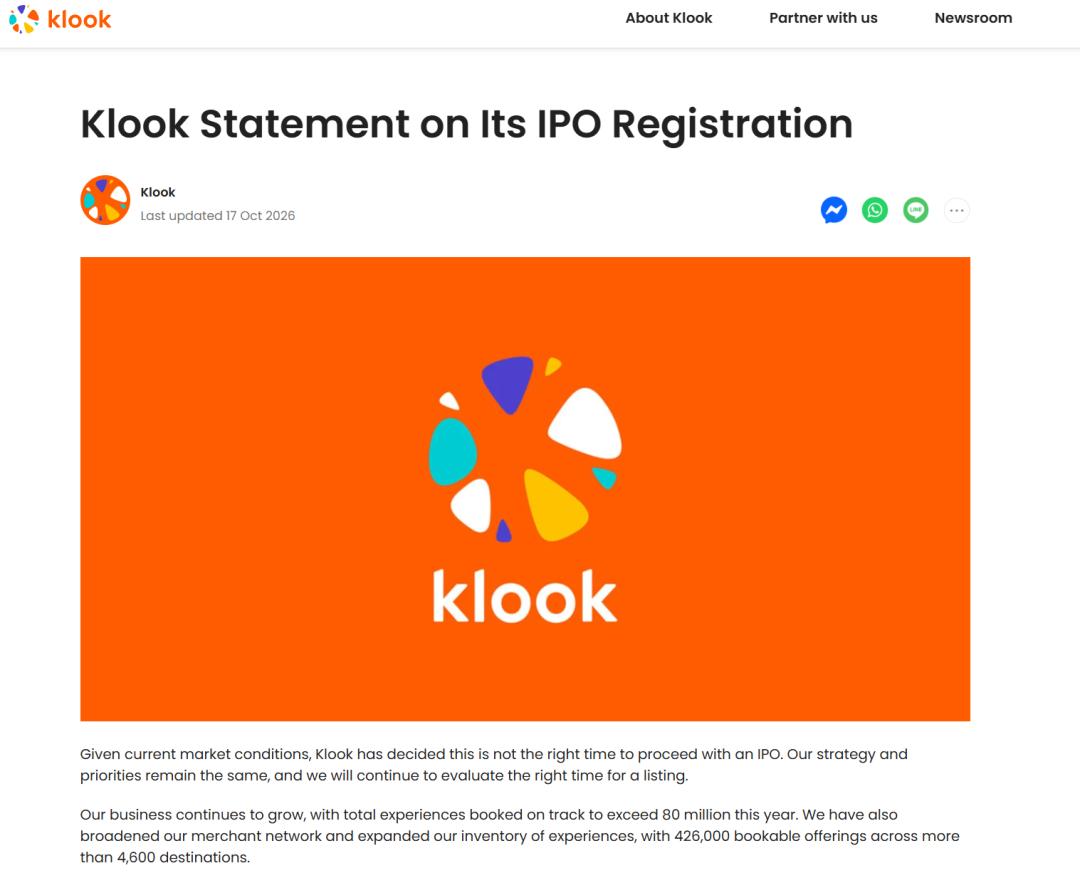
Klook's official website announced the withdrawal of its IPO
It is worth noting that Klook also stated that the number of experiences booked through its platform this year is expected to exceed 80 million, yet these seemingly impressive figures failed to help it smoothly cross the listing threshold.
Founded in 2014, Klook was co-founded by Eric Gnock Fah and Bernie Xiong, who came from investment banking backgrounds, together with software engineer Kelvin Lau.
The first two had work experience at Citigroup and Morgan Stanley respectively. The booking troubles they encountered during a trip to Nepal made them spot the entrepreneurial opportunity in destination tourism.
Over more than a decade, they targeted the business of how tourists can have fun at their destinations after booking flights and hotels.
No matter if you want to buy a theme park ticket in Japan, or book a guided half-day tour in an unfamiliar city, you can make reservations through Klook. Its business later expanded to local transportation and accommodation as well.
Theoretically, such a recreation market that is deeply popular among young people should never lack profit opportunities, but looking at Klook's recent situation, its operation is indeed far from satisfactory.
The prospectus shows that Klook's revenue reached 417 million US dollars in 2024, a year-on-year increase of 24.4%, but it still posted a net loss of 99.3 million US dollars for the whole year. Even though tourists booked about 2.5 billion US dollars worth of travel products through the platform, there is still a long way to go before the company can make real profits.
In the first three quarters of 2025, Klook's book net loss expanded to 142 million US dollars, of which about 126 million US dollars came from losses related to convertible preferred shares. In the same period, the company's operating loss was about 9.84 million US dollars, and it still failed to cross the profitability threshold.
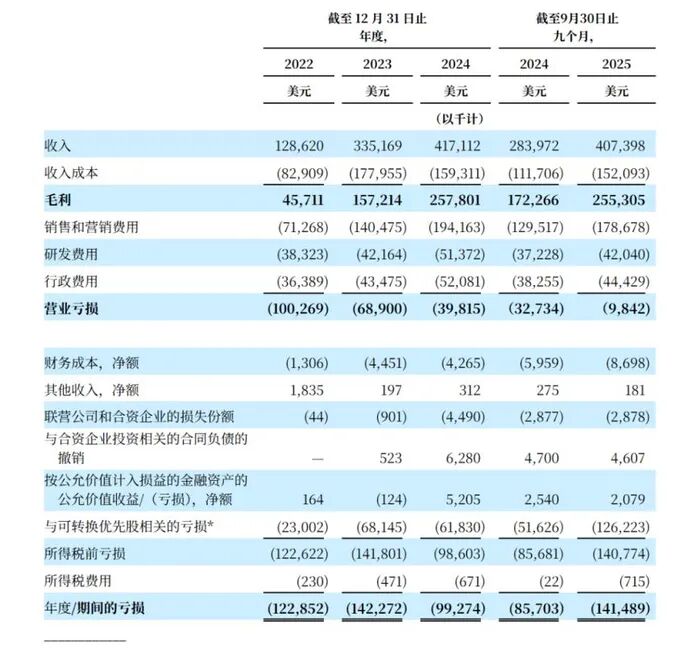
Now, after several rounds of financing, the public thought Klook was fully prepared for its listing, but it suffered a setback at the last moment.
Coincidentally, KKday, a Taiwan-based independent travel booking platform that has similar business to Klook and also focuses on local experiences, has also seen continuous news of layoffs and restructuring in the past two years.
At the beginning of 2025, Kkday laid off 38 employees, covering staff at home and abroad. In June of the same year, the company announced that it would gradually streamline about 15% of its total workforce in the second half of the year, which is expected to affect 135 to 140 people, mainly concentrated in the IT, customer service and operation departments.
In August this year, KKday launched another organizational restructuring, integrating some overlapping functions. Although it did not announce the number of employees affected by the adjustment, the company has made three consecutive adjustments to its personnel and organizational structure in just a year and a half.
Similar turmoil has also taken place at Tripadvisor, a veteran player in the global online travel industry.
Many Chinese tourists used to open it to check hotel reviews before going abroad. After years of expansion, its subsidiary Viator has also become an important platform for booking local tours and experiences around the world, but its seniority and scale have not brought it a stable operation.

In 2024, the overall acquisition transaction of Tripadvisor that the outside world expected failed to materialize. In February this year, Starboard, an activist investment fund holding about 9% of its shares, publicly pressured the board of directors to evaluate the possibility of selling the entire company, and planned to nominate new directors to seize the majority of seats on the board.
Ironically, it is precisely the predicament of these companies that makes people notice that even companies that arrange food, drink and fun for young people have many things on their schedules that cannot be completed as planned.
02
Why are young people increasingly willing to spend money on experiences when they travel, yet platforms that specialize in experience booking still cannot make substantial profits?
If you look back at Klook's accounts, you will find that from 2022 to the first three quarters of 2025, the company's cumulative net loss has exceeded 500 million US dollars, and the hard days of burning money to expand scale are far from over.
In fact, local experience platforms are superficially wrapped in a tech shell, but essentially they are still doing the tough work of traditional local ground travel agencies.
Unlike highly standardized flights and hotels, fragmented destination products are extremely scattered, and their management difficulty is not at the same level.
The prospectus shows that Klook has nearly 310,000 experience products spread across 4,200 destinations, with an average of only about 74 products per location.
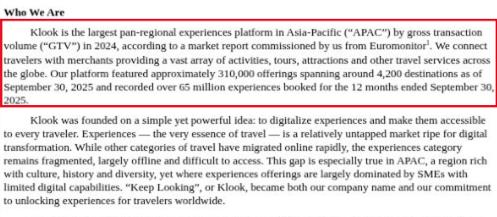
Such a widely scattered layout makes it very difficult to build a competitive moat in a single city, not to mention that behind platforms like Klook, there are countless small and medium-sized fleets and family workshops that lack digital capabilities.
The platform usually needs to help small overseas merchants maintain their inventory, and in case of extreme weather, it has to manually coordinate refunds and rescheduling for tourists. The larger the order volume, the heavier the burden of operation and customer service it bears.
At the same time, the extremely thin gross profit margin has also locked the company's profitability.
In the first three quarters of 2025, Klook's total transaction volume reached 2.292 billion US dollars, but the gross profit only accounted for 11.1% of the total transaction volume.
To attract traffic, the platform has to sell theme park tickets or transportation cards and vouchers, but the prices of these standard products are very transparent, and they barely make any profit after deducting subsidies.
If it turns to local day tours or hotel-attraction packages with higher commissions, the extended service chain is extremely easy to get out of control, and even directly damage its reputation.
Beijing Business Daily reported last year that a consumer bought a Hokkaido day tour product on Klook. Since the itinerary did not mark the sightseeing differences between different pick-up points, the consumer missed two attractions for no reason.
After the trip, the tourist contacted customer service to negotiate a refund, but was repeatedly prevaricated. Among the four solutions the platform offered, three of them tried to force consumers to use points to deduct cash payments.

Last spring, when Klook sold Lady Gaga concert plus hotel packages, it also triggered consumer complaints to Beijing Business Daily about false publicity and refund difficulties, because tickets were not issued for a long time and hotel benefits kept changing.
Ultimately, due to low product gross profit and low customer unit price, the platform can only adopt a lightweight limited service model to control costs, which leads to numerous loopholes in the performance process.
In addition to the internal problems on the supply side and after-sales service, such platforms are also at the most passive end of the travel consumption funnel.
Most tourists have already booked their flights and hotels before departure, and they often search for local experience projects at the last minute before departure or even after landing.
Klook, which lacks natural high-frequency traffic entrances, can only spend huge sums of money to buy advertisements on search engines all year round, or sign tens of thousands of social media influencers to post promotional content, but it ends up being backfired by the high cost of traffic.

Besides, private order skips are very common in local chartered car services and small featured tour groups. Tourists add social media accounts with local guides on the spot, and the platform can be easily bypassed when they travel next time or recommend the service to friends.
Spending huge cross-border customer acquisition costs to win low-frequency orders worth only dozens of dollars, while also guarding against supplier order skips and customer complaint compensation, it is extremely difficult for Klook to tell Wall Street an attractive profit story.
03
Its own hematopoietic problem has not been solved yet, and the encirclement from external giants has made the situation of vertical experience platforms even worse.
In the past, large comprehensive travel groups thought that the profit of tickets and local tours was very thin, but under the current situation of intensifying stock competition, the experience business has become a must-win battlefield for giants to retain users.
Around the world, Booking, which owns the reservation system FareHarbor, has continuously promoted its connected travel strategy in recent years.
Relying on more than 24,000 local operators connected through its system, Booking has accessed more than 150,000 experience projects on its main site, and directly integrated them into its Genius membership system.
Airbnb, the home-sharing giant, has also taken frequent actions. Since last year, it has high-profile restarted its experience and local service sector. Its platform not only launched more than 3,000 featured tours led by local experts, but also expanded its business to airport transfer and travel photography fields.

Back in the Asian market, Ctrip will pop up recommended nearby tickets and chartered car services the moment users finish booking flights and hotels.
At the same time, Xiaohongshu and TikTok have risen rapidly. Countless local overseas tour guides directly acquire customers with zero commission by posting short videos, diverting a large number of young customer groups from the source.
Facing the cross-border invasion of giants, platforms like Klook are actually facing a dimensionality reduction attack on the traffic end.
Large travel groups have already amortized their customer acquisition costs when selling flights and hotels. The marginal marketing cost of promoting local experiences incidentally is almost zero, and they can even use discounted attraction tickets as booking benefits for hotel customers.
In contrast, vertical platforms have to rely on scattered orders worth only dozens of dollars to support a team of nearly 2,000 people.
Since the giants' offensive is so fierce, will independent platforms be completely crushed?
The answer is that as platforms like Klook keep encountering obstacles in the capital market, mergers and acquisitions will also accelerate the reshaping of the industry pattern.
In February this year, Expedia completed the acquisition of Tiqets, an attraction ticketing platform. By October, some British travel agencies had begun to test the sales of related activities through Expedia's TAAP system.
By joining the large group, Tiqets obtained new distribution channels, and Expedia also incorporated the merchant relationships accumulated by Tiqets over the years into its own business, saving the time of building a supply network from scratch.
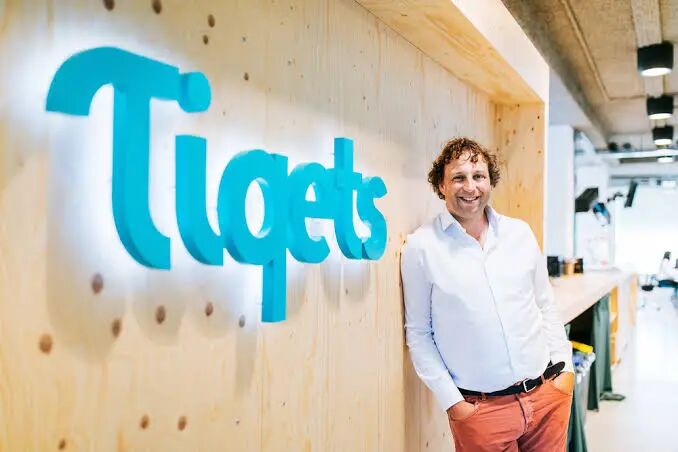
After recognizing the market pattern, top experience platforms must change their future operation modes if they want to survive.
Instead of spending huge sums of money to compete with large groups for independent app customer acquisition, it is better to turn into the "public utility infrastructure" behind the travel industry. Just like Viator supplying products to Airbnb, or Klook providing interfaces for airlines and super apps, acting as a general supply chain contractor can earn stable distribution revenue.
On the product side, platforms also need to lower their stance and operate more like a boutique travel agency that focuses on meticulous operation.
Even if heavy involvement in service will make the company move further away from the narrative of a light-asset tech stock, keeping the bottom line of service performance and cash flow is far more important than blindly expanding the number of products.
After all, today's Wall Street no longer pays for money-burning stories.
Speaking of which, at the end of October last year, business travel unicorn Navan cut its valuation by 3 billion US dollars to go public, and its share price still plummeted by 20% on the first trading day.
Klook can still wait for the next listing window, but when it resubmits its application, it still needs to explain to investors what position it actually occupies in the travel industry chain.
This article is from the WeChat Official Account Travel Daily, author: Theodore Xi, published with authorization from 36Kr.