The national inventory of new residential properties has dropped below 400 million square meters, and housing prices in first-tier cities continue to rise.
On October 19, the National Bureau of Statistics released the "Changes in Sales Prices of Commercial Residential Properties in 70 Large and Medium-Sized Cities in September 2026" and the national real estate development and sales performance statistics. The statistics show that in September, among the 70 large and medium-sized cities, the sales prices of commercial residential properties in first-tier cities continued to rise month-on-month, while the month-on-month decline in second- and third-tier cities generally narrowed.
From January to September, the national sales area of newly built commercial residential properties decreased by 13.8% year-on-year. However, as the supply declined even more significantly, the for-sale area of commercial residential properties continued to drop by the end of September, marking the first time in 21 months since the beginning of 2025 that the figure fell below 400 million square meters.
01 New home prices rose month-on-month in 17 cities
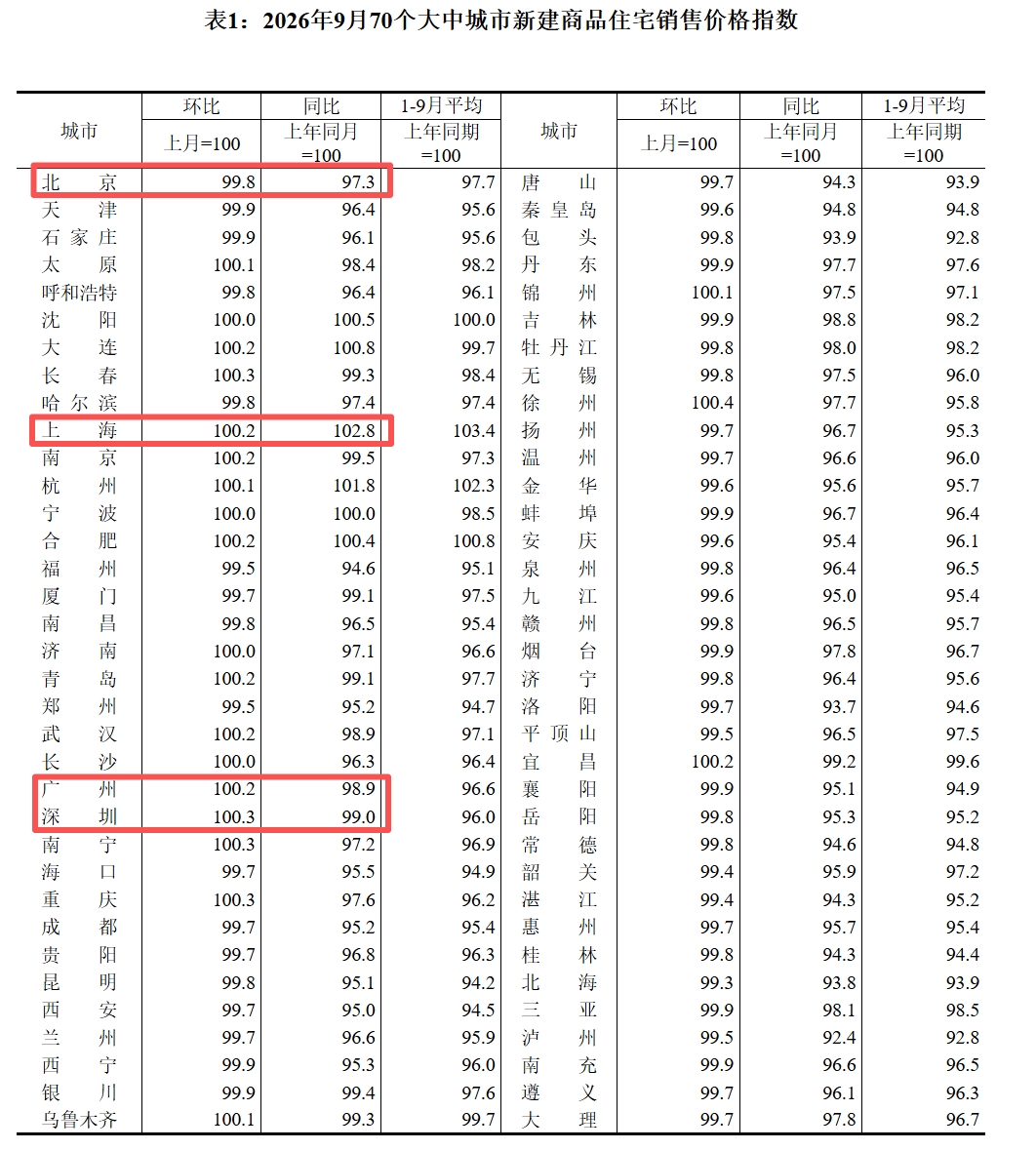
In September, among the 70 large and medium-sized cities, 17 cities saw month-on-month increases in the sales prices of newly built commercial residential properties, 2 more than the previous month, maintaining a steady recovery momentum.
Among them, the sales prices of newly built commercial residential properties in first-tier cities rose by 0.1% month-on-month, the same increase as the previous month. Shanghai, Guangzhou and Shenzhen recorded increases of 0.2%, 0.2% and 0.3% respectively. Beijing dropped by 0.2%, the only first-tier city that has witnessed consecutive month-on-month declines in home prices.
Source: Official website of the National Bureau of Statistics
The market recovery in second-tier cities expanded to more areas. Home price indices of central cities including Wuhan, Yichang and Xuzhou posted month-on-month increases. Overall, the sales prices of newly built commercial residential properties in second-tier cities remained flat in September, compared with a 0.1% month-on-month drop in the previous month.
However, compared with the same period of last year, home prices in major cities are still in a downward range, and only 5 cities including Shanghai, Hangzhou, Shenyang, Dalian and Hefei saw month-on-month home price increases.
02 Secondary home prices in all first-tier cities rose month-on-month
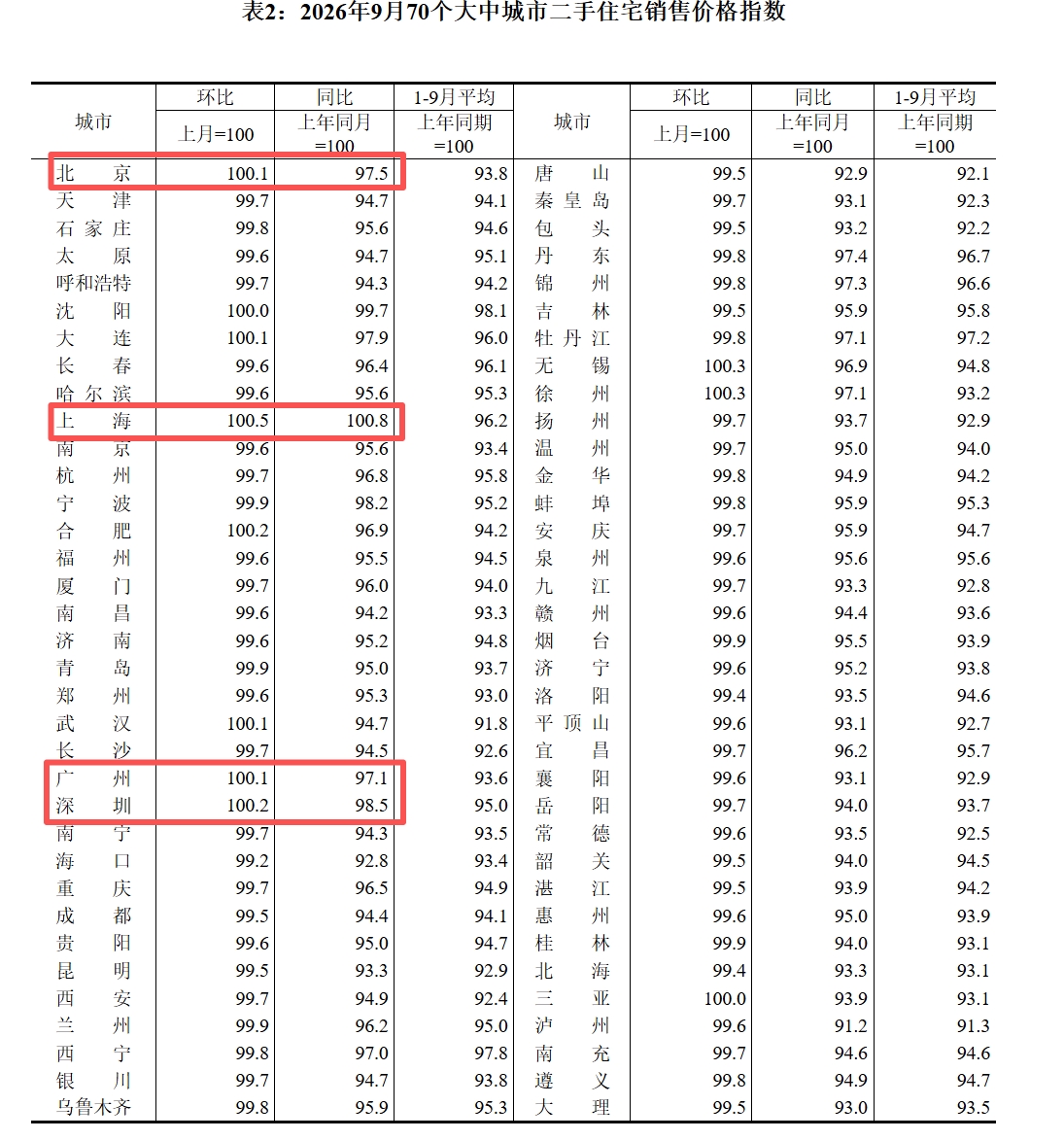
The recovery of the national secondary home market is better than that of the new home market. Data from the National Bureau of Statistics shows that in September, among the 70 large and medium-sized cities, 9 cities recorded month-on-month increases in secondary residential property sales prices, 6 more than the previous month.
Among them, the sales prices of secondary residential properties in first-tier cities rose by 0.2% month-on-month, 0.1 percentage points higher than the growth rate of the previous month. Beijing, Shanghai, Guangzhou and Shenzhen increased by 0.1%, 0.5%, 0.1% and 0.2% respectively. The secondary home price in Beijing resumed its month-on-month growth.
Source: Official website of the National Bureau of Statistics
The sales prices of secondary residential properties in second-tier cities fell by 0.2% month-on-month, with the decline narrowing by 0.1 percentage points from the previous month. The sales prices of secondary residential properties in third-tier cities fell by 0.3% month-on-month, the same decline as the previous month.
The overall transaction volume of secondary homes rose, playing a clear supporting and stabilizing role in market prices. According to data from the Ministry of Housing and Urban-Rural Development, from January to September, the online signing area of secondary home transactions reached 617.46 million square meters, up 10.7% year-on-year.
In terms of prices, the year-on-year decline in secondary home prices in first-, second- and third-tier cities all narrowed compared with the same period last year. Among them, the sales prices of secondary residential properties in first-tier cities fell by 1.5% year-on-year, with the decline narrowing by 1.2 percentage points from the previous month. The sales prices of secondary residential properties in second- and third-tier cities fell by 4.5% and 5.4% year-on-year respectively, with the decline narrowing by 0.4 and 0.2 percentage points respectively.
The upward momentum of the secondary home market is expected to continue. Analysts from the Beike Research Institute believe that the mortgage interest discount policy has lowered the home purchase threshold and effectively boosted market confidence. Overlapped with a number of recent market-stabilizing policies, it will play a positive role in real estate market transactions. Data from the Beike platform shows that after the introduction of the interest discount policy, the number of inquiries and viewings from secondary home buyers increased significantly, with the weekly viewing volume rising by about 20% month-on-month.
03 Commercial residential property inventory falls below 400 million ㎡ again
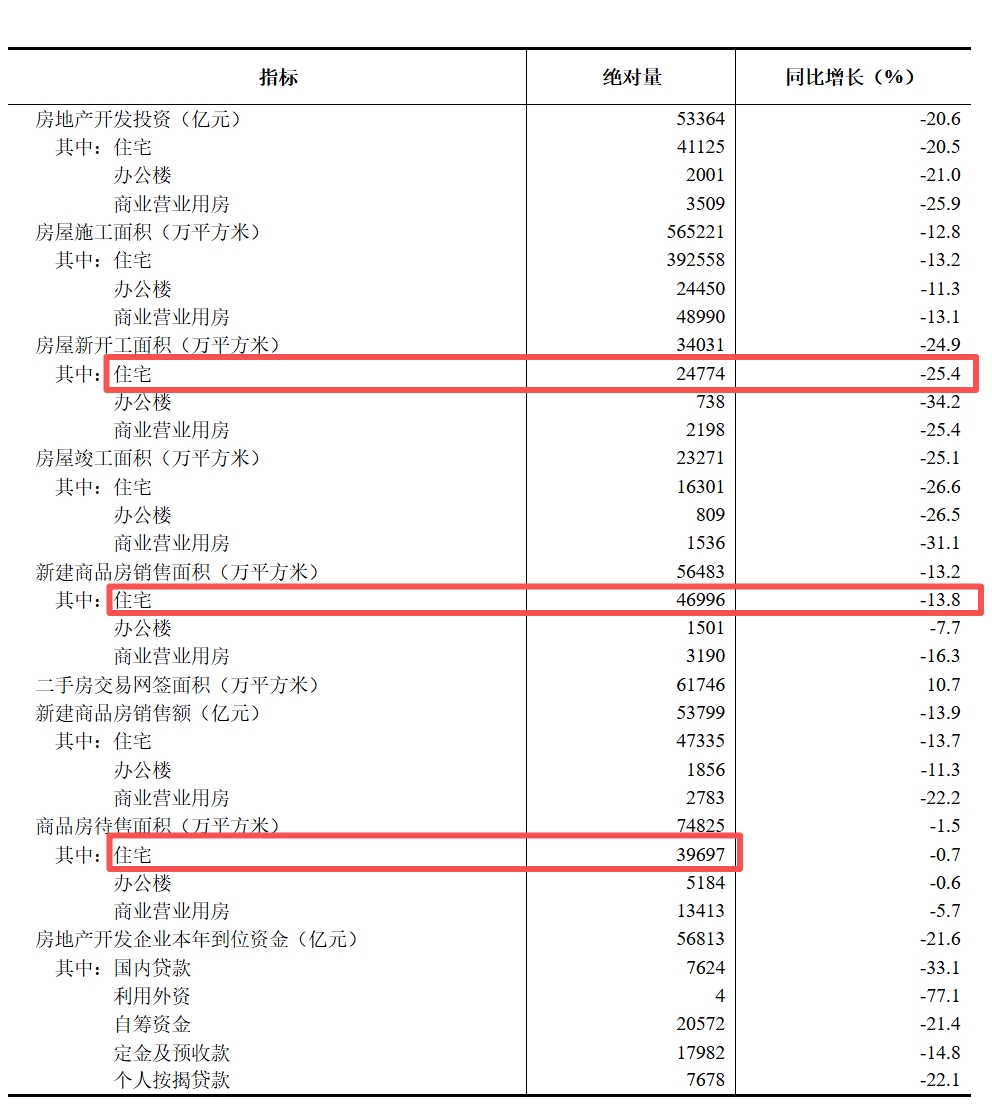
At present, the national real estate market is still in the bottoming-out stage. According to the basic national real estate market data released by the National Bureau of Statistics, from January to September, several core indicators including national real estate development investment, new residential construction area, sales revenue of newly built commercial residential properties, and funds in place for real estate development enterprises all recorded double-digit year-on-year declines.
However, as the decline rate of new residential construction area (down 25.4% year-on-year from January to September) has long been higher than the decline rate of sales area (down 13.8% year-on-year from January to September), the inventory of commercial residential properties has continued to decline since the beginning of this year, and the destocking effect is remarkable.
Data from the National Bureau of Statistics shows that by the end of September, the national inventory of commercial residential properties stood at about 396.97 million square meters, marking the first time it has fallen below 400 million square meters since the beginning of 2025.
Source: Official website of the National Bureau of Statistics
As the new home market transitions to the system of delivering completed existing homes instead of off-plan properties, it is expected that new home supply will remain at a low level in the next 1 to 2 years, and the destocking process will accelerate, with the new home destocking cycle in some key cities shortened to less than 12 months. The new home market is expected to bottom out and recover in 2027.