The first batch of third-quarter financial reports have been unveiled, and the inflection point of banks' net interest margin revenue is on the horizon.
The 2026 Q3 financial reports of commercial banks have started to be disclosed, with 5 rural commercial banks in Zhejiang Province taking the lead in releasing their results.
On October 14, Zhejiang Daishan Rural Commercial Bank (referred to as "Daishan Rural Commercial Bank") and Zhejiang Suichang Rural Commercial Bank (referred to as "Suichang Rural Commercial Bank") simultaneously published their 2026 Q3 financial reports.
Adding Zhejiang Longyou Rural Commercial Bank (referred to as "Longyou Rural Commercial Bank"), Zhejiang Wenzhou Ouhai Rural Commercial Bank (referred to as "Ouhai Rural Commercial Bank"), and Zhejiang Tongxiang Rural Commercial Bank (referred to as "Tongxiang Rural Commercial Bank"), these rural commercial banks have become the first batch of "test takers" to hand in their papers across the entire market.
Although the scale of these rural commercial banks is not large, their advantage lies in early disclosure. A look at their financial data reveals a notable common point — net interest income has generally been on the rise.
The fact that these rural commercial banks are the first to release their reports means that the Q3 performance of the 42 A-share listed banks is also expected to deliver solid results.
01. Net Interest Income Rises in Most Cases
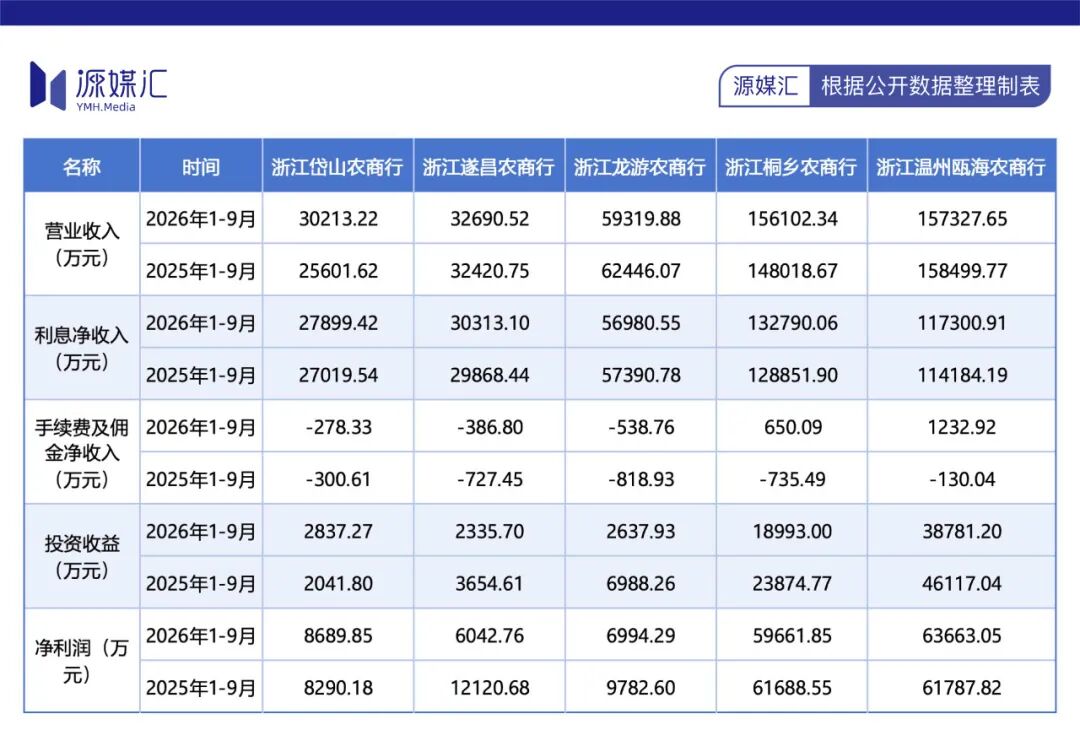
Among the 5 rural commercial banks in Zhejiang, Ouhai Rural Commercial Bank posts the largest operating revenue, with 15.73 billion yuan of operating revenue and 6.37 billion yuan of net profit in the first three quarters of 2026.
Tianyancha shows that Ouhai Rural Commercial Bank was established on June 17, 2005, with a registered capital of about 12.64 billion yuan, and Huang Wenhai as its legal representative.

Image source: Tianyancha
A breakdown of Ouhai Rural Commercial Bank's operating revenue shows that out of the 15.73 billion yuan operating revenue, net interest income reached 11.73 billion yuan, up 2.73% year on year.
Following closely is Tongxiang Rural Commercial Bank, which recorded 15.61 billion yuan of operating revenue in the first three quarters of 2026. Then Longyou Rural Commercial Bank, Suichang Rural Commercial Bank and Daishan Rural Commercial Bank realized operating revenue of 5.93 billion yuan, 3.27 billion yuan and 3.02 billion yuan respectively.
The most notable indicator is net interest income. In the first three quarters of this year, Tongxiang Rural Commercial Bank, Suichang Rural Commercial Bank and Daishan Rural Commercial Bank all achieved year-on-year growth in net interest income, while Longyou Rural Commercial Bank's net interest income remained largely flat year on year.
This seemingly unimpressive figure carries great weight against the broader backdrop of bank operations.
Data from the National Administration of Financial Regulation shows that in the second quarter of 2026, the net interest margin of commercial banks stood at 1.41%, up 1 BP quarter on quarter, marking the first single-quarter recovery since 2022.
Most of the aforementioned Zhejiang-based rural commercial banks achieved positive growth in net interest income, driven by two key factors: expanding loan scale and lowering liability costs — the dividend from deposit repricing is being fully realized at this stage.
The net fee and commission income presents a more interesting picture. In the first three quarters of 2025, 4 out of the 5 rural commercial banks recorded negative net fee and commission income, which means their fee income was less than their fee expenditure.
However, the trend has reversed this year: Ouhai Rural Commercial Bank recorded 12.33 million yuan in net fee and commission income, and Tongxiang Rural Commercial Bank recorded 6.5 million yuan, directly turning losses into profits. The other three rural commercial banks including Longyou, Daishan and Suichang still posted negative figures, but the deficit has narrowed significantly.
As for investment income, it is strongly tied to market performance. Except for Daishan Rural Commercial Bank which recorded year-on-year growth, the other 4 rural commercial banks all saw investment income shrink to varying degrees, which directly affected their net profit.
Ouhai Rural Commercial Bank achieved year-on-year net profit growth in the first three quarters of 2026, with its net profit of 6.37 billion yuan nearly 20 million yuan higher than the same period last year; Daishan Rural Commercial Bank recorded a net profit of about 87 million yuan, up nearly 5% year on year.
02. All Capital Adequacy Ratios Meet Regulatory Requirements
After reviewing the income statement, we turn to the asset side.
In terms of asset size, as of the end of Q3 2026, Tongxiang Rural Commercial Bank has total assets of 106.23 billion yuan and Ouhai Rural Commercial Bank has total assets of 105.65 billion yuan, both crossing the 100 billion yuan threshold, making them the "giants" among this group of rural commercial banks.
Longyou Rural Commercial Bank's total assets stand at 34.851 billion yuan, while the remaining Daishan Rural Commercial Bank and Suichang Rural Commercial Bank both have total assets around 20 billion yuan.
Capital adequacy ratio is the "safety cushion" for banks. The red lines set by regulators require the capital adequacy ratio to be no lower than 10.5%, the tier-1 capital adequacy ratio no lower than 8.5%, and the core tier-1 capital adequacy ratio no lower than 7.5%.
According to the currently disclosed data, except for Tongxiang Rural Commercial Bank which has not released relevant figures, all other aforementioned rural commercial banks have capital adequacy ratios that meet regulatory requirements.
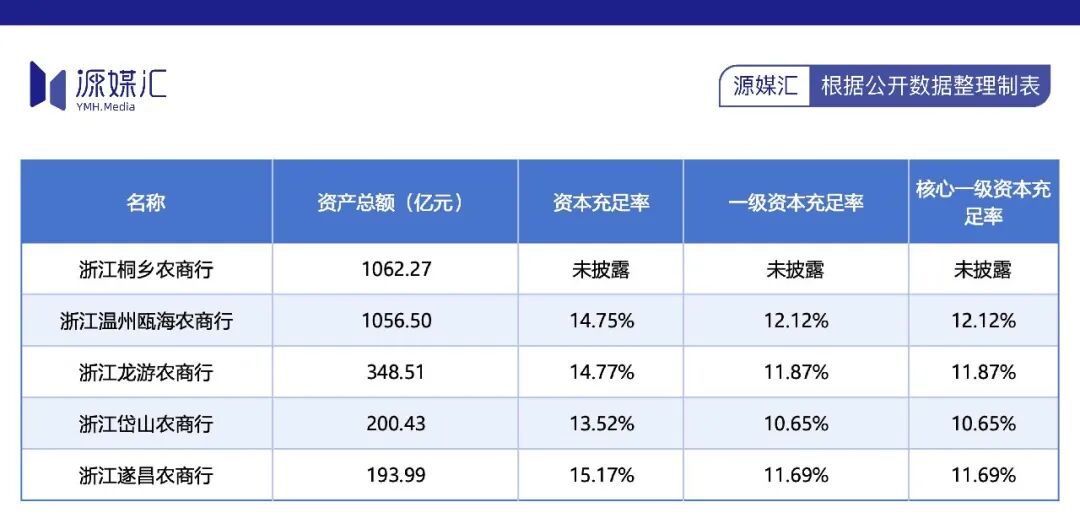
Suichang Rural Commercial Bank has the highest capital adequacy ratio at 15.17%, while Ouhai Rural Commercial Bank has the highest core tier-1 capital adequacy ratio at 12.12%, and Daishan Rural Commercial Bank has the lowest figure.
Nevertheless, rural commercial banks can replenish capital by issuing "secondary capital and tier-2 capital bonds". At the end of December last year, Daishan Rural Commercial Bank issued 200 million yuan of secondary capital bonds to supplement its capital adequacy ratio.
It is worth noting that the aforementioned rural commercial banks all issued secondary capital bonds in the past few years, but the coupon rates show a downward trend.
For example, Longyou Rural Commercial Bank issued two tranches of secondary capital bonds successively in 2022 and 2023, totaling 400 million yuan, with a coupon rate of 5.20% for one tranche and 5.00% for the other. Ouhai Rural Commercial Bank issued a 600 million yuan tranche in 2023 with a coupon rate of 4.80%, and a new 400 million yuan tranche in 2025 with the coupon rate directly cut to 2.40%.
The decreasing bond issuance cost year by year indicates that the market's credit recognition of these county-level rural commercial banks is rising, and also reflects that the risk-free interest rate has indeed dropped to a new level.
03. A Hidden Signal in Banks' Q3 Financial Reports
The solid Q3 performance of these rural commercial banks has sounded the "charge trumpet" for the 42 A-share listed banks.
Wind data shows that according to the scheduled disclosure timetable, Bank of Shanghai will take the lead on October 21, becoming the first A-share listed bank to release its 2026 Q3 financial report, followed by Ping An Bank on October 24.
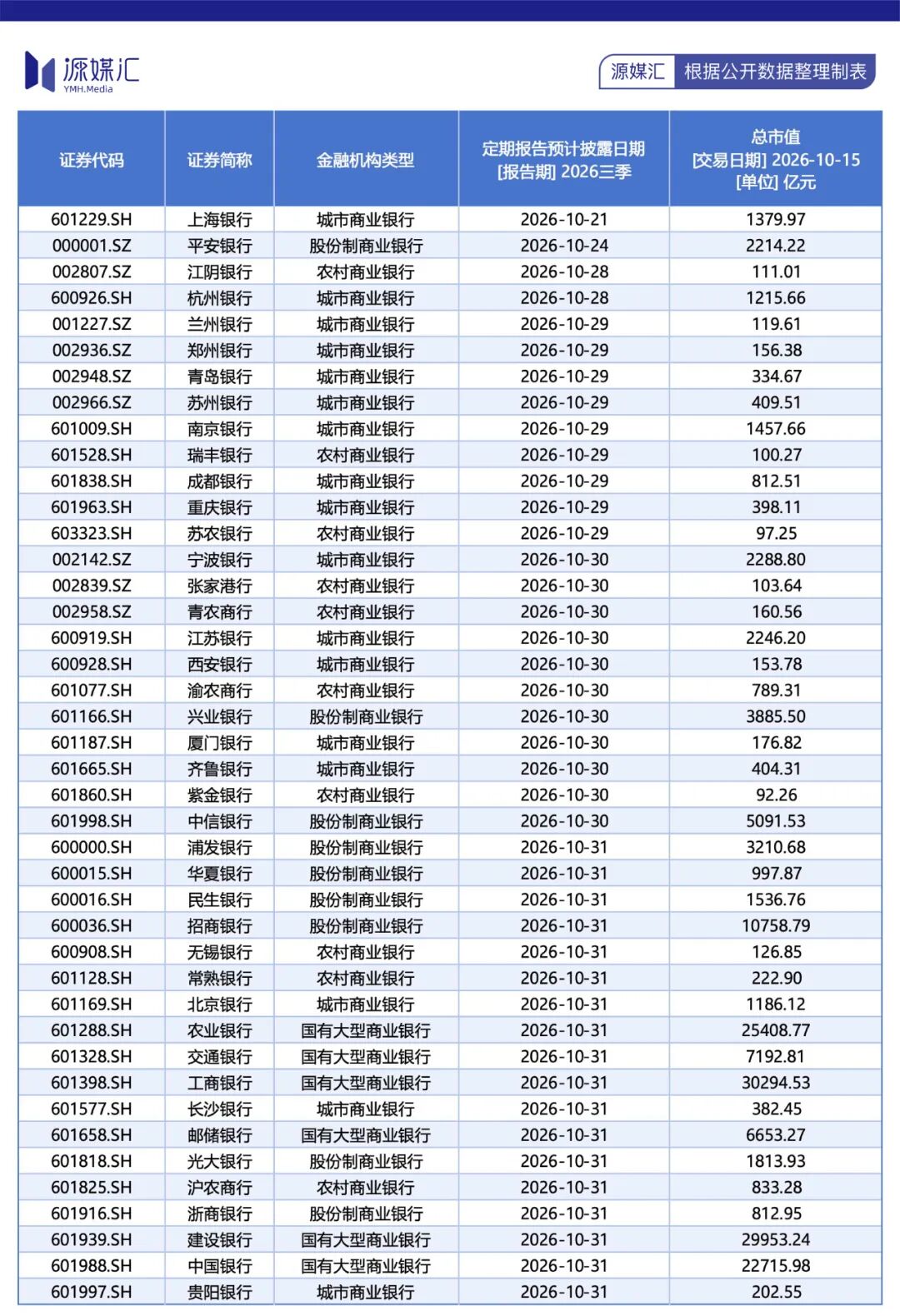
The real "disclosure boom" will come at the end of the month: on October 28 and 29, the Q3 financial reports of 10 listed banks including Bank of Hangzhou, Bank of Nanjing and Bank of Suzhou will be released one after another.
October 30 will be even busier, with 12 banks including Qilu Bank, Bank of Jiangsu, Industrial Bank, China CITIC Bank and Xiamen Bank handing in their reports together.
The most notable day is October 31, when 18 banks will release their reports in one day: the six major state-owned banks including Industrial and Commercial Bank of China, Agricultural Bank of China, Bank of China, China Construction Bank, Bank of Communications and Postal Savings Bank of China will all disclose their results, and all joint-stock banks including China Merchants Bank, Shanghai Pudong Development Bank, China Minsheng Bank, China Everbright Bank, Huaxia Bank and Zheshang Bank will also release their reports on the same day.
A total of 30 banks will disclose their reports in the last two days of the month, accounting for more than 70% of the 42 A-share listed banks.
Securities firms' expectations for this collective report are slightly differentiated from the data of these leading rural commercial banks.
SDIC Securities predicts that the net interest margin of listed banks in the first three quarters of 2026 will drop by 1 BP compared with the first half of the year, and the cumulative year-on-year growth of net interest income will reach 7.8%, 0.6 percentage points lower than that in the first half of the year. Although the positive contribution from scale expansion is weakening, other non-interest income is expected to become the main growth driver.
Shenwan Hongyuan Securities holds a more optimistic view: 2026 is a year for banks to improve revenue and consolidate provisions. Looking forward to the fourth quarter, based on "the sustainability of improvement in bank statements, the implementation of interim dividends of some banks, and the re-catalysis of patient capital layout", it is expected that the A-share banking sector will welcome further valuation repair.
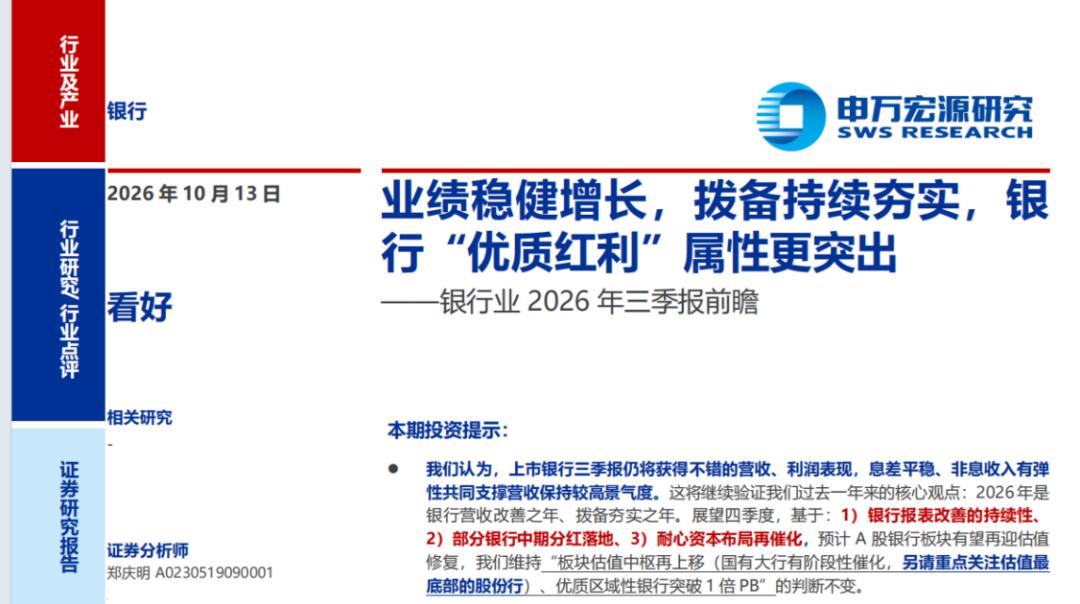
Image source: Shenwan Hongyuan Securities Research Report
The research report of Guosen Securities points out that the net interest margin of listed banks is highly certain to continue to stabilize, the earnings expectation is shifting from continuous pressure to bottoming out and improving, and the foundation of steady cash returns is further consolidated. If policy support can drive the recovery of effective financing demand, the improvement of corporate cash flow and the mitigation of credit risks, coupled with the stabilization of net interest margin, the earnings recovery of banks is expected to further accelerate, ushering in a "Davis Double Click".
The Q3 financial reports of these Zhejiang-based rural commercial banks are more like the "prelude" to the A-share listed banks' results.
The signal of positive growth in net interest income is far more important than looking at the profit figure of a single bank — it proves that the stabilization of net interest margin is not empty talk, the dividend from deposit repricing is quietly flowing into bank statements, and the turning point of net interest margin income is finally coming.
However, differentiation is also obvious: banks that rely on interest income can still maintain stable operations, while those that rely on investment income to boost performance are facing increasing challenges brought by market fluctuations. Banks with high capital adequacy ratios have both offensive and defensive capabilities, while those with thin safety cushions need to consider the next round of capital replenishment.
The Q3 performance of the 42 A-share listed banks is about to be disclosed, and the foreshadowing laid in the "prelude" of these rural commercial banks will be given an official answer by the trillion-level figures of the listed banks.
Note: The materials of this article come from official reports and public information, and the views are for reference only. Some images are from the Internet, please inform us to delete them if there is any infringement.
This article is from the WeChat official account "Yuan Media", written by Tong Hua, and authorized for release by 36Kr.