In 2027, Beijing may usher in a new housing shortage.
After the 828 New Deal, the transaction volume of Beijing's residential land market plummeted sharply, and so far, only 3 residential land plots have been transacted. The market is about to witness zero transaction in October.
After the enthusiasm of real estate enterprises for land acquisition cools down, it is almost a foregone conclusion that the annual land market will turn cold. According to public information, in the first 10 months of 2026, the total planned construction area of transacted residential land in Beijing is about 2.391 million ㎡, with a year-on-year decrease of 16.3%, about 460,000 ㎡ less than the same period last year.
On the one hand, the transaction volume of the land market continues to decline, on the other hand, the transaction volume of the residential market is picking up. According to the data from Beijing Property Sales Ranking, from January to September, 29,179 units of commercial residential buildings were transacted in Beijing, with a transaction area of 3.5564 million ㎡, increasing by 10.96% and 6.28% year-on-year respectively.
The growth rate under the caliber of Beijing Municipal Bureau of Statistics is even higher: from January to August, the city's residential sales area reached 4.895 million square meters, up 12.5%.
Meanwhile, the transaction of the second-hand housing market has also rebounded. In the first 9 months of this year, the cumulative online signing of second-hand residential buildings in Beijing reached about 137,000 units, a year-on-year increase of 5.1%, hitting a new high in nearly five years. Market demand continues to be released.
The scissors gap generated by one decrease and one increase, superimposed on the delay of new supply brought by the implementation of the policy of "capped pre-sale and priority of existing home sales", Beijing market may face a structural new housing shortage in 2027.
1
Land supply has been declining
In the past three years, the transaction volume of residential land in Beijing has been declining.
2023: 61 residential land plots were transacted, with a total construction area of about 5.812 million ㎡; 2024: The number of transacted plots directly dropped to 41, with a total construction area of 4.7038 million ㎡, a decrease of 19.07%; 2025: The transaction area dropped sharply again, with a total planned construction area of 3.5907 million ㎡, a decrease of 23.66%; 2026: A total of 36 residential land plots were transacted in the first 10 months, with a total planned construction area of about 2.391 million ㎡, a further year-on-year reduction of 16.3%.
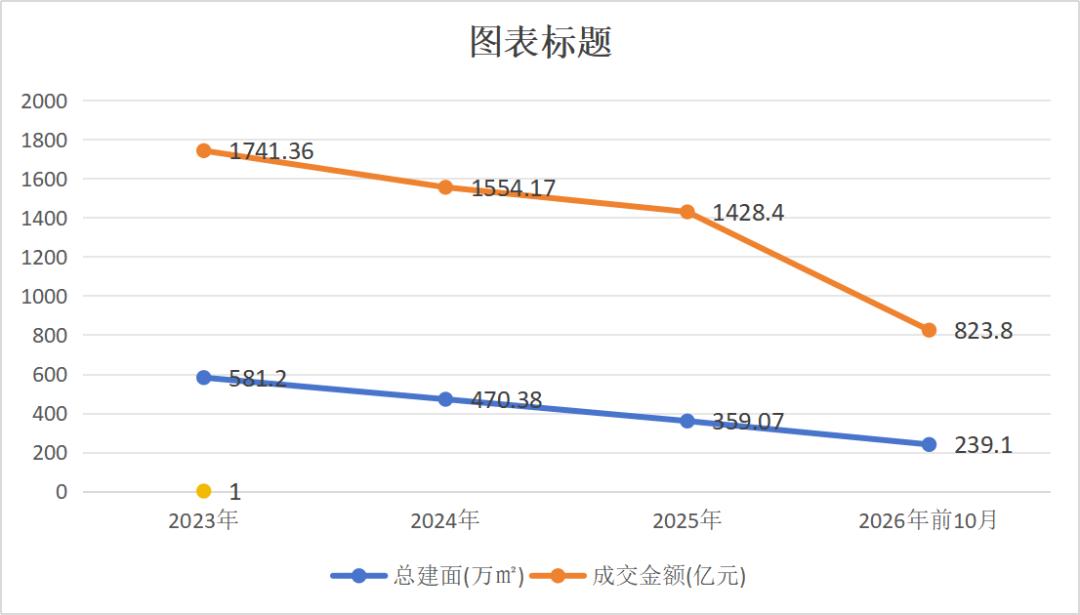
Data
For three consecutive years, the total construction area of transacted residential land in Beijing has seen a double-digit decline.
The land supply gap mainly appeared in the first half of the year. From January to June, 21 residential land plots were transacted in Beijing, with a planned construction area of about 1,219,700 ㎡, a sharp year-on-year decline of 48%. In July and August, the residential land market seized the opportunity to increase supply, a total of 12 residential land plots were transacted in the two months, and real estate enterprises replenished their land reserves.
However, the 828 New Deal became a turning point. The rules of the game for new houses have changed. The existing home sales have extended the project capital return cycle by 1-2 years, and the peak capital occupation is about 2-3 times that of the pre-sale mode. The new deal also requires that all purchase funds paid by home buyers, including down payments and personal housing loans, be deposited into regulatory accounts, and the regulation will not be lifted until the project is completed and accepted, and supporting facilities such as water, electricity, gas and heat meet the delivery conditions.
According to the statistics of the China Index Academy, after the full-process supervision of pre-sale (and existing home deposit) funds, the situation that funds "can go in but cannot come out" has become the biggest anxiety for enterprises. The project development company system restricts the group's fund adjustment, forcing the project level to carry out independent cash flow management. Real estate enterprises need to recalculate their accounts, and their willingness to acquire land is insufficient.
After three consecutive land auctions were stopped recently, last Friday, Beijing released the 12th round of proposed residential land supply list for 2026, with only 3 plots, the total planned construction scale of which is only 143,500 ㎡, with an average area of less than 50,000 ㎡ per plot. The only currently listed and transferred plots CP02-0704-0049, 0077-01 and 0073 in Xiejiazhuang Village, Changping District, will be auctioned on site in early November.
The total planned construction area of the above four residential land plots is only about 244,000 ㎡, while the total construction area of residential land transacted in the first 10 months of this year is about 460,000 ㎡ less than the same period last year. After the new regulation of "priority of existing home sales", real estate enterprises are under greater capital pressure to acquire land, and they will inevitably be more cautious in the land market, so it is unrealistic to rush to increase the volume by the end of the year.
It is almost a foregone conclusion that the transaction volume of residential land this year will continue to drop sharply, and the annual transaction volume may be less than 3 million ㎡ (total planned construction area), refreshing the lowest record in 20 years.
2
Supply Gap Appears
The residential land transactions in 2026 correspond to the new housing supply in 2027. However, in accordance with the detailed rules of Beijing's "828 New Deal", the plots transacted after August 28 must enter the market according to the new nodes of "capped pre-sale" or "existing home sales". The entry time of new houses is postponed by more than one year as a whole, and they can only be sold after the structure is capped or even the project is completed, so the time difference between supply and demand has been multiplied.
This means that the plots transacted after August this year will most likely not form effective new housing supply until 2028. The brand-new projects on the market in 2027 will only have about 2 million ㎡ of land transacted in the first 8 months of this year, and the stock that has been consumed this year must be removed.
On the demand side, according to the official caliber of Beijing Municipal Bureau of Statistics, from 2023 to 2025, the average annual transaction scale of commercial residential buildings in Beijing remained stable at more than 7 million ㎡ (7.4869 million ㎡, 7.857 million ㎡, 7.24 million ㎡). That is to say, the market needs to digest about 7 million ㎡ of new housing sources every year, which is roughly equivalent to the sum of residential land transaction volumes in 2025 and 2026.
However, the total transaction volume of residential land in 2026 has been greatly reduced, which can only form about 2 million ㎡ of effective supply. Together with the housing sources of the 2025 ongoing sales projects, there is still a relatively large gap compared with the demand of about 7 million ㎡, and this gap is difficult to be completely filled in the short term.
Beijing's new housing market is about to see the first time that supply cannot meet demand since the market downturn. It is expected that there will be a significant supply gap of new houses in Beijing in the second half of 2027.
3
Some Properties Are Not Sold Out While Others Are in Short Supply
Although Beijing's market supply and demand are facing a turning point, the scarcity of new houses is not evenly distributed.
New houses in Beijing are divided by two lines:
One is the time line, which separates the fourth-generation residences and non-fourth-generation residences. According to statistics, the overall stock of new houses in Beijing is about 70,000 units at present, of which about 10,000 units are fourth-generation residences, and about 60,000 units are historical inventories before the introduction of the fourth-generation residence policy. About half of the historical inventory has become unsold existing homes, which are still difficult to be destocked quickly.
Moreover, there will soon be another large-scale leap in product competitiveness in the market. On October 12, Beijing Municipal Commission of Planning and Natural Resources issued the "Opinions on Improving the Public Space Quality of Urban Residential Buildings (Trial)", raised-floor residences will become new products that will be gradually popularized in the future. The inter-generational product gap between historical inventory and new projects will continue to widen, and the value of old products will be further discounted.
The other line is the regional distribution line. According to the statistics of the China Index Academy, by the middle of 2026, the destocking cycle of new houses in Beijing is about 18.3 months. However, the inventory structure is significantly differentiated: the proportion of inventory in outer suburban sectors is relatively high, and the destocking cycle generally exceeds 30 months; available housing sources in the six urban districts and the suburban improvement sectors are consumed rapidly, and the destocking cycle of high-quality sectors has been shortened to less than 12 months, taking the lead in entering the tight supply range.
This differentiation means that the possible "new housing shortage" in the future will not be city-wide, insufficient supply will only occur in new projects and new products in the core urban areas and suburban improvement areas. The old projects that were difficult to sell before are still difficult to destock unless they are discounted to an absolute cost-effective level.
4
New Housing Supply Is Concentrated in a Few Real Estate Enterprises
The contraction of land supply, superimposed on the continuous improvement of industry concentration, makes the "control right" of Beijing's new housing supply in the future more and more concentrated in the hands of a few leading enterprises.
According to public statistics, among the 36 residential land plots transacted from January to September 2026, more than half were taken by 8 enterprises, namely China Overseas, China Merchants, China Resources, CSCEC, Jinmao, Greentown, Future Science City and Poly, and most of the plots obtained by these enterprises are high-quality plots in core locations.
This means that when the supply of new houses shrinks in the future, the available high-quality housing sources on the market will be highly concentrated in a few real estate enterprises. Relying on the core land reserve acquired in the early stage, these enterprises will occupy a dominant position in the new housing market in the next 2 to 3 years.
The flow of the land market is becoming more and more concentrated, and cash flow will also gather to leading enterprises through new projects. In 2025, the TOP20 enterprises by sales amount of commercial residential buildings in Beijing's new housing market seized about 77% of the market share, an increase of 4.4 percentage points year-on-year; the TOP10 enterprises seized about 60% of the market share. In 2026, the concentration trend is further strengthened. From January to September, among the TOP20 real estate enterprises in Beijing, the equity sales of 5 enterprises including China Overseas, Beijing Urban Construction, China Resources, CSCEC Real Estate and China Merchants Shekou are 1.26 times the sum of the last 15 enterprises.
After the 828 New Deal, the rules of the game for new houses have changed. The existing home sales have extended the project capital return cycle by 1-2 years, and the peak capital occupation is about 2-3 times that of the pre-sale mode. These real estate enterprises with large project reserves and strong capital strength will take the lead in the new round of competition, while small and medium-sized real estate enterprises will face greater pressure on their capital chains, and their willingness and ability to acquire land will be further reduced.
For the market, what we will face in the future is not only the problem of supply and demand gap of high-quality projects in core areas, the market supply rhythm will also depend more on the promotion strategies of leading enterprises.
Land supply has been reduced for four consecutive years, inventory in core areas is being destocked at an accelerated pace, and leading enterprises' market control capacity is enhanced. The superposition of these three forces makes the possibility of periodic tight supply of new houses in core areas of Beijing in 2027 rising.
This article is from the WeChat official account "Future Habitat", written by Xiaowu Jiandawu, authorized for release by 36Kr.