Zhiyuan Innovation has launched a new round of financing with a valuation of 50 billion yuan, and its Hong Kong stock IPO plan has been suspended.
On October 13, according to a report by *Caijing* magazine, AgiBot, the embodied AI unicorn, has recently launched a new round of financing with a financing amount of about 1 billion to 1.5 billion yuan. This round of financing is nearly completed, and its latest valuation is about 50 billion yuan. Regarding the new financing, valuation and IPO progress, the relevant person in charge of AgiBot said there is no comment for the time being.
The launch of this round of financing means that AgiBot will not be able to complete its Hong Kong stock IPO within this year. According to the relevant requirements of the Hong Kong Stock Exchange, if a listing applicant completes new financing after submitting its listing application and before listing, unless it obtains a special exemption, the listing applicant cannot be listed for trading until 120 days after the completion of the financing. The aforementioned investor said that the new round of financing means AgiBot cannot complete its IPO within this year.
A new financing of 1 billion to 1.5 billion yuan has postponed the listing schedule of a unicorn valued at 50 billion yuan. Behind this is a trade-off between the anchoring rhythm of valuation and the capitalization window period.
AgiBot was founded in February 2023, and it is a general-purpose AI robot company. Deng Taihua, the founder, chairman and CEO of the company, revealed at the partner conference in April this year that AgiBot's operating revenue grew from 300,000 yuan in the first year of the company's establishment to more than 60 million yuan in the second year, and then exceeded 1 billion yuan in 2025, achieving a 20-fold growth every year. It is the robot company in China that has achieved revenue of over 1 billion yuan the fastest from its establishment, and also the AI company in China that has achieved revenue of over 1 billion yuan the fastest from its establishment. Its 2026 target is to achieve several times of growth again.
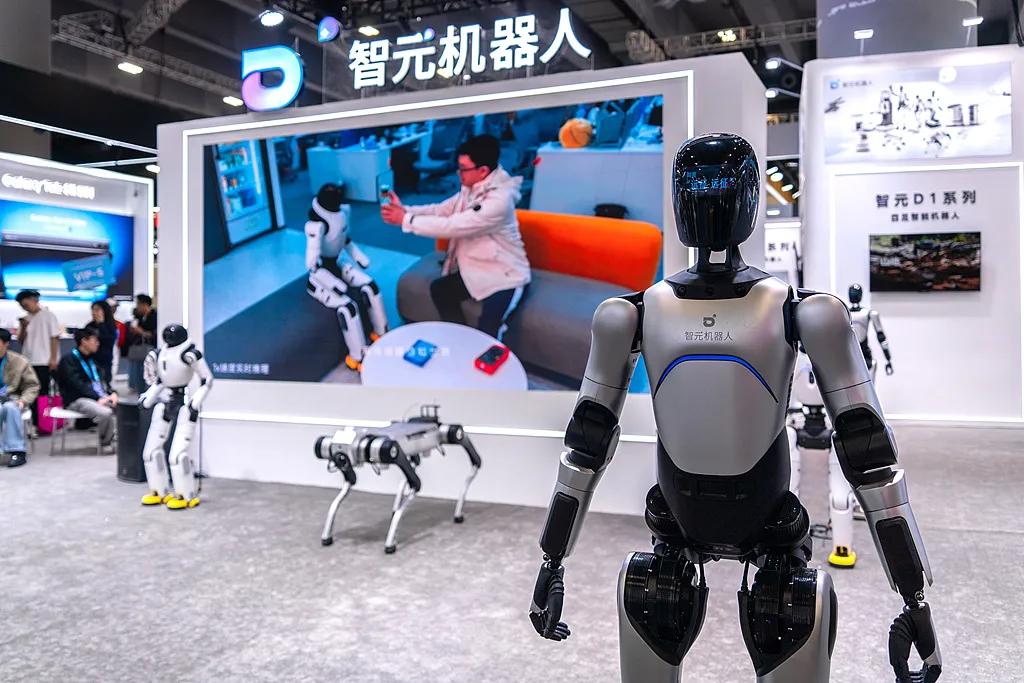
In terms of product matrix, AgiBot has built a product line covering six series: Yuanzheng, Lingxi, Jingling, Kutuo, Juechen and Zhenxuan, covering forms such as full-size humanoid robots, half-size humanoid robots, wheeled humanoid robots and quadruped robots. According to statistics from Omdia, the shipment volume of AgiBot's general-purpose humanoid robots exceeded 5,100 units in 2025, ranking first in the world and accounting for about 39% of the global humanoid robot market. According to data from CIC, in terms of revenue in 2025 and the first quarter of 2026, AgiBot Innovation is the world's largest general-purpose AI robot company.
On the production side, on September 24 this year, the 20,000th general-purpose embodied intelligent robot Yuanzheng A3 Ultra of AgiBot was officially off the assembly line at Chimelong Spaceship Park in Hengqin and delivered to Chimelong Group. It crossed the 10,000-unit mark in March 2026, exceeded 15,000 units in June, and reached 20,000 units on September 24. It took about 6 months to grow from 10,000 units to 20,000 units.
AgiBot announced the launch of preparations for its Hong Kong stock listing in July 2026. At that time, some investors revealed that AgiBot was expected to be listed as soon as August, with a target valuation of 40 billion to 50 billion Hong Kong dollars. But three months later, the listing schedule was disrupted by a new round of financing.
According to the relevant requirements of the Hong Kong Stock Exchange's *Listing Rules*, if a listing applicant completes new financing after submitting its application and before listing, unless it obtains a special exemption from the Stock Exchange of Hong Kong, it cannot be listed for trading until 120 days after the completion of the last tranche of financing. The original intention of this rule is to prevent issuers from manipulating valuations through surprise financing before listing, and ensure that the valuation at the time of listing has sufficient market verification time.
AgiBot's new round of financing is nearing completion. Even if the financing is completed at the end of October, according to the 120-day standing period calculation, the earliest it can be listed is at the end of February 2027. This means AgiBot will miss the 2026 Hong Kong stock listing window.
However, from another perspective, this round of financing is not a "passive delay" for AgiBot. In the process where its valuation has climbed from 15 billion yuan to 50 billion yuan, AgiBot chose to lock in the current valuation through a new round of financing instead of accelerating the listing process. The logic behind this choice is to consolidate the valuation foundation through primary market financing and provide a more sufficient reference for subsequent IPO pricing.
AgiBot's decision to postpone the IPO needs to be understood in the overall context of the capitalization process of the embodied intelligence industry.
In 2026, embodied intelligence companies are intensively sprinting to the capital market. More than 20 embodied intelligence companies have relevant listing plans, including complete machine manufacturers such as Unitree Robotics, AgiBot Robotics, Galaxy General, companies focusing on robot brains and models such as Xbot, Starway Robotics, Zhisquare, and core component companies such as Pacini Sensing Technology. Hangzhou-based embodied intelligence company Deep Robotics' application for STAR Market IPO was accepted by the Shanghai Stock Exchange in May this year, and Leju Robotics' GEM IPO application was also accepted by the Shenzhen Stock Exchange.
However, the listing review is tightening. According to media reports in September, the China Securities Regulatory Commission has issued informal "window guidance" to some investment banks and investment institutions, clearly raising the approval threshold for humanoid robot enterprises' IPOs, and the regulator pays more attention to whether the order revenue is real and sustainable. Stock exchanges are asking increasingly specific questions about the commercialization capabilities of enterprises.
For example, Deep Robotics' prospectus shows that its revenue doubled in the first half of this year but it fell into losses again, with only 6 units of humanoid robots sold. The Shanghai Stock Exchange raised 15 questions in the first round of inquiry, focusing on the company's detailed demonstration of the sustainability of performance growth in combination with product unit price, on-hand orders and customer structure.
Unitree Robotics' market performance also provides a reference for the industry. After Unitree was listed on the STAR Market in August this year, its market value shrank from a peak of 444.9 billion yuan to about 170.4 billion yuan, a drop of more than 60% from the high point. An investor focusing on embodied intelligence said that after Unitree's listing, the financing enthusiasm in the primary market for embodied intelligence has declined to some extent, but many investors are still paying attention to and investing in the sector. "The robot industry will definitely have value in the future, and the industrial development also requires a certain degree of foam."
Against this background, AgiBot's choice to continue financing in the primary market and postpone the IPO schedule to 2027 is a pragmatic arrangement of rhythm. The current primary market still has positive valuation expectations for leading embodied intelligence companies, while the secondary market's pricing logic for unprofitable robot companies has not been fully established. Locking in the valuation in the primary market and waiting for a more mature market window is more controllable than facing the risk of valuation correction after a hasty listing.
AgiBot's shareholder lineup is an important foundation supporting its valuation. In the primary market, AgiBot Innovation's shareholder lineup covers national teams, local funds, insurance capital, securities firms, industrial capital and financial investment institutions, including GL Ventures, Tencent, BYD, Lens Technology, M31 Capital, BlueRun Ventures, CAS Star, HSG, Baidu, JD, SAIC Motor, BAIC, etc.
From the perspective of equity structure, Sangpeng (Shanghai) Technology Partnership (Limited Partnership) holds 28.0747% of the shares, Guanbao (Shanghai) Technology Partnership (Limited Partnership) holds 10.2191%, Xingsu (Shanghai) Technology Partnership (Limited Partnership) holds 9.1969%, Pengyi (Shanghai) Robot Technology Partnership (Limited Partnership) holds 6.2926%, Shanghai Hillhouse Chenjun Equity Investment Partnership (Limited Partnership) holds 3.3343%, Beijing Hillhouse Yurun Equity Investment Fund Partnership (Limited Partnership) holds 3.3342%, Guangxi Tencent Venture Capital Co., Ltd. holds 2.6264%, and Deng Taihua holds 2.6167%. The executive partners of the first three shareholders are all Deng Taihua.
The intensive shareholding of industrial capital has built an industrial collaboration network for AgiBot covering the supply chain and application scenarios. Shareholders of automakers such as BYD, SAIC Motor and BAIC correspond to the potential implementation of embodied intelligence in automobile manufacturing scenarios; JD, as a logistics giant, corresponds to the application of robots in warehousing and logistics scenarios.
This industrial ecology of "shareholders are also customers" has been reflected in AgiBot's customer structure. Companies that have invested in AgiBot, such as Longqi Technology, have deployed AgiBot's robots in their factories, and JD Logistics and AgiBot have jointly launched the heavy-duty embodied robot Jingling G2 Max and deployed it to the Smart Wolf Warehouse.
From 300,000 yuan in revenue to 1 billion yuan in revenue, from 15 billion yuan in valuation to 50 billion yuan in valuation, AgiBot has completed the leap from zero to a unicorn in the embodied intelligence track in less than four years. 20,000 robots off the production line, the world's No.1 humanoid robot shipment volume, and six series of product matrix, these data outline the commercialization progress speed of this Shanghai-based enterprise in the embodied intelligence field.
The launch of the new round of 1 billion to 1.5 billion yuan financing has postponed AgiBot's IPO schedule to 2027. This is not a passive extension, but an active choice of rhythm. Locking in the 50 billion yuan valuation in the primary market and waiting for the secondary market to have a more mature pricing logic for embodied intelligence companies is more prudent than rushing to list with an unvalidated valuation.
Whether AgiBot's 2026 revenue target of "several times of growth" can be fulfilled, whether the leap of humanoid robots from "demonstrating capabilities" to "operating capabilities" can be completed as scheduled, and the valuation tolerance of the Hong Kong stock market for unprofitable embodied intelligence companies, will all determine the pricing starting point when AgiBot's 2027 IPO window opens.
This article is from the WeChat official account "Unicorn Early Info", author: iponews Studio, published by 36Kr with authorization.