Big tech giants have come to their senses: scrambling to compete in large model development is far less lucrative than selling chips.
In China's AI chip market, two changes are accelerating. Nvidia's market share is being eroded by domestic manufacturers, and the shipment volume of non-GPU accelerators is also on the rise.
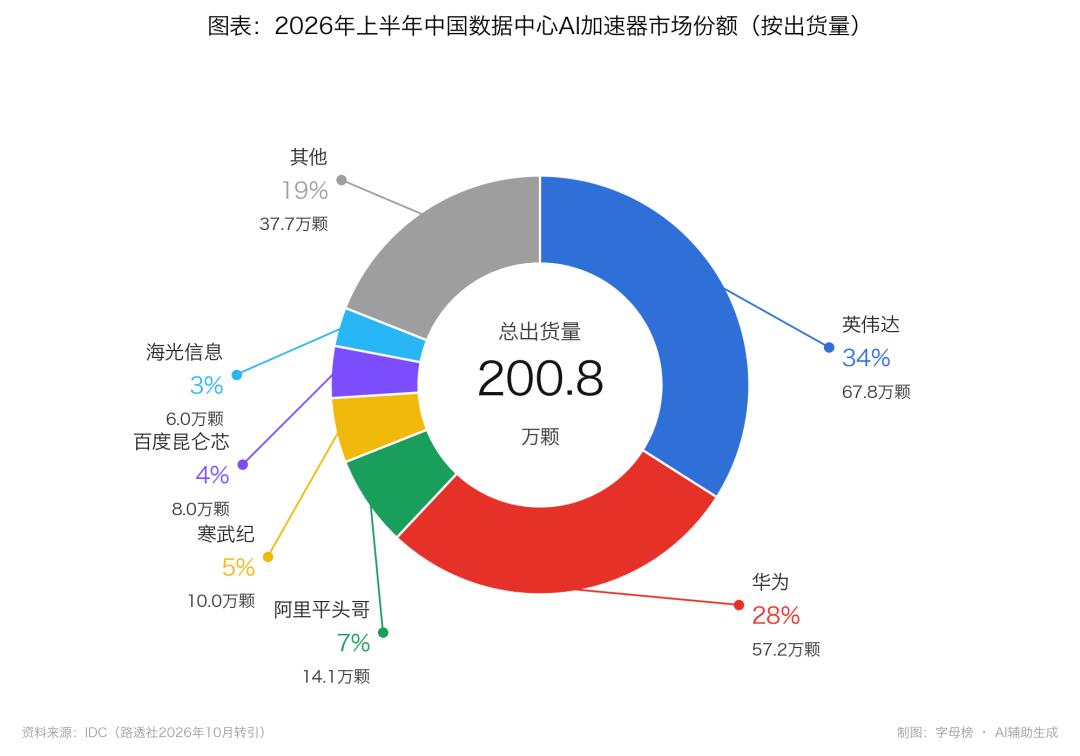
Recently, data disclosed by IDC just confirms this change — in the first half of 2026, the total shipment of AI accelerators in China's data centers reached 2.008 million units, of which non-GPU accelerators shipped 1.016 million units, exceeding GPUs in scale for the first time. Nvidia still ranks first, but its share gap with Huawei Ascend is only 6 percentage points.
Behind both changes are the figures of major tech giants. Wu Yongming, CEO of Alibaba, disclosed in March this year that the annualized revenue of T-Head Semiconductor has reached the 10-billion-yuan level. At the Yunqi Conference in September, Alibaba launched the Zhenwu V900 again, which is scheduled to be mass-produced and commercialized in the first quarter of 2027, and the annual shipment of AI chips is expected to increase significantly. Baidu is pushing for the spin-off and listing of Kunlunxin, the Tianchi super node has achieved full-stack domestic production, and Kunlunxin has completed the R&D and commercialization of three generations of AI chips.
These major manufacturers with booming chip sales are exactly the ones that have been shouting the loudest about full-stack AI. They have not missed a single link from chips and cloud to models and applications.
At present, since the model track is already extremely crowded, selling more chips has become a practical choice for major players in the AI competition.
01
While model companies are still looking for a way to profitability, the bills for training and inference have already become the profits of chip manufacturers.
According to the IDC report, in the first half of this year, Nvidia's shipment in China's data center AI accelerator chip market dropped by 44% year-on-year, with a market share of 34%; Huawei accounts for 28%, T-Head and Kunlunxin account for 7% and 4% respectively, and their combined share has exceeded Nvidia; Huawei, T-Head, Kunlunxin and Cambricon account for about 95% of the shipment in the non-GPU segment.
The direct reason for the increase in chip shipments of major manufacturers is the rising volume of model calls, the restricted supply of Nvidia's high-end products, and the fact that domestic chips have received both new demand and substitution orders at the same time.
At this year's Yunqi Conference, Wu Yongming directly listed AI models, AI chips and AI cloud as the three cornerstones. He said, "Chips are responsible for producing Tokens, and the cloud is responsible for delivering Tokens to every place that needs them."
Huawei has been pushing the industrial chain to expand production. Xu Zhijun said that currently "we will supply as much as we can produce"; the 950PR for inference has been launched on the market, and the 950DT super node for training is expected to be supplied on a large scale at the end of this year or early next year.
Alibaba also revealed that Zhenwu M890 has more than 650 external customers, covering more than 20 industries.
While domestic large models are open-sourced and priced lower, the deployment threshold for enterprises is reduced, and agents bring new demand for repeated model calls.
At a forum in September, Baidu cited the example of Taikang: more than 3,500 agents went online, with an average daily Token consumption of 20 billion. Once an enterprise starts to use Agents on a large scale, it will be followed by a continuous computing power expenditure.
High model call volume means strong inference demand. Training requires continuous investment as models iterate, while inference costs money every time it is used. Deloitte predicts that inference will account for about two-thirds of AI computing volume in 2026.
This leaves opportunities for self-developed custom chips. When the same type of task runs repeatedly, chips can be optimized around specific models and scenarios to reduce the cost of each call. Some institutions estimate that in adapted inference scenarios, the energy efficiency ratio of customized chips can reach 1.5 to 3 times that of general-purpose GPUs, and the unit computing power cost is reduced by more than 35%.
Seeing that inference chips have become a lucrative business, more and more giants want to enter the track. Tencent launched Zixiao 2.0 in July, which is mainly for its own business use, and plans to promote the deployment of 100,000 cards by the end of the year; according to reports, ByteDance's chip R&D team has exceeded 1,000 people; even the model company DeepSeek has been exposed to be developing self-developed inference chips.
However, if you want to sell chips to external parties, you must first make the business run smoothly in your own ecosystem.
The full-stack AI that giants advocate has a very practical help for chip sales: they have their own models, cloud and high-frequency applications, which can polish chips with real traffic first, dilute R&D costs, and then sell the verified products to customers in similar scenarios.
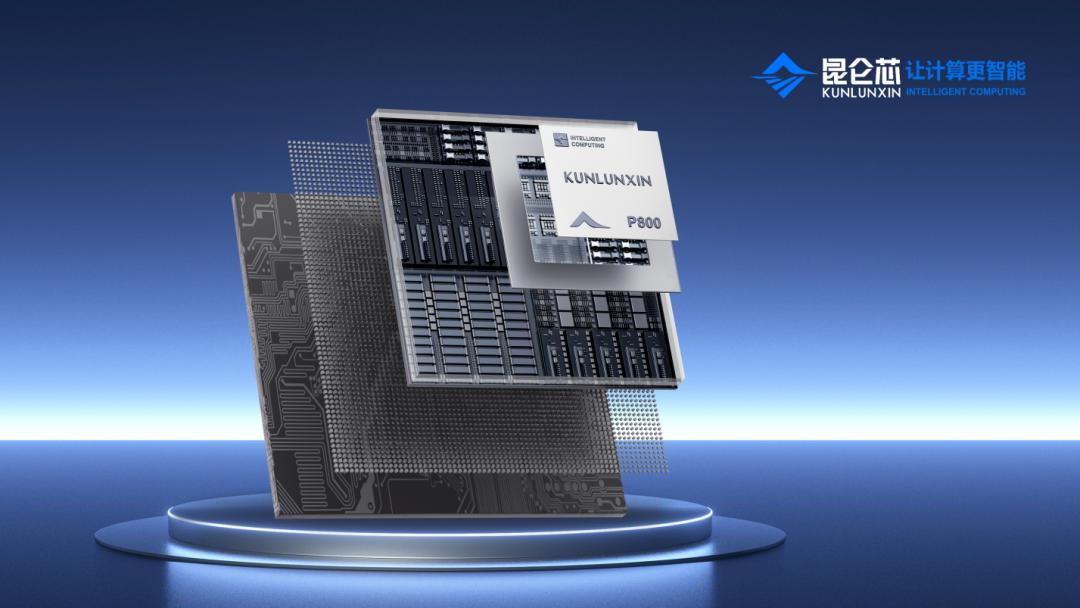
Domestic giants have already made this logic work. Shen Dou, Executive Vice President of Baidu Group and President of Baidu Intelligent Cloud Business Group, introduced that Kunlunxin P800 "has been fully verified inside Baidu", and it was launched to external industries after undertaking most of Baidu's inference tasks. In the billion-level inference procurement of China Mobile, Kunlunxin won 70%, 70% and 100% of the shares in three bid packages respectively.
Full-stack AI may not allow giants to take the lead in every layer, but as long as the chip layer runs smoothly, there will be stable external demand. The demand accumulated from models and cloud is helping them sell chips smoothly.
02
Amazon has already set a good example for the business of full-stack AI vendors selling chips.
Before the generative AI boom, Amazon had already deployed self-developed chips for AWS, which was originally intended to reduce the cost of cloud services. In the AI era, cheaper training and inference computing power has become a selling point for it to attract external customers. Anthropic and OpenAI have successively promised to use Trainium. In the second quarter of this year, the chip business including Trainium and general-purpose computing chip Graviton achieved an annualized revenue run rate of more than 25 billion US dollars.
Now Amazon is no longer satisfied with only charging computing power service fees through AWS. In this year's shareholder letter, Amazon CEO Jassy specifically measured the scale of the chip business according to the standard of independent chip companies, and proposed the possibility of selling full-container chip equipment to third parties.
Compared with Amazon, domestic giants have gone a step further, directly making the business public, forming two monetization directions. One is hardware monetization, making chips into various solutions such as super nodes; the other is to push chip companies to the capital market separately, turning chips into independent assets.
The first path is to adhere to hardware monetization, represented by Huawei and Ascend super nodes.
Super nodes are becoming a common sales method for domestic chips, packaging hundreds of chips into a complete computing system and selling it to customers, avoiding direct single-card comparison with Nvidia, showing customers what scale of models the whole system can run and how efficient it is, so that supporting products such as networks and storage are also packaged into the chip business.
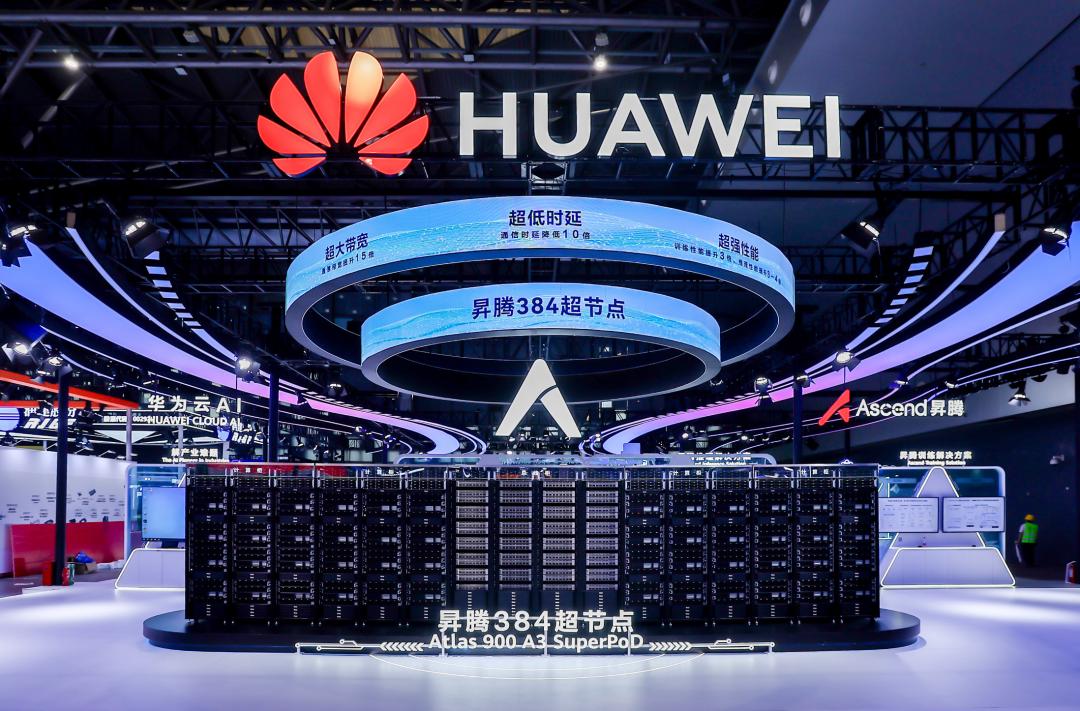
Huawei is the representative of this path. At the Full Connect Conference in September, Huawei released the Ascend 960 super node, and at the same time disclosed that more than 1000 sets of Ascend 910C super nodes have been deployed, and the Ascend 950 super node has also been commercially used on a large scale. In addition, Huawei is also promoting the open source and opening of CANN to improve the Ascend software ecosystem. In September this year, Huawei disclosed that more than 40 models have been natively trained based on Ascend and CANN.
Alibaba is also expanding its business beyond the cloud. The Panjiu super node server equipped with Zhenwu V900 is scheduled to be launched in the first quarter of 2027. Baidu also revealed that the 30,000-card cluster of Kunlunxin P800 has been lit up and put into use.
Hardware monetization is not just about selling equipment. Domestic giants are pushing self-developed chips to markets beyond cloud services, and doing both cloud service business and local delivery business at the same time.
The second path is to split the chip business into assets that can be independently valued and financed.
Baidu takes the most active approach: since the model business has not yet achieved considerable profitability, I will first let the chip business get independent pricing.
Kunlunxin submitted its listing application to the Hong Kong Stock Exchange in a confidential form in January, and completed the listing counseling filing on the Science and Technology Innovation Board in May. Baidu explained in the announcement that the spin-off will help investors evaluate Kunlunxin independently and establish an independent financing channel. According to a report by The Information, Kunlunxin is seeking an estimated listing valuation of about 500 billion US dollars, which is higher than Baidu's market value of about 360 billion US dollars at the time of the report.
The rich returns of the chip business have already been reflected in Baidu's financial statements. In the second quarter, Baidu's AI cloud infrastructure revenue increased by 50%, of which GPU cloud revenue increased by 283%.
Alibaba has a similar plan. Since the models and applications have not yet been fully verified, it will first expand the business that can generate stable revenue.
In the financial report of August, Alibaba merged the Cloud Intelligence Group and T-Head into "AI Cloud and Computing Power Services". In the quarter ending at the end of June, this segment achieved a revenue of 48.437 billion yuan, a year-on-year increase of 45%. It first merged the chip and cloud business into one account, and then considered pushing it to the capital market.
Caixin previously quoted people familiar with the matter as saying that Alibaba has decided to support T-Head to list independently in the future; Wu Yongming said that this possibility is not ruled out, but no clear timetable has been disclosed so far.
03
In the ecosystem of China's AI chips, today's big customers are tomorrow's competitors.
China's AI chip market is forming a layered pattern: Huawei leads the training chip track, the inference track focuses on cost performance, traffic is in the hands of major giants, and model manufacturers are responsible for expanding the overall demand scale.
Major giants hold procurement budgets, application traffic and investment capabilities at the same time, and can act as buyers, shareholders, sellers and competitors respectively in different cooperative relationships.
To see how complicated this relationship can be, just look at Tencent and Enflame Technology.
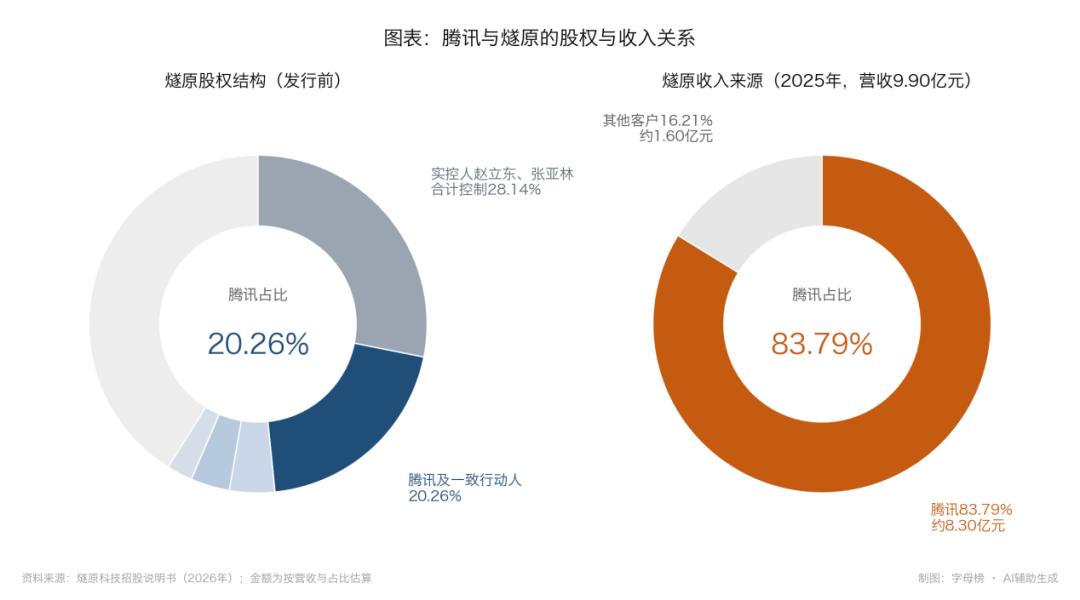
Enflame Technology was recently listed on the Science and Technology Innovation Board. Tencent has invested in it for 11 consecutive rounds, holding 20.26% of the shares and being its largest shareholder; Enflame's prospectus shows that 83.79% of its revenue in 2025 came from Tencent, which is both its largest customer and largest shareholder.
At the same time, Tencent is also promoting its own Zixiao chip project.
For Enflame, Tencent provides not only capital, but also real tasks, test environments and procurement scale. For Tencent, supporting a chip company can make products improved around its own needs, and also provide an additional supply source. The more Tencent uses its own chips, the more orders left for external suppliers need to be re-competed for.
The relationship between Alibaba and Huawei is similar. While Alibaba is making T-Head a 10-billion-yuan level business, it is still looking for suitable chips in the procurement market.
According to previous reports, after the release of DeepSeek V4, Alibaba, Tencent and ByteDance are all negotiating new orders for Ascend chips with Huawei. Alibaba and Tencent have jointly locked more than 450,000 Ascend 950PR chips, with the total order value exceeding 47.5 billion yuan.
Externally, Alibaba and Baidu pushing self-developed chips to the market will compete with their own suppliers for the next order; internally, the two departments of each company are doing their own accounting: the procurement department considers which type of card is more suitable, and the chip team considers who their own products can be sold to.
However, in the next stage, the production capacity problem may make these relationships more difficult to handle.
Zhao Haijun, Co-CEO of SMIC, talked about the "siphon effect" of AI earlier this year, saying that AI demand is crowding out the global foundry and storage production capacity.
According to a report by CCTV Finance, domestic computing power chips have "exploded in orders": domestic computing power demand is more than 10 times the supply, and the delivery schedule of some products has been postponed to one year later.
According to institutional calculations, the demand for domestic AI chips in 2026 is about 4.2 million units, the supply of SMIC N+2 process is about 2.6 million units, and the gap is about 40%; Huawei has locked about 43% of the production capacity with a five-year long-term agreement, and Cambricon gets 9% to 11% of the capacity.
In addition to wafers, HBM storage is also in short supply. The price increase of domestic chips mentioned earlier is partly due to the rising procurement cost of high-bandwidth memory.
The competition in this industry is changing from "who has stronger chip performance" to "who can get more production capacity".
Giants have orders, capital, and businesses that continuously consume chips, so they have more chips in the competition for production capacity. But if they take one more share, other manufacturers may get one less share.
Will the future production capacity allocation shift from "the highest bidder gets the goods" to a coordinated arrangement in a certain sense?
Models can continue to iterate and compete, and the full-stack story can continue to be told, but chip orders must be delivered on time.