Panorama of Q3 2026 Venture Capital Market: Investors Poured 424.8 Billion Yuan in Capital: The Total Amount of Funds Is on the Rise, Yet It Only Flows to 1% of All Companies
One quarter, 424.8 billion yuan.
This figure is 74.3% higher than the same period last year. If we only look at the total volume, China's venture capital market in the third quarter of 2026 is experiencing the most robust recovery in the past three years. However, another set of figures tells a completely opposite story: the median of single financing deal remains 20 million yuan, with zero growth.
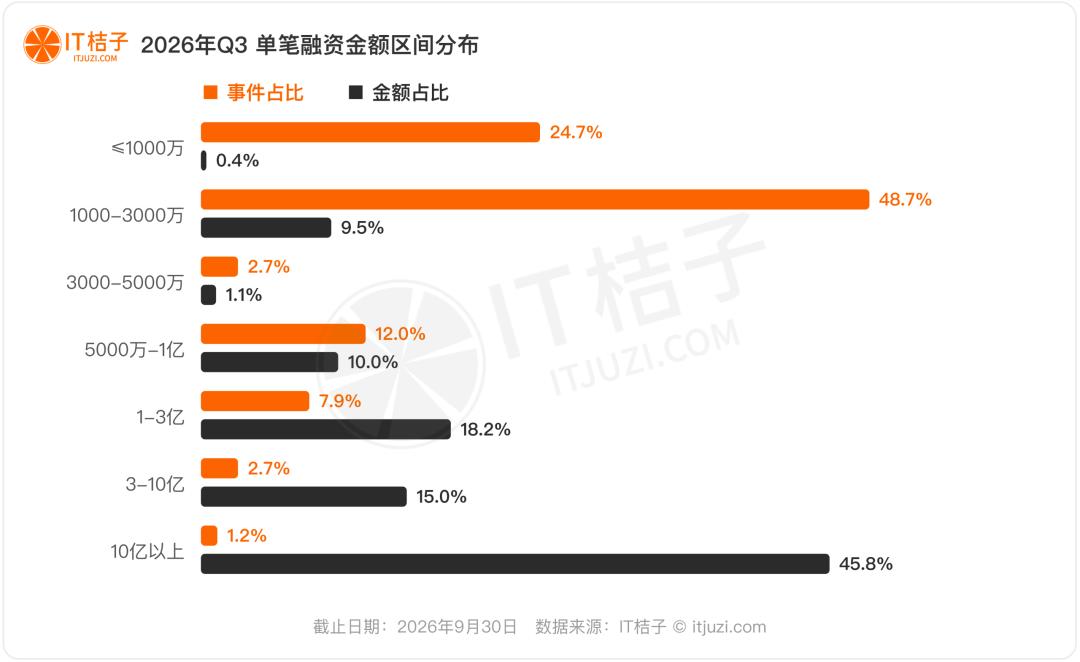
43 transactions worth more than 1 billion yuan, accounting for 1.2% of the total number of deals, took up 45.8% of the total capital; 881 small-sized financing deals of less than 10 million yuan only accounted for 0.4% in total.
There is indeed more capital in the market, but it is not distributed more evenly.
I. Market Overview: Rising Volume and Price, Intensifying Siphon Effect
In the third quarter of 2026, a total of 3,566 financing events took place in China's venture capital market, with a quarter-on-quarter increase of 22.8% and a year-on-year increase of 42.1%; the total disclosed financing amount reached 4.2481 trillion yuan, up 4.8% quarter on quarter and a striking 74.3% year on year.
In terms of the scale of single financing deal, the average financing amount rose to 119 million yuan (97 million yuan in the same period of 2025, up 23% year on year); but the median of single financing deal remained at 20 million yuan, completely flat with that of last year. The scissors gap between the average value and the median expanded to 6.0 times.
By month, there were 1,245 deals (164.15 billion yuan) in July, 1,122 deals (110.22 billion yuan) in August, and 1,199 deals (150.43 billion yuan) in September. The number of monthly deals in the third quarter all stayed above 1,100, with obvious capital investment peaks in July and September respectively. The market activity presented a "high-level plateau" rather than a "pulse market".
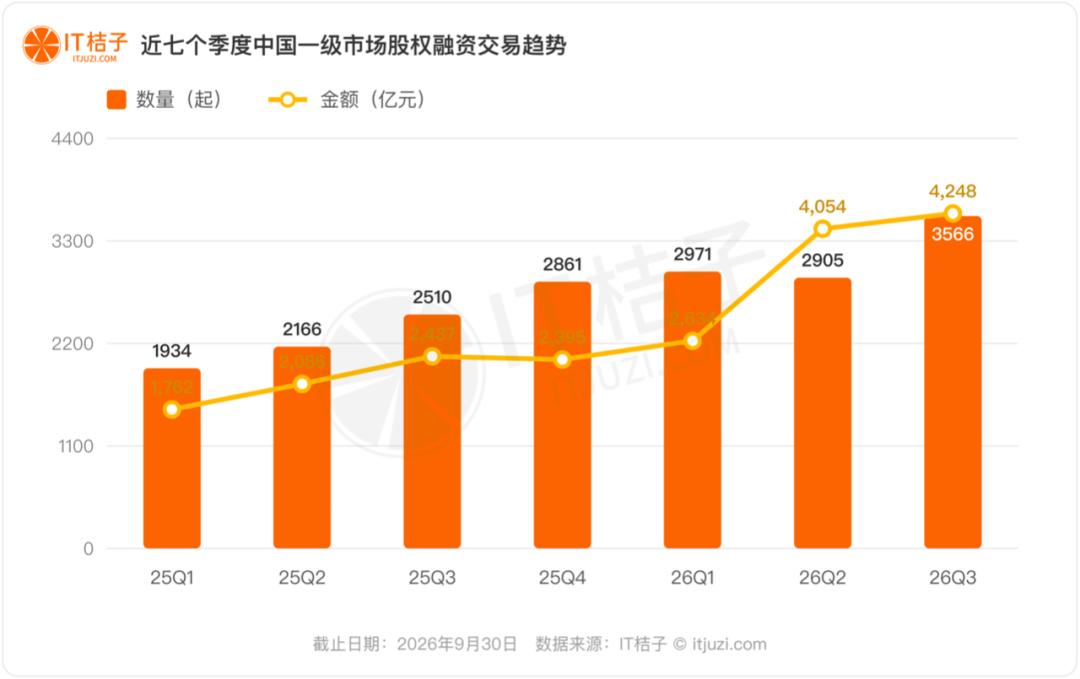
The quarter-on-quarter jump in market activity marks that the recovery channel since Q1 has not only continued, but also accelerated significantly. The number of events in the first three quarters of 2026 was 2,971, 2,905 and 3,566 respectively. The number of deals in Q3 alone exceeded 3,500 for the first time, hitting the highest level since 2025.
However, on the other side of the total volume expansion, there is an extreme structural differentiation:
• There were only 43 super-large transactions of over 1 billion yuan (accounting for 1.2%), but they took up 194.66 billion yuan, accounting for 45.8% of the total disclosed amount;
• Meanwhile, there were 881 small-sized financing deals below 10 million yuan (accounting for 24.7%), contributing only 0.4% of the total amount.
In other words, the "volume" of the market is recovering universally, while the distribution logic of "price" is highly skewed. The 50.88 billion yuan Series A financing of DeepSeek in Q2, the 3.5 billion US dollar Series F financing of Moon AI in Q3, and the 3 billion US dollar Series A financing of Kling AI are constantly raising the market's psychological expectation for super projects. The rise of the average value and the stagnation of the median is the most straightforward data footnote of this "dumbbell-shaped" capital structure.
Cumulatively in the first three quarters of 2026, a total of 9,442 equity financing events took place in China's primary market, with the total disclosed financing amount reaching 1.09357 trillion yuan — the amount has exceeded the full-year level of 2025 (868.01 billion yuan), and the number of events (9,442) has also approached the full-year level of 2025 (9,471). It has become a definite fact that the overall market has entered an upward cycle.
II. Track Map: Concentration of Hard Technology Rises to a New Level
From the industry dimension, advanced manufacturing ranks first steadily with 41.9% of the event share (1,493 deals), with a disclosed amount of 157.54 billion yuan (accounting for 37.1%). The integrated circuit sub-sector, with 418 events and a disclosed amount of 76.56 billion yuan, has become the most intensive track in the whole market. The capital narrative of domestic substitution has extended from "equipment and materials" to "manufacturing capacity" — the 29.32 billion yuan strategic investment in the third phase of Wuxi Hua Hong Hongli and the 6.5 billion yuan strategic investment in Yiswei Materials are both oriented to capacity construction.
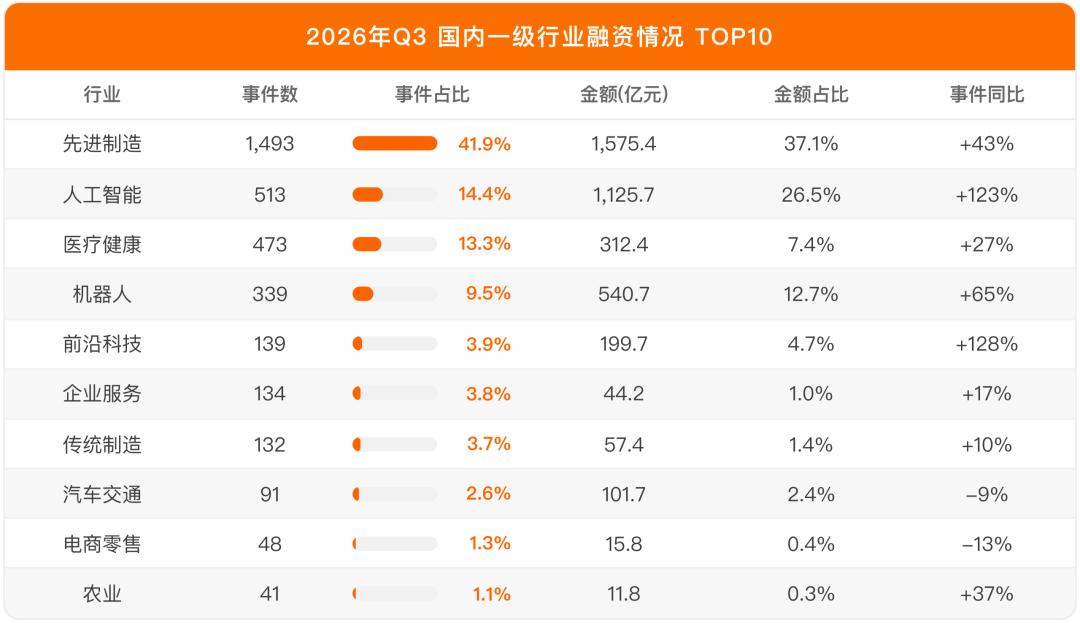
The artificial intelligence industry is the track with the most rapid amount growth this quarter. (Data taking rule here: IT Juzi event database - artificial intelligence industry, this data adopts a stricter industry concept. Different from the data taking of artificial intelligence tags, financing results of companies in a wider AI field can be obtained under the tag. The same applies below.) There were 513 events (accounting for 14.4%), with a disclosed amount of 112.57 billion yuan (accounting for 26.5%), and the number of events increased by 123% year on year. The 3.5 billion US dollar Series F financing of Moon AI Kimi and the 3 billion US dollar Series A financing of Kling AI mark that the financing scale of large model companies has entered the "ten-billion-dollar level" era. The capital focus has further shifted from the 2025 "basic model" to multimodal applications, AI Agent and reasoning computing power — the three lines of AI industry applications (139 deals), AI technology layer (136 deals) and AI basic layer (93 deals, 20.79 billion yuan) are advancing in parallel.
The robotics industry recorded 339 deals (accounting for 9.5%) and 54.07 billion yuan (accounting for 12.7%), up 65% year on year. The 6.33 billion yuan Series A financing of XPeng Robotics and the 4.92 billion yuan strategic investment of Connoxten show that the track has expanded from "humanoid robot complete machine" to surgical robots, core components and embodied intelligence ecology. It is worth noting that the proportion of early-stage events in both the robotics and AI tracks is above 80% (81.9% for AI, 80.8% for robotics), and capital continues to bet on the front end of "technological paradigm change".
Frontier technology recorded 139 deals (accounting for 3.9%) and 19.97 billion yuan (accounting for 4.7%), up 128% year on year, making it the second fastest-growing track in terms of event growth. Commercial aerospace (116 deals and 23.4 billion yuan in the aerospace sub-sector), quantum computing and controllable nuclear fusion have become the main increments. Large-scale strategic investments of 6.98 billion yuan for Yuanxin Satellite and 5 billion yuan for Changguang Satellite indicate that low-orbit constellations have entered the stage of large-scale networking.
Healthcare recorded 473 deals (accounting for 13.3%) and 31.24 billion yuan (accounting for 7.4%), with the number of events up 27% year on year, but the proportion of the amount continues to decline. The export of innovative drugs is still the main line, and the effect of pipeline maturity as the watershed of valuation has been further strengthened — biotech companies with clear licensing model expectations continue to obtain large financing, while projects in the early concept verification stage generally stay at the level of tens of millions of yuan.
Other noteworthy signals: enterprise services (134 deals, 4.42 billion yuan) saw a 17% year-on-year increase in events, but the average single deal was only 33 million yuan, and AI SaaS has not yet formed a climate in terms of amount; automotive and transportation recorded 91 deals, down 9% year on year, and the popularity of autonomous driving and solid-state battery narratives has cooled down; although there were only 38 deals in local life services, it contributed 7.77 billion yuan due to the 7.03 billion yuan strategic investment in Luckin Coffee.
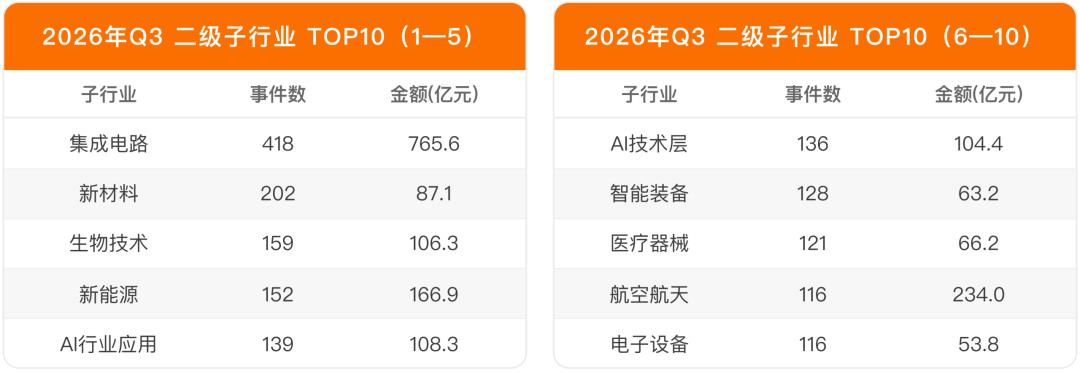
Top 10 Secondary Sub-sectors
At the sub-sector level, integrated circuits lead by a wide margin with 418 deals and 76.56 billion yuan, whose amount is more than twice the sum of the second to fourth places (new materials, biotechnology, new energy), accounting for 18.0% of the total market disclosed amount; aerospace became the second highest hard technology sub-sector in terms of amount with 116 deals and 23.4 billion yuan; the three AI sub-sectors (industry applications 139 deals / 10.83 billion yuan, technology layer 136 deals / 10.44 billion yuan, basic layer 93 deals / 20.79 billion yuan) totaled 368 deals and 42.06 billion yuan; service robots recorded 96 deals and 17.6 billion yuan, with an average single deal amount of 183 million yuan. The concentration of capital at the sub-sector level is even higher than that at the industry level — the leading sub-sectors are not only highlands of event density, but also gathering places for super-large transactions.
Overall, the five tracks of advanced manufacturing, artificial intelligence, robotics, healthcare and frontier technology together account for 82.9% of the event share and 88.4% of the amount share this quarter (76.3% and 62.3% in the same period last year). The concentration of "hard technology" has not loosened, but is accelerating to converge.
III. Stage Migration: Simultaneous Expansion of Early-stage Deals and Siphon Effect in Later Stages
In the third quarter of 2026, the early stage (seed round to A+ round) accounts for 74.9% of the event share (2,670 deals), contributing 42.5% of the amount (180.58 billion yuan); the growth stage (Pre-B round to D round) accounts for 15.1% (537 deals), contributing 22.7% of the amount (96.24 billion yuan); the later and strategic stage accounts for 10.1% (359 deals), but contributes 34.8% of the amount (147.99 billion yuan).
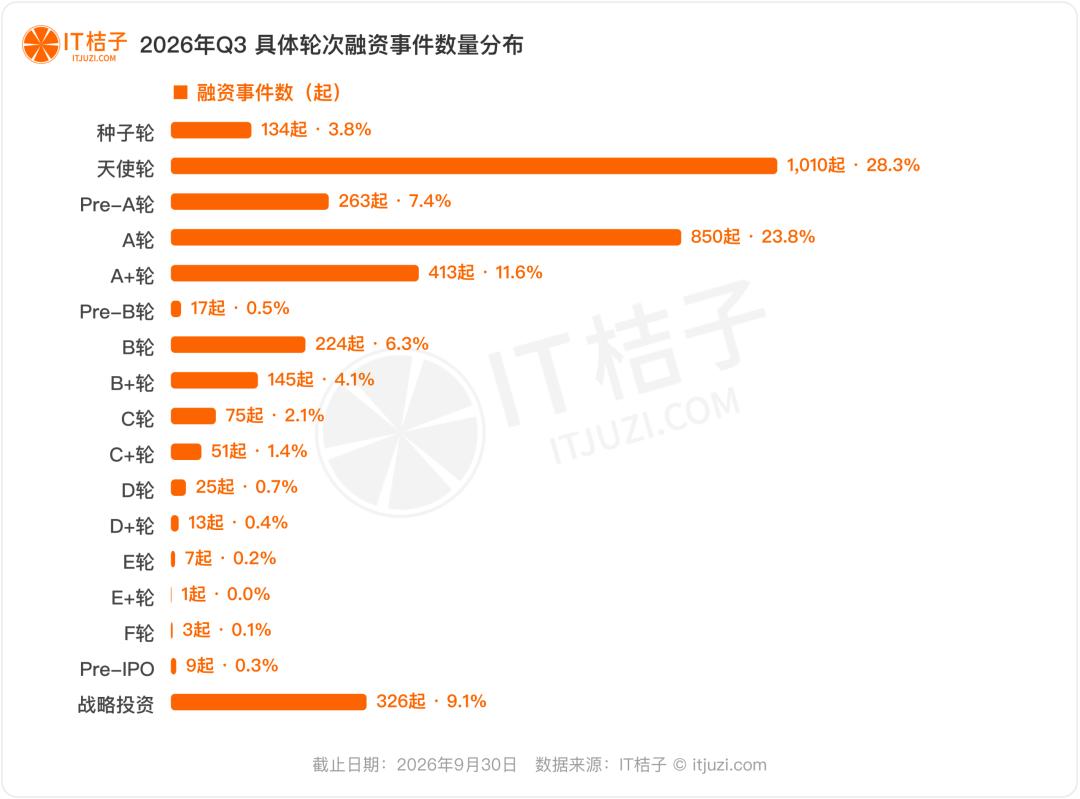
Compared with Q1, the proportion of early-stage events rose slightly from 73.1% to 74.9%, and the proportion of early-stage amount increased from 34.9% to 42.5% — institutions not only bet on more projects at the front end, but also increased the single investment intensity. In terms of round distribution, the angel round has become the largest single round with 1,010 deals (28.3%), followed by 850 deals (23.8%) in the A round, and the two rounds together account for 52.1% of the whole market; the number of angel round projects in the AI and robotics tracks reached 189 and 132 respectively, and the technological paradigm change continues to spawn new teams.
The "small proportion of events but high proportion of amount" in the later stage has further reached the extreme: 326 strategic investments contributed 114.5 billion yuan, accounting for 27.0% of the total disclosed amount. Industrial capital and state-owned capital platforms are undertaking a large number of capacity-oriented and integration-oriented capital needs in the form of "strategic investment" — this is the most important structural source of the amount growth in Q3.
The awkward situation of the growth stage (Series B rounds) has not improved: 537 events only got 22.7% of the amount, with an average single deal of 179 million yuan. For a large number of Series B companies that have completed technical verification and are on the eve of large-scale delivery, the financing window is still relatively tight. This distribution of "prosperous front end, concentrated back end, and pressured middle waist" is the most typical three-stage structure of the market this quarter.
IV. Regional Pattern: Five Core Regions Stabilized, Urban Echelon Rearranged
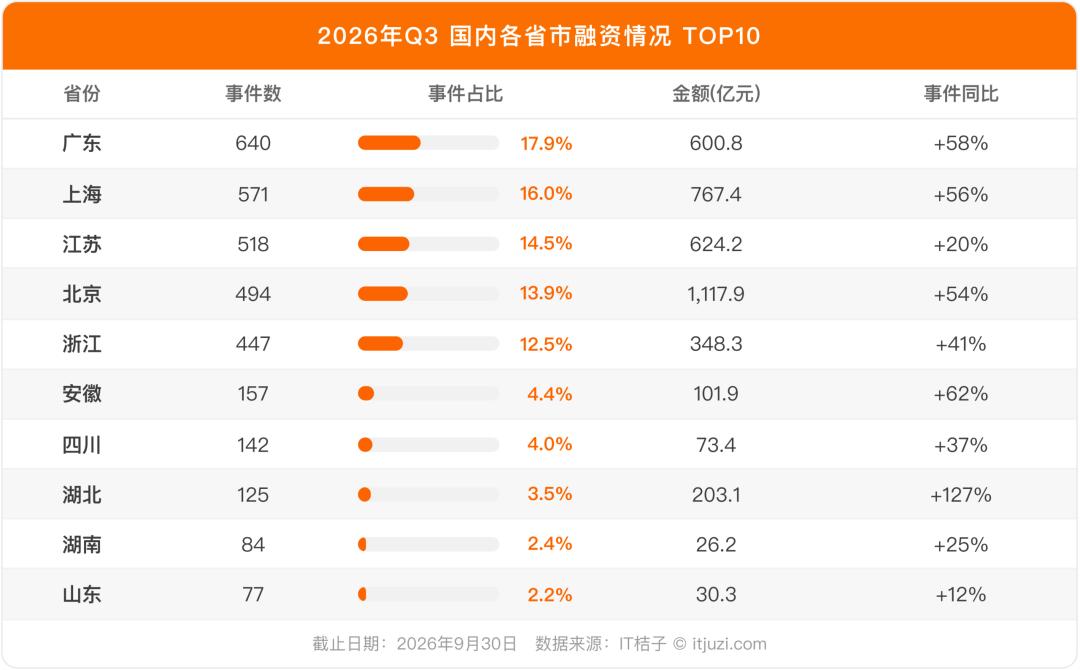
The five provinces and cities of Guangdong, Shanghai, Jiangsu, Beijing and Zhejiang together account for 74.9% of the event share and 81.4% of the amount share. Compared with Q1 (74.5% / 76.3%), the event concentration is basically flat, but the amount concentration has risen sharply by 5.1 percentage points — super-large financing is further gathering in leading provinces.
Beijing ranks first in terms of amount with 111.79 billion yuan (26.3% of the national total), and its proportion of amount is 12.4 percentage points higher than its proportion of events. Large AI financing deals such as Moon AI and Kling AI are concentrated in Haidian