Akeso Biopharma: Having completed its sixth round of financing within six years, the company has raised an additional 1.94 billion yuan from the market this time.
Before the market opens today (October 14), Akesobio (9926.HK) announced the placement of 20 million new shares at a price of HK$97.76 per share, with Morgan Stanley acting as the exclusive overall coordinator, exclusive global coordinator and exclusive bookrunner. The net proceeds amount to HK$1.941 billion, and the transaction is expected to be completed on or before October 16.
The word "discount" appears twice in the announcement. Compared with the closing price of HK$105.00 on October 13, the discount is approximately 6.90%; compared with the average price of the last five trading days of HK$107.22, the discount is approximately 8.82%.
There is another unstated discount in the announcement. Compared with the placement price of the last round at HK$149.54, the share price has been discounted by 34.6%.
Why would a company with approximately RMB 9.16 billion in cash on its books, narrowing its half-year loss by RMB 141 million and just turning positive in operating cash flow, rush to place new shares of HK$1.94 billion at a 6.9% discount when its share price has already dropped by 35%?
01 History of Seven Rounds of Financing
First, arrange the financing history of Akesobio since its listing in a table.
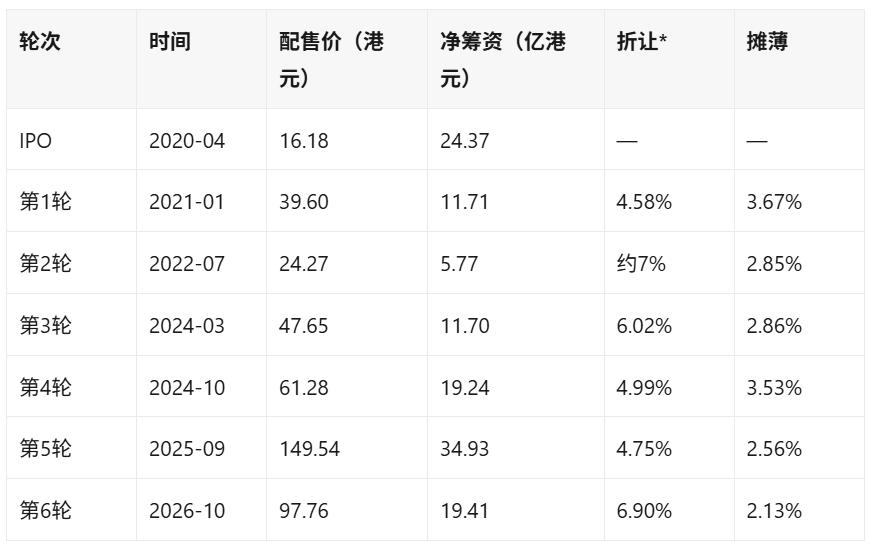
*The discount benchmark is the closing price of the full trading day immediately prior to the date of the placement agreement. Data source: all previous announcements of Akesobio on the Hong Kong Stock Exchange.
The round in July 2022 is most memorable. The share price fell from HK$39.60 in the previous year to HK$24.27, nearly halved, but the company still raised HK$577 million through placement. In September 2025, the situation was the opposite: near the historical high of HK$157, it raised HK$3.493 billion in one go. Raise more at high prices, raise less at low prices, and never miss any opportunity.
For the company's balance sheet, it is a standard rational operation to raise financing when cash is abundant; if you wait until your cash is nearly exhausted to knock on the market's door, the door will definitely have been closed. In the exit list of Hong Kong Stock Exchange 18A companies in the past few years, most post-mortem reports record the same cause of death. However, another side is rarely written into the announcements: The company wins every time, and shareholders pay every time.
In six and a half years since listing, Akesobio has raised a total of approximately HK$12 billion through equity financing (net amount caliber), with cumulative losses of RMB 3.47 billion. In 2023, most of the $500 million down payment from the Summit collaboration was recognized as approximately RMB 2.9 billion in license fee revenue, making Akesobio profitable for the first time in the year, before returning to losses in 2024. The only profitable year since listing came from selling rights, not selling drugs. The capital market has always been the one footing the bill.
Multiplying these six placement rounds together gives another figure that the company will not take the initiative to announce: Assuming a shareholder buys shares at IPO and holds them until today without any additional purchase or sale, his shareholding ratio is only about 84%. Over the seven years, he has to accept an annual dilution of two to three percentage points as a routine.
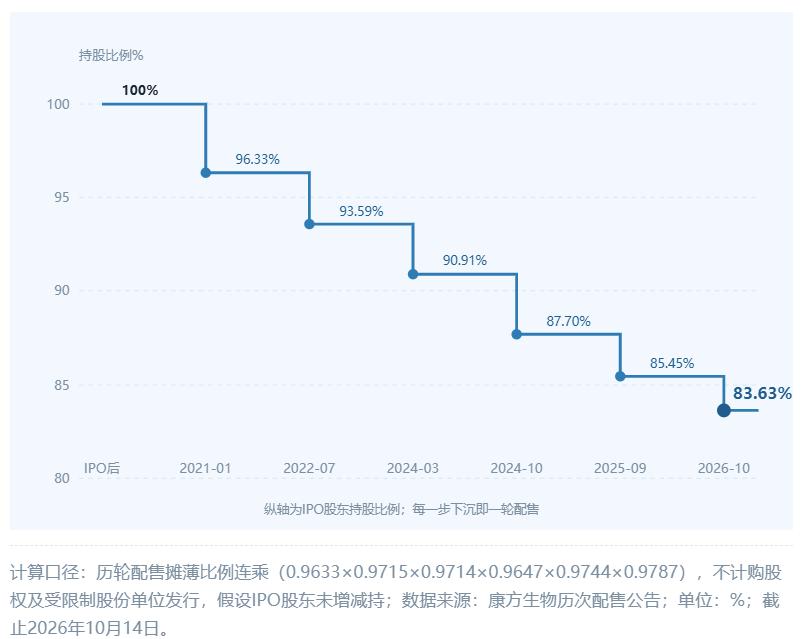
Figure: After seven rounds of financing in seven years, IPO shareholders' shareholding ratio is only 84%
02 Gross Profit Cannot Cover Dual Expenses
Look at the revenue and expenditure structure in the 2026 interim report. Total revenue in the first half of the year was RMB 1.806 billion, up 27.92% year on year, of which commercial sales revenue was RMB 1.803 billion, up 28.65% year on year, coming from two bispecific antibodies: Cadonilimab and Ivonesimab. The gross profit margin was 74.24%, down 5.16 percentage points year on year, and the cost of sales increased by 59.94% year on year.
On the expenditure side, R&D expenses amounted to RMB 783 million, sales and marketing expenses amounted to RMB 786 million, totaling RMB 1.569 billion. The gross profit for the current period was approximately RMB 1.34 billion.
Gross profit cannot cover the dual expenses, leaving a gap of RMB 230 million. This is still based on the premise that more than 10 Phase III clinical trials are in the stage of high capital investment, which is the exact words of the management at the performance meeting on August 27.
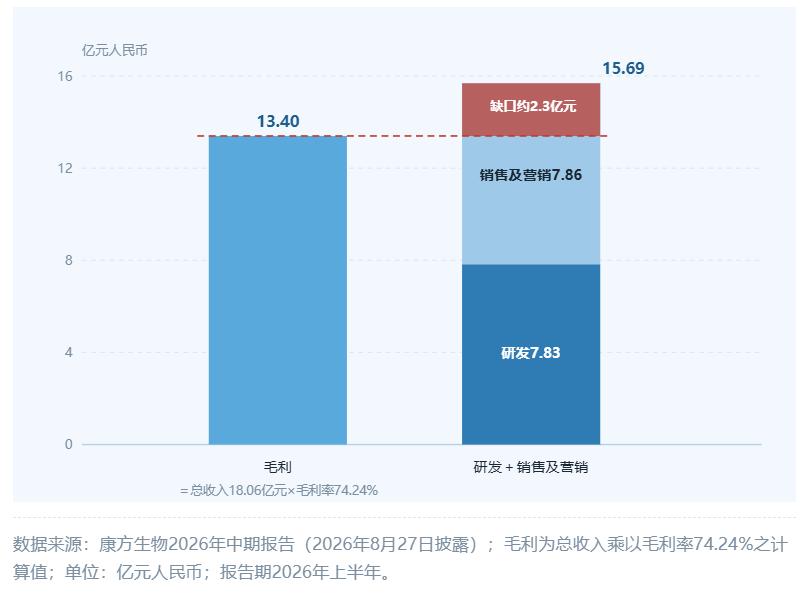
Figure: Half-year gross profit of RMB 1.34 billion, R&D plus sales of RMB 1.57 billion
Revenue growth also fell short of expectations. Nomura's outlook on July 24 predicted that the first-half revenue would be RMB 2.4 billion and net profit would be RMB 46 million. The actual revenue was only 75% of the expectation, with a net loss of RMB 447 million. JPMorgan Chase lowered its 2026-2028 sales forecast for Ivonesimab by 42%, 42% and 29% respectively on September 2, and cut its target price from HK$145 to HK$125. One of the reasons for the cut is that the renewal of medical insurance for Cadonilimab led to a 20% price reduction, and the growth in volume was offset by the drop in price: the number of doses for cervical cancer indication increased by more than 100%, and that for gastric cancer increased by 200%, but the reported revenue only rose by 28.65%.
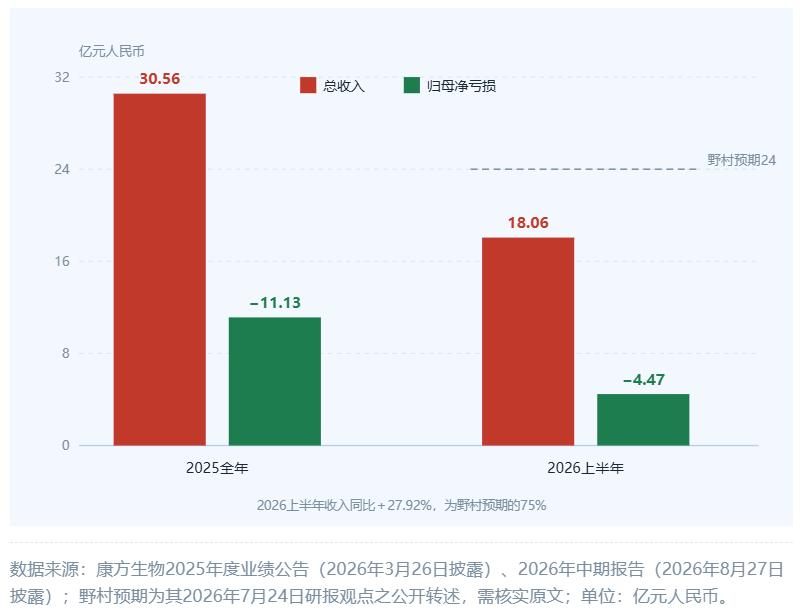
Figure: Recent status of the company's revenue and profit
In terms of cash flow, for the whole year of 2025, Akesobio's net operating cash outflow was RMB 948 million; in the first half of 2026, the net inflow was RMB 290 million, marking the first positive value since its listing. Cash from drug sales has started to flow back, but the speed of cash inflow cannot keep up with the speed of cash burn for global clinical trials for the time being.
03 One Molecule, Two Targets; One Cash Flow, Two Sources
The scientific name of Ivonesimab is bispecific antibody: one molecule binds to two targets, PD-1 and VEGF at the same time, releasing the immune brake on one hand and cutting off the tumor blood supply on the other. Among the 16 Phase III studies worldwide, all 5 studies with readout results are positive. Evaluate Pharma's risk-adjusted net present value for Ivonesimab exceeds $25.2 billion, ranking first among all global drug pipelines under research. This is the starting point of the whole story of Akesobio.
Ivonesimab is bispecific, and Akesobio's cash flow is also bispecific: one binding target is domestic sales, and the other is equity financing. Without either of the two "targets", the clinical advancement speed will drop to zero.
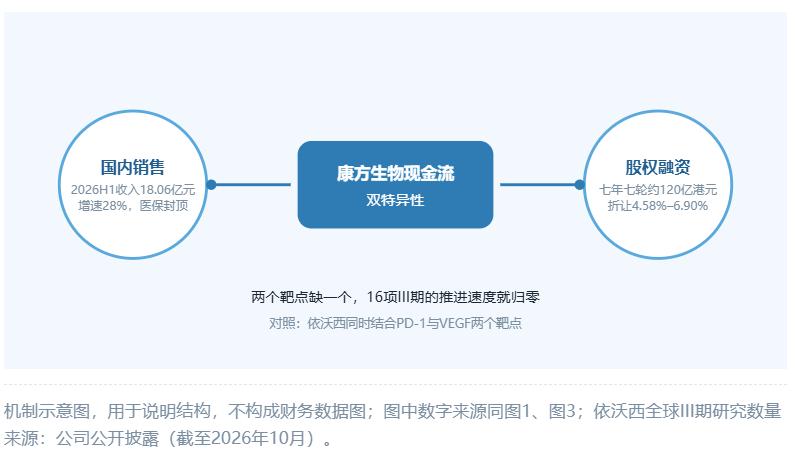
Figure: The "bispecificity" of Akesobio's cash flow
The binding force of the first target is capped by medical insurance. The revenue growth rate of domestic bispecific antibodies is 28%, with volume increasing but price decreasing, and the ceiling is clearly visible.
The binding force of the second target depends on the mood of the Hong Kong stock market. Over the past six years with six rounds of financing, Akesobio has developed a certain precision in its affinity for this "target": when the market offers a window, it takes money at a 5% to 7% discount; when the market does not, it waits for the next window.
The control group is on the other side of the ocean. In December 2022, Akesobio licensed the rights of Ivonesimab in North America, Europe, Japan and other markets to Summit for a total maximum amount of $5 billion, with part of the $500 million down payment paid in the counterparty's stock, setting a record for the amount of out-licensing of Chinese innovative drugs at that time. Three years later, this company that holds the overseas rights of Ivonesimab stated in its Q2 report that its existing working capital is insufficient to support its operations in the next 12 months, and then was saved by AstraZeneca's $2 billion equity investment.
The clinical trials in China and the self-funded global multi-center studies retained by Akesobio do not have AstraZeneca as a backstop, and can only rely on the cash on its own books and a placement channel that can be opened at any time.
The $2 billion from AstraZeneca goes into Summit's account, and there is no direct cash inflow to Akesobio. Milestone payments and sales royalties will not start to be counted until the FDA gives approval.
04 Two Outcomes, the Money Is Already on the Books
Now we can answer the question raised at the beginning.
November 14 is the PDUFA date for Ivonesimab's BLA, with the indication of EGFR-mutant non-squamous non-small cell lung cancer that progresses after treatment with third-generation EGFR-TKI. If approved, Ivonesimab will become the first Chinese original bispecific antibody to be listed in the US, and Akesobio will receive a double-digit percentage of overseas sales royalties as agreed.
The problem is that this is not a guaranteed review. The global Phase III HARMONi study supporting the BLA showed clear benefit in the primary PFS endpoint: median 6.8 months vs 4.4 months, HR=0.52. However, the primary OS analysis in May 2025 did not reach statistical significance. After extended follow-up, the OS hazard ratio in Western populations improved from 0.98 all the way to 0.76, and it has not been disclosed that the preset significance has been reached. There are real variables in the review.
The subject of insurance itself is valuable enough. At the WCLC in September, the updated overall survival data of the Chinese Phase III HARMONi-2 study showed that for first-line PD-L1 positive non-small cell lung cancer, the median overall survival of Ivonesimab monotherapy was 30.8 months, head-to-head beating Pembrolizumab's 22.6 months, with a 27% reduction in the risk of death. It is the world's first drug that beats Keytruda on both PFS and OS endpoints. The Keytruda it targets generated global sales of $31.6 billion in 2025. For such a valuable asset, paying a 2.13% premium for insurance is not expensive.
Thus the essence of this placement emerges: the HK$1.94 billion raised at a 6.9% discount is an FDA review insurance with a 2.13% premium. If approved, this money will be the cheapest ammunition before the start of commercialization; if the review is delayed or rejected, it will be the provisions to survive the winter. In either outcome, the money is already on the books.
The announcement clarifies the use of funds more clearly than any previous round: 85% will be invested in R&D pipelines and platforms, 5% in the commercialization of approved products, and 10% for general corporate purposes. The proportion of R&D investment has risen all the way from 65% in the March 2024 round to 70%, 80%, and 85% this time. The proportion of commercialization investment has been compressed from 25% to 5%. All ammunition is bet on clinical trials, and domestic sales will support domestic sales.
05 Management Cashed Out HK$449 Million in the Last Round, Minority Shareholders Pay in This Round
Putting the two placement rounds in September 2025 and October 2026 together, we see two different stories.
In the last round, the company placed 23.55 million new shares to raise HK$3.493 billion. At the same time, Xia Yu, the chairman, and Li Baiyong, the chief scientific officer, each transferred 1.5 million old shares at the same price of HK$149.54, cashing out a total of HK$449 million, which was at the historical high of the share price. After the placement, Xia Yu's shareholding was diluted from 11.4% to 10.94%, and Li Baiyong's shareholding was diluted from 5.65% to 5.34%. In the following year, the share price fell from HK$157 to HK$105, and the institutions that took over the shares at HK$149.54 had a floating loss of more than one third.
In this round, only the company issues new shares, with no transfer of old shares. If you interpret it positively, it means that the management does not think the share price of HK$97.76 is worth cashing out; if you interpret it negatively, they have already sold at HK$149.54 last time, and it would look improper to take a ride for the second time within a year. The signal itself is ambiguous, and the only clear thing is: there are old shares for sale at high prices, and only new shares for dilution at low prices, and the company will raise financing no matter at which price level.
The trading session on October 14 gave the voting result. The share price fell by about 10% in the morning session, nearly 1.5 times the 6.9% discount rate. The market is digesting not only this discount, but also the expectation of every discount in the future.
This article is from the WeChat official account "Yi Yao", author: Li Jingyi, published with authorization from 36Kr.