The "sell the news" slump hits on earnings day: all four major U.S. banks have released their financial results, yet Wall Street is not buying in.
On October 13 local time, the Q3 earnings season of US stock market was kicked off by the four major US banks.
Theoretically, this is the most confident appearance of the financial sector: Goldman Sachs saw its equity trading revenue surge 72%, Citi achieved its best Q3 performance in at least a decade in the fixed income trading business, and JPMorgan Chase posted a 6% year-on-year rise in net profit in the third quarter.
However, after the market close, the market gave a cold response — performance beating expectations did not drive share prices up, and performance in line with expectations also failed to push prices higher.
JPMorgan Chase's revenue and profit both missed expectations, with its share price closing down 0.86%; Goldman Sachs' EPS and revenue significantly beat expectations, once rising more than 4% before market open, but was dragged down to a 0.23% decline at the close; Citi's earnings beat expectations but plunged about 5.6%; Wells Fargo's revenue and net interest income failed to meet targets, down more than 3%.
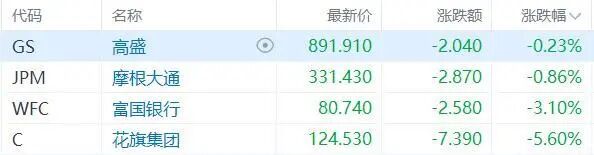
The most notable thing to record on this day is not how much profit a certain company made, but that "strong earnings reports" are losing their magic power.
Goldman Sachs' Equity Trading Revenue Surged 72%
Goldman Sachs was supposed to be the protagonist of the day.
Earnings reports show that its Q3 revenue reached 18.68 billion US dollars, up 23% year on year; net profit hit 5.3 billion US dollars, up 29% year on year; diluted earnings per share stood at 17.01 US dollars, higher than 12.25 US dollars in the same period of last year.
The most eye-catching highlight is that equity trading revenue jumped 72%, investment banking business revenue rose 21%, and asset management fee revenue hit a record high.
Among them, equity financing revenue was 3.365 billion US dollars, up 96% year on year; equity intermediary revenue was 3.076 billion US dollars, up 52% year on year.
The driving factors lie in the strong growth including prime brokerage business and portfolio financing, as well as the significant improvement in derivatives trading.
However, FICC trading revenue reached 3.47 billion US dollars, down nearly 1% year on year, lower than market expectations.
David Solomon, CEO of Goldman Sachs, warned in September that this business would face slowdown pressure.
Against the backdrop of the dual recovery of investment banking and trading, this is a performance report that can make the management smile on the earnings call.
But the market does not think so.
Goldman Sachs' share price rose more than 4% in early trading, as if to price in all the "better-than-expected" performance at once, but capital soon began to retreat; by the close, the share price instead edged down 0.23%.
The reason is not complicated.
Goldman Sachs' outstanding performance largely comes from the boom in equity trading, while FICC (fixed income, commodities and foreign exchange) revenue fell by nearly 1%, and the backlog of investment banking business also declined compared with the second quarter.
For Wall Street, "strong performance this quarter" has already been reflected in expectations, and "whether performance can be even stronger next quarter" is the basis for trading decisions.
In other words, Goldman Sachs is not performing poorly, but is overhyped by overly high expectations.
JPMorgan Chase's Net Profit Rose 6% YoY in Q3
JPMorgan Chase is the US bank with the largest asset size, and its earnings report is more like a physical examination of the macro economy.
The company's adjusted Q3 revenue of 50.91 billion US dollars missed expectations, and total trading revenue of 10.3 billion US dollars was also lower than expected;
Its profit in Q3 reached 15.3 billion US dollars, up 6% year on year, higher than 14.4 billion US dollars in the same period of last year;
Adjusted EPS was 5.75 US dollars (after excluding the 658 million US dollars loss on investment securities), which was quoted as 5.57 US dollars by the market under the GAAP caliber.
By business segment, fixed income trading revenue fell 4% year on year, marking the first decline in more than two years;
Equity trading revenue soared 49% year on year to 4.95 billion US dollars, hitting the best quarterly performance in history;
However, as total expenses exceeded expectations, the company also recorded a net loss of 658 million US dollars on investment securities.
However, Jamie Dimon's warning carries more weight than the numbers:
Large-scale fiscal deficits, stubborn inflation, persistently high asset prices, rising interest rates and the geopolitical environment are all constantly changing under the surface.
Dimon pointed out in the statement that the US economy continues to be driven by strong business investment and sustained consumer spending.
The subtext of the CEO is often that people should not only look at how much profit the company made this quarter, but also pay attention to how the interest rate and credit cycle will evolve next.
Citi's Revenue Hit Its Best Q3 Level in a Decade
Citi is the most counter-intuitive case.
Its Q3 revenue reached 23.845 billion US dollars, up 8% year on year, higher than the expected 23.72 billion US dollars;
Net profit was 5.245 billion US dollars, up 40% year on year;
Diluted earnings per share was 2.85 US dollars, up 53% year on year, exceeding the expected 2.65 US dollars.
CEO Jane Fraser said: "This quarter's results include our best third quarter revenue in a decade, positive operating leverage and a marked improvement in returns, reflecting the continued, disciplined execution of our strategy."
According to traditional logic, such a stock should rise.
However, Citi closed down about 5.6%, making it one of the worst performers among the four major banks.
What the market focused on is not the year-on-year base, but the quarter-on-quarter performance and quality: Although trading revenue was strong, equity sales and trading revenue was lower than market expectations.
Equity sales and trading revenue stood at 1.73 billion US dollars, lower than expectations. Although it rose 14% year on year, the decline compared with the second quarter is very obvious.
More crucially, investors are worried about the weakening quarter-on-quarter trading revenue and pressure on credit card profits.
Credit card business profit fell 8% year on year, for three reasons:
Higher reward costs, increased fees paid to partners, and higher credit provisions (US credit card provisions reached 1.9 billion US dollars, up 4% year on year).
However, the underlying data is not bad: customer consumption amount increased by 13%, and loan size rose by 9%.
Wells Fargo's Revenue Stalls
Wells Fargo's story is the most typical "traditional bank" narrative.
Net profit in Q3 was 5.95 billion US dollars, or 1.87 US dollars per share, up 13% year on year, slightly beating expectations.
But the company's revenue of 21.87 billion US dollars missed expectations, and net interest income also failed to meet the target — net interest income reached 12.52 billion US dollars, lower than the expected 12.59 billion US dollars.
Looking into Wells Fargo's earnings report, you will find it is a report where "the structure is better than the figures".
Among them, Consumer Banking and Lending (CBL) is the biggest highlight.
Net profit rose 21% year on year to about 2.76 billion US dollars, auto loan revenue surged 33% year on year, loan issuance volume increased 15%, and the number of new credit card accounts exceeded 660,000.
This set of data points clearly to the fact that US consumers' willingness to spend and borrowing capacity remain healthy.
Wells Fargo's management dares to say that "credit conditions are good", and that's where their confidence comes from.
Wealth and Investment Management is another hidden bright spot.
The segment recorded revenue of 4.1 billion US dollars, up 12% year on year, with customer assets rising 11%.
The growth rate is higher than the company's overall level. More importantly, it represents the core direction of Wells Fargo's "light capital income" transformation —
Management fees, custody fees, and wealth management consulting fees do not rely on net interest margin, nor are they affected by the interest rate curve.
In addition, Wells Fargo repurchased 28.6 million shares for about 2.5 billion US dollars in the quarter, and raised its dividend to 0.50 US dollars per share.
Return on tangible common equity rose to 16.3%, and the operating efficiency ratio improved to 63%.
However, the CET1 capital adequacy ratio fell to 10.0%, lower than the previous 11.0%.
The decline is caused by capital consumption from share repurchases, increased risk-weighted assets from balance sheet expansion, and the negative impact of rising interest rates on accumulated other comprehensive income.
If Wells Fargo continues to repurchase shares at the current pace and maintains loan growth, it may need to weigh the priority between "growth" and "capital return" in the next few quarters.
This article is from WeChat Official Account "Gelonghui Finance Hotspot" (ID: glh_finance), written by Outsider, authorized for release by 36Kr.