China, Japan and South Korea are jointly targeting 2030, and the decisive battle for solid-state batteries is coming.
On June 23, 2026, Dalian, the Summer Davos Forum. At a dialogue themed "No Power, No Intelligence", Zeng Yuqun, Chairman of CATL, was asked about solid-state batteries. His unexpectedly candid update on the technology progress goes like this: if the technology maturity is rated on a scale of 1 to 9, with Level 9 representing mass production readiness, solid-state batteries have only reached Level 4 at present.
But at several other core nodes, a completely different rhythm is unfolding:
In Bishan, Chongqing, BYD's 20GWh sulfide all-solid-state battery production line is in full swing, with the goal of realizing small-batch demonstration installation on high-end models in 2027. In Chiba, Japan, Idemitsu Kosan's large-scale solid electrolyte pilot plant under construction for Toyota is also advancing at full speed, scheduled to be completed in 2027. In Seoul, South Korea, Samsung SDI has displayed all-solid-state battery samples on its exhibition booth, with the mass production date locked in the second half of 2027.
On September 28, the Ministry of Industry and Information Technology of China publicly released the "15th Five-Year Plan for the Development of the New Battery Industry" jointly issued by seven departments, which clearly locks the initial large-scale application of all-solid-state batteries in 2030. China, Japan and South Korea all have their national timetables for the commercialization of solid-state batteries, and their critical moments are all anchored at the same time point.
Collective Sprint
The "15th Five-Year Plan for the Development of the New Battery Industry" of China clarifies the progress roadmap of all-solid-state batteries, which serves as a clarion call at the national level to accelerate the development of solid-state batteries.
The acceleration at the enterprise level actually started long ago. According to statistics, in the first quarter of this year alone, 25 solid-state battery projects were signed and started construction across China, with a total investment of over 35 billion yuan. Major battery enterprises that launched projects earlier have basically anchored their first key goal -- small-batch production and vehicle installation operation -- in 2027.
BYD clearly takes the sulfide route as an important direction, and targets to realize small-batch production in 2027;
Geely publicly stated its goals: to unveil prototype vehicles in 2026, put 1,000 demonstration operation vehicles on the market in 2027, and achieve a cell energy density of over 500Wh/kg and reduce the material cost to below 0.6 yuan per Wh by 2030;
GAC's all-solid-state battery pilot line was completed and put into trial production at the end of 2025; Chery's all-solid-state battery pilot line has been officially put into operation, with an annual production capacity of 0.5GWh and the capability of continuous production of 60Ah-level automotive-grade cells. Gotion High-Tech completed the construction of a 0.2GWh pilot line in 2025 and launched vehicle road tests. By August 2026, its cell energy density exceeded 400Wh/kg, and the 2GWh mass production line has finished the production line design...
South Korea's sprint carries the taste of fighting with its back against the wall.
One week before the release of China's "15th Five-Year Plan for the Development of the New Battery Industry", on September 22, at the Korea Chamber of Commerce and Industry in Seoul, South Korea's Ministry of Trade, Industry and Energy, together with LG Energy Solution, Samsung SDI, SK On and other enterprises, released the "Battery Industry Technology Roadmap". The core contents include:
Launch all-solid-state battery prototypes in 2027 and realize commercialization in 2030; the government will add about 400 billion won in new R&D projects over five years starting from 2027, and the private sector will invest about 8 trillion won by 2030.
The most thought-provoking clause in the roadmap is that the three cell enterprises LG Energy Solution, Samsung SDI and SK On, which usually compete fiercely with each other, will unify standards in non-competitive links such as specifications to reduce redundant investment.
Half a month later, on October 7, South Korean President Lee Jae-myung chaired the release of the K-GX Green Great Transformation Strategy, which plans to invest about 1,000 trillion won in the next ten years, and the verification and commercialization of next-generation batteries were once again explicitly mentioned.
What makes the three South Korean competitors shake hands is the pressure from common external forces.
In 2023, the global market share of South Korean battery enterprises was 23%~25%, and this figure dropped to 15.3%~16% in 2025, while the combined market share of 6 leading Chinese enterprises reached about 67%; in key material links such as negative electrode, separator and electrolyte, the share of South Korea has all fallen below 7%.
South Korea has basically lost the game of liquid batteries, so it is eager to reshuffle the cards and start over.
The timetables of the three major enterprises are getting tighter and tighter.
Samsung SDI is the pacesetter: at this year's InterBattery exhibition, it unveiled its all-solid-state battery named SolidStack, with the mass production target set in the second half of 2027, targeting an energy density of 1000Wh/L. Its first batch of customers are not only automobile manufacturers, but also "physical AI" products such as humanoid robots.
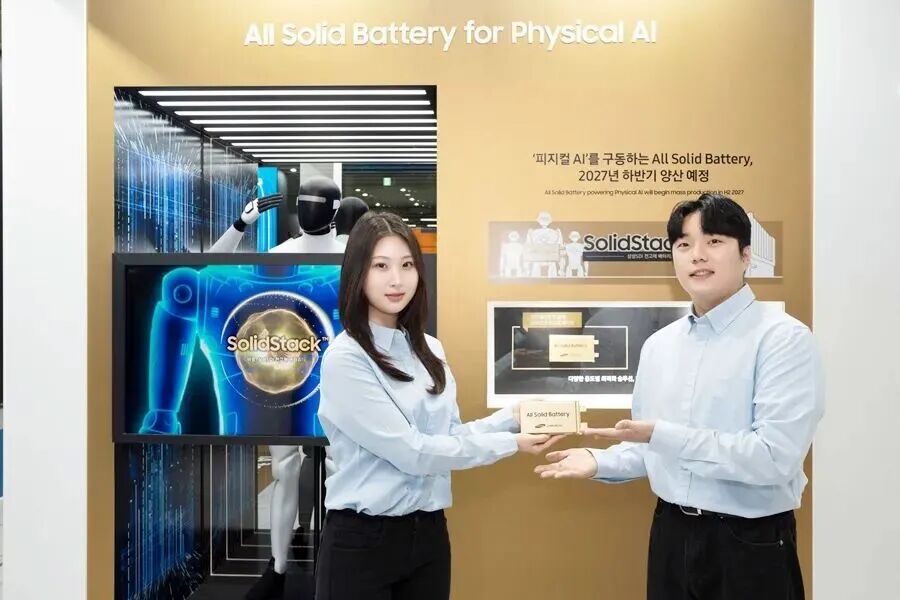
Image source: Samsung
SK On sets the commercialization node in 2029, with a target energy density of 800Wh/L;
LG Energy Solution also announced that the commercialization time of sulfide all-solid-state batteries is 2029, and it will build a dry electrode all-solid-state pilot line in the second half of this year.
Japan is the one that "has been prepared for a long time" but is still in the preparation process.
On June 2 this year, the Strategic Promotion Conference of Japan's Storage Battery Industry revised the "Storage Battery Industry Strategy" formulated in 2022 to the "Storage Battery and Power Supply Industry Strategy", which clearly states that all-solid-state batteries will be officially put into practical use around 2030, and a domestic manufacturing base matching the demand scale will be established in the mid-2030s.
Enterprises are also already in position.
In January this year, Idemitsu Kosan made the final investment decision and started construction of the large-scale solid electrolyte pilot plant in Chiba, which is planned to be completed in 2027 with a designed annual production capacity of hundreds of tons, and the materials produced will be supplied to Toyota. On the other side, Toyota is also cooperating with Sumitomo Metal Mining to mass-produce cathode materials, with the commercialization target set between 2027 and 2028.
Nissan launched the Yokohama trial production line in January 2025, completed the test of 23-layer cell automotive all-solid-state prototype in April this year, and targets to install it on vehicles in the 2028 fiscal year; Honda's demonstration production line also started trial production in January 2025.
The three countries, with three timetables, converge in the same year: in 2027, almost all players say they will achieve "small-batch production"; in 2030, almost all players say they will realize "commercialization".
From government planning to enterprise roadmap, this is a three-way game that determines who will dominate the discourse of the battery industry in the future.
Generational Transformation
In today's lithium batteries, there is liquid electrolyte between the positive and negative electrodes, where lithium ions swim back and forth. Liquid is easy to use and can penetrate every gap of the electrode; but it is flammable, and also restricts the application of more "radical" high-capacity materials.
The solid-state battery replaces the liquid electrolyte with a solid electrolyte.
The advantages are obvious: the cell energy density is expected to reach 400 to 500Wh/kg, which is about 1.5 to 2 times that of mainstream liquid batteries; the flammable liquid is eliminated, and the risk of thermal runaway is greatly reduced; it can also be matched with high-capacity negative electrodes such as lithium metal, making 1000km range and 10-minute-level fast charging possible.
But behind all the benefits, there is one common word: difficulty.
Liquids can automatically fill gaps, but solids cannot. Two solids are attached to each other rigidly, just like two bricks stacked together, with gaps everywhere at the microscopic level. The materials will also expand and contract during charging and discharging, once the interface loosens or cracks, the internal resistance will soar and the battery will degrade rapidly. Applying pressure to the battery can improve the contact, but the pressure system will take up extra weight, space and cost; the materials are sensitive to moisture, so the factory needs to create an extremely dry environment...
More critically, to achieve large-scale commercialization, it is necessary to maintain consistent standards in every production process under harsh conditions to achieve a sufficient yield. Zeng Yuqun said in 2024 that the most difficult part is the solid-solid interface. CATL has been researching this for seven or eight years, but it has only reached Level 4 on the 9-level maturity scale.
How to overcome these difficulties directly leads to the divergence of technical routes: sulfide electrolyte has the highest ionic conductivity, which is the closest to liquid, but it is afraid of water and air, and will generate toxic hydrogen sulfide when exposed to moisture; oxide is stable, but hard and brittle; polymer is easy to process, but its conductivity at room temperature is insufficient. No route is perfect.
Even if the technical problems are solved, there is still an economic account to calculate. According to industry estimates, the current cost of all-solid-state cells is about 1.6 to 2.2 yuan/Wh, while that of lithium iron phosphate is only 0.39 to 0.5 yuan/Wh, a difference of 3 to 5 times. The figure disclosed by Nissan is even more staggering: at the current level, the cost of building an all-solid-state battery electric vehicle is as high as 100 million yen (about 4.3 million yuan).
Starting from solving these problems, the three countries have taken three different paths.
Japan's core route is to bet heavily on sulfide based on its unique first-mover advantage.
The story starts with a barrel of oil. The protagonist is Idemitsu Kosan, the second largest oil refiner in Japan. In the mid-1990s, it began to study the sulfur separated from the refining process, and then developed the sulfide solid electrolyte.
In 2011, the team led by Riji Kanno from Tokyo Institute of Technology cooperated with Toyota researchers and discovered the sulfide material LGPS whose room temperature ionic conductivity is comparable to that of liquid electrolyte. Two years later, Toyota and Idemitsu began to jointly tackle the R&D and production of sulfide solid electrolyte. Ten years later, in October 2023, the two sides officially announced their cooperation for mass production. On the press conference stage, Idemitsu's president Shunichi Kito asserted that the era of solid-state batteries is just around the corner.
Now Toyota holds more than 1,300 patents related to sulfide all-solid-state batteries. It is cooperating with Idemitsu Kosan to develop sulfide electrolyte, and cooperating with Sumitomo Metal Mining to develop cathode materials, vowing to launch vehicles equipped with all-solid-state batteries between 2027 and 2028. In addition to Toyota, Nissan and Honda have also bet on the sulfide route.
Interestingly, Japan's all-solid-state battery development has also experienced a round of strategic swings and hesitation.
In 2022, Japan hoped to continue to compete with China in the field of liquid batteries, and then shifted its national strategic direction from "focusing investment on all-solid-state batteries" to consolidating the manufacturing foundation of liquid lithium batteries first. But this year, like South Korea, it has become desperate about the prospect of liquid lithium batteries, and then brought all-solid-state batteries back to the core position.
South Korea follows the "engineering school" path, pinning its advantages on material innovation and rapid docking with customers for verification.
In 2020, the Samsung Advanced Institute of Technology published a study on silver-carbon composite negative electrodes in *Nature Energy*: using a very thin layer of silver-carbon material to guide the uniform deposition of lithium, and achieved a volumetric energy density of over 900Wh/L on a 0.6Ah experimental soft-pack cell. Following this path, Samsung SDI developed the design of sulfide electrolyte plus "anode-free" -- it does not really have no negative electrode, but does not pre-place negative electrode materials, allowing lithium to grow by itself during charging, so as to free up more energy storage space, at the cost of stricter requirements for deposition uniformity and interface stability.
In 2022, Samsung SDI started the construction of an all-solid-state pilot line of about 6,500 square meters at its Suwon R&D center, named "S-Line". Then CEO Choi Yoon-ho called it the springboard for Samsung SDI to become the absolute number one.
In 2023, Samsung's samples began to be delivered to customers. In April of the same year, the South Korean government announced that the public and private sectors would invest a total of 20 trillion won to develop advanced batteries by 2030, with all-solid-state batteries as one of the key priorities. The Ministry of Trade, Industry and Energy did not hide its ambition: to make South Korea start the commercial production of solid-state batteries "earlier than others".
China takes advantage of its unique large-country characteristics, following the strategy of "multi-line parallel, phased implementation", and achieving qualitative change through quantitative accumulation.
First, there are new forces with the background of universities and research institutions:
For example, Welan New Energy, incubated by the Institute of Physics of the Chinese Academy of Sciences, follows the oxide + polymer composite electrolyte route and plans to realize small-batch production of all-solid-state batteries in 2027. Its core team includes Chen Liquan, academician of the Chinese Academy of Engineering, who is the doctoral supervisor of Zeng Yuqun. Tsingtao Energy, incubated by Tsinghua University, was founded by the team led by Nan Cewen, academician of the Chinese Academy of Sciences and dean of the School of Materials Science and Engineering of Tsinghua University. It adopts the organic-inorganic composite technical route, has realized the mass production and vehicle installation of semi-solid batteries, and claims to rank first in the global shipment of solid-state batteries.
Then there are different paths for liquid battery enterprises such as CATL, BYD, Gotion High-Tech, and EVE Energy: CATL, as a strong player, does not have to make trade-offs, and simultaneously develops three routes of sulfide, oxide and polymer; BYD, Gotion High-Tech and EVE Energy take the sulfide route.
Finally, the auto manufacturers that directly participate in the R&D also have their own paths: for example, Geely adopts the parallel layout of sulfide and oxide dual technical routes; Chery has bet on both the sulfide system and the polymer route; GAC adopts the comprehensive technical path dominated by sulfide electrolyte, with collaborative optimization of composite cathode and silicon-based negative electrode; SAIC is based on the polymer-inorganic composite electrolyte technical route...
In 2024, China's All-Solid-State Battery Industry-University-Research Collaborative Innovation Platform was established, which linked these different routes and forces together, and the R&D of all-solid-state batteries has moved from separate operations to joint operations.
Overall, Japan wins with its early start, South Korea wins with its exquisite engineering capability, and China wins with its complete routes and fast implementation -- the three countries have their own advantages and their own risks.
The Decisive Battle
The competition of all-solid-state batteries is not only limited to China, Japan and South Korea.
In May 2025, BMW installed the large-size all-solid-state cells of American company Solid Power into the i7 test car, which ran on the roads around Munich. In February this year, American company QuantumScape put the Eagle test line into use in San Jose, and CEO Siva Sivaram positioned it as a proof of scalable manufacturing.
In Europe, ProLogium Technology is building a factory in Dunkirk, France, which is planned to form a production capacity of 0.8GWh in 2028.
The global attention is finally focused on China, Japan and South Korea, because of their industrial thickness. Even for those European and American enterprises, there are often traces of China, Japan and South Korea behind them, or they cannot do without the technical or component support from China, Japan and South Korea.
According to the *Global Electric Vehicle Outlook