Ma Huateng's wisdom from Tao Te Ching
In his public statements, Ma Huateng has barely mentioned Laozi and *Tao Te Ching*. Yet his series of concrete practices are highly aligned with the wisdom of Laozi's *Tao Te Ching*, and he is arguably the entrepreneur who fits this wisdom best, without peer.
Late one night in November 2010, Zhang Xiaolong, then General Manager of Tencent's Guangzhou R&D Division, stared at his computer screen. A foreign app called Kik caught his attention. Just 15 days after its launch, the product had exceeded one million users. He then wrote an email to Ma Huateng in Shenzhen, stating that a new type of communication product would emerge in the mobile internet era, which would likely pose a huge threat to QQ, and Tencent should develop such a product immediately.
Ma Huateng was still awake, and replied immediately: Agreed, do it right away.
This email exchanged late at night launched the most important self-revolution in the history of the Chinese internet. Its drama does not lie in the accuracy of vision, but in its structure: The helmsman of China's largest social company agreed that a senior executive based far away in Guangzhou, who was formally part of the mailbox team, could develop a product that would subvert the company's core offering.
Behind this scene lies a rare leadership style. Ma Huateng often gives his core senior executives tremendous trust and authorization, helping them achieve outstanding results. But he himself rarely holds press conferences, rarely gives exclusive interviews, and rarely talks about himself. Although his spirit is behind every product, he seems almost invisible. When people use WeChat, they think of Zhang Xiaolong; when they play games, they think of TiMi; when talking about investments, they think of Martin Lau; when talking about industrial internet, they think of Dowson Tong; when discussing AI, they think of Shuyao Yao. This is exactly the definition Laozi gave for top leaders 2,500 years ago: "The highest type of ruler is one of whose existence the people are barely aware... When the task is accomplished and the work is done, the people all say: We did it naturally."
In his public statements, Ma Huateng has barely mentioned Laozi and *Tao Te Ching*. Yet his series of concrete practices are highly aligned with the wisdom of Laozi's *Tao Te Ching*, and he is arguably the entrepreneur who fits this wisdom best, without peer.
Success without taking credit: 47.5%
Giving birth to it but not possessing it, acting but not relying on it, achieving success but not dwelling on it. It is precisely because one does not dwell on success that it never fades away. — Chapter 2 of *Tao Te Ching*
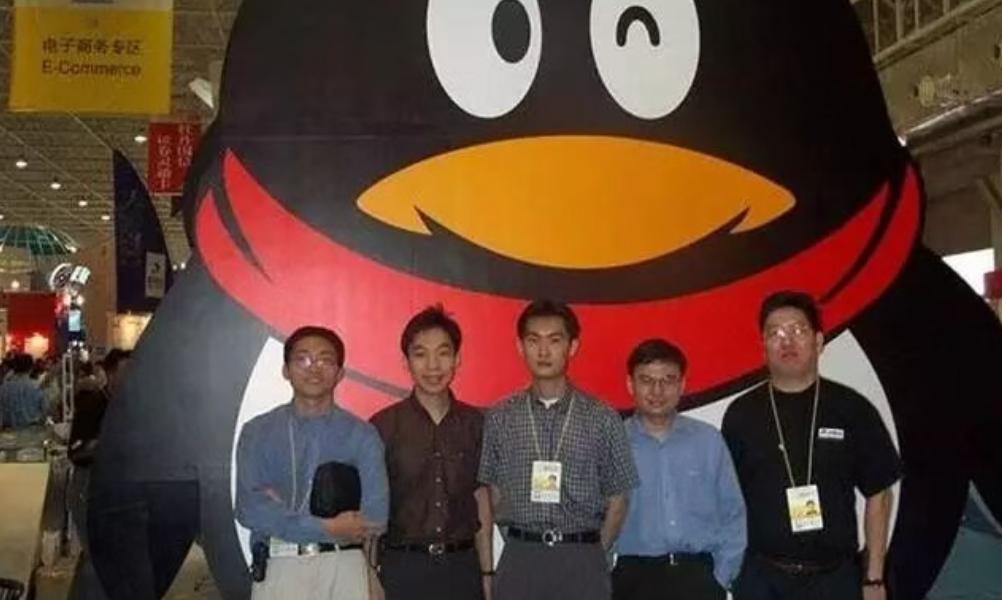
When Tencent was registered in 1998, the five founders pooled 500,000 yuan. The equity distribution plan was: Ma Huateng contributed 237,500 yuan, accounting for 47.5% of shares; Zhang Zhidong contributed 100,000 yuan, accounting for 20%; Zeng Liqing contributed 62,500 yuan, accounting for 12.5%; Xu Chenye and Chen Yidan each contributed 50,000 yuan, each accounting for 10%.
There is a deliberate numerical arrangement hidden in this set of figures: 47.5%. Ma Huateng had to be the largest shareholder, but his stake had to be less than the sum of the other four. His later explanation roughly went like this: The sum of their shares should be a little more than mine, so that a monopoly and dictatorship cannot be formed; but I must contribute the main capital and hold the largest share, so that the company has a backbone.
Against the background of that era, it is easy to see how abnormal this design was. In the late 1990s, founders of Chinese private enterprises generally sought absolute controlling stakes, with 51% as the bottom line and 67% making them feel secure. Equity means power, and power means security. With the largest capital contribution and the character "Teng" from his own name embedded in the company's name, Ma Huateng voluntarily designed his own stake to a structure that "cannot dominate everything unilaterally".
This is not a math problem, but a governance philosophy. *Tao Te Ching* says "give birth to it but not possess it" — you create it, but you do not own it. Tencent was born from Ma Huateng, but from day one, it was designed to be the shared child of five people. The subsequent facts are the footnote of cause and effect: Zhang Zhidong built the technical foundation of QQ, Zeng Liqing expanded the market, Chen Yidan took charge of legal and administrative affairs, the five "tigers" each took their own responsibilities, and no one left for eight years. In the early days of Chinese internet when the average cooperation lifespan of founders was less than five years, this was almost a miracle.
After the listing, equity dilution continued. Currently, Ma Huateng holds around 8.8% of the shares, and the largest shareholder is South Africa's Prosus, but no one considers Tencent to "belong" to Prosus. Laozi explained this clearly in Chapter 7: "He who puts himself behind others finds himself ahead; he who disregards his own safety finds his safety preserved. Is this not because he has no selfishness? Thus he is able to achieve his own selfish ends." Those who place themselves behind others end up standing at the forefront.
After the success of WeChat, all product credit went to Zhang Xiaolong. Ma Huateng was the approver and escort of that victory, but he never appeared on the honor roll. The next line after "achieving success but not dwelling on it" gives the answer: "It is precisely because one does not dwell on success that it never fades away." Precisely because he does not claim credit, the credit never leaves — QQ belongs to the team, WeChat belongs to Zhang Xiaolong, and Honor of Kings belongs to the Chengdu studio. As a result, every generation of product personnel believes that the things they build at Tencent will bear their own names.
The highest level, people barely know of its existence: Products grow naturally
The highest type of ruler is one of whose existence the people are barely aware; the next is one whom the people love and praise; the next is one whom the people fear; the next is one whom the people despise... When the task is accomplished and the work is done, the people all say: We did it naturally. — Chapter 17 of *Tao Te Ching*
Over its 28 years of development, Tencent has gone through multiple technology cycles, creating a number of era-defining hits including QQ, Qzone, games, WeChat, WeChat Pay, and Channels. If you check the facts, none of these game-changing hits were personally planned and initiated by Ma Huateng.
The idea of QQ was almost aborted in the initial market promotion, it was Zhang Zhidong and his team that developed it; WeChat came from a late-night email sent by a marginal team in Guangzhou; Honor of Kings was created by the TiMi Studio in Chengdu; WeChat Red Packet was originally just a Spring Festival experiment by an internal team. Ma Huateng's role was to approve, follow up, allocate resources, and make the final decision on who to support at critical moments. In his own words from a 2013 speech: "Actually two teams were working on it, but in the end the one that was more popular won... The product made by our wireless business department was not as good as the one made by the team that developed QQ Mail at the Guangzhou R&D Center."
This is the later well-known "horse racing mechanism": in the same direction, multiple teams are allowed to work on the project at the same time, and the market decides who survives. This is almost heretical in management theory — repeated investment, internal competition, resource waste. The Mobile QQ department explicitly opposed WeChat back then, because it directly threatened its own business. But Ma Huateng suppressed the opposition and let the two "horses" keep running.
In 2013, he explained this logic thoroughly in an internal speech: "How can we make more preparations for ourselves... We can try things that may even conflict with our existing business. Because if you don't do it, your competitors will definitely do it, so it's better to try it yourself first."
Chapter 17 of *Tao Te Ching* describes four tiers of leaders, and the highest tier has only eight words to sum up its features: when things are done successfully, people all say they grew naturally. Tencent's organizational form is a perfect sample of this judgment. When the founder does not act as the only brain of the organization, the organization can become a tropical rainforest. What species grow in the rainforest is not decided by the gardener, but by the ecosystem.
Act before things happen: The body is still warm
Act before things have happened, govern before chaos has broken out. — Chapter 64 of *Tao Te Ching*
Ma Huateng has a widely circulated quote in the industry: "The decline of a hundred-billion-yuan company is very common. I often say that when a giant falls, its body is still warm."
He has stated this sentence in multiple versions. In 2013, when Tencent's market value just touched 100 billion US dollars, his expression in the internal speech was more straightforward: "We have touched the 100 billion US dollar mark, which is actually very scary... Several giants have fallen ahead of us, many of them just collapsed like that, their bodies are still warm, which is very frightening." In the same speech, he counted them one by one for the audience: Nokia, with a market value of 200 billion euros, was sold for only 4.7 billion US dollars; BlackBerry, once valued at hundreds of billions of dollars, could not even be sold; Microsoft clung to Windows and Office and refused to let go, falling into passivity step by step.

*Tao Te Ching* advocates "act before things happen", taking action before things occur. The difficulty of this does not lie in foresight, but in human nature: in good times, people do not feel the sharp pain of loss, so it is very difficult to voluntarily abandon vested interests to make changes. Ma Huateng himself pointed this out: "When people are in it and have no sharp pain, it is very difficult for them to give up some of their own interests to make changes."
That is why the story of WeChat is worth telling over and over again. In that late night in 2010, Zhang Xiaolong's email said that WeChat would "pose a huge threat to QQ", which was Tencent's core business. The success of WeChat meant personally arranging a gravedigger for QQ. Looking back three years later, he described it with breathtaking words: "Frankly speaking, if WeChat was not developed by Tencent, if we did not attack our own business, but it was developed by another company, we would probably not be able to resist it at all. Looking back, the life-and-death moment was only one or two months."
The life-and-death moment only lasts one or two months — this is the best measurement of "act before things happen". It will be too late to take action when the crisis becomes visible. The second half of Chapter 64 of *Tao Te Ching* says "a tree as big as a hug grows from a tiny sapling". All catastrophic crises are as small as a mailbox team at their initial stage. The only difference is whether the helmsman sees it as a threat or an opportunity at that stage.
This sense of alertness has continued to this day. In 2018, the headline of a People's Daily report was "Ma Huateng: Tencent has never had a day of peace of mind". At the general meeting of shareholders in May 2023, he talked about AI: "We initially thought artificial intelligence was a once-in-a-decade opportunity for the internet, but the more we think about it, the more we feel that it is a once-in-a-few-centuries opportunity, similar to the industrial revolution brought by the invention of electricity." On the same occasion, he also said the other half: do not rush to release semi-finished products — the other side of "act before things happen" is not to deliver semi-finished products just to get a head start. Between speed and slowness, it is still about mastering the water temperature.
Three years later, the water temperature changed as expected, and his statement also changed. At the general meeting of shareholders in May 2026, when asked if Tencent's AI had fallen behind, Ma Huateng gave a very rare answer among entrepreneurs: "A year ago we thought we had boarded the ship, but later found that the ship was leaking. Now we feel we are standing on it, but cannot sit down yet, and still hope the ship can go faster."
At the same conference, he also had a more thought-provoking self-statement: Tencent may not be the fastest in the industry to seize opportunities, but "we cannot just watch others work and casually step over to seize their territory. We tried to seize others' territory in the past but mostly failed later."
Connecting these two sentences, "act before things happen" reveals its most difficult part. Laozi's original words are immediately followed by four characters: "govern before chaos breaks out". But on the matter of AI, Tencent did not achieve "govern before chaos breaks out". In 2023, it thought it had seen the direction clearly, but in the following year or two, it realized that the ship was leaking. That period was exactly the window when DeepSeek shocked the world with extremely low cost, Alibaba's Qwen iterated continuously, and various models refreshed the ranking intensively, while Hunyuan's presence in the basic model field has always been the part questioned by the outside world.
What is worth learning is exactly this admission. "Act before things happen" is not an infallible predictive ability, but the ability to change course immediately once you find the ship is leaking. Tencent's response was engineering-based: in December 2025, it upgraded the large model R&D architecture, newly established the AI Infra Department, AI Data Department, and Data Computing Platform Department, putting the people who know models best in the most critical positions; in the second quarter of 2026, R&D expenditure reached 27.28 billion yuan, a year-on-year increase of 35%, capital expenditure reached 52.78 billion yuan, a year-on-year increase of 176%, the vast majority of which flowed to computing power. A company that has made profits for decades is willing to invest real money again for a position it admits it "cannot sit down" on. This is the mature version of "act before things happen": it is not the foresight of a young hero, but the loss stopping and re-investment of a mature incumbent.
The end of Laozi's Chapter 64 is 16 words: "Be as careful at the end as at the beginning, and you will never fail." Be as careful at the end as at the start. Tencent's AI story has not ended yet, but it has at least proved that a huge organization can admit that it is standing unsteadily when it is at its most comfortable.
Bent can be whole: From a big tree to a forest
Bent can be preserved, twisted can become straight... Precisely because it does not compete, no one in the world can compete with it. — Chapter 22 of *Tao Te Ching*
On November 3, 2010, Tencent released the famous "difficult decision": users had to choose between installing 360 or installing QQ. The 3Q war ended with Tencent's victory, but it was also recorded in history as a total fiasco for Tencent — it won the battle, but lost the entire public opinion field. A company with hundreds of millions of users overnight became the "public enemy of all".
The instinct of most entrepreneurs is to pursue a complete victory or defend themselves with grievances. Ma Huateng chose the third path: turning around. In 2011, Tencent organized a series of expert seminars called "Diagnose Tencent", inviting external criticisms one by one to listen to them, then held the first Partner Conference, announcing the open strategy.
The depth of this turn can be measured by a statement four years later. In 2015, Ma Huateng publicly said: "Tencent only has half of its life in its own hands, and the other half is handed over to partners."