12 weeks after the Mercedes-Benz rolled over in the test
On October 21, 1997, at a test site near Stockholm, Sweden.
Robert Collin, a journalist from the local automotive magazine *Teknikens Värld*, drove a Mercedes-Benz A-Class that had been on the market for just over a month, performing a maneuver extremely familiar to Swedes at a speed of around 60 km/h: emergency lane change, simulating avoiding an elk that suddenly darted onto the road.
On the first attempt, the body of the car swayed slightly. On the second attempt, the car first lifted one wheel, then the other, swayed left and right several times before landing upside down. The two people on board sustained minor injuries.
When the news reached Mercedes-Benz headquarters in Stuttgart, the first reaction from the Mercedes press office was: this is an "extreme test", "under normal circumstances, no one will turn the steering wheel like this".
A century-old automaker that built its reputation on safety stumbled on the most basic safety maneuver with its latest model. What to do next determined whether it would eventually be nailed to the pillar of shame, or turn the shame into a legend.
Rollover
In the automotive world, Mercedes-Benz is almost synonymous with "safety".
In 1959, Mercedes-Benz put into mass production the safety body that combined crumple zones and a rigid passenger cabin, and started systematic real-vehicle crash tests in the same year; in 1969, it established an accident research department to feed findings from real car crashes back to R&D; in 1978, it joined hands with Bosch to equip mass-produced cars with the Anti-lock Braking System (ABS); in 1981, the airbag was mass-produced on the Mercedes-Benz S-Class... After this series of measures, in the minds of many consumers —
Safety is not a configuration of Mercedes-Benz, but the identity of Mercedes-Benz.
But by the mid-1990s, this identity began to face growth challenges.
The high-end car market was limited in size, but Mercedes-Benz set a goal to push annual sales past 1 million units by the turn of the century. It had to move downmarket, make small cars, and pursue scale.
The A-Class was the most critical move in this strategy. It was the first front-wheel-drive compact car in Mercedes-Benz's history, with a length of less than 3.6 meters, and R&D investment of about 2.5 billion marks. To maintain the Mercedes-level crash safety in such a short body, engineers designed a "sandwich" double-layer floor: in the event of a frontal collision, the engine would slide along a preset path under the passenger cabin floor instead of squeezing into the cockpit.
The design was very clever, but the cost was that the body became taller and the center of gravity moved up.
Protecting people after a collision and keeping the car stable during emergency avoidance are two different test questions. Mercedes-Benz had decades of experience in the first question, but never expected the second question to be waiting for it in Sweden.
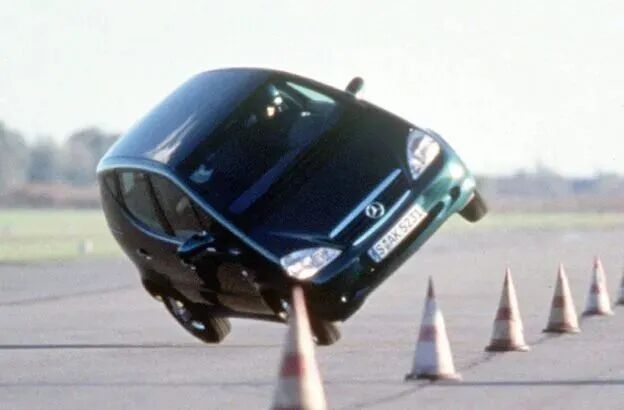
The first-generation Mercedes-Benz A-Class rolled over during the moose test, Source: Autofan
But this test was not new. Since the 1970s, Swedes have used similar methods to test the obstacle avoidance ability of cars, and later it was incorporated into the ISO 3888-2 international standard. In Sweden, it has a more poignant name: "Child Test". It simulates not only elks, but also children, neighbors, and passers-by who suddenly rush onto the road.
When the news that Robert Collin of *Teknikens Värld* went "upside down" at the Stockholm test site spread, Mercedes-Benz's instinct was to defend itself, calling it an extreme test, "no one will turn the steering wheel like that."
Even after public opinion surged, Mercedes-Benz immediately conducted a retest according to the scenario, and confirmed in the test that the A-Class had the possibility of rolling over, the first thing they did was not to be completely honest, but to try to argue.
On October 30, the German TV program *Panorama* broadcast a very confrontational footage. When Jürgen Hubbert, head of Mercedes-Benz's passenger car business, was asked about the test, he admitted that Mercedes-Benz's retest found that the A-Class did have the possibility of rolling over in this test, but at the same time emphasized that the tires had a great impact on the results.
At that time, Hubbert had just returned from the Tokyo Motor Show, where he described Mercedes-Benz's safety and luxury to global media.
But when the reporter turned the camera to Collin and asked if the tire was the problem?
Collin only answered two words: "No." Then he pointed out that the problem was the body height and center of gravity.
Public opinion further fermented. Engineers can argue how fast the speed and how sharp the steering wheel turn count as "normal driving", and whether there is a problem with the tires, but the public only has one thought: what if one day a child really rushes out on the road?
After that, Mercedes-Benz hurriedly held an international press conference. Even if it admitted the problem on a larger scale and adopted a low profile, it still failed to calm the controversy. Even the name given to this test by the German newspaper *Süddeutsche Zeitung* — "moose test" — quickly became a hot word across Germany, and more media began to line up to conduct retests.
Then the problem began to become fatal. Mercedes-Benz realized that what they were losing was not the test in front of them, but the default assumption that "Mercedes is safer than others", as well as consumer trust.
The fact that German automotive media had already noticed handling hidden dangers in previous tests was also dug up, followed by the question of why these situations were not clearly told to readers at that time?
Correction
Mercedes-Benz's managers did not sit idle, nor did they want to shift the blame and refuse to take responsibility.
During the dozen hours flying back to Germany from Tokyo, Hubbert, who had learned about the test rollover accident, crowded on the cabin floor of the Boeing 747 with his colleagues, repeatedly deducing the cause of the rollover.
After returning to Stuttgart, he set up a crisis team in the conference room next to his office. People from R&D, production, materials, and public relations all came, plus two "outsiders": Bosch, the ESP supplier, and Mercedes-Benz's advertising agency. At its peak, the team had more than 30 people, meeting every day for more than a month, often until late at night.
But before the final solution was worked out, Hubbert, who was surrounded and attacked by public opinion, submitted his resignation to Schrempp, CEO of Daimler-Benz. As the director in charge, he wanted to take responsibility through his resignation, and block the pressure for the then head of R&D, who later became the chairman of Daimler's board of directors, Dieter Zetsche.
But Schrempp's answer was only one sentence: "That's impossible. You have to go solve the problem."
Hubbert finally decided to thoroughly investigate and solve the problem.
On November 11, 1997, 21 days after the Swedish test results, Daimler-Benz announced:
Delivery of the A-Class was suspended for 12 weeks.
In the 12 weeks that followed and for a longer period, Mercedes-Benz abandoned the debate over the right or wrong of the test itself, returned to the origin of making cars safer, and implemented rectification on every component: replaced the stabilizer bar, re-tuned the springs and shock absorbers, lowered the body, widened the wheelbase, changed the tire size, and at the same time made the ESP body stability system standard across the entire lineup.
Mercedes-Benz recalled all about 2,600 cars that had been delivered to European customers to a dedicated service center for modification. Car owners could drive a Mercedes courtesy car while waiting; all about 17,000 cars that had been off the production line were reworked.
Before the rectification was completed, the Rastatt plant only maintained low-level production according to the new standards, and the original planned capacity ramp-up plan was forced to be postponed.
Stiffening the suspension meant that ride comfort would be compromised. Mercedes-Benz was well aware of this, but between safety and comfort, it did not hesitate.
The accounts were also very clear. According to estimates at the time, the rectification would affect operating profits by about 100 million marks in 1997 and about 200 million marks in 1998, totaling about 300 million marks, more than one-tenth of the total R&D investment of the entire model.
One of the core expenditures was that the ESP body stability system, which cost more than 1,000 marks per unit, was installed for free for all customers by Mercedes-Benz.
This set of technology was jointly developed by Mercedes-Benz and Bosch over many years, and was first launched on the flagship S600 coupe in 1995. It was a veritable top-level configuration. Installing it in an entry-level small car had no precedent in the compact car market at that time. But Mercedes-Benz decided: install it! Install it for free, and install it on all units!
To truly implement the plan, the greater challenge was the supply chain and production installation.
A system that had previously only been supplied for high-end models suddenly had to cover a new high-volume model, and the entire chain had to keep up. Bosch's engineers worked overnight to adapt the software, the hydraulic regulator production line was urgently expanded, and the Nuremberg plant had to build a new yaw rate sensor production line in less than three months, with an additional investment of about 20 million marks.
In the end, equipment installation and debugging continued between Christmas and New Year. The factory and the works council quickly reached a consensus to tide over the difficulties together, running 21 shifts a week including Sundays to work overtime.
Bosch's project leader later recalled that by the end, no one cared who was the customer and who was the supplier. Everyone had only one goal: to get back Mercedes-Benz's lost trust and quality dignity doubly.
It is not enough to think you have fixed it, you have to test yourself repeatedly with greater difficulty.
To this end, Mercedes-Benz first invited Finnish rally legend Rauno Aaltonen to conduct 38 repeated moose tests and standard slalom tests on the improved A-Class under different loads and different speeds; in February 1998, they invited about 1000 journalists in Barcelona to test drive in person, including the moose test of course.
All tests passed smoothly. Then Mercedes-Benz invited German tennis star Boris Becker to launch a endorsement advertisement, with a sentence that was repeatedly quoted later:
"The strong do not make mistakes, the stronger learn from mistakes."
In the same month the advertisement was launched, the A-Class resumed delivery.
In the second month after the resumption of delivery, the order volume of this car had exceeded 120,000 units. The rectification not only made Mercedes-Benz correct its attitude, but also forged the stronger capability of the entire supply chain, so the orders were fulfilled quickly.
The moose that once made Mercedes-Benz lose all face was made into a plush toy and given to car owners. Daimler's 1997 annual report also included the A-Class crisis in its exposition of the "learning organization".
Then came an ending that even Mercedes-Benz did not expect.
Dividend
Before the 2004 facelift, the first-generation Mercedes-Benz A-Class sold a total of about 1.1 million units.
The moose eventually became the mascot of A-Class fans. When the new generation A-Class was launched at the Geneva Motor Show in 2012, a moose even ran out on the big screen. Peter Fuss, an automotive industry expert at EY, later commented that that rollover was a "gift from the sky" for Mercedes-Benz.
The bigger gift belongs to the entire industry and consumers.
ESP was not invented because of this Mercedes-Benz rollover, but this incident greatly accelerated its popularization. Inventing a technology and making more people use it are two equally important industrial processes: the latter requires cost reduction, capacity ramp-up, choices from automakers, consumer cultivation, and deciding what configuration is "worth" being standard.
This rollover made Mercedes-Benz take the lead in advancing the popularization of ESP by several years.
Starting from 1999, Mercedes-Benz gradually promoted ESP as a standard configuration for all its car lines, and other automakers followed suit. Taking Sweden, where Mercedes-Benz originally rolled over, as an example, the ESP installation rate of new cars was only 15% in 2003, but reached 96% in 2008. After that, the EU further stipulated that new models must be equipped with ESP from November 2011, and all newly registered passenger cars must be equipped with it from November 2014; the United States fully mandated it from the 2012 model year.
This accelerated popularization has finally brought great benefits to consumers. A study by the American Insurance Institute for Highway Safety shows that ESP can reduce fatal single-vehicle rollover accidents by about 80%. Bosch estimates that in the 25 years since ESP was launched, it has avoided nearly 500,000 injury accidents and saved about 15,000 lives in the EU alone.
A company's admission of mistakes and correction ultimately raised the safety bottom line of an entire industry.
Of course, not every crisis turns into a gift.
In November 1986, the American CBS program *60 Minutes* broadcast footage of the Audi 5000 "unintended acceleration". It was later learned that the demonstration car in the program had been tampered with; in 1989, the investigation conclusion of the National Highway Traffic Safety Administration also believed that the accident was mainly caused by the driver pressing the wrong pedal.
Audi's response to public opinion was always tough, and it did win the argument from a technical and standard perspective. But what it got in return was that consumers gradually stayed away. Audi's sales in the United States plummeted from about 74,000 units in 1984 to about 12,000 units in 1991, and even considered exiting the US market in 1993.
One admitted mistakes and corrected them then made a big comeback, the other was right in reasoning but lost the market. The key difference was not in the test, but in the response. Willy Dietz, director of the German Institute for Automotive Economic Research, later summarized Mercedes-Benz's choice at that time: "Daimler was very clear that short-term economic losses are far better than permanently losing customer trust."
More than 20 years later, Toyota added a footnote to this rule. In 2008, Toyota had just surpassed General Motors to become the world's top seller, and then recalled nearly 10 million vehicles due to the "unintended acceleration" problem. In February 2010, Akio Toyoda admitted at a US congressional hearing: Toyota's growth rate may have exceeded the speed of cultivating talents and organizational capabilities. After that, Toyota set up a special global quality committee and voluntarily slowed down the pace of expansion.
From Mercedes-Benz to Audi, then to Toyota, these stories leave several inspirations for today's automotive industry.
First, standards are the bottom line, and redundancy is the brand. Especially for life-and-death systems such as braking, steering, and stability, there is no "good enough", only "the more the better".
Second, "it never happened in actual use" cannot convince users. The value of safety parts is that they may never be used in a lifetime, but the one time they are used, they must be foolproof.
Third, the more you aim for high-end markets, expand scale, and build new brands, the more you cannot afford to lose trust. Mercedes-Benz A-Class had an accident at the critical point of sprinting for 1 million annual sales, and Toyota had an accident at the moment of reaching the top of global sales.
Fourth, the most expensive option in a crisis is often the cheapest. 12 weeks of suspended delivery and 300 million marks of rectification brought back nearly 30 years of "safe Mercedes-Benz" reputation afterwards; while Audi paid for being "in the right" with a full decade of lost US market.
Fifth, making bad news heard is as important as technological leadership. Making internal shouts and even complaints heard, and taking external tests and criticism seriously, are necessary conditions for pursuing perfection.
Today, Chinese automobiles are advancing from scale to brand, from mass-market models to million-level luxury at a speed rarely seen in the world. China is already the world's largest automobile producer and exporter, and Chinese brands are entering thousands of households in Europe, the Middle East, and Southeast Asia, and have