Delivery is power
On October 2, 2026, Novartis issued a check to Suzhou Ab Therapeutics: an upfront payment of 575 million USD, with a total transaction value of up to 7.8 billion USD. This deal has been circulating across the entire industry for a whole week.
Ab Therapeutics' ABO2203 is still in early clinical stages, far from the stage where peak sales can be monetized. What Novartis is actually bidding for is the lipid nanoparticle that delivers mRNA-encoded T cell engagers into the body. The 7.8 billion USD is essentially paying for this key that opens the door to cells.
One week later on October 5, Genentech and Alector stated the same thing more explicitly. Alector sold its pipeline AL050 to Genentech for an upfront payment of 100 million USD with a milestone cap of 1.17 billion USD; however, it retained full ownership of the ABC platform that delivers drugs across the blood-brain barrier, and its own pipelines can continue to use the platform as usual. The buyer not only accepted this retention clause but also paid separately for it, extending Alector's cash runway to 2029.
Four days later on October 9, the third check came from a different track: Triastek (Nanjing) signed a cooperation and licensing agreement with Johnson & Johnson (signed by Janssen Pharmaceutica NV) to jointly develop novel oral drugs; Johnson & Johnson's venture capital arm JJDC simultaneously took an equity stake. The key priced this time opens the door to the "oral administration" segment.
Looking further back, there is a long queue of similar deals: AbbVie fully acquired Capstan for approximately 2.1 billion USD, Eli Lilly acquired Orna for approximately 2.4 billion USD, Novartis exercised its option to acquire Sironax's brain delivery platform for 125 million USD, and Eli Lilly and QurCan's TERP™ platform is priced on a per-project basis with milestones of up to 237 million USD per project.
All these transactions point to the same judgment: Delivery is power.
Price Gap Spanning Three Orders of Magnitude
Sorting out delivery-related transactions in the past 14 months by amount, the structure is very clear:
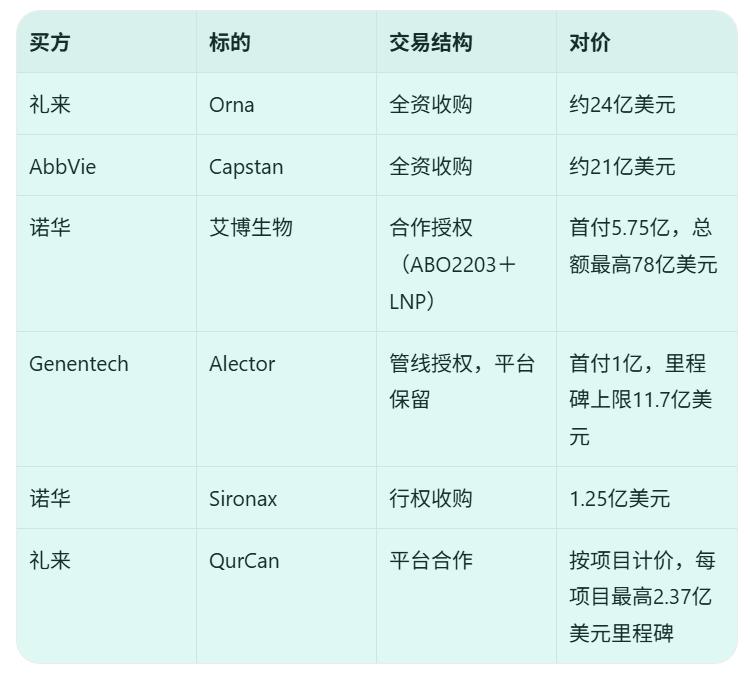
Note: Full acquisition represents total consideration, while licensing cooperation adopts the structure of upfront payment plus milestones. The two types are not suitable for direct comparison; all data is subject to official company announcements.
There is another lower price range outside the table: Lexeo licensed the TfR1 CapX AAV capsid to Apertura, with the capsid traded as an independent target at a value ranging from millions to tens of millions of USD. The same type of rights spans three orders of magnitude, with only two differences: the universality of the platform, and the depth of verification.
What explains the situation better than the transaction amount is the deal structure. QurCan prices on a per-project basis, which is equivalent to charging a separate access fee for each door; Novartis locks in Sironax first and exercises the option later, holding the platform as a call option; Alector only sells its pipelines and retains the platform. Buyers pay for access, sellers retain ownership, and both sides reach a consensus on the same judgment: the more doors a platform can open, the less it should be sold out in one go. Triastek and Johnson & Johnson represent the fourth form, a dual-track parallel structure: the licensing agreement grants technology usage rights, while JJDC's equity stake grants governance rights and information rights.
QurCan's TERP™ turns this universality into an engineered design. In traditional LNPs, the functions of "encapsulating nucleic acids" and "determining the destination" are intertwined in the same structural layer; TERP™ splits it into two layers: the inner lipid core is only responsible for encapsulation, and the outer polymer shell is only responsible for targeting. To switch target organs, users only need to replace the outer shell without changing the inner core. Commercially, this modular structure means that a fee is charged for each new project matched.
The third notable trend is that Chinese assets appear in the seller position for the first time. On August 31, Wisdom Biotech and CREATE Medicines reached a cooperation on tLNP delivery, covering 3 in vivo cell therapy projects, with rights in Greater China and regions outside Greater China split equally between the two parties.
It goes without saying that the direction has changed: over the past three decades, Chinese pharmaceutical companies were used to exchanging Greater China regional rights for overseas technologies; this time, what goes out is China's original delivery platform, and what comes back is equally split rights, even attracting strategic investment from multinational pharmaceutical companies for the first time.
The Answer in the Cost Sheet
Why is delivery worth so much? The answer lies in the cost sheet.
Take CAR-T as an example. The cost of ex vivo CAR-T is the sum of five links: leukapheresis, viral vector production, clean room expansion, lymphodepletion chemotherapy, and inpatient management. Each link is a cost center that can hardly be compressed, with rigid prices for cold chains, infusion centers, and ex vivo manufacturing facilities.
In vivo CAR-T eliminates the entire set of these costs. tLNP or lentiviral vectors are directly infused, making the three major cost centers of blood collection, expansion and lymphodepletion disappear completely, and the administration scenario shifts from inpatient to outpatient. In the recently released Phase I data of LB2501, 6 patients in the DL2 group achieved 100% ORR and 83.3% CR, with no lymphodepletion required and outpatient administration. The most valuable part of this set of data is not the efficacy, but the word "outpatient": shifting inpatient specialist treatment to routine outpatient treatment rewrites the payment model of this pipeline, as well as the denominator of its target market.
The same logic applies to the CNS field. Enzyme replacement therapy relies on repeated intrathecal injections, which involve lumbar puncture, inpatient stay and poor compliance; by using a BBB transport vector, the drug can be delivered to the brain via intravenous administration. Taking the mRNA route one step further, the drug changes from a "protein" to an "instruction for producing protein", allowing the body to produce the drug by itself.
At the other end of the cost sheet lies the word "oral administration". Polypeptides are the largest drug category of this decade, but their biggest physical flaw is extremely low oral bioavailability. Johnson & Johnson's simultaneous signing of the cooperation contract and payment of the consideration confirms that "oral delivery", as an independent tradable asset class, is being systematically priced. After GLP-1, "getting the substance delivered" is scarcer than "what substance to deliver".
Industry data is converging in the same direction. In 2026, the global delivery industry chain market size is approximately 21.8 billion USD, growing 17.3% year on year; among which the mid-stream "targeted delivery technology platform" segment is approximately 8.9 billion USD, the pool where delivery rights are explicitly priced; the growth rate of CNS targeted delivery is approximately 23%, the fastest across the entire industry; the Asia-Pacific region has a market size of 4.1 billion USD with a 21% growth rate, higher than the global average.
The industry chain is divided into four layers: upstream raw material components, mid-stream technology platforms, downstream payload integration, and terminal CMC scale-up. The competition for pricing power takes place in the mid-stream. A validated tLNP platform can simultaneously connect three unrelated pipelines for oncology, autoimmunity and rare diseases. There are more than 340 tissue-targeted delivery pipelines that have entered clinical stages, of which approximately 28% use novel AAV serotypes or non-viral vectors.
Behind this is the same pressure. The global ceiling of drug prices is being systematically pushed down by regulations, and pharmaceutical companies can only earn excess profits from "more patients × longer duration of treatment". At present, delivery is the only factor that can systematically reduce the unit cost of efficacy.
Delivery does not just make drugs better, it makes drugs cheaper.
Why China
In this landscape, China is no longer standing outside the door for the first time.
JY231, a lentiviral in vivo CAR-T product jointly developed by Jiyin Bio and Tongji Hospital of Huazhong University of Science and Technology, was published in NEJM (doi:10.1056/NEJMc2603114): 16 patients were followed up for 6 months, with rapid and complete B cell clearance, transient inflammatory reactions in 11 cases resolved within two weeks, and no severe neurotoxicity. This is the first top-tier journal-level clinical evidence in the in vivo CAR-T track, with a wider safety window than expected.
Ab Therapeutics' ABO2203 data presented at AACR 2026 is equally critical: 3 ITP patients achieved complete B cell clearance with no CRS; 9 hematological malignancy patients had ORRs of 33%, 67% and 100% respectively across different dose groups. The absence of CRS is a structural advantage of the mRNA route, with transient expression that is controllable and stoppable.
Triastek extends the evidence to the oral administration segment: 3D printed pharmaceuticals are also a typical engineering proposition, and the cost reduction demand of "shifting from injection to oral administration" is equally rigid in China.
Why China? There are three structural reasons.
First, delivery is an engineering problem, not a target discovery problem. Target discovery relies on decades of accumulation in basic research, while delivery relies on chemistry, materials science and rapid iteration, which exactly aligns with the organizational strengths that Chinese teams are good at.
Second, abundant clinical resources accelerate the data readout. It takes far shorter time to enroll 16 patients, complete 6-month follow-up and publish the results in NEJM in China, while the same process would require a much longer enrollment cycle in Europe and the United States.
Third, the payment structure creates forced incentives. China's national medical insurance has limited payment capacity for high-priced individualized treatments, so the cost reduction demand of "eliminating ex vivo manufacturing" is more rigid in China than in any other market. tLNP pipelines of companies including MagicRNA and Immorna are also advancing, and this team is much larger than the outside world imagines.
The 6-Month Ceiling
The above is about price, but the risks are not yet priced in.
All in vivo routes have short follow-up periods, with the longest being 6 months. The relapse rate after immune reset and the risk of lentiviral insertional mutation (which requires more than 10 years of follow-up) are still in the blind spot. The median follow-up of LB2501 is only 2.3 months.
A more specific concern comes from animal experiments. In Capstan's tLNP experiment on 22 monkeys, 1 case of hemophagocytic lymphohistiocytosis occurred in the highest dose group (15 mg/kg), leading to euthanasia, while elevated IL-6 and liver enzymes were also observed. In the first half of 2026, Capstan/AbbVie's CPTX2309 will read out the primary Phase I safety endpoint in healthy subjects, and that result will determine whether the tLNP camp will be revalued or corrected downward.
The risks in the oral administration track are different in form, but also not priced in: the cooperation between Triastek and Johnson & Johnson has just started, and there is no clinical readout for the human bioavailability of 3D printed oral polypeptides — there is a full development cycle between the asset class being priced and the technology being fully validated.
There are also opposing views: delivery has always been an integral part of drugs, and framing it as an independent power is just an investment banking narrative, and the platform value will eventually be realized through molecules. This refutation confuses two levels. Scientifically, delivery and molecules are indeed inseparable, and both need to be realized in the same product; commercially, what can be separated is the right of decision. After Alector sold AL050, its ABC platform still exists, and it can still match keys for molecules of the second, and third companies. Anything that can decide who can enter the door and at what cost is power.
It must also be recognized that the milestone consideration of the 237 million USD per project level implies repeated successful applications of the platform across multiple projects; if the first project fails, all subsequent consideration will be reset to zero. This part of the premium is prepaid, and whether it is overdrawn depends on the readouts in the next 12 months: longer follow-up data of JY231 and LB2501 will verify the biggest variable of "durability"; the first clinical data of QurCan TERP™ will verify whether the decoupled design can be transformed from an engineering narrative to clinical evidence.
Conclusion
The value of a drug has always been equal to the molecule multiplied by the ability to deliver it. Over the past 100 years, the industry has only paid for the first part.
Now, the second part is starting to appear in contracts.
In Wuhan, on the follow-up form of Tongji Hospital, the 6-month grid for the 16th patient of JY231 has just been filled. Further ahead, the entire page is blank.
This article is from the WeChat official account "Yi Yao", written by LI Jingyi, authorized for release by 36Kr.