There are queues outside four milk tea shops on the same street, where scalpers resell the 18-yuan milk tea for as high as 100 yuan.
What people queue up for is not milk tea, but a reason to visit.
During the National Day holiday in Guangzhou, in the newly opened MixC in Liwan District, four stores are lined up along one corridor. At the entrance of Chayanyuese, there are two signs: one reads "2 cups per person per order, purchase limit", the other states "We do not endorse any form of queuing on behalf of others or purchasing by proxy". Next to the notices, scalpers are calling out prices: the original 18-yuan Youlan Latte is sold for 100 yuan.
One day before National Day, four stores in one corridor
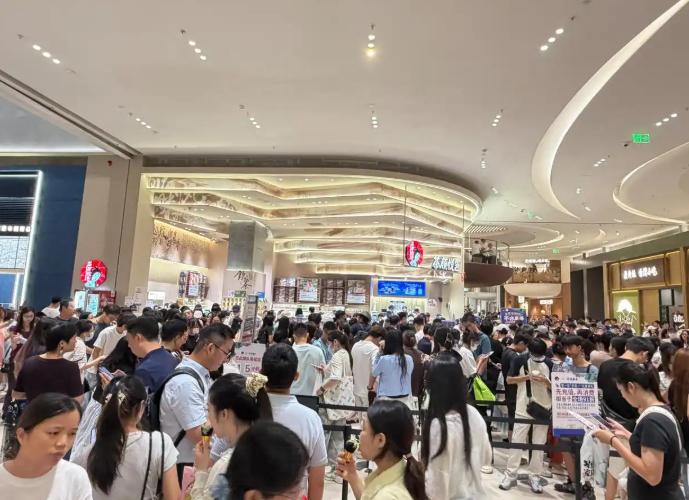
On September 30, the first MixC in Guangzhou opened at Baie Tan, Liwan District. Nearly 500 brands debuted on the same day, more than 60% of which are first stores, flagship stores or custom stores. In the tea drink zone on B1 floor, four stores are crowded in the same corridor: Heytea's first Cake Lab+ in Guangzhou, the first Chayanyuese store in Guangzhou, Goodmoli's first store outside Hunan Province, and Jinlimen.
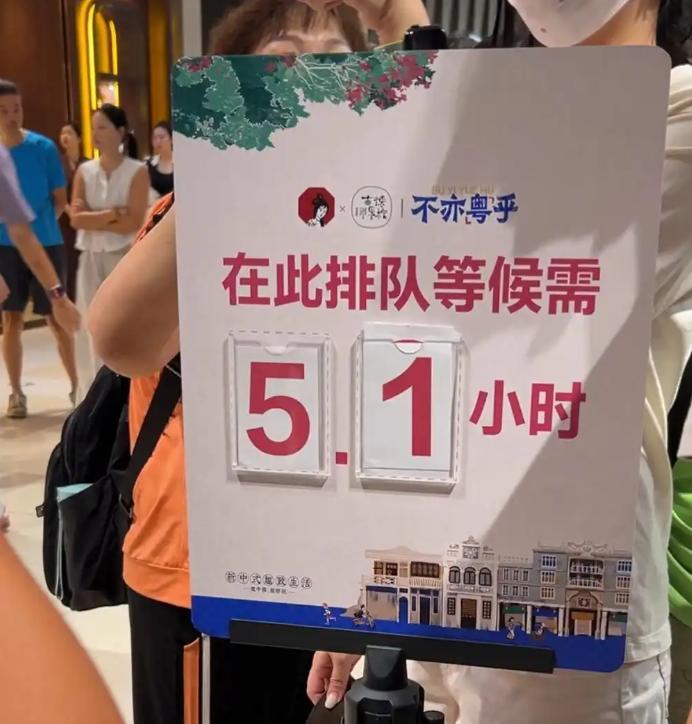
On the opening day, the Chayanyuese store opened at 10 a.m., and people showed up as early as 6 a.m. The one-hour-after-opening notice showed that the waiting time in the queue was 5.1 hours; after pre-ordering via the mini-program, the verification time was scheduled for 2 hours later. At 12 noon, both Chayanyuese and Goodmoli stopped accepting orders and suspended queuing.
21 Caijing News
The data on the next day further illustrates the scale of this mall. On October 1, the first day of National Day, Baie Tan MixC received 287,000 visitors in a single day; the number of passengers entering Fangcun Metro Station ranked second across the entire Guangzhou metro network (second only to Guangzhou South Railway Station). At one point, Exit F was set as entry-only, and some trains passed the station without stopping. The "Etang Light and Shadow Show" originally scheduled to run for three consecutive days was forced to cancel due to passenger flow pressure. The number of passengers entering a single metro station was pushed to the second place across the entire network by this single mall.
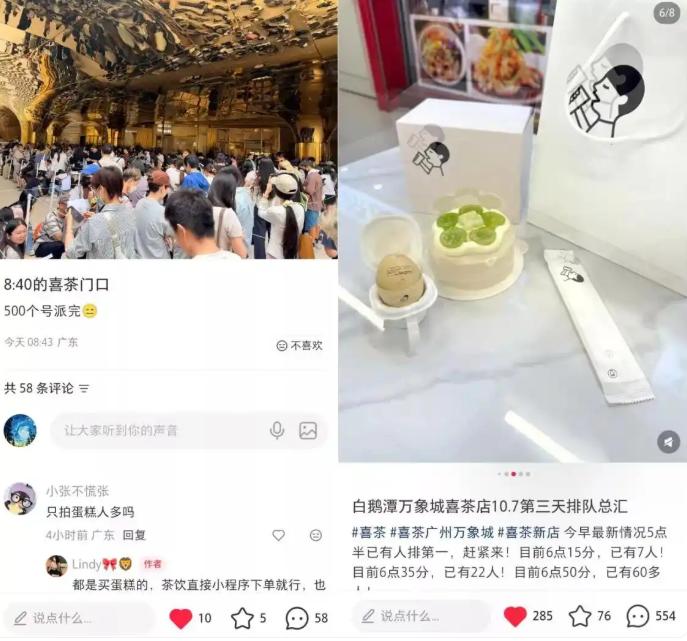
What did people on site think? On the morning of October 5, a netizen recorded the scene on Xiaohongshu: "I have queued for many Heytea new store opening events before, but I was still shocked by the scene today. I arrived at around 9:20, and I was already in the third queue, with an estimated 200 to nearly 300 people in front of me." This note ended with "decided to leave immediately", and was shared over 1,000 times with 156 comments.
Another consumer working in Guangzhou put it more plainly: he came to queue "mainly to join in the fun". A consumer who arrived at the store at more than 7 a.m. on October 7 got number 170, and did not get his cake until after 10:40 a.m.
18-yuan milk tea, 82-yuan "expedite service"
Apart from queuing, what is more worth recording this time is the scalpers' price list.
Reporters from *Consumer Reports* saw on site that scalpers were holding two drinks in their hands, with Youlan Latte buckets placed beside them for resale at marked-up prices: the original 18-yuan Youlan Latte was priced at 100 yuan, and the original 88-yuan Youlan Latte bucket was priced at 188 yuan. A scalper's words revealed the essence of this business: "All are freshly picked. If you queue up now, you will have to wait for a very long time."
Screenshot from Xiaoxiang Morning Herald
We thought this familiar scene would never appear again after 2020, but we never expected it to reappear so soon.
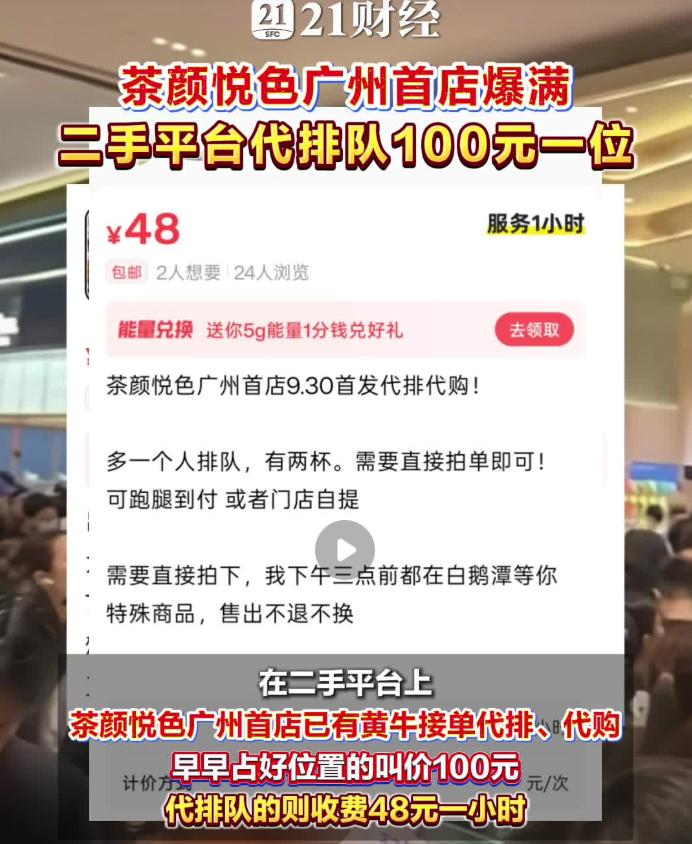
The same logic applies to the online scenario. On September 30, 21st Century Business Herald found a large number of queuing and purchasing proxy information on second-hand platforms: occupying a good position is priced at 100 yuan, and queuing on behalf of others costs 48 yuan per hour. Note the billing unit — by the hour. This is not a simple resale markup, but turns "waiting time" into a measurable and tradable target. The market has long calculated how much a cup of milk tea is worth; but how much "you can wait two hours less" is worth had no price before, and it has a price this time.
Brands are also taking countermeasures. Two signs reading "2 cups per person per order, purchase limit" and "We do not endorse any form of queuing on behalf of others or purchasing by proxy" are placed at the entrance of Chayanyuese at the same time.
There are also institutional explanations for why the queue is so long. Chayanyuese has long adopted the "pre-order — verification" mode: after placing an order via the mini-program, customers must verify the order in store before the production process starts. This practice ensures "freshly made and freshly served", but objectively prolongs the waiting time. It has been complained by netizens as "standing-and-waiting meal pickup" before, and the brand is already testing a new order placement method.
Now that all kinds of tea are easily available, why are people queuing again?
This is also the question this article tries to figure out. Why are the queues of Chayanyuese and Heytea lined up together this time?
Let's start with Chayanyuese. In 2020, customers queued for 8 hours at its first Wuhan store; in 2022, when two stores opened simultaneously in Nanjing, the peak waiting time at the Jingfeng store in Jiangning reached 5 hours; the limited-time pop-up store in Shenzhen in 2021 even required a "lottery" to enter. But the fading of the craze is also a fact — industry reviews generally mention that the grand scene of "queuing for 8 hours" in Wuhan has become history, and customers can get drinks within 5 minutes or even without queuing at stores in many cities.
The reasons are all publicly available: consumers have limited patience, a questionnaire shows that 65.38% of people can accept a maximum of 15 minutes of waiting, and only 1.92% are willing to queue for more than 1 hour; the verification mode damages the experience, customers have to queue for payment first then queue for pickup, and they have to re-queue if they leave the line midway; its outlets outside Hunan are sparse, Changsha can keep queuing time within an acceptable range with high-density stores, but this density cannot be maintained outside the province; there has been no major adjustment to its core products for a long time.
But there is a counterexample worth noting: people are still queuing at Chayanyuese stores in Changsha, and almost every time it enters a new city, it sets off a round of craze. What has faded away is the "daily queuing", not the "queuing for first stores".
Screenshot from social platforms
Then let's look at Heytea. Its queuing phenomenon has long been driven by holiday promotions and co-branding activities. For example, in December 2024, the "buy one get one free" activity at its Guangzhou Tower Plaza store led to such a long queue that the mini-program showed "Tea making is busy". The real turning point came in February 2025 — Heytea announced that it would suspend joining business, turn to "refusing low-price involution", and invest resources in differentiated stores. It renovated more than 130 stores in batches that year.
After that, its queuing news no longer relies on promotions, but on store formats: in April this year, when the Shenzhen MixC World store opened, which is the country's first Cake Lab, the queuing time exceeded 4 hours on the opening day.
So what are the common reasons? There are three points.
Store formats have changed — what is sold is no longer just a cup of tea, but a "reason to visit"
Heytea's Cake Lab operates as an independent store, its Lab 2.0 integrates four major labs, and its DP program focuses on spatial narrative (the bamboo weaving installation at its Shamian store took 240 hours of manual weaving); Chayanyuese's Guangzhou store adopts the "Amusement Park" store format, covering hundreds of square meters, and sells snacks and cultural and creative products in addition to tea drinks; Goodmoli opens its first store outside Hunan Province for the first time.
The result is straightforward: cakes, ice cream, limited spaces and other "things that standard stores do not have" are the real targets that people queue up for. Consumers are increasingly concerned about whether the store is "worth a special trip".
Business districts need it — commercial real estate is falling into passenger flow anxiety, taking first stores as the antidote
Industry data shows that the per capita shopping mall area has risen from 86.45 square meters in 2021 to 111.9 square meters in 2025, an increase of nearly 30%, but offline passenger flow has shifted from scale growth to structural differentiation — there are more and larger shopping malls, but the number of people has not increased proportionally.
It is worth noting that what supports the opening passenger flow is not luxury brands, but affordable, youth-oriented first stores with strong check-in attributes. The investment attraction logic of business districts has also changed: they no longer only focus on the short-term contribution of rent, but on whether the stores can bring long-term passenger flow and topic popularity. Queuing is not a one-man show of brands, but "determined passenger flow" jointly created by business districts and brands.
Screenshot from Xiaoxiang Morning Herald
Cities are also placing bets
Guangzhou is the city with the largest number of tea drink stores in China, with 12,482 stores, ranking first nationwide, with the most mature consumers and the most sufficient competition. However, Baie Tan did not have top-tier commercial facilities for a long time in the past. Residents in Liwan District and the Foshan area adjacent to Guangzhou had to travel half across the city to Tianhe District if they wanted to visit high-end shopping malls. The radiation radius of this wave of passenger flow even goes beyond the city: a consumer from Foshan took the metro and arrived at Fangcun in 13 minutes; the entire Greater Bay Area opened 4 shopping malls in the three days around the National Day holiday.
At this point, we can sum up the three questions in one sentence:
What has cooled down for Chayanyuese is "daily queuing", what does not have queuing for Heytea is "standard stores", and what people queue for this time is an "event" — first store, limited edition, new store format. The fact that three brands are crowded in one corridor is no coincidence: it is the three parties of brands, business districts and cities, at the same point in time, in the same way, solving their own passenger flow problems respectively.
Queuing is not that important now
Finally, let's talk about our views on this matter.
First, what this wave of queuing proves. In the past year, the net number of tea drink stores across the country decreased by 43,200, and the store density has been saturated. In this context, the "reason to visit" is still effective — consumers are willing to spend time for "things that standard stores do not have", which shows that homogenization is not unsolvable, and the antidote is not on the price list.
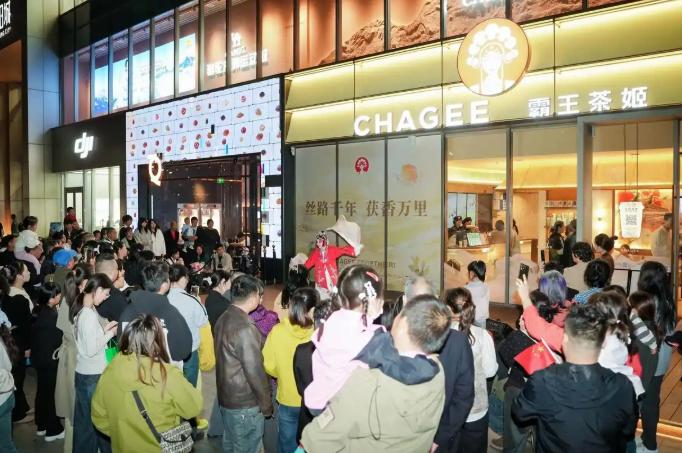
Image from Jiemian News
But the return of queuing does not mean the recovery of brands. What people queue for this time is an "event", not "daily life".
Events will come to an end, and daily operation is the real ledger. The first store dividend has its own cycle. The report has already pointed out that "the first store dividend usually only has a 6-month window period".
The real variable is that the relationship between business districts and brands has changed. In the past, it was "brands rent shops in business districts", but now it has become interdependent: business districts expect brands to bring passenger flow, and brands expect business districts to provide good locations and preferential policies.
Therefore, for B-end readers, the inspiration from this wave is not "whether you should learn to create queuing phenomena", but — does your store have a reason "worth a special trip"? If yes, this wave is related to you; if not, queuing has nothing to do with you, and price war is what you need to focus on.
Chayanyuese's own answer is very practical: "We will gradually open the second and third stores in Guangzhou later", but it remains cautious about expansion, emphasizing that it will "plan based on the overall market response in Guangzhou". It is not that difficult to make a long queue at the store entrance — what is difficult is whether people are still willing to queue for it after the second and third stores are opened.
This article is from the WeChat official account "China Beverage Express", written by Wang Jian, authorized for release by 36Kr.