Asia (China) Hospitality Industry Development Report, September 2026
September Asia (China) Hotel Overview
01 Global Hospitality Industry Development Trends
According to data from Cushman & Wakefield, the overall European market recorded a 3.0% year-on-year growth in RevPAR in the first half of 2026, mainly driven by a 2.2% rise in ADR and a 0.5 percentage point increase in occupancy. 22 countries achieved growth, while only 4 markets saw declines. Hotel transaction volume exceeded 11.5 billion euros, with luxury hotel investments accounting for 46% of total investment, and the average transaction price reached 522,000 euros per room and 364,000 euros per room respectively. Across all transactions, the average price per room rose 9% year on year.
In addition, in the African market this month, Banyan Tree Group announced that it has acquired the majority stake in Newmark Hotels & Reserves, an operator of luxury safari hotels in Africa, and will complete the full acquisition afterwards. Newmark will be incorporated into Banyan Tree Group as a collection brand under its umbrella, with 26 hotels, mountain lodges and wildlife reserves under its management distributed across 7 African countries. After the transaction is completed, Banyan Tree Group's business footprint will cover 28 countries, with 14 hotel and residential brands, including nearly 130 hotels, resorts and reserves, 30 branded residential projects, and more than 140 spas and art galleries. Before acquiring Newmark, Banyan Tree had already deployed 4 hotels and supporting spas in Morocco, Mauritius, South Africa and Tanzania; the upcoming Dhawa Ouidah hotel in Benin will also help the group formally enter the West African market.
02 Asia-Pacific (China) Market Development Trends
The hotel markets in Japan and South Korea in September showed the characteristics of simultaneous advancement of asset investment and high-end brand expansion. On the one hand, hotel asset transactions remained active, with resorts and hotels in core cities still being the key focus of capital. On the other hand, international high-end brands continued to accelerate their entry into core tourist destinations in Japan and South Korea, where Hokkaido emphasizes skiing and natural vacations, Kyoto relies on world cultural heritage and historic districts, and Seoul targets core high-end consumption and urban luxury customer groups.
In terms of the Japanese and South Korean investment markets, Japan's real estate investment trust One REIT Inc. acquired Okinawa Grand Mer Resort for 5.555 billion yen. The hotel is currently fully leased to KPG Hotel & Resort Co., Ltd., a subsidiary of Japan's Kato Pleasure Group. The planned renovation works include converting 40 Japanese-style guest rooms into Western-style rooms, renovating 6 suites, adding a children's playroom and upgrading the swimming pool. South Korea's Hyundai HAIM Asset Management has completed the acquisition of a hotel located in Lotte Castle SKY-L65, Dongdaemun, Seoul, which has about 260 guest rooms. Hong Kong Phoenix Real Estate Investment Company also participated in this acquisition.
In terms of brand expansion in Japan and South Korea, Pacifica Hotel Group of Japan and its subsidiary Furano Hotel Operation Company signed a franchise agreement with Marriott International to build The Westin Rusutsu Resort Hokkaido. The hotel is located near the Kitano-no-Mori cable car station, and it is the first resort hotel under The Westin brand in Japan. In addition, the latest member of Shangri-La Group's ultra-luxury brand "Shangri-La Signatures" — Songtei Kyoto, Shangri-La Signatures will settle in Kyoto, Japan. Located opposite the UNESCO World Heritage Site Nijō Castle, the hotel has 77 rooms and suites, and will become the second hotel in the Shangri-La Signatures collection following the Water's Edge at Shangri-La Hotel, Hangzhou. Aman Group announced the Aman Seoul project, marking the brand's first entry into the South Korean market. The project is located in Cheongdam-dong, the top high-end area of Seoul, in the Gangnam district, overlooking the scenery of the Han River.
03 Personnel Changes in Hotel Groups
In September, 6 hotel chains saw important personnel changes. International enterprises paid more attention to asset acquisition, capital solutions and hotel portfolio management at the level of global expansion. In addition, brand standards, product iteration and stock asset renewal are becoming important parts of group competitiveness.
Among international enterprises, first, Kempinski Hotels Group announced the appointment of Noel Attard as Chief Development Officer to coordinate the expansion strategy of the group's global hotel portfolio. Attard has 20 years of experience in Kempinski brand operation, finance and corporate affairs. He recently led the formulation of the group's business transformation strategy and served as CEO of Kempinski Trading DMCC (Dubai). After taking office, he will be responsible for leading the expansion of the global hotel portfolio and capturing growth opportunities including acquisitions, management contracts and brands in key and emerging markets. In addition, the group also appointed Andrea Vanni as Group Chief Financial Officer. Vanni has more than 25 years of professional experience in the European luxury real estate industry, and has served as a member of the Supervisory Board of Kempinski AG for more than three years, with profound expertise in debt and equity capital solutions in the real estate sector. Second, Hilton Group announced that Mark Weinstein stepped down as Hilton's Global Chief Marketing Officer and Head of Luxury Brands, and will take up a management position outside the travel industry. Hilton has not yet announced the successor for this position.
Third, Marriott International announced the appointment of Chris Buckner as Senior Vice President, Marriott International Loyalty, effective immediately. Buckner previously worked at The Points Guy, and earlier served in loyalty-related executive positions at PayPal and JetBlue. As Buckner takes on his new role, Marriott is continuing to optimize its loyalty benefits portfolio to adapt to changing guest preferences. Fourth, Starwood Hotels Group appointed Tom Chalmers as the group's new Senior Vice President of Design and Architecture. He will take the lead in promoting the iteration and upgrading of Starwood Hotels Group's global design concept, and coordinate all design work for new projects and existing hotels.
Among local enterprises, first, Pushenhui Hotel Group officially appointed Leo Li as Operations Director, who will fully coordinate work in operation management, performance growth, brand culture construction, project development and preparation, to help the group build a new benchmark for high-end cultural travel accommodation.
04 Hotel Asset Transaction Trends
In September, the ABN Index monitoring directory counted a total of 65 hotel assets in the stages of sale, auction and failed auction, which was basically the same as the previous month. There were 21 hotels with auction prices of over 100 million yuan, and only 1 hotel was completed this month. Key hotel auction projects: Sanya Marina Hotel was successfully sold on Alibaba Auction Platform, with a transaction price of about 132.7 million yuan. The assessed value of the subject is 237.122 million yuan, equivalent to a 56% discount. Compared with the first auction price of 166 million yuan, the price shrank by about 20%, and the converted unit price is about 11,600 yuan per square meter. In addition, all hotels with a value of over 100 million yuan this month ended in failed auctions. For example, the hotel assets of Wuhan Greenland Center were unsold at 869 million yuan, the Le Qing Courtyard by Marriott Hotel in Wenzhou was unsold at 529 million yuan, the hotel assets of Chengde Jiahe Plaza were unsold at 442 million yuan, Tianjin Royal Jinxu Hotel was unsold at 418 million yuan, Turpan Wanzhou Loulan Grand Hotel in Xinjiang was unsold at 246 million yuan, and Jinlu Meihua Grand Hotel was unsold at 240 million yuan.
In addition, the 1.844 billion yuan REIT of Zhejiang New Century Tourism was approved. The underlying assets of the fund are three New Century Grand Hotels in Hangzhou, Wenzhou and Shengzhou, with a total of 1428 guest rooms. The fund is a contractual closed-end fund with a contract term of 34 years, with a total of 600 million raised shares, managed by China International Capital Corporation Fund Management Co., Ltd. and custodied by China CITIC Bank Co., Ltd. The average occupancy rate of the three hotels in the pool in 2025 was 67%, and the average operating gross profit margin was 31%. The project adopts the whole-lease mode, and the rent is determined by whichever is higher between fixed rent and share-based rent. New Century Tourism Group provides joint and several liability guarantee, and arranges a five-year performance bet.
05 Hotel Opening and Signing Status in China's Hotel Market
According to the statistics of brands monitored by ABNData (Asia Travel & Lodging Big Data Research Institute), 223 new hotels opened in September, and the number of openings was basically the same as the previous month.
The breakdown data shows that in September, a total of 33 high-end hotels (luxury hotels, international high-end hotels, domestic high-end hotels) opened, of which 25 were international hotel brands and 8 were local hotel brands. Among local brands, Sanya Haitang Bay Poly Yueya Hotel is the first Hainan store of the "Yueya" brand under Poly Business Travel, and Jiangmen Lingnan No.5 Hotel is a new project jointly implemented by Lingnan Group and Jiangmen Cultural Tourism. Among international brands, Hilton newly opened Chongqing Lijia Baiyunhu Hotel, a Curio Collection by Hilton, and Chengdu Pulemu Hotel, a Tapestry Collection by Hilton. A total of 159 mid-range hotels (upper mid-range hotels, mid-range hotels) opened, of which 111 were local hotel brands and 48 were international hotel brands. Hampton by Hilton under Hilton Group opened 9 hotels, and Fairfield by Marriott under Marriott International opened 8 hotels. All Seasons under Huazhu Group opened 14 new stores in a row with excellent performance; Atour Hotel under Atour Group opened 6 new stores simultaneously.
A total of 31 economy hotels opened. Hanting Hotel under Huazhu Group opened 12 hotels with excellent performance. The GreenTree series under GreenTree Inn Group opened 6 hotels in total, which also performed well.
According to the statistics of brands monitored by ABNData, 131 hotels reached agreements in September, showing a significant growth trend in the number of signings. In the luxury and high-end hotel sector, the Argyle Group successively signed 7 high-end hotel projects, including Argyle Resort Dalian Laoshan Mountain Hot Spring, Argyle Boutique Hotel Haining Guanlan, Jiaxing Zhejiang, Argyle Grand Hotel Shijiazhuang Hebei, as well as 2 Argyle Gathering hotels and 2 Argyle hotels. InterContinental Hotels Group opened up new territory in first-tier cities this month, signing Kimpton Shenzhen New World Xiangmihu Hotel, Crowne Plaza Guangzhou Baiyun, and voco Shanghai Jing'an Jinshuiwan. Among local brands, Wanda signed for Wanda Realm Nantong Hotel and Wanda Yi Hua Hotel at Kunming Railway Station, and 2 new Wanda Jin Hua Hotel projects. Shandong Cultural Tourism and Lanling Urban Development Group cooperated on a new high-end resort hotel project, signing the Sanfengshan Puju Lanting Yiting Hotel. Luggage Travel Group, Xinrongji and two state-owned assets cooperated on a new ultra-luxury hotel project, signing Xiashan Taizhou Fucheng Resort Hotel.
In the upper mid-range hotel sector, the number of signings of international brands has rebounded significantly this month. The mid-range hotel brand portfolio under Wyndham Group made collective efforts, including the new signings of La Quinta by Wyndham Qionghai Yinhai Road, 3 new Wyndham Garden hotels, 5 new Days Inn by Wyndham hotels, 2 new Days Inn Suites by Wyndham hotels, 2 new Ramada hotels, and 2 new Meiyin hotels. Fairfield by Marriott under Marriott has significantly accelerated in this quarter, newly signing Fairfield by Marriott Suzhou Xiangcheng Economic Development Zone and Fairfield by Marriott Xiangcheng Economic Development Zone.
Among local brands, 8 new ELong hotels under ELong Hotel Technology, 2 new ELong An Yue hotels, 3 new Mehao Lizhi hotels, 4 new Mehao hotels, 2 new Meilihao hotels, 5 new Duolanda hotels, and 5 new Yizhi hotels were newly signed. Under Yali Digital Technology, 4 new Yameitu hotels, 2 new Yameitu Huanyue hotels, 6 new Yeste hotels, 2 new Yasefei hotels and 2 new Yeste International hotels were newly signed. Under Wanda, 3 new Wanda Moments hotels, as well as Wanda An Yue Hotel and Wanda Yue Hua Hotel were newly signed. 7 new Huayi Select hotels under BTG Homeinns were newly signed. Under Atour, new signings included Shamao Atour Hotel and Zhujiang Piano Dream Park Atour Hotel.
In the economy hotel sector, 9 new Huayi hotels were newly signed.
September Hotel List Release and Analysis
01 Top 50 Luxury Hotels List
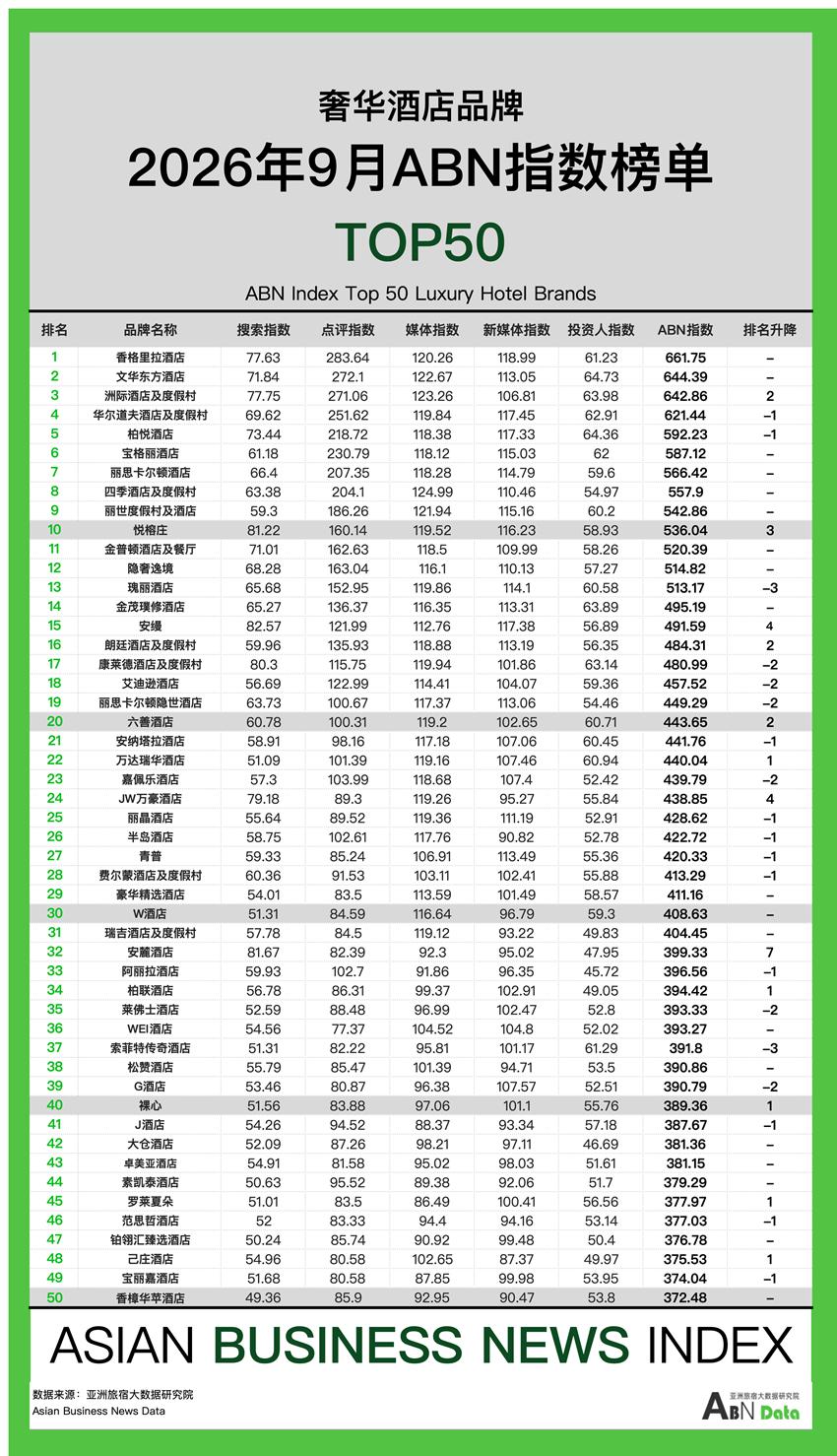
#Comprehensive Analysis#
The penetration of international brands and the upgrading of cultural resort products go hand in hand | From the second half of 2025 to 2026, high-end hotels have been intensively launched in coastal cities around Zhejiang. Behind this is not only the active layout of cities seizing the opportunity of the Yangtze River Delta integration, but also the market logic of high-end hotel brands sinking to find new growth points.
First, international luxury brands and local high-end brands are making two-pronged layouts. The Baosheng Cultural Tourism Complex Project, located on the north side of Phoenix City, Zhujiajian, Zhoushan, Zhejiang, plans to complete the main structure capping within this year, enter the decoration stage in 2027, and is expected to officially open for operation in May 2028. The complex will adopt the dual-brand operation mode of "international luxury brand + self-owned high-end brand". On the one hand, it introduces the ultra-luxury brand "Conrad" under Hilton Hotels Group to fill the gap in Zhoushan's coastal ultra-luxury tourism market, and become the first truly luxury brand hotel in Zhoushan; on the other hand, it operates its own brand "Baosheng", targeting business travelers, to build a high-end comprehensive hotel complex that meets various needs such as business, tourism, conferences and parent-child activities.
Second, boutique resorts and catering are coordinated. Xiashan · Taizhou Fucheng Resort Hotel was signed in Linhai this month, which is jointly built by four parties: Luggage Travel Group, Xinrongji Catering Group, Taizhou Urban Investment Group and Linhai Social Development Group. Luggage Travel is responsible for brand operation, Xinrongji provides supporting catering, and the two state-owned enterprise platforms provide land and construction support, forming the "brand + catering + state-owned assets" combination. This project is the first project of the Xiashan brand in Taizhou, and it is also the high-end hotel catering layout of Xinrongji returning to its hometown after expanding from Linhai to the whole country.
Third, create a rare experience through ancient building regeneration and Song-style aesthetics. Ahnluh Youxianzhai Hotel officially opened in Songlanshan Coastal Tourism Resort, Xiangshan County, Ningbo City, Zhejiang Province. The hotel is authorized and managed by the Ahnluh brand, built over 12 years, relying on more than 30 century-old ancient dwellings relocated from Sanming, Fujian, taking the handed-down famous painting "Four Scenes of Landscape" by Liu Songnian, a painter of the Southern Song Dynasty, as the construction blueprint, planning 31 guest rooms, and setting up academies, tea houses, health care and Song culture experience spaces. Different from large-scale comprehensive resort hotels, this project establishes product differentiation through low-density courtyards, traditional architecture and cultural experience, and serves high-end customer groups who value privacy, aesthetics and in-depth experience with a relatively limited room scale.
On the whole, Zhejiang's high-end hotel market is forming a multi-level layout: Hangzhou mainly meets the needs of urban business, exhibition and comprehensive consumption, while coastal and regional destinations further meet the needs of vacation, parent-child, cultural experience and short-distance leisure. Behind this is that the supply products of regional cultural tourism in the province are becoming more mature. The construction of transportation, scenic spots, block renewal and cultural tourism activities have enriched the tourism attractiveness of regional cities. For example, during the small long holiday, Taizhou held a customs fair relying on "cultural tourism + food", attracting more than 27,000 tourists, driving a month-on-month increase of more than 50% in consumption. Xianju launched a giant arowana rising into the sky, a dragon parading across villages, and fish lantern night scenes to increase the number of overnight tourists.
Overall, international luxury hotels and local boutique brands are sinking in Zhejiang's coastal areas and characteristic destinations. The key to their future competition lies in whether the brand positioning matches the destination resources. Ancient buildings and Song-style aesthetics can constitute product differentiation, but they need to be continuously fulfilled through services, activities, catering and content operations.
Summary: In September 2026, the media and new media indexes of luxury hotels remained at a high level, and the comprehensive average score of the five index monitors reached 455.93.
Search Index: The search index this month