Super El Niño has arrived: some people fear natural disasters, while others are waiting to make a fortune.
On October 9, the National Climate Center of China announced that a super El Niño event has officially formed.
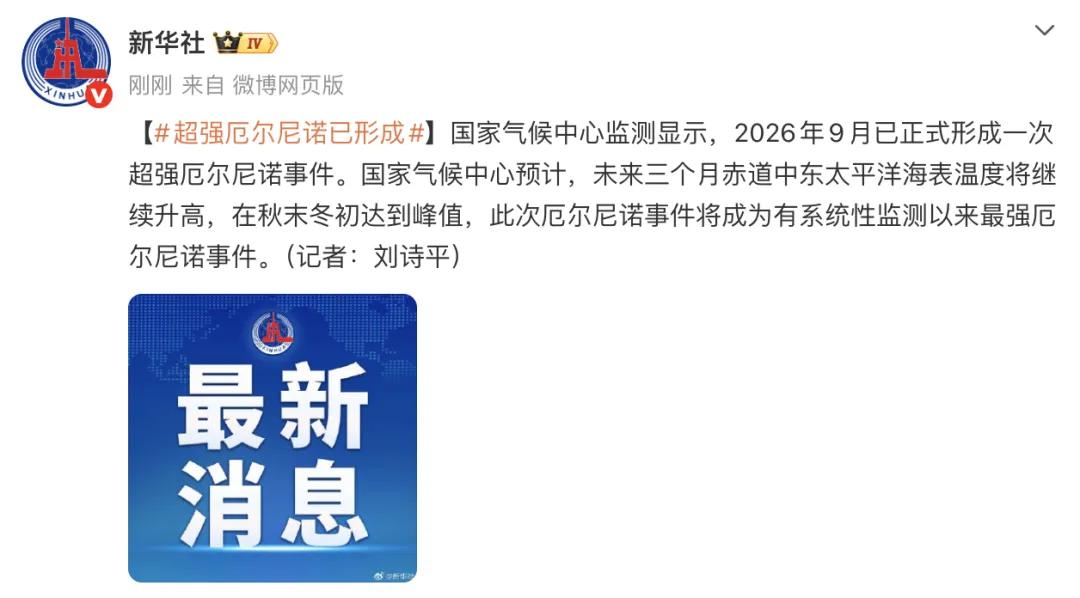
The announcement did not come as a surprise. Since May this year, the seawater in the central-eastern equatorial Pacific has continued to warm. From July to September, the sea surface temperature index in key regions reached 2.54℃, which has crossed the threshold for determining a super El Niño. The National Climate Center predicts that this round of El Niño will peak in the late autumn and early winter of this year, and may even become the strongest one since systematic monitoring began.
The last time such a strong El Niño phenomenon occurred dates back to 2015 to 2016. Before that, the super El Niño from 1997 to 1998 also left a painful memory for the public.
In 1998, catastrophic floods occurred successively in the Yangtze River, Nenjiang River and Songhua River basins. The national flood disasters displaced hundreds of millions of people, with direct economic losses as high as 264.2 billion yuan. This climate anomaly that lasted for several months is considered one of the important influencing factors of the severe floods in the Yangtze River Basin that year.

By 2016, China was once again affected by the super El Niño. At the beginning of the year, Hunan and other places suffered from low-temperature, rain, snow and freezing weather, with local blizzards; after the beginning of summer, the middle and lower reaches of the Yangtze River experienced severe floods, and Hunan, Hubei, Anhui and other places were impacted to varying degrees.
In less than 20 years, two rounds of super El Niño have left us with profound memories of floods, ice and snow, and various extreme weathers.
Nowadays, similar climate anomalies may happen again. However, in addition to paying attention to the possible losses caused by extreme weather, the capital market has begun to calculate another account.
From grain, sugar, palm oil to hydropower, thermal power, energy storage, virtual power plants, even air conditioners, refrigerants and shipping, the seawater warming occurring in the Pacific Ocean is changing the supply-demand relationship of different industries.
For some companies, extreme weather may mean higher costs; while for other enterprises, it may become a new performance catalyst.
Agriculture has started to pay for El Niño
If there is any industry that is first impacted by El Niño, agriculture is undoubtedly the first to bear the brunt.
After all, compared with the manufacturing and service industries, agricultural production is an industry that "depends on the weather for food". The atmospheric circulation changes caused by El Niño make originally humid areas suffer from drought, and also make rainfall increase significantly in other regions. No matter continuous high temperature, insufficient precipitation, or sudden floods, they will disrupt the normal growth cycle of crops.
What's more troublesome is that the production of the world's major agricultural products is concentrated in a few countries. Once important producing areas such as Brazil, India or Southeast Asia encounter abnormal weather, it will not only affect local production and consumption, but also the supply-demand relationship of the entire international agricultural product market.
The capital market has obviously begun to worry about this, and the A-share agricultural sector is the first to respond quickly.
On October 9, Jinjian Rice Industry, Wanxiang Denong and Dunhuang Seed Industry hit the 10% daily limit successively, Qiule Seed Industry rose 14.04%, Shennong Seed Industry rose 9.41%, and Kangnong Seed Industry rose 7.42%. From grain processing to corn and rice seed industries, the capital market has almost covered the entire agricultural industry chain.
This rise may be driven by speculation during the market downturn, but more of it is catalyzed by fundamentals. The latest data released by the Food and Agriculture Organization of the United Nations a week ago shows that the global food price index reached 136 points in September, up 1.5% month-on-month and 5.8% year-on-year. Among them, the grain price index rose 5.1% month-on-month, sugar rose 6.1%, and vegetable oil rose 0.9%.
Although factors such as blocked international shipping and rising energy costs have also pushed up food prices, the abnormal weather brought by El Niño has become the main driver affecting the supply expectation of agricultural products.
The most affected one is grain. According to the latest forecast released by FAO on October 2, the global grain output in 2026 is expected to be 2.979 billion tons, down 2.1% from the historical high in 2025. As a result, global corn prices rose 5.6% in September, reaching the highest level in more than three years; wheat prices rose 6.3%, also hitting a new high since August 2023.
In particular, some parts of the United States and the European Union have experienced dry and hot weather, which has affected the yield prospect of coarse cereals; the uneven distribution of monsoon rainfall in India has also lowered the global rice production forecast.
This also explains why the seed companies in A-share market rose first. The core businesses of enterprises such as Wanxiang Denong, Dunhuang Seed Industry and Qiule Seed Industry all involve corn seeds. When abnormal weather increases the uncertainty of agricultural production, the market will naturally pay attention to the demand for drought-resistant, high-temperature-resistant, high-yield and stable-yield seeds.
In addition to grain, sugar is more directly impacted in terms of supply.
On October 8, Reuters reported citing data from the U.S. Department of Agriculture that due to insufficient rainfall and high temperature brought by El Niño, India's sugar production forecast for the 2026/27 season has been lowered from the previous 33.6 million tons to 29.5 million tons, a reduction of 4.1 million tons, a drop of more than 12%.
The impact of this figure is not small. According to the USDA's statistics for the previous year, India's sugar output accounts for about 16% of the global total, second only to Brazil. Once India reduces production, it will not only affect its domestic sugar supply, but also may change its export capacity, thus affecting international sugar prices.
In fact, the prices in the futures market have already reacted in advance. On October 6, the ICE raw sugar futures once rose to 20.81 cents per pound, hitting a new 19-month high. Local listed sugar companies in India also rose collectively, with some companies seeing a single-day increase of 7%.
Compared with seed companies that simply rely on the concept of food security, the impact on sugar enterprises is more easily reflected in their operating data. Taking A-share listed COFCO Sugar as an example, the company achieved operating revenue of 9.277 billion yuan in the first half of 2026, down 21.16% year-on-year; the attributable net profit reached 608 million yuan, up 36.75% year-on-year, and the non-recurring profit and loss deducted net profit increased by 40.70% year-on-year.
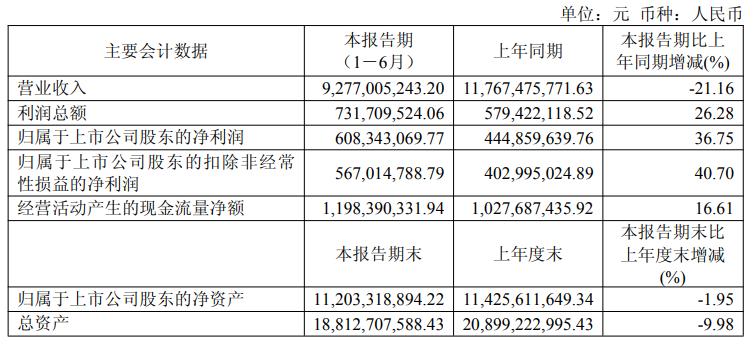
Although the company's semi-annual report shows that the decline in revenue in the first half of the year was mainly affected by the decline in product sales volume and selling price, and the profit improvement was related to operating factors such as cost reduction, and the impact of El Niño was not mentioned, COFCO Sugar also operates sugar processing, trade and other businesses. Since the rise of international raw sugar prices is a certainty, the profits brought by the rise in sugar prices will also be a natural thing.
Another industry chain that is receiving attention is palm oil. As one of the most important vegetable oils in the world, palm oil supply is highly concentrated in Indonesia and Malaysia. El Niño will increase the probability of drought in Southeast Asia, thus affecting the growth of oil palm trees and fruit yield.
Unlike grain, the impact of drought on palm oil often has a lag. Insufficient water may not only affect the current harvest, but also affect the yield in the following months or even longer through processes such as flower bud development, female flower ratio and fruit bunch formation.
This means that even if El Niño peaks this winter, its impact on palm oil supply may continue until 2027.
The market's concern about palm oil has been reflected in prices. According to FAO data, the global vegetable oil price index reached 198.6 points in September, up 18.3% year-on-year. Among them, the rise in palm oil prices was an important reason for the rise of the vegetable oil index that month. FAO clearly pointed out that the production concerns caused by dry weather in Southeast Asia and the growth of global import demand jointly supported palm oil quotations.
Similar problems also appear in industrial chains such as natural rubber, coffee and fish meal.
Abnormal weather in Southeast Asia may affect natural rubber production, weather changes in Brazilian producing areas may disturb coffee prices, and changes in water temperature off the coast of Peru may affect anchovy fishing and fish meal supply. For tire, coffee chain and aquatic feed enterprises, the rise in upstream prices often means cost pressure first, rather than additional profits.
Looking back at the agricultural stock market on October 9, the seemingly irrational market funds are actually trading two different expectations: one is the food security anxiety caused by extreme weather, and the funds pour into concept companies such as seed industry and grain processing first; the other is the commodity price rise caused by supply contraction, and the sugar, palm oil and other industries have seen more obvious price changes.
Agriculture is only the first stop of the global industrial chain reaction caused by this climate anomaly.
Extreme weather reshuffles the cake of the power industry
If the agriculture industry is worried about production reduction caused by extreme weather, then for the power industry, the troubles brought by El Niño may be more complicated.
On the one hand, abnormal high temperature will greatly push up the power demand of refrigeration equipment such as air conditioners, putting more pressure on the already strained summer power grid; on the other hand, changes in rainfall distribution will affect the power generation capacity of hydropower stations, making power supply more unstable.
All of this has actually happened in advance.
On July 10, the National Energy Administration announced that the national electricity load reached 1.518 billion kilowatts, refreshing the historical record for the first time. By the end of July, this figure further climbed to 1.553 billion kilowatts, an increase of about 45 million kilowatts compared with the peak in 2025. For comparison, the National Energy Administration pointed out that the national electricity load increased by 150 million kilowatts in about ten days in early July, equivalent to the total electricity load of Japan.
The capital market obviously noticed this change earlier than the National Energy Administration.
As early as the end of May to June this year, the A-share power sector ushered in a round of rise. By mid-June, Huadian Liaoning Energy rose nearly 500% within the year, Yuneng Holdings rose more than 280%, Huadian Energy rose more than 220%, and Datang Power rose more than 130%. The change in power supply and demand brought by extreme weather has indeed become one of the important reasons why the market pays attention to the power sector.
However, in the power sector, there are also thermal power and hydropower camps, which can be described as some happy and some sad.
In the most popular explanation, drought will reduce the inflow of water to hydropower stations, thus lowering power generation; and insufficient hydropower supply may require thermal power to make up for it. This means that even if the total social electricity consumption does not increase significantly, the change in power generation structure has also changed the operating performance of different power enterprises.
SDIC Power is an example. According to the company's 2026 semi-annual report, SDIC Power achieved operating revenue of 23.886 billion yuan in the first half of the year, down 7.05% year-on-year, and attributable net profit was 3.535 billion yuan, down 6.83% year-on-year.
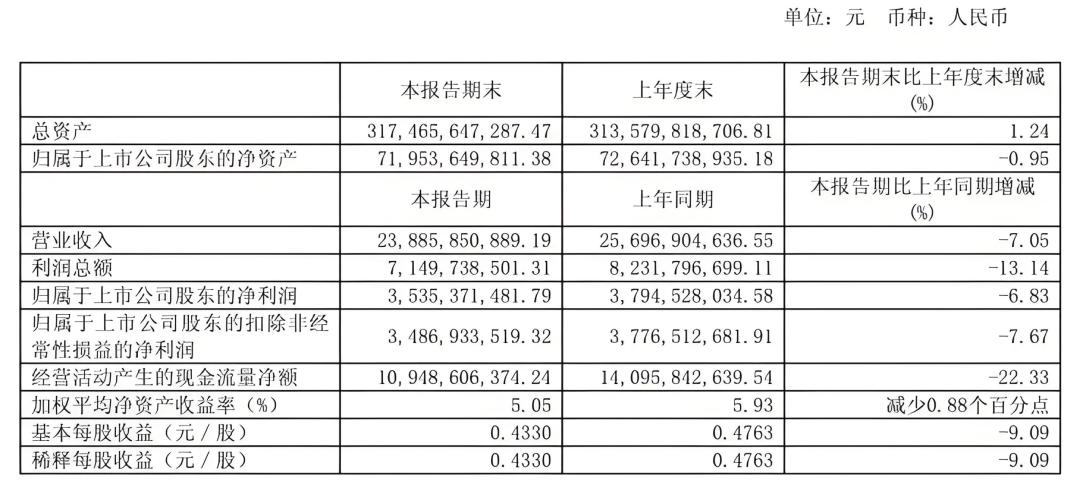
Among them, the hydropower generation was 39.452 billion kWh, down 17.43% year-on-year; Yalong River Hydropower, as the company's important hydropower asset, saw its power generation down 20.01% year-on-year. One of the main reasons is that the relevant river basins had insufficient rainfall and less incoming water.
Thermal power, which has been "suppressed" for a long time, has also gained more share in the change of energy structure.
In January this year, the National Development and Reform Commission and the National Energy Administration further improved the generation-side capacity tariff mechanism, allowing all regions to raise the coal power capacity tariff standard in light of actual conditions, and gradually establish a reliable capacity compensation mechanism. In simple terms, thermal power enterprises used to make money mainly by generating more electricity. Now, even if the power generation is reduced, as long as they can stably provide power during peak electricity consumption, they also have the opportunity to obtain corresponding capacity compensation.
This means that thermal power is gradually shifting from the traditional main power generation source to a role that takes into account power supply, peak shaving and backup.
Behind this, it is actually a new problem facing the entire power system: when the installed capacity of wind power and photovoltaic is increasing, and extreme weather makes power demand and hydropower output more unstable, how can the power grid ensure the balance between supply and demand at every moment?
The answer obviously cannot only rely on increasing thermal power units. As a result, energy storage and virtual power plants have begun to be pushed to the forefront.
The so-called virtual power plant does not mean building another power plant. Instead, it organizes industrial and commercial energy storage, charging piles, air conditioners and other adjustable power-consuming equipment through a digital system to carry out unified scheduling when the power grid is in tight supply and demand.
The core of this business is not simply selling electricity, but generating new commercial value from the originally scattered power consumption resources through methods such as demand response, power trading and auxiliary services. Among them, some listed companies have begun to turn such businesses into revenue.
Taking Dongfang Electronics as an example, the company achieved operating revenue of 3.667 billion yuan in the first half of 2026, up 15.98% year-on-year. Among them, the revenue of intelligent power distribution and utilization business was 2.39 billion yuan, up 36.74% year-on-year; the revenue of comprehensive energy and virtual power plant business was 129 million yuan, up 9.19% year-on-year.
The change of Guoneng Rixin is even more obvious. In the first half of 2026, the company's operating revenue reached 352 million yuan, up 9.66% year-on-year, and the attributable net profit was 70.12 million yuan, up 52.52% year-on-year. Among them, innovative products including power trading, energy storage energy management, microgrid and virtual power plant achieved operating revenue of 26.34 million yuan, up 62.96% year-on-year.
Although these innovative businesses currently only