Monthly salaries have surged by 40% in a year, are Japanese companies going crazy in the fierce scramble for talents?
If you travel to Tokyo on China's National Day, you will most likely spot a large number of young people in white shirts and black suits on trains and city streets.
They have not yet fully developed the seasoned bearing of regular office workers in their formal suits, and there is still a noticeable trace of inexperience on their faces, making it clear at first glance that they are college students.
However, if you assume they are rushing to a job interview, you are mistaken.
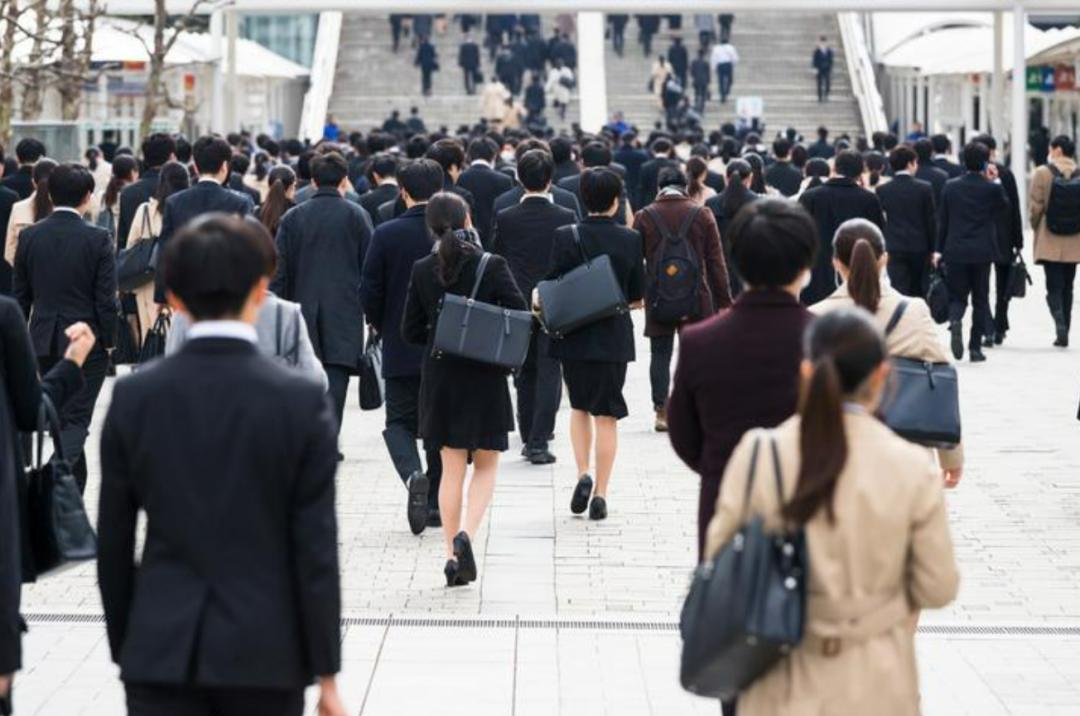
Every October 1st is the date when major companies in Japan collectively hold their "Naiteishiki" (pre-employment confirmation ceremony).
In simple terms, the so-called "Naiteishiki" is a "quasi-employment ceremony" hosted in advance for fresh graduates who are set to officially join the company in the spring of the following year.
The company will issue official pre-employment confirmation certificates to the students, have executives deliver speeches, and invite new hires to introduce themselves. Some enterprises will also arrange interaction sessions between new and veteran employees, company tours, followed by group dinners. In other words, while Chinese fresh graduates graduating next year are still in the hot "Golden September and Silver October" job-hunting peak,
The 2027 graduating cohort in Japan are already sitting at the same dining table sharing meals with company executives.
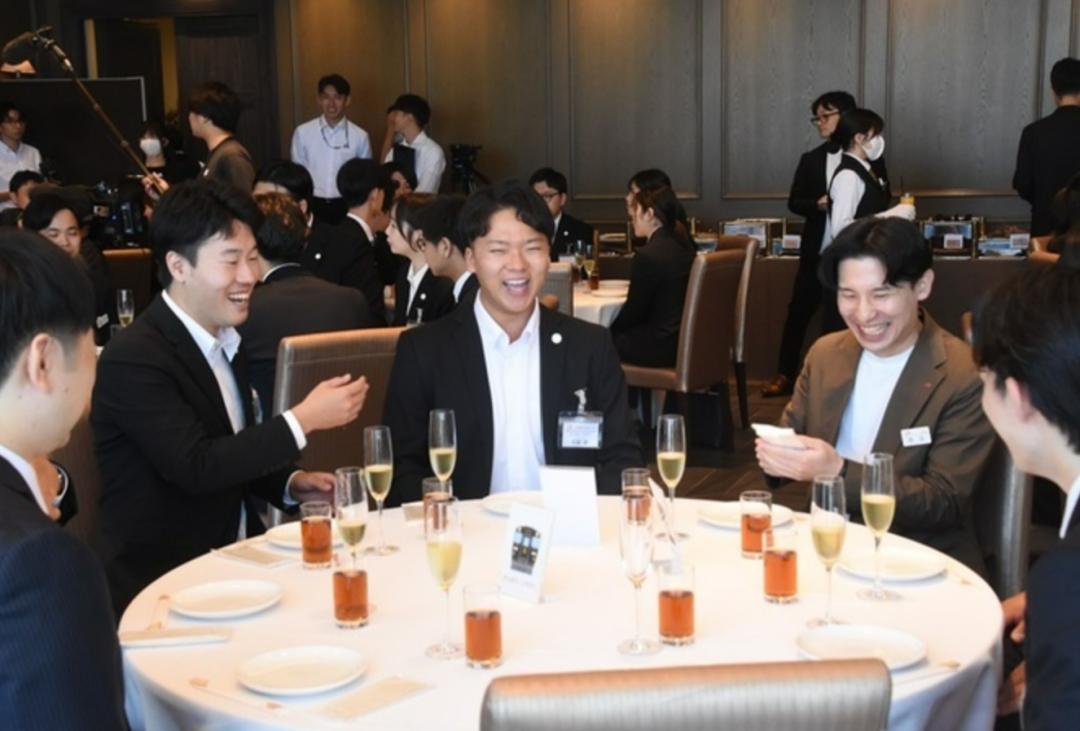
Image source: Nishinihon Shimbun
When it comes to cutthroat competition, our East Asian neighbor never falls behind.
But this time, it is not college students that are "rolling" themselves to the limit, but the companies facing severe labor shortages.
01
How far will Japanese enterprises go to poach talents
Here's a little-known fact:
Since the mid-2010s, Japan's fresh graduate recruitment market has already been a stable seller's market.
What does a seller's market mean? To put it bluntly, it is "the candidates pick the company, not the other way around."
The long-term labor shortage caused by declining birth rates has made talent one of the scarcest resources in the Japanese market.

To what extent has this scarcity reached?
Take college students as an example, the job-offer-to-applicant ratio for undergraduate students of the 2027 graduating cohort is 1.62.
This means that if there are 100 undergraduate graduates looking for jobs, there are 162 corresponding recruitment openings.
The high school graduate employment market is even more exaggerated. According to statistics, for high school students graduating in March 2026 who seek jobs through their schools and Hello Work public employment service, the job-offer-to-applicant ratio has reached an astonishing 4.12 — roughly 121,000 job seekers competing for 499,000 positions.
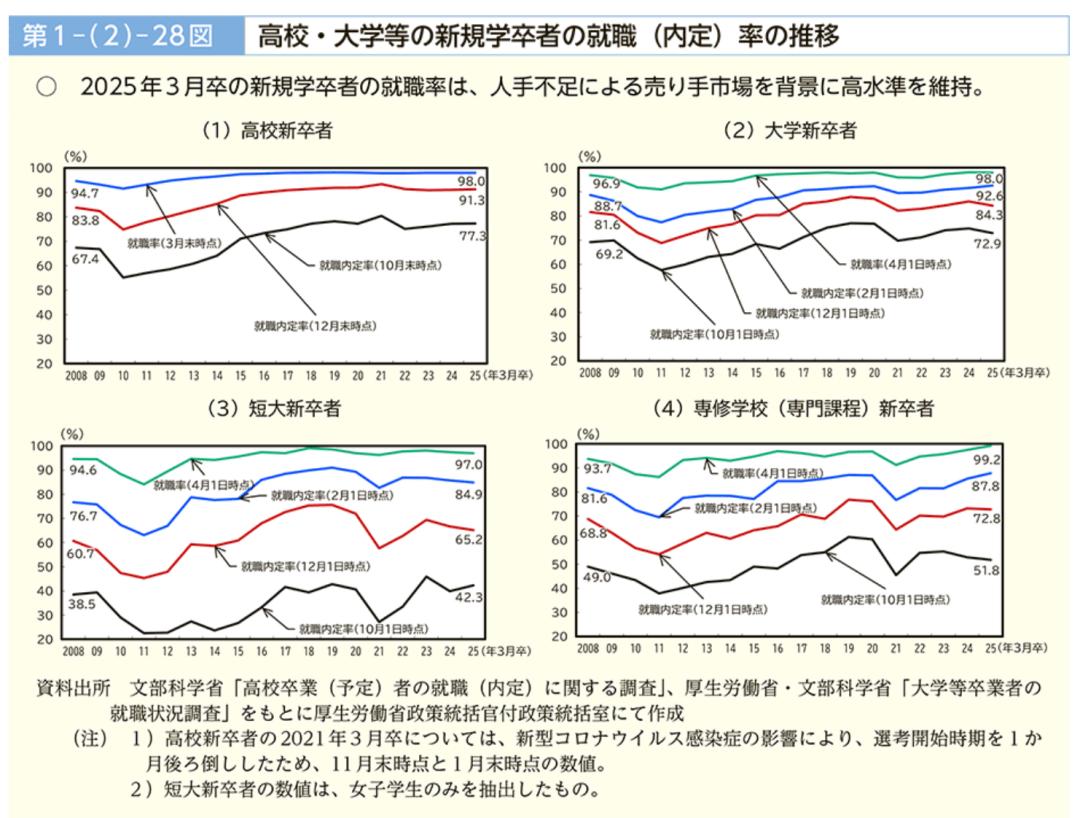
Caption: For Japanese college students graduating in March 2025, the employment rate has exceeded 97% regardless of the ranking of their university. Source: "Labor Economic White Paper" published by the Ministry of Health, Labour and Welfare of Japan
With far more job openings than job seekers, it is naturally the enterprises that are getting anxious.
To compete for talents, Japanese enterprises have been escalating their efforts in recent years.
The first move is to seize the initiative as early as possible.
Although the official regulation from the Japanese government states that enterprises can only start formal recruitment in June of the student's senior year of university.
In reality, enterprises have flocked to campuses a year or even earlier to "reserve talents", and their classic line goes like this: "Hey student, even though you are only a junior now, we will send you an offer right away, make sure you join us after graduation!"
According to a survey by the well-known Japanese job-hunting platform Recruit, 38.1% of Japanese students graduating in 2027 had already received job offers by March 2026.
Moreover, these offer holders have received an average of 1.92 offers from different companies, and 51.7% of the pre-employment confirmation holders have more than one offer in hand.

Data from another job-hunting platform Mynavi is even more staggering:
On March 1, 2026, 46.0% of the 2027 graduating cohort had already received offers, the figure rose to 58.7% by the end of March, and hit 70.9% by the end of April.
By the date the government defined as "the official start of recruitment", on June 1, 77.2% of college students had already received job offers.

Of course, to win over candidates, speed alone is far from enough, real financial incentives are also required.
As a result, you can see that the starting salary for fresh graduates at many large Japanese companies is being raised year by year, no, it is being raised drastically.
Take the large Japanese housing enterprise Daiwa House as an example. In 2021, the starting monthly salary it offered to undergraduate graduates was 216,000 yen (about 9,200 RMB).
In 2022, it was 220,000 yen.
In 2023, it was 240,000 yen.
In 2024, it was 250,000 yen.
By 2025, it stepped on the gas pedal all the way, raising the starting monthly salary to 350,000 yen (about 14,900 RMB).
In just one year, the starting monthly salary for new hires rose directly by about 4,300 RMB, a surge of 40%.
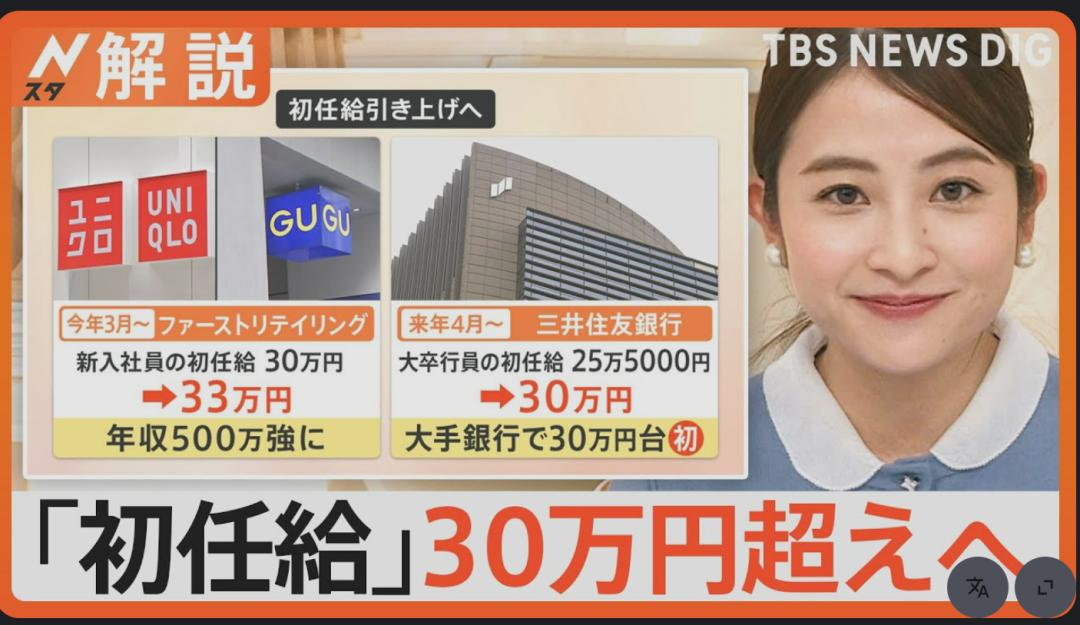
Fast Retailing, the parent company of UNIQLO, did not fall behind either. In 2025, the starting salary for fresh graduates was raised from 300,000 yen to 330,000 yen, and it will be further raised to 370,000 yen (about 15,800 RMB) in 2026.
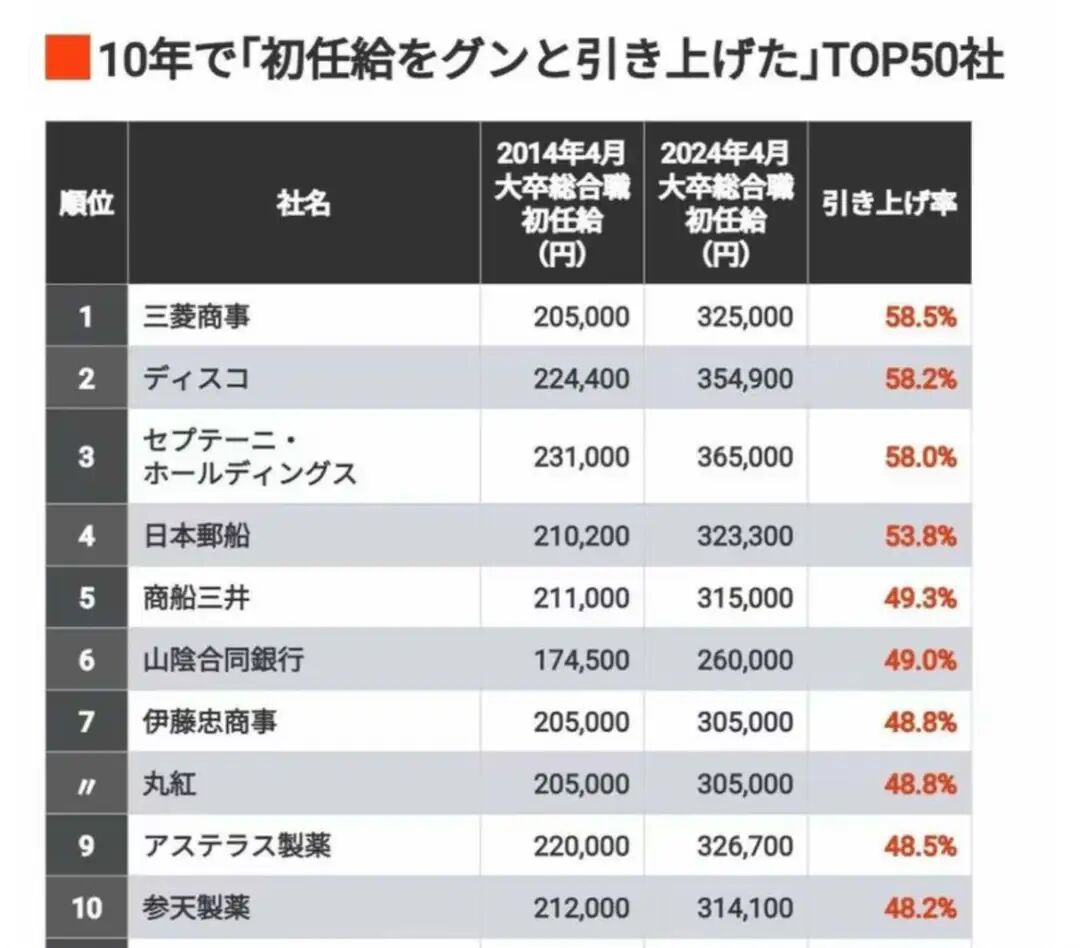
Companies with the largest fresh graduate salary increase from 2014 to 2024. Source: Shushoku Shikipo (Employment Quarterly Report)
According to the reasons for salary hikes surveyed by Mynavi, more than half of the enterprises stated that:
"Since other companies are raising salaries, we have no choice but to follow suit."
As a result, a salary arms race exclusively for fresh graduates has kicked off.
More and more large enterprises are raising the monthly starting salary for fresh graduates above 300,000 yen, and the speed of the increase is so fast that many students have already seen their expected salary rise before they even officially join the company.
Under this crazy salary growth, a very absurd scenario has even emerged:
Salary reversal.
Veteran employees who have worked for 3 years find that even though their salaries have been raised several times, the faster rising starting salary for fresh graduates makes their own salary lower than that of newly joined employees.
Who can put up with that?
Therefore, to avoid the salary of new hires exceeding that of existing employees, companies have to raise the salary of all employees at the same time.
The situation gradually evolved like this: to compete for new hires, companies raise the starting salary for fresh graduates.
Then to prevent veteran employees from feeling frustrated, companies raise salaries for existing staff as well.
Originally they only wanted to spend a little extra money to recruit a few college students, but in the end they found the entire company's payroll has been pulled upward together.
This time, every employee can have a reason to cheer.

02
Japanese enterprises: "Coaxing" students to come to work
The favored are always fearless.
When the salary offered by different companies is roughly at the same level, students will inevitably start to ask:
"So what else can you offer me besides money?"
As a result, enterprises are like peacocks spreading their tails during courtship, racking their brains to please college students.
Recruitment at traditional Japanese companies used to only need to promote themselves as "century-old large enterprises", but now they go as far as to post a fancy list of "100 reasons to choose us" on their official websites.
Our childcare leave acquisition rate is 100%.
We have very little overtime (we will show you the average monthly overtime data).
We offer flexible / remote work options.
We provide company housing, or direct rental subsidies if you do not want to live in company accommodation.
We will grant you XX days of leave and corresponding subsidies when you get married, give birth to a child, or have a family member pass away. All our employees can enjoy discounts for dining, watching movies, and staying at hotels.
Even if you just come to attend our information session, you can get a gift worth XX yen.
.....
In short, everything that can prove "we are a company worth joining" will be put on the table.

Especially in industries that used to have difficulty attracting female employees, enterprises will specifically promote the proportion of female managers, the utilization rate of childcare leave, interviews with female employees, and so on.
Some even create special dedicated pages exclusively for female job seekers.
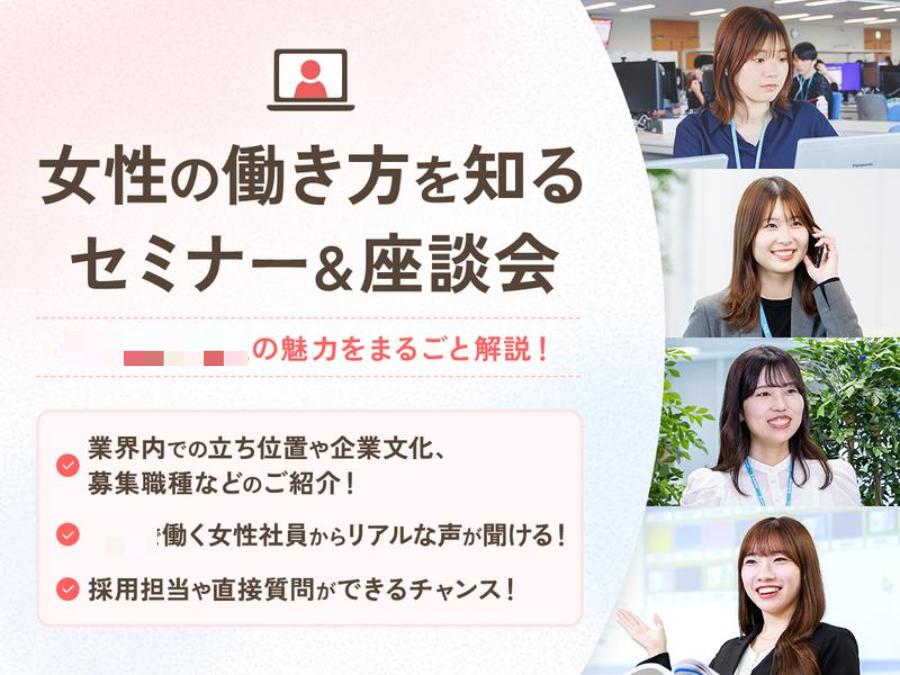
Special information sessions exclusively for female job seekers
Looking for a job in Japan is like going on a series of blind dates.
Both sides will line up all their "marital capital" to show off, but as long as the right to choose is not completely equal, one side will definitely be far more anxious and uncertain.
And as long as the official employment day has not arrived, this "marriage deal" can hardly be regarded as completely settled.
For Japanese enterprises, the most headache problem is not even that students do not show up for interviews, but that —
The student who has already promised to join ends up backing out.
Most people's intuition is that after receiving an offer, students will worry that the company might go back on its word.
But the situation in Japan now is exactly the opposite: after the enterprise issues an offer, it is far more afraid that the student will change their mind.
