Everyone is working on IP, but why are they such a huge hit?
During the just-concluded National Day Golden Week, we found that quite a number of shopping malls launched new IP activities to welcome the peak consumption season, featuring IPs such as CHIIKAWA, Butter Bear, Star Man, Mickey Mouse, Snoopy and many more, which is simply a "battle of the titans".
This also reflects from the side that the industry still regards IP activities as an effective marketing method, which can not only support the facade of the mall, but also drive huge passenger flow.
After carefully reviewing the content of various activities, we can see that the industry has formed some basic routines in operation: choosing popular IPs to guarantee mass appeal, launching brand-new themes to boost public discussion, and selling limited-edition peripheral products to drive fans to visit the site.
Then a new question arises: when the industry has almost formed a set of standard practices, why can some malls' IP activities become a huge hit, while others fail to generate much public attention? The answer definitely lies in the subtle differences under those standard practices.
Capture the Peak Moment of Emotion
Now everyone knows that IP must hit consumers' emotions to create sufficient reasons for all kinds of non-essential consumption.
Therefore, just like prescribing the right medicine for an illness, we use cute images to accommodate the public's fatigue, use abstract images to replace consumers' "emotional outbursts", and use passionate images to awaken the expectations deep in their hearts.
However, emotion is not a static object that can be classified and then ignored. On the contrary, emotion is fluid and fluctuating, with quiet troughs and peaks where people want to raise their arms and cheer. One of the reasons why some IP activities can go viral is that they match the peak emotional moment when consumers have the strongest desire to express themselves.
For example, the IP activity "Residents of Bikini Bottom - Summer Slacking Town" launched by Jing An Kerry Centre Shanghai this summer uses the daily life of background fish in SpongeBob SquarePants to humorously echo the working status of office workers.
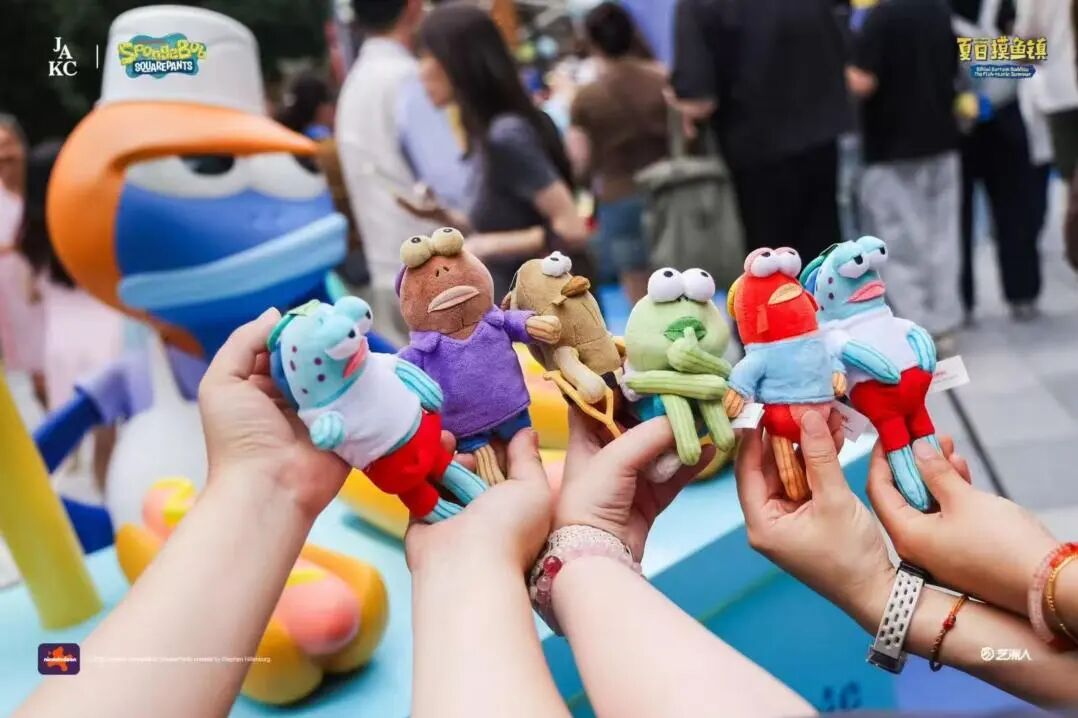
Background fish in Bikini Bottom | Source: Project Xiaohongshu
The idea of office workers "slacking off at work" probably exists all year round, but Jing An Kerry Centre seized the moment when this emotion was the strongest - summer. Office workers who stick to their posts commute under the scorching sun while wrapping up their mid-year summaries, only to see happy smiling faces of people on summer vacation all over their social media feeds when they open their phones.
When work burnout continues to rise, the tired and weak background fish becomes a ready-made outlet for expression. The accumulated emotions of everyone are released like a flood breaking a dam, and a large number of resonant contents such as "this fish is acting like me", "my mental state is like this" and "who installed a camera at my workstation" are posted on social media.
According to the disclosure of "Shanghai Jing'an", in the first weekend after the launch of the activity, the passenger flow of Jing An Kerry Centre reached 150,000 person-times, with a year-on-year increase of nearly 200%; by the countdown to the end of the activity, the average daily passenger flow of the project still remained at nearly 100,000 person-times, with a year-on-year increase of about 40%.
We can imagine that if this set of IP installations is placed in the Spring Festival season when everyone gets their year-end bonus and is setting new year goals, the effect will most likely not be so outstanding.
In addition to fluctuating with seasonal changes, emotional peaks can also be artificially created, especially during large-scale events such as concerts and sports competitions.
From the announcement, ticket sales to the opening of the event, the gradually rising excitement and curiosity are almost free fuel for the popularity of shopping malls. Activities such as "STAYREAL PARK" launched by Hangzhou Kerry Centre during Mayday's concert, and "Checkered Flag Carnival" presented by West Bund Dream Center Shanghai during the F1 Chinese Grand Prix, have all attracted considerable passenger flow by leveraging the momentum of large-scale events.
However, such officially derived IPs are too rare, so what else can we do to effectively leverage the momentum?
The practice of Shanghai Jing'an Joy City may be worthy of reference.
This summer vacation, the 2nd Shanghai International Game & Animation Month kicked off. The activity lasted for nearly 70 days, covering three major exhibitions: CCG EXPO, BilibiliWorld and ChinaJoy, with almost top-tier circle appeal across the country.
Almost at the same period, Jing'an Joy City's "JOY UNIVERSE Shine! Dimension Ceremony 3.0" was launched, gathering more than 30 national first-stop IP pop-ups, covering more than 50 heavyweight IPs across multiple categories such as classic animations, popular games, domestic novels, celebrities and internet influencers, basically covering all fields involved in the Shanghai International Game & Animation Month.
When there is no designated IP for large-scale events to derive from, Jing'an Joy City simply replaces specific theme binding with the idea of "interest extension", broadens the path, and directly turns itself into a "sub-venue" that can receive the same group of people, rather than an optional "second scene" affiliated to large-scale events.
During this activity, the total passenger flow of the project exceeded 4.9 million person-times, a year-on-year increase of 5%; the total sales of the whole mall exceeded 520 million yuan, a year-on-year increase of 4%. Among them, the sales of the IP pop-up exceeded 2.7 million yuan on the first day of opening, refreshing the single-day sales record previously set by the national first-stop CHIIKAWA theme pop-up.
What's more wonderful is that "JOY UNIVERSE Shine! Dimension Ceremony" itself is also Jing'an Joy City's own IP, which has been held for three consecutive sessions as of this year. The project can build momentum for itself while leveraging external momentum, and incorporate the passenger flow attracted at this moment into the base of future growth.
Let Consumers "Immerse into the Story"
Another buzzword about IP activities is "sense of participation".
Shopping malls are well aware that today's consumers are no longer satisfied with just taking photos with sculptures, so they have arranged sessions such as doll parades, author autograph signings, and small DIY competitions to create more IP touchpoints.
However, in this interactive setting, consumers seem to have done a few more things, but they are still expressing their love as fans, which is essentially a kind of onlooker standing outside the story.
What if we can let consumers truly enter the story? Here, we have to mention the "Absurd Wedding Scene - Siam Lipu x Pink Rabbit" IP activity of Nanjing Jingfeng Center.
At the beginning of the activity promotion, Jingfeng Center used the statement of "a bossy president booked the entire Jingfeng Center just to make his beloved girl smile", first putting the mall itself into the IP story, turning the originally irrelevant venue party into an essential part of the plot.
Then, the project logically invited everyone to "witness the love", creating a guest identity for consumers.
As a result, almost all interactions between consumers and the mall are packaged into the wedding scenario: coming to the mall is to "attend the wedding", on-site check-in is to "take photos with the newlyweds for commemoration", and buying peripheral products becomes "giving wedding gifts". Consumers can not only feel the perspective of the IP protagonist at a closer distance, but also integrate their daily consumption behaviors into the IP narrative context, making them reasonable and interesting.
The scalability of the story scenario also stimulates consumers' creative desire. Everyone is competing to show how they went to the scene to "send blessings", and continue to write their own "wedding side stories", constantly producing personalized materials that can be spread for secondary communication. According to the report of "Nanjing Release", this activity topped the national hot list of Douyin, and the single-day passenger flow of the project exceeded 150,000 person-times.
Of course, it is not easy to find the entry point for consumers to enter the story, which is closely related to both the IP characteristics and the positioning of the shopping mall.
A relatively easier way to operate may be the "cultivation-based" path: show the corresponding changes of the IP under the attention of consumers, so that consumers can naturally move from "the audience outside the story" to "the caretaker in the story".
For example, on the eve of the Mid-Autumn Festival, Chongqing The Ring Shopping Park decorated its outdoor block with fluffy "Moon Rabbit Troupe" as festival decorations.
Through the discussion about what to do with the little rabbits on rainy days, the project began to protect the little rabbits from rain according to the suggestions of consumers, thus pulling everyone into the nurturing narrative: the festival device that was originally just for good-looking has become a anthropomorphic role that needs to be cared for; the passers-by who originally checked in and left have been upgraded to nurturers who continue to pay attention to the little rabbits.
At present, almost every note about the little rabbits can get thousands of likes, and the comment areas are even asking the project to launch peripheral products of the little rabbits as soon as possible.
In this case, bringing consumers into the narrative framework may be more important than simply pursuing the richness of IP content: as long as a good beginning is written, consumers will actively continue the plot of the story, and even create new consumption demands.
Connect the "Last Mile" of In-mall Merchants
When we interviewed IP operator Qiansuo Culture, its founder Liu Juan asked us a very interesting question in return: shopping malls have such rich merchant resources, why not include them in IP activities? Other partners are trying their best to bind their rights and interests with IPs. It seems that only in shopping malls, IP activities and merchant promotions are always operated separately.
Indeed, the excitement of quite a number of IP activities is only limited to the atrium area of several hundred square meters on site. As the mall's own resources, in-mall merchants are left idle, as if they can only wait for the incremental passenger flow to come in.
There are of course many practical difficulties. Major brands have their own tonality control, and the cashier systems are not fully connected. But shopping malls can still start with merchant resources that are easy to link. For example, during the "Summer Slacking Town" activity, Jing An Kerry Centre Shanghai cooperated with 4 catering merchants to launch IP-themed delicacies, expanding the concept of "limited-edition peripheral products" from the pop-up store to the merchants.
To go a step further, we can also turn the entire store into an IP activity scene.
In the "Pretend to Go to Work Company - Illustration Little Man x Pink Rabbit" activity in October last year, Jingfeng Center jointly set up a themed coffee shop with merchants, and uniformly packaged everything from the scene to the food and supporting materials such as coasters. This coffee shop also became one of the most popular check-in points of this activity.
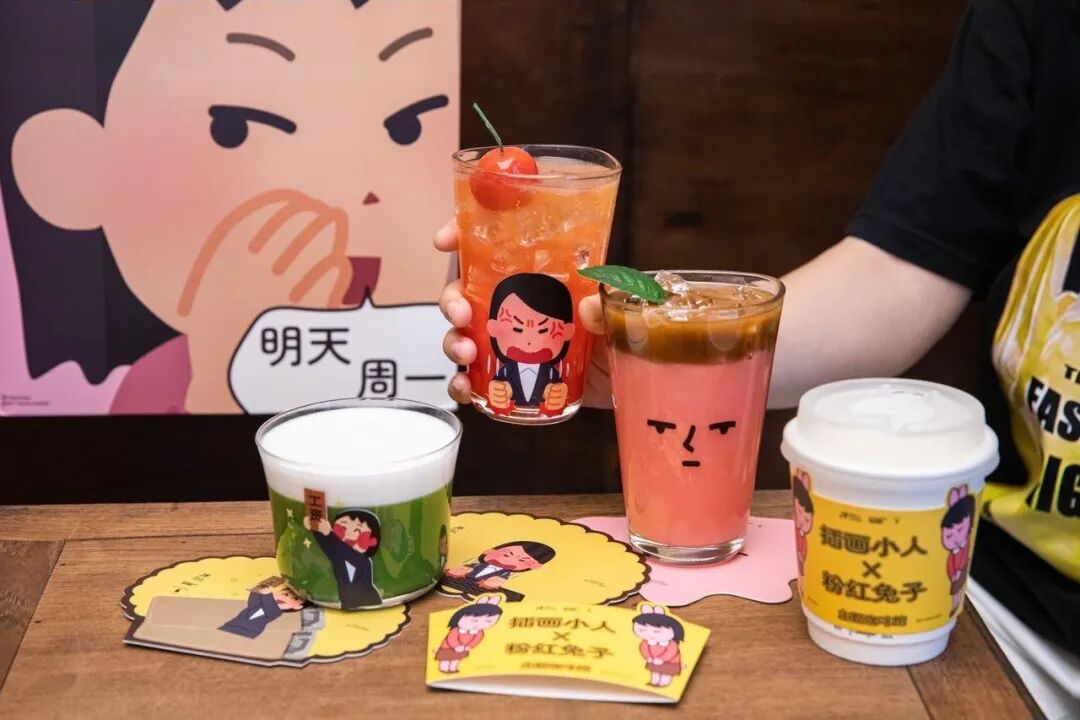
"Illustration Little Man x Pink Rabbit" Themed Coffee Shop|Source: Project Xiaohongshu
We also observed that in Jingfeng Center's latest IP activity "A Happy Day - Yi'er and Bubu", the same merchant once again became the partner of the themed coffee shop. This continuous enthusiasm for investment most likely indicates the effectiveness of the activity implementation.
For merchant resources that are difficult to directly apply the IP theme, the focus is on exploring the extended consumption preferences of IP fans: apart from the IP, what are they most likely to like? What connections can their favorite things have with the in-mall merchants?
We can refer to the practice of Bank of China when launching the Line Puppy credit card: in addition to conventional activities such as consumption gifts and lucky draws, it specially set up exclusive pet-raising services for cardholders, including physical examinations, insurance, pet-friendly service privileges and so on.
This is obviously based on the judgment of IP fans' pet-raising preference, and uses this concept to connect the cross-format merchant rights and interests to form distinctive card-opening benefits.
Translated into the context of shopping malls, a well-organized cross-format rights and interests package can not only mobilize more merchant resources, but also convert IP fans into members of merchants and even the mall, making a single visit an opportunity for long-term repurchase.
At present, we seem not to have seen any shopping mall implement similar practices, which is worth looking forward to.
Conclusion
An expert who has been deeply engaged in shopping mall IP curation for more than 10 years shared with us that in fact, the essence of IP activities has never changed. It is nothing more than the copyright owner and the shopping mall exchanging resources, so that both sides can get more channels of exposure and monetization.
This judgment reminds us that under the "right time, right place and right people" that makes IP activities go viral, there may also be a core capability: the cognitive power of the shopping mall itself.
Only shopping malls that fully understand the customer group, merchants and the core of IP culture can grasp the fulcrum where they intersect with the IP, and leverage greater popularity.
Shopping malls with such cognitive power will not let IP activities become a one-time marketing "traffic package", but take them as a long-term tool to build brand image, and deepen the concrete expression of the project's temperament in each implementation.
After all, the most valuable IP that a shopping mall can build is itself.
This article is from the WeChat official account "Mr. Mall", author: Gillian, published with authorization from 36Kr.