Holidays, the gentlest rebellion of humankind against time.
By Zhang Chunyi
Case Lead and Researcher, Center for Business Knowledge Development and Communication, School of Management, Fudan University
Compared with the "perfect vacation" imagined by human beings, the Golden Week we obtain by swapping regular rest days still has a certain gap from the ideal.
In 1516, Thomas More, the British thinker and utopian socialist, depicted such a life in *Utopia* written in Latin: the Utopians only work six hours a day, and they can spend the rest of their time reading and chatting.
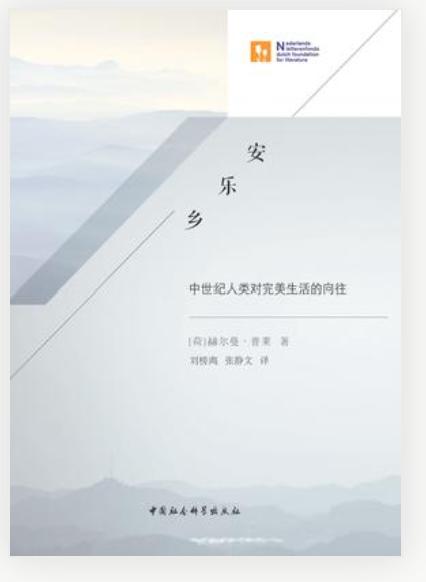
As revealed in the book *The Land of Cockaigne: Medieval Human Yearning for a Perfect Life*, the folk fantasy in Europe at that time was that roasted chickens would fly into people's mouths by themselves. In some versions, the more you sleep, the more you earn, which perfectly interprets the meaning of "getting rich by lying flat".
In *The Peach Blossom Spring*, Tao Yuanming described these lucky people as "they do not know the existence of the Han Dynasty, let alone the Wei and Jin Dynasties". It seems that even the time slows down, and naturally there is no KPI as we have today; but "it is not suitable to tell it to outsiders", which means do not post it on Moments.
In the story "Visiting Dai on a Snowy Night" from *A New Account of Tales of the World · Uninhibitedness*, Wang Ziyou suddenly missed his friend at night, took a boat overnight, but turned back when he arrived at the door, leaving a sentence "I set out with full enthusiasm, and returned after my enthusiasm was exhausted". This kind of impromptu travel forms a sharp contrast with the "special forces-style travel" nowadays.
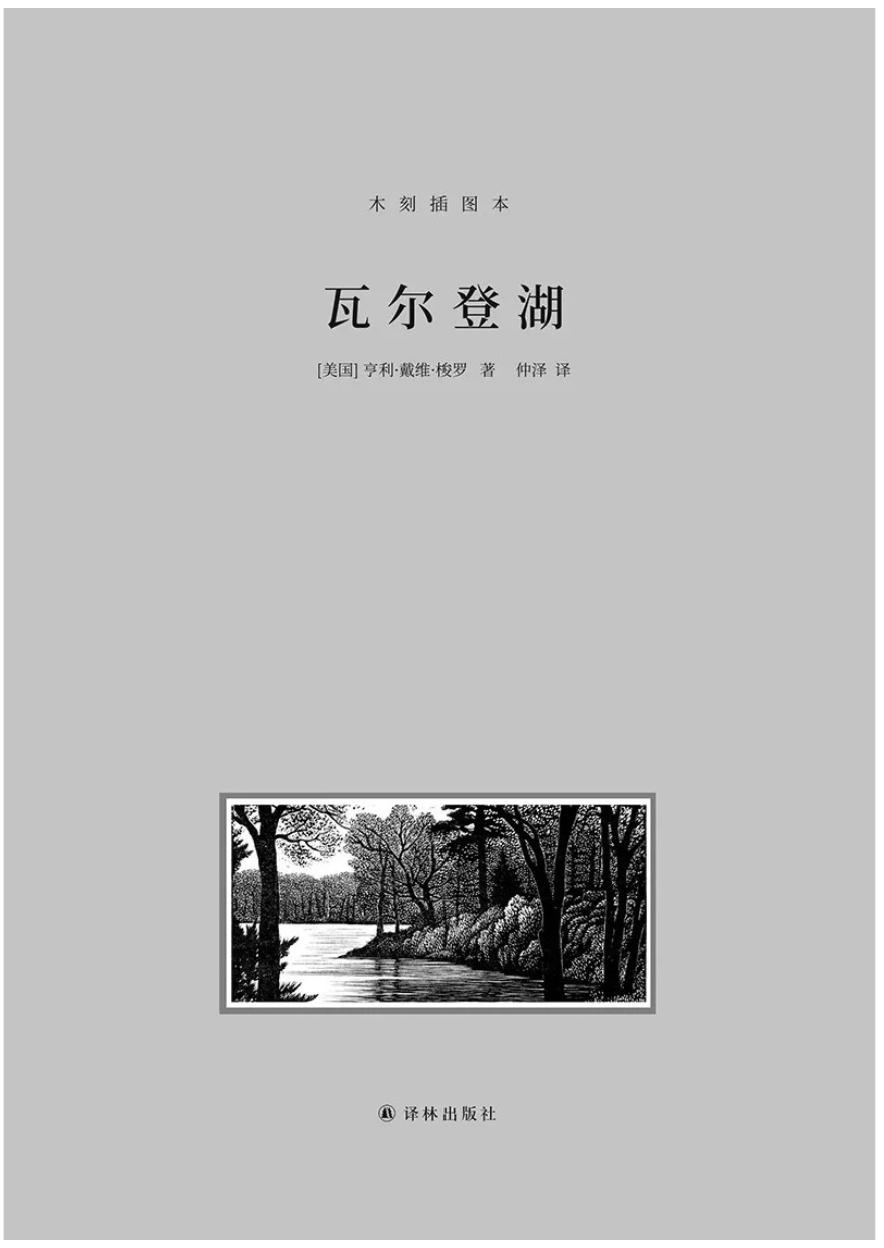
When I was a teenager, my favorite book was *Walden* by Henry David Thoreau. He lived by the lake for two years, two months and two days. According to his own account, he only needed to spend about six weeks a year working to make a living to support his life. This does not include all activities such as writing. Contemporary people always have the ability to turn tourism or even long-term stay in other places into another form of work, being busy instead of living a "real life". Thoreau's experience makes people rethink the relationship between material needs and spiritual life. He was less than 28 years old when he lived in seclusion at Walden Pond, with wisdom disproportionate to his age.
In 1920, Karel Čapek, the Czech writer, used the word "robot" in his sci-fi script *R.U.R. (Rossum's Universal Robots)*. The word was suggested by his brother Josef Čapek, derived from the Czech word "robota", which means forced labor and drudgery. In the play, the robots will also awaken their consciousness and overthrow the enslavement and rule of human beings over them. The work thus raises issues of technology, labor and the human situation.
Before the industrial society, people's rest arrangements were mostly related to agricultural solar terms, religious sacrifices or status. In ancient China, there was already a vacation system for officials, and the holidays were related to solar terms and administrative arrangements, which varied in different dynasties and periods. Since the late Qing Dynasty, the Western-style weekly system has been gradually introduced into China.
After World War II, the modern vacation system was further developed, and there are still obvious differences in the statutory working hours and paid annual leave arrangements of various countries.
For a long time after the founding of the People's Republic of China, we implemented a single day off on Sundays. Many people born in the 1970s and 1980s experienced this in their school days. In 1994, China implemented a working hour system of 44 hours per week on average, usually arranged in the way of "big and small weeks", that is, two days off every other week. On May 1, 1995, China began to implement a 40-hour working week system. State organs and public institutions in principle implemented two days off on Saturdays and Sundays. The Spring Festival, May Day and National Day "Golden Weeks" began in 1999. In 2007, China revised the holiday arrangement, added Qingming Festival, Dragon Boat Festival and Mid-Autumn Festival as public holidays for all citizens, and promulgated the *Regulations on Paid Annual Leave for Employees*, the relevant provisions of which have been implemented since 2008. From the "rest for bathing" in the Han Dynasty to today's paid annual leave and public holidays, the reform of the vacation system is the result of the combined effect of productivity development and social concept progress.
1. A thousand-year-long "bargaining"
There is a saying that the earliest human holidays were granted by gods. In Jewish tradition, God spent six days creating the world and rested on the seventh day, which is the Sabbath and also an important source of the "seven-day week". In 321 AD, Roman Emperor Constantine ordered that urban officials and artisans rest on Sundays. This became one of the early examples of legally stipulating Sunday rest.
Ancient Chinese officials also had a vacation system. According to ancient records, officials in the Han Dynasty had a "rest for bathing every five days", that is, one day off every five days to go home to take a bath and change clothes. The name of the holidays at that time was full of the flavor of "bath center". In the Tang Dynasty, it became "ten-day rest", one day off every ten days. Officials in the Han Dynasty took one day off every five days, and officials in the Tang Dynasty took one day off every ten days. It seems that history is progressing while the vacation is regressing. In fact, it is not the case. In addition to the ten-day rest, Tang Dynasty officials also had different types of holidays such as festival leave, home leave, marriage and funeral leave, so we cannot only look at the interval of fixed rest days.
There were many religious festivals in medieval Europe, but the number of festivals was not equal to the actual rest days of farmers, and agricultural work and housework still had to continue. In the era of the Industrial Revolution, factory labor made working hours more concentrated, and long working hours also became an important source of labor-capital conflicts.
Then the workers began to fight for their rights.
In 1817, utopian socialist Robert Owen shouted the slogan: eight hours for work, eight hours for recreation, eight hours for rest.
On May 1, 1886, workers in Chicago, the United States, held a general strike for the eight-hour working day, which is the origin of "International Workers' Day". In 1889, the founding congress of the Second International decided to designate May 1 as International Workers' Day.
In 1936, France passed a law establishing a two-week paid annual leave system for a wide range of workers. In the summer of that year, a large number of workers crowded into trains and headed for the beaches. By 2026, 90 years have passed since this reform, which has become an important node in the history of mass vacation development.
Looking further back, there was another interesting turning point in 1926. Ford Motor Company implemented a five-day, 40-hour working week. The time outside work also created conditions for travel and consumption. In modern industrial society, vacation is gradually linked to mass consumption.
So what exactly happened to working hours? Economic historians Michael Huberman and Chris Minns sorted out the working hour data of many countries from 1870 to 2000. In the long run, the annual working hours of many countries involved in the study have been significantly shortened, but the pace and range of decline are not consistent.[1]
2. Who decides your vacation?
If vacation is only determined by productivity, the richer and more leisure countries will be, and the trend should be consistent. This is not the case. Huberman and Minns' research found that labor force, inequality and historical differences in working hours are related. To understand the distribution of work and rest, we can not only look at income and productivity, but also look at institutions and social conditions.[1]
What factors exactly determine the vacation of workers? Looking at each stage separately, there are at least four forces:
First, labor force, which has been listed above and will not be repeated. Second, the consideration of enterprises. Work efficiency, employment arrangement and consumer demand may all affect how enterprises arrange working hours. Third, national policies. China's Golden Week is a typical example. In 1999, the State Council increased the statutory public holidays for all citizens from 7 days to 10 days, with 3 days off for Spring Festival, May Day and National Day respectively, and then connected with the previous and subsequent weekends to form three 7-day long holidays. Coping with the Asian financial crisis and expanding domestic demand are one of the backgrounds to understand this change.[2] Fourth, culture and religion. The Sabbath, Spring Festival, Cold Food Festival, Eid al-Fitr all reflect the influence of cultural traditions on rest arrangements. The date and number of vacation days are usually affected by the above factors.
Next, we sort out part of the changes of the vacation system according to two clues of global and China. The global part is a summary for easy reading, and there are overlaps and vacancies in the time of each stage, which does not represent the unified historical stage of all countries; the two clues do not correspond one by one in time.
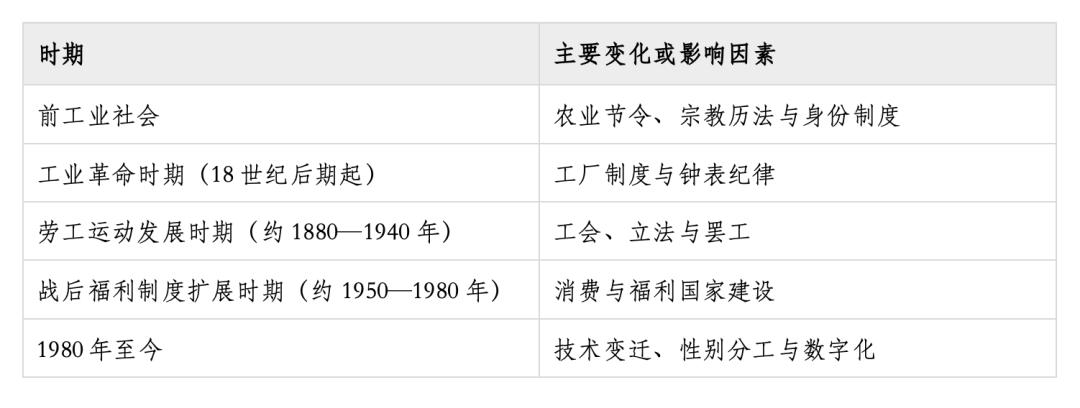
Partial clues of the evolution of the global vacation system
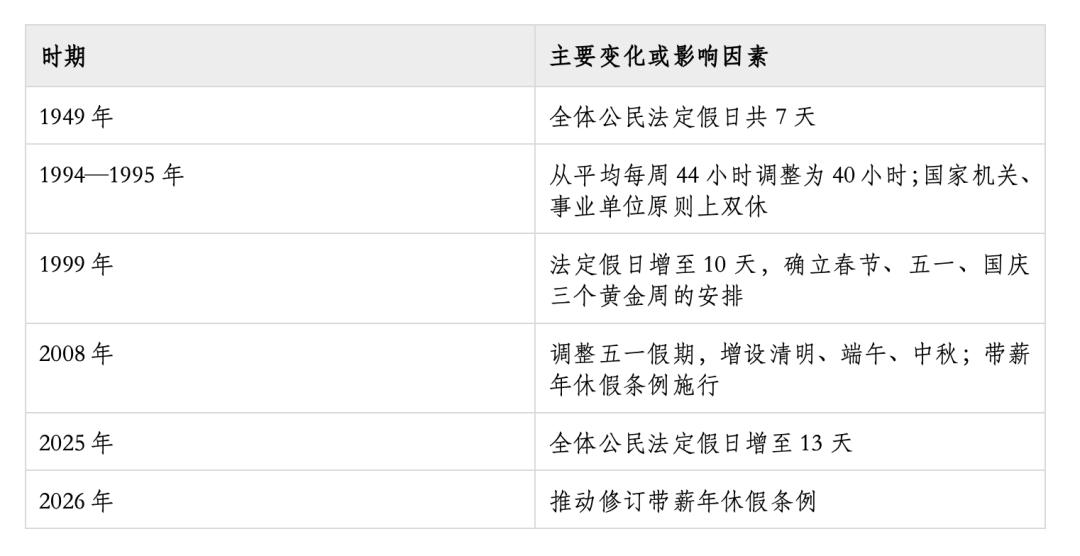
Partial changes of China's statutory holidays and weekly rest system
3. How do other countries arrange their vacations?
China currently has 13 statutory public holidays. Compared with other countries, the number is not the most, nor the least, which is equivalent to that of France and Germany, more than 10 days in the UK, 11 days in the United States, and 12 days in Sweden. Compared with other countries, the main gap lies in the realization of paid annual leave.
France: If you work during the full annual leave entitlement period, you can usually get five weeks of paid annual leave. The statutory weekly working hours for full-time employees are usually 35 hours, which is not the absolute maximum working hours. In Paris in August, many small shops have signs on the door saying "On vacation, see you in September". Since 2017, there has also been a "right to disconnect", and relevant enterprises need to make arrangements for the use of digital tools and the protection of employees' rest time; whether the regulations are violated cannot be judged only by the time when the message is sent.
Germany: Under the five-day working system, the statutory paid annual leave is at least 20 days, and the contract or collective agreement can stipulate more days. The seriousness of Germans towards vacation is roughly equivalent to our requirement for "on-time food delivery".
Sweden: Statutory annual leave is 25 days, but the paid entitlement must meet the corresponding eligibility conditions. In principle, you can take four consecutive weeks of vacation from June to August, which needs to be combined with applicable rules and agreements. Each child's parental allowance usually corresponds to a total of 480 days, which can be allocated by parents according to regulations, among which there are days reserved by each party and non-transferable. Their "fika" (coffee break) is even regarded as a cultural system.
Japan: There is paid annual leave, but for a long time, people "have vacation but dare not take it". After the "Work Style Reform" in 2019, the law requires employers to ensure that workers who are entitled to 10 days or more of statutory annual leave each year actually take at least 5 days. This also shows that to implement the vacation rights on paper, institutional guarantees are needed.
United States: There is no general statutory paid annual leave requirement for private sector employees at the federal level, which is quite rare among developed countries. The specific arrangement usually depends on employment contracts, collective agreements and enterprise policies, and must comply with applicable laws.
Australia: There is "long service leave". If you work in a company for about ten years, you can get a very long paid long vacation, and the regulations vary from state to state. In New South Wales, employees are usually entitled to two months (about 8.67 weeks) of paid long service leave after 10 years of continuous service. In Victoria, long service leave is calculated as 1 week for every 60 consecutive weeks of service, and usually can be applied for after 7 consecutive years of service. This is equivalent to a "loyalty reward": If you can stay in the company for a long time, the company will allow you to go out and see the world.
Many people are dreaming of a "four-day work week". Iceland carried out an experiment of shortening weekly working hours from 2015 to 2019, which mainly shortened the weekly working hours to 35-36 hours, not uniformly changed to four working days a week. The participants accounted for about 1% of the national labor force. The report said that the productivity or service level of most participating units was maintained or improved, and the well-being of employees was improved. A 2021 report said that about 86% of workers had shortened their working hours or obtained the right to shorten their working hours. In 2022, 61 companies in the United Kingdom participated in the experiment, and the result report released in 2023 showed that most of them chose to continue after the end.[3-4]
4. Evolution of China's long holidays
In 1999, the State Council revised the *Measures for the Holidays on National Festivals and Anniversaries*, taking three days off for Spring Festival, May Day and National Day respectively, and adding the previous and subsequent weekends to make up seven days, thus the "Golden Week" was born. One of the backgrounds was the insufficient domestic demand at that time, hoping to boost consumption through holidays. There was another adjustment in 2008, canceling the original 7-day May Day Golden Week arrangement, and including Qingming Festival, Dragon Boat Festival and Mid-Autumn Festival as statutory holidays. Since 2025, according to the newly revised measures, the statutory Spring Festival holiday has been increased from 3 days to 4 days, re-including New Year's Eve, the statutory Labor Day holiday has added May 2nd, and the total number of statutory public holidays for all citizens has increased from 11 days to 13 days.[5]
What have long holidays brought?
① The collective carnival of consumption and cultural tourism. During the 8-day consecutive holiday of National Day and Mid-Autumn Festival in 2025, the Ministry of Culture and Tourism announced that the number of domestic tourists was 888 million, and the total domestic tourism consumption was 809.006 billion yuan. In 2025, the total domestic tourism consumption of residents was