Gotion High-Tech teams up with Volkswagen to pour 3.2 billion euros into building a battery factory, securing its entry ticket to the European market, yet the tight carbon footprint shackle has only just been put in place.
Gotion High-Tech's joint venture factory in Europe with PowerCo brings opportunities as well as challenges including compliance requirements.
Energy Foresight learned that on September 28, Gotion High-Tech and PowerCo, the battery subsidiary of Volkswagen, signed an agreement with a total investment of 3.222 billion euros, under which the two parties will set up three joint ventures in Valencia, Spain, Sulany, Slovakia, and Kenitra, Morocco. The day after the news was released, Gotion High-Tech hit the 10% price limit 8 minutes after the market opened, with pending orders exceeding 890,000 lots.
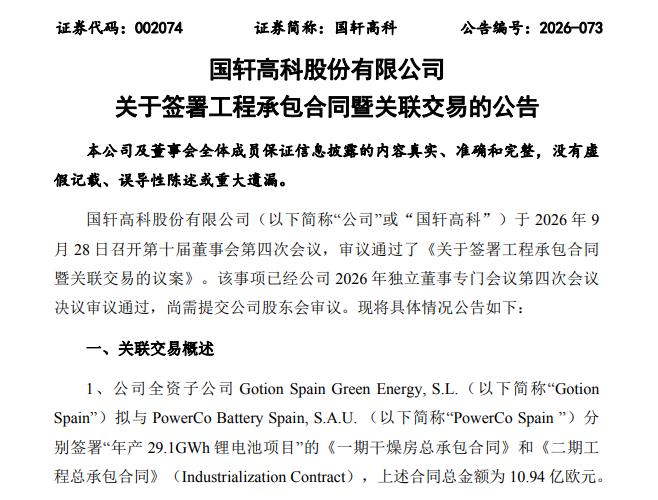
What is worth noting about this matter is not the figures themselves. The global installed capacity of power batteries reaches nearly 1000GWh a year, and the planned production capacity of 37GWh is far from an unprecedented huge investment. What really deserves attention is the structure of this transaction: Gotion will contribute approximately 1.598 billion euros, while PowerCo will contribute approximately 1.624 billion euros, making the contributions of both parties almost equal. In terms of equity arrangement, for the 29.1GWh project in Valencia, PowerCo holds 51% of the shares to take the controlling stake, and Gotion holds 49%; for the 8.4GWh project in Sulany and the 100,000-ton cathode material project in Morocco, Gotion holds 51% of the shares and takes the controlling stake.
This is not an ordinary overseas factory construction investment. It is a transaction concerning the access right to the European market.
Volkswagen has delivered far more than just a factory
The Valencia plant is not a project built from scratch by Gotion. The plant was previously led and promoted by PowerCo. The Spanish government has allocated more than 260 million euros in subsidies to the plant through the PERTEVEC program, of which 152 million euros are cash subsidies that the Valencia joint venture has obtained before this investment. Instead of directly acquiring the plant, Gotion enters the project by capital increase to PowerCoSpain, and participates in subsequent construction and operation. However, the construction progress of the plant has been repeatedly delayed. After years of independent development by PowerCo, the mass production of cells has never been realized.
This situation is exactly the same as that of Northvolt. The once highly promising "top battery enterprise" in Europe declared bankruptcy after burning 15 billion U.S. dollars of investment, and the plan for the Heide plant in Germany was once stranded, before it was taken over and promoted by the U.S. company Lyten. According to data from the IEA, Chinese enterprises including CATL, BYD, and CALB control about 80% of the global battery production capacity. European automakers have calculated an account: the comprehensive production cost of large-scale mass-produced power batteries is about 30% higher than that in China, the electricity price is 3 to 5 times that of China, and the hourly wage of workers is 5 times that of China.
Volkswagen's choice is very pragmatic. Rather than continuing to burn money in a project that cannot be operated smoothly, it is better to hand over the factory to the party that can make it run properly. The conditions for Gotion to take over are also clear: in exchange for a 49% equity stake, it obtains an existing base that has received government subsidies and is located in the core of Spain's automotive industry cluster. Spain is an important production base of the Volkswagen Group in Europe, and the geographical location of the Valencia plant determines that it serves Volkswagen's vehicle production lines in Southern Europe rather than Gotion's own business.
The arrangements for Slovakia and Morocco are the opposite. Gotion holds a 51% controlling stake in these two projects, keeping the key link of cell manufacturing in its own hands, and at the same time using the 100,000-ton lithium iron phosphate cathode material production capacity in Morocco to provide upstream supply for European battery bases. The trade facilitation conditions between Morocco and the European Union itself serve as a buffer to avoid tariff barriers.
The EU's carbon footprint rule is a hurdle that Gotion has not yet crossed
However, obtaining the factory and equity does not mean getting the passport to enter the European market.
The EU's mandatory carbon footprint declaration for energy storage batteries has come into effect on February 18, 2026, and the Digital Battery Passport will be implemented on February 18, 2027. What is more tricky is the design of the accounting rules: only two models, "national average power consumption mix" and "directly connected power", are retained for carbon footprint calculation, and the green certificates commonly purchased by Chinese enterprises are not recognized. This means that even if Gotion uses green power to produce cathode materials in Morocco, the carbon footprint data will still fail to meet the requirements if the power source is not recognized by the EU accounting system.
Since August this year, the EU Customs has changed its regulation on the carbon footprint declaration of imported batteries from "pass after declaration" to mandatory random inspection. Several batches of battery products exported from China to the Port of Rotterdam have been detained because their green power certificates do not meet the requirements.
Gotion's layout of cathode materials in Morocco and cell manufacturing in Spain and Slovakia follows the correct direction of localized production. However, from the compliance of raw material source codes and power mix factors to mineral due diligence and recycled material proportion, every item requires rebuilding the data system of the supply chain. Building a factory only means getting the admission ticket to the examination room, and the exam has just started.
Gotion's overseas gross margin is racing against capital expenditure
Gotion High-Tech's revenue in the first half of 2026 reached 27.776 billion yuan, a year-on-year increase of 43.22%, and its attributable net profit reached 1.386 billion yuan, a year-on-year increase of 278.05%. The global installed capacity of power batteries reached 28GWh, with a market share of 4.6%, ranking fifth in the world. Overseas revenue reached 9.476 billion yuan, a year-on-year increase of 48.06%, accounting for 34% of the total revenue.
What is more noteworthy is the gross margin of overseas business: 18.05%, which is higher than the 14.34% of domestic business. It contributes nearly 40% of the gross profit with about 34% of the revenue. This shows that Gotion's overseas business is not losing money just to grab market share, and the increasing delivery of standard cells meeting Volkswagen's standards is indeed improving its revenue structure.
But the other side of the coin is capital expenditure. Gotion needs to invest approximately 1.598 billion euros this time. Coupled with previous preliminary investments in Vietnam, Slovakia and other places, the company is currently in a high capital expenditure cycle. The non-recurring profit and loss deducted attributable net profit for the first half of 2026 is estimated to be only 85 million yuan to 120 million yuan, and there is a huge gap compared with the 1.386 billion yuan attributable net profit, so the contribution of investment income and non-recurring gains and losses cannot be ignored. It usually takes 2 to 3 years for an overseas factory from construction to full production, during which the pressure of depreciation and financial expenses will continue to exist.
The cooperation between Gotion and Volkswagen started in 2020 when Volkswagen took a stake in Gotion, and it took five years until the official mass production and delivery of standard cells in November 2025. Volkswagen plans to continuously purchase Gotion's standard cells from 2026 to 2032, covering major brands such as ID. and Skoda. According to the research report of BOCOM International, Volkswagen is expected to become Gotion's most important incremental customer in 2026, with the estimated shipment exceeding 10GWh.
But "the most important customer" and "the only customer" are two completely different concepts. If Gotion's customer matrix in Europe only relies on Volkswagen, its bargaining power and risk resistance capability will be limited. The final destination of the Valencia plant's production capacity and whether the Slovakia plant can expand orders from European automakers other than Volkswagen are the key variables that determine the long-term return of this investment.
Germany has restarted electric vehicle purchase subsidies this year, with a total amount of 3 billion euros, covering about 800,000 new cars, and there is clearly no geographical restriction. The demand for electrification in Europe will continue to grow under policy stimulus, but the distribution of the incremental market cake depends on who can control the cost within the compliance framework. Gotion has obtained the factory and Volkswagen's orders, and the next challenge is: In the process of supply chain restructuring driven by the EU's carbon footprint rules, can it run faster than its European competitors, while moving more steadily than its Chinese peers.