By reducing one degree of freedom, Sharpa has secured the right to define dexterous manipulation.
Sharpa has proactively removed one degree of freedom from its new generation of dexterous hands.
On September 28, at the International Conference on Intelligent Robots and Systems (IROS) held in Pittsburgh, USA, Sharpa launched its new generation dexterous hand W02. Compared with the previous generation product, it features a more compact structure and lighter weight, with tactile coverage extended from the fingertips to the fingers and palm, while the number of active degrees of freedom is reduced from 22 to 21.
The degree of freedom determines how many types of movements the manipulator can control independently, and it is also one of the most intuitive parameters to understand the capability of a dexterous hand. For a company that once integrated 22 active degrees of freedom into a human-hand-sized structure, this trade-off is quite meaningful.
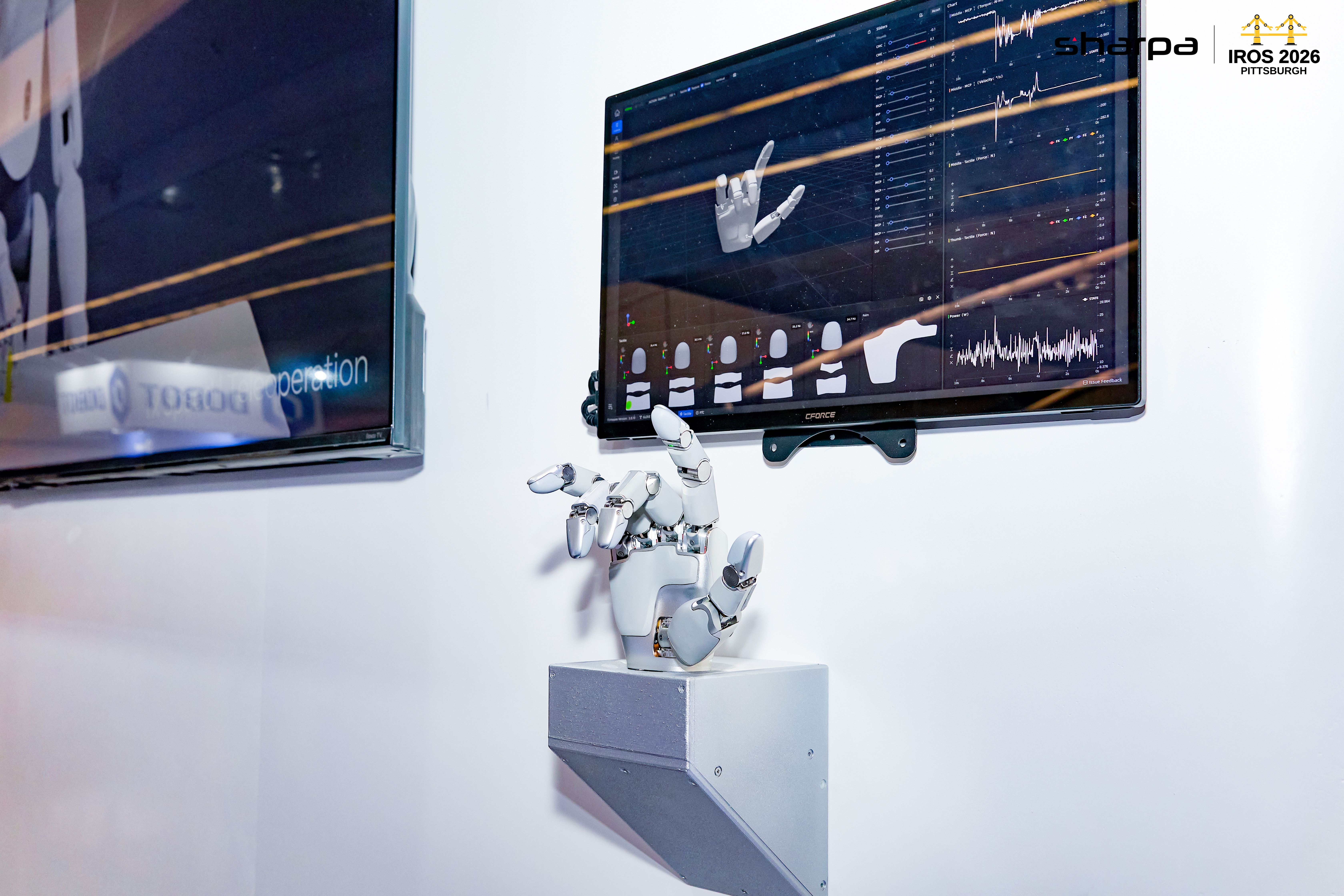
Sharpa's new generation dexterous hand W02
Launched alongside the W02 are the general-purpose humanoid robot D01 and the exoskeleton data glove AE01. The former provides complete machine movement and full-body tactile perception, while the latter is used for teleoperation and data acquisition. Combined with the previously launched operation model CraftNet, Sharpa attempts to consider the design of the hand within the complete operation process covering perception, control and skill development.
By removing one degree of freedom, what exactly is lost and what can be gained? This needs to be judged based on the tasks performed by the robot.
01. 22 to 21, Sharpa rewrites the evaluation criteria for dexterous hands again
Degree of freedom is one of the most frequently compared indicators for dexterous hands. More independently controlled motion dimensions provide more posture and movement combinations for the manipulator, but also increase the complexity of structure and control. Whether they can be fully utilized depends on the requirements of the tasks for the hand.
In May 2025, Sharpa launched its first-generation dexterous hand, which combines 22 active degrees of freedom, visual-tactile perception and human-hand configuration. This product, originally named Sharpa Wave and now called W01, has later been adopted by top universities around the world and included in NVIDIA's robot reference solutions. Being adopted by external R&D teams has also made Sharpa's product selection begin to influence how more teams realize dexterous operation.
By the second generation, the company began to re-examine the contribution of one of the joints.
The degree of freedom removed by the W02 is the CMC (carpometacarpal joint) degree of freedom at the base of the little finger. Sharpa's pre-application research found that this degree of freedom is used less frequently in common grasping and in-hand operations, which is mainly manifested as the little finger rotating along its own axis, with limited contribution to most practical tasks. Removing it can simplify the structure of the little finger root and reduce potential failure points.
This adjustment first considers the balance between stability and the overall hand design. Whether an additional motion dimension is worth the corresponding structure, weight and control costs needs to be judged based on actual use. Sharpa stated that the adjustment of W02 also incorporates feedback from exchanges with many customers.
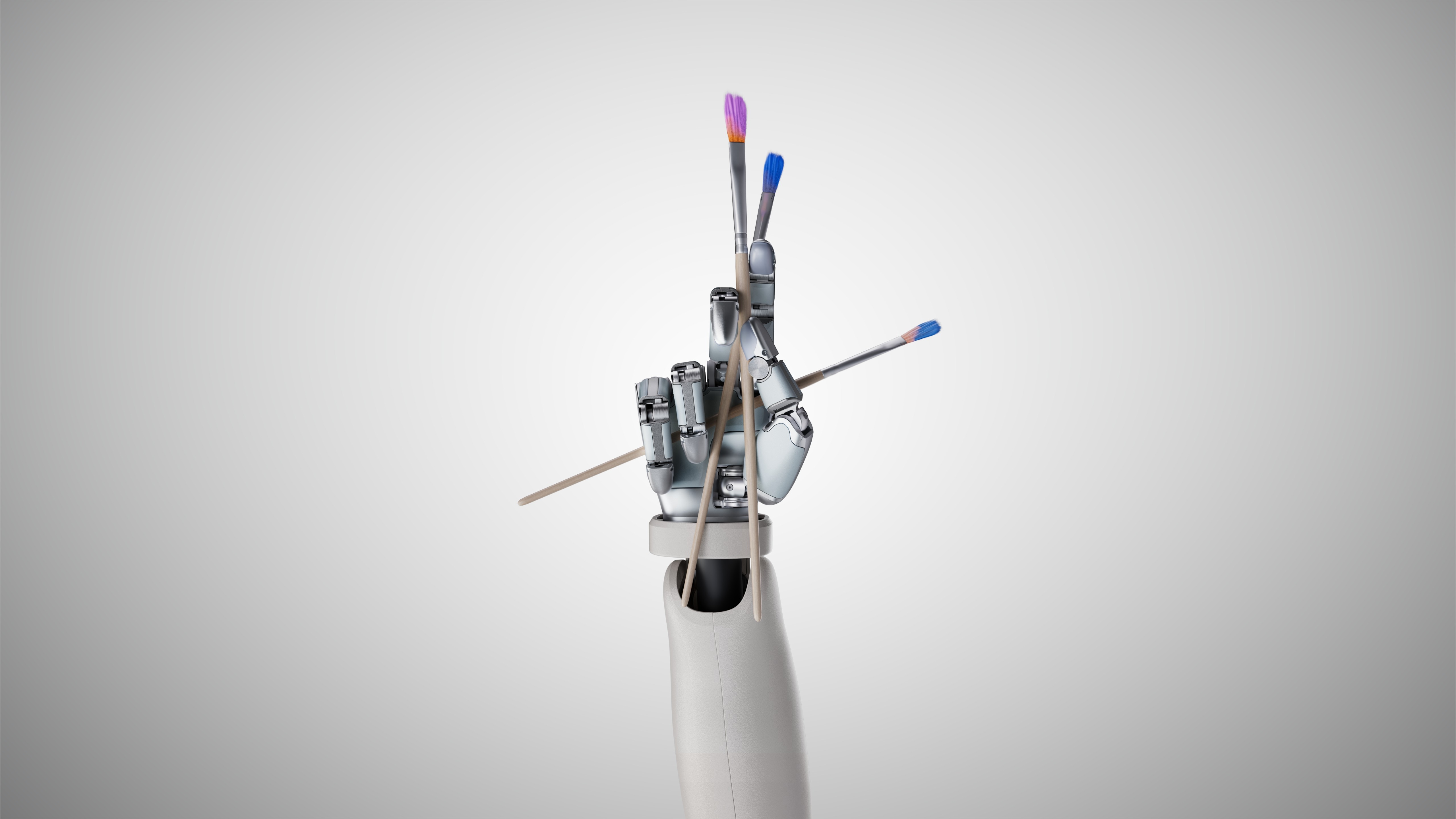
Sharpa's new generation dexterous hand W02
"Less frequent use" is still limited by the scope of tasks.
Low-frequency movements in common grasping may be useful in some special operations. To judge the cost of removing it, it is necessary to compare the completion status, failure reasons and continuous operation performance of the two generations of products in the same task. Reducing a potential failure point is a consideration in structural design; how much the stability of the entire hand is improved still requires test results.
At the same time as the reduction of degrees of freedom, changes in size and perception capability have taken place. According to the company, the overall size of W02 is about 30% smaller than that of W01, and it is lighter, which helps reduce the load on the forearm. The fingertips are equipped with high-resolution visual-tactile sensors, and the palm and other areas are covered with electronic skin.
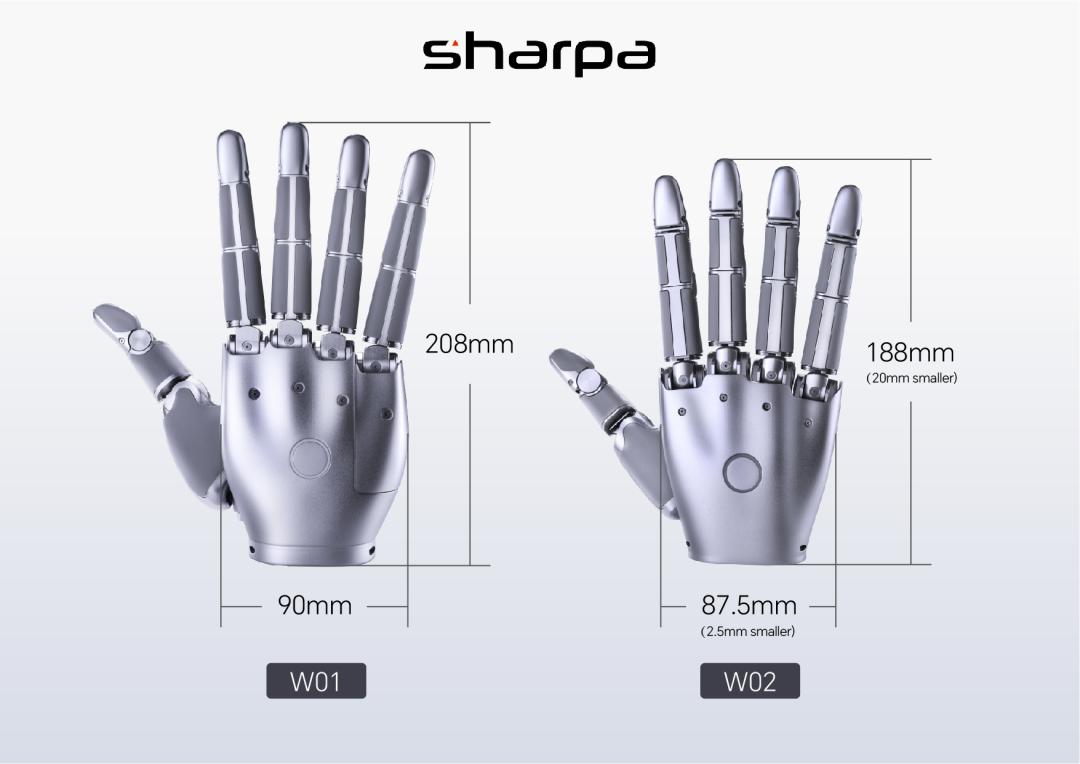
Comparison between Sharpa dexterous hand W01 and W02
The significance of size is easier to see in the operation space. Door handles, tableware, tools, and a large number of work processes are all built around the size of human hands. An overly large mechanical structure, even with more motion capabilities, may be difficult to enter these environments.
The expansion of tactile coverage corresponds to another problem, that is, the contact position between the object and the hand will change with the movement. When holding a soft object, the pressure needs to be adjusted according to the deformation; when using a tool, it is necessary to take into account the finger position, contact state and movement trajectory. Where the contact occurs and whether the object slides will affect the next movement. The newly added perceptual information can only improve the operation if it participates in the control in time.
From 22 to 21, while retaining the high-degree-of-freedom motion capability, Sharpa pays more attention to stability, human-hand scale and contact perception. The complexity of the mechanical structure is not equivalent to the complexity of the tasks that can be handled. Whether this trade-off is reasonable depends on whether the dexterous hand, after cooperating with the wrist and arm, can stably complete continuous tasks in changing contacts.
This also means that the competition of dexterous hands may be shifting from "parameter maximization" to "task contribution maximization". Degree of freedom, size, weight and sensing capability are no longer independent indicators. More importantly, whether they can be truly transformed into task capabilities under limited structure and control costs.
For the embodied intelligence industry, compared with "who can make it more complex", "who can prove that every part of the complexity is useful" is the current vane.
02. After contact comes the hard battle of dexterous operation
Previously, Sharpa's robot has been deployed in a DQ store in Shanghai, using the original equipment, tools and operation processes of the store to participate in ice cream production. This type of task requires the robot to adapt to the existing process, and also puts the hand's motion capability, size and perception to the same test.
Taking stirring as an example, the robot needs to hold the paper cup, and at the same time fix the metal ring on the cup mouth with the thumb and index finger. The paper cup will deform, and stirring will change the force. If the grip is too loose, it is easy to lose stability, and if it is too tight, the cup may be crushed.
The difficulty here is to make the fingers, wrist and arm continuously cooperate with the change of contact. The fingers maintain the position of the cup and the metal ring, the wrist adjusts the posture, the arm drives the cup to move, and the force feedback participates in controlling the gripping force.
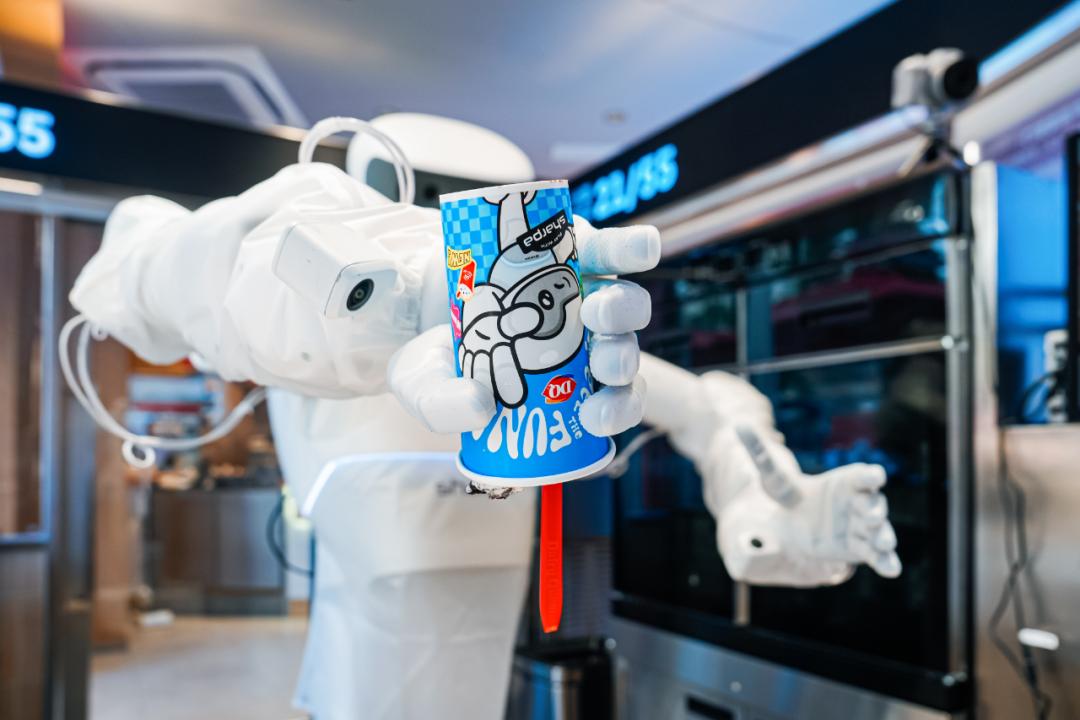
Sharpa robot making ice cream in a DQ store
Sharpa's CraftNet processes motion planning and contact control in layers.
System 1 is responsible for planning the overall movement and guiding the manipulator to approach the object; System 0 continuously fine-tunes the position of the hand and fingers at a frequency of about 100Hz based on tactile feedback. The execution status is then fed back to the upper layer to help the system correct the motion plan. On the robot, tactile feedback thus participates in grip control, enabling the robot to adjust its movement as the force changes.
This division of labor corresponds to different processing rhythms. The overall movement needs to be advanced according to the process, but the change in contact may occur before the movement is completed. Layered control allows local adjustments to be made more frequently.
Even if perception and control are connected, the robot may still make mistakes in the change of contact. Sharpa team's WM-Craftnet research, which is accepted by CoRL 2026, integrates wrist depth, tactile sense, proprioception and motion history into a continuously updated state, trying to deal with real sensor noise, as well as changes in object position and contact relationship.
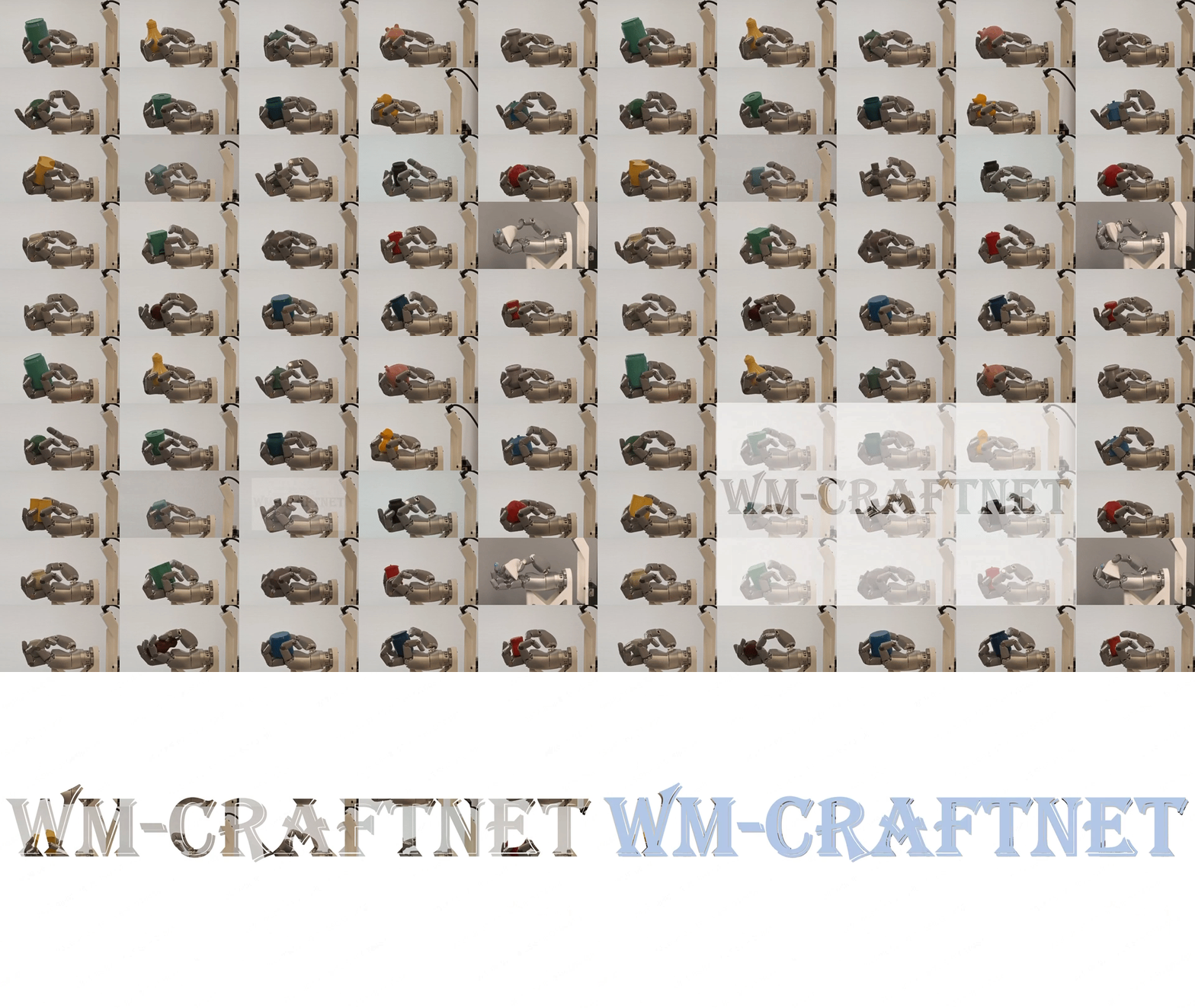
In the W01 real machine demonstration, the corner block can rotate continuously for more than one minute. In some perturbation tests, the system can also adjust the grip and resume rotation.
The research team also made public failure cases, for example, the duck-shaped object tipped over after completing five rotations. Continuously judging the contact state and restoring the grip in time after losing stability is still a difficult problem for the control system.
03. Defining the upper limit of dexterous operation depends on the entire system
This new product continues the consideration of operation space and contact changes.
D01 adopts a spherical wrist joint close to the human body scale, which is convenient for adjusting the posture in a limited space; the electronic skin covering the arm, chest and other areas collects tactile information at a frequency of 100Hz. According to the company's disclosure, the maximum end effector speed of D01 exceeds 10.5m/s, and the repeat positioning accuracy is 0.2mm.
The size of the wrist is related to whether the hand can approach the object at an appropriate angle, and the body tactile sense extends the perception range beyond the fingertips. When the operation object touches the palm or the arm is subjected to external force, the control program also needs to judge how to respond to avoid local adjustments interrupting the ongoing task.
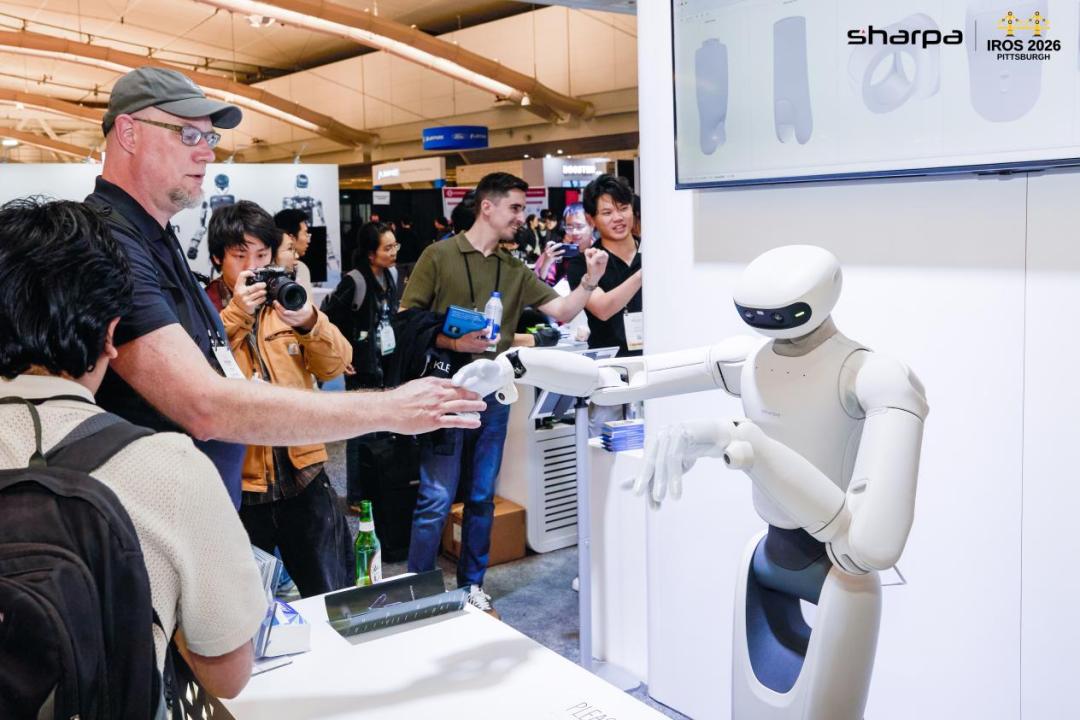
The way of exerting force during contact also affects how the robot obtains operation skills. AE01 captures the natural joint movement of the operator through 22 encoders, and maps the movement to the robot; each fingertip supports 256 levels of dynamic tactile feedback, which transmits the gripping force and contact state back to the human hand. Operators can adjust their movements according to contact feedback while seeing the object move, providing the teaching with contact information corresponding to the movements.
The bartending demonstration at the IROS site adopts the teleoperation method, where the operator wears AE01 to control D01, and completes ice adding, wine pouring, shaking and serving in sequence. Another demonstration presents the robot's response to contact with the arm and chest.
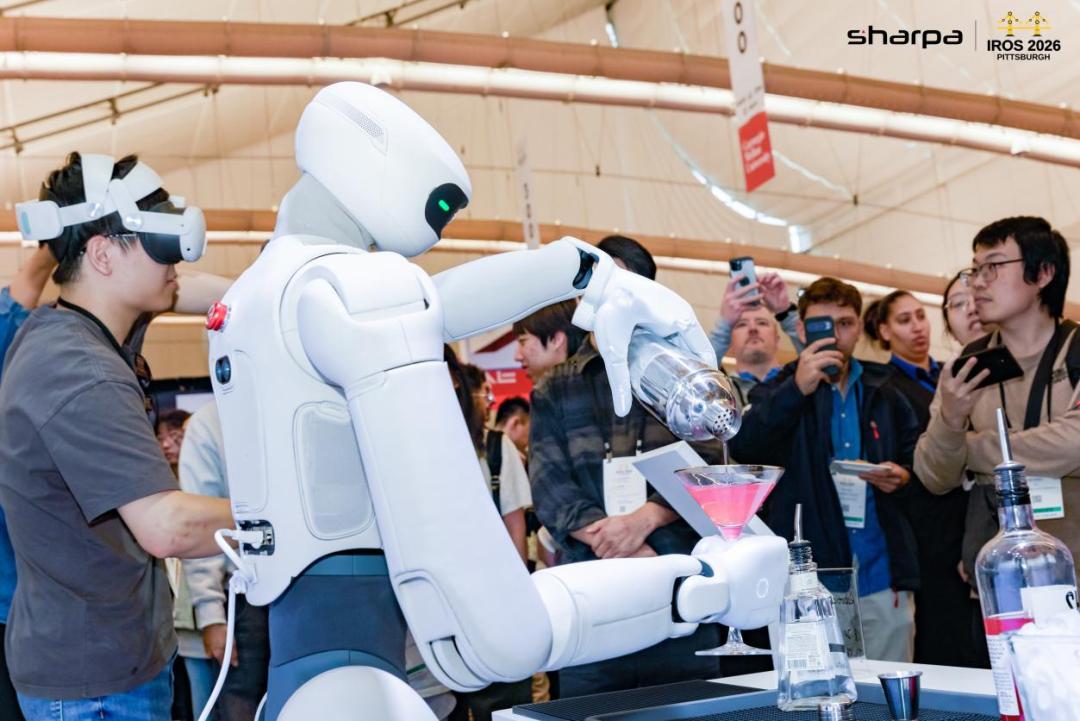
Deformation of the paper cup and sliding of the object will change the operation conditions of the robot. Adjusting hardware, perception, control and data acquisition around the same task gives the team the opportunity to judge which link the problem lies in: whether the movement range is insufficient, the contact is not perceived in time, or the control fails to make effective adjustments.
If the real difficulty of complex operation is how to continuously perceive, judge and correct errors after contact occurs, then dexterous hands can hardly be regarded as an isolated component. The focus of the industry has begun to turn to the operating system composed of hands, body, tactile sense, control and data. Whether these capabilities can form a closed loop in the same task determines how complex real-world problems the robot can ultimately handle.
The existing models and task experience provide the R&D foundation for the new products, and the adaptation effect on D01 and W02 still needs to be verified through corresponding task tests.
04. Only by becoming the innovation starting point of top teams can one have the confidence to define the industry
The technical influence of a robotics company is also reflected in what conditions it can provide for others' innovation.
The selection experience of Nanyang Technological University illustrates how researchers weigh the capabilities of manipulators. In an interview published on Sharpa's official website, Assistant Professor Ziwei Wang introduced that the low-degree-of-freedom hands previously used by the team were limited in position accuracy and wrist-finger cooperation during screwing and assembly; another type of hand was too large to enter the assembly space of the gearbox. The final choice of W01 takes into account the accuracy, built-in tactile sense, supporting model files, deployment tools and teleoperation support.
He specifically mentioned the lateral movement of the metacarpophalangeal joint (MCP): "The key is to see which joint it is and what movement it can bring." This is a different motion capability from the little finger base CMC removed by W02. For researchers, whether each joint is necessary is determined by the task at hand.
After selecting the hardware, the team also needs to make these capabilities participate in the control. The DexTeleop-0 research of Nanyang Technological University and other institutions uses two UR7e robotic arms and two W01s to build a platform, adding tactile correction to human teleoperation instructions.
7 operators conducted 5 tests for each method and each task respectively. In the Tube Operation task involving dual-arm cooperation and liquid transfer, the completion rate of the third stage increased from 34.29% when the movement was directly mapped to 77.14%. The hardware was not replaced, and the way tactile information was used changed the task result.
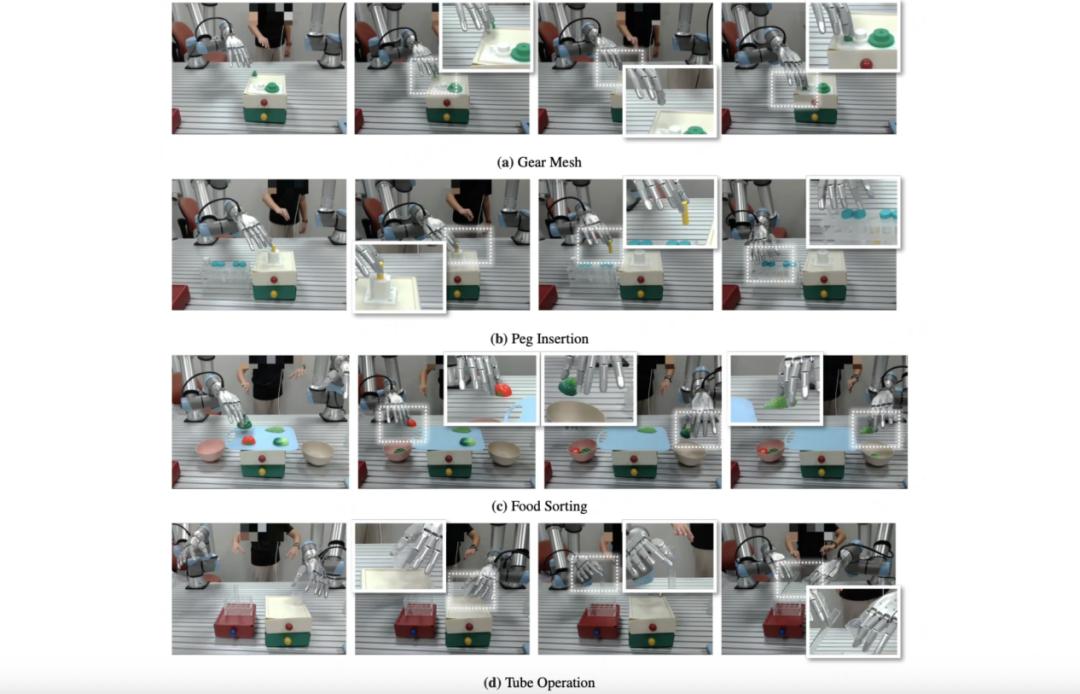
In the DexTeleop-0 research of Nanyang Technological University and other institutions, two Sharpa Wave dexterous hands are mounted at the ends of two UR7e robotic arms to screw components into the gearbox and assemble smooth spheres onto the tubes
The same hand can also support different algorithm routes. The CAIP research of the University of California, Berkeley, NVIDIA and other institutions uses human videos and robot data to improve the visual model, and W01 provides two-handed operation test conditions for tasks such