World Model, the first year of AGI for robots
Introduction Alibaba CEO Wu Yongming stated at the Yunqi Conference that the total thinking capacity of machines in the future will exceed that of humans by more than 1,000 times, and machines will take on 99.9% of all thinking work, yet "the representative product of the machine intelligence era has not emerged" — he compared AI Coding to "the electric light in 1882". Centering on the three cornerstones of AI models, AI chips, and AI cloud, Alibaba announced that the parameter size of its next-generation Qwen model will reach 5-10T, T-Head released the Zhenwu V900 (with 3 times the computing power of the M890 and a single cluster scalable to 500,000 cards), and Alibaba Cloud will have data centers with a total capacity of over 20GW by 2032. What is thought-provoking is that while industry leaders are imagining ASI, the academic community is breaking down "superintelligence" from a slogan into three executable engineering blueprints through a series of papers: superintelligence for cybersecurity, the debate over the definition of world models, and embodied AGI classification. When ASI grows a physical form, what exactly will the singularity of physical AI look like?
The last missing piece of AGI does not lie in larger conversational models, but in world models and physical AI that "enable AI to grow limbs and a physical body".
01 World Model: Why AGI Needs a "Physical Body"
The Physical Intelligence team at Shanghai AI Laboratory put forward a restrained yet sharp definition: A world model is a compressed modeling of the state transition process of the physical world under the constraint of limited computing resources.
The key term here is "compression", not "generation". The core task of a world model is compression in the sense of information theory, which distills high-dimensional, redundant, and noisy physical observations into a compact, usable physical representation; generating videos is only an emergent capability that comes along after proper compression, rather than the goal itself.
This definition derives three major attributes: full modality (modeling all perceptions including vision, hearing, and touch simultaneously), multi-dimensional asynchrony (data sampling frequencies of different dimensions are naturally different), and locality (intelligent agents can only observe local parts, external influences can only be interventions, and the system is naturally a POMDP).
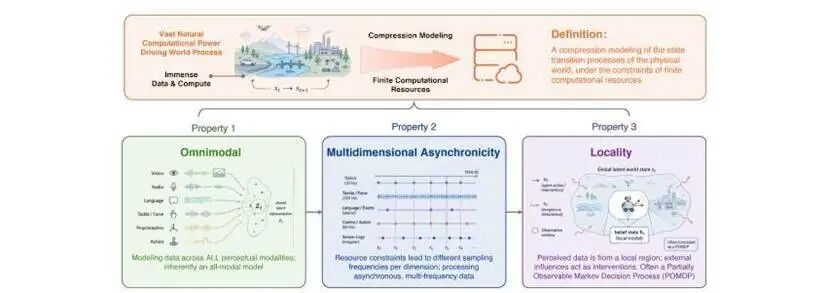
The definition and three major attributes of the world model from Shanghai AI Laboratory
The most noteworthy point is its assertion that "data determines the upper limit": The upper limit of the generalization capability of any intelligent system in the physical world is determined by the physical diversity of training data, rather than the model structure. At present, the only place that can provide such diversity at scale is the open internet — every ordinary video contains physical priors such as object permanence, rigidity and flexibility, occlusion and causality.
02 From "Act as You See" to "Imagine First, Then Act"
If the world model is the "brain of the physical world", robots still need an interface that turns imagination into actions. In the past three months, this interface has got its own name: World Action Model (WAM).
Traditional VLA models follow the logic of "act as you see"; WAM takes one step further — it first predicts "what the world will become if I do this", and then decides the action. This small step pushes robots from "conditioned reflex" to "act after careful planning".
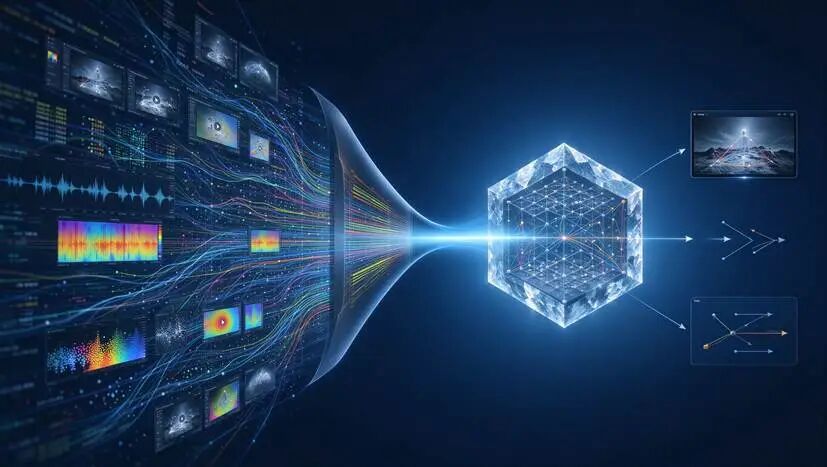
The world model compresses high-dimensional physical data into a unified representation, and then decodes it for rendering, simulation and planning
In the past few months, this track has seen almost collective sprinting.
NVIDIA's Cosmos 3 uses a unified Mixture of Experts Transformer architecture to integrate five modalities: language, image, video, audio and action, into a single model, claiming that one framework can simultaneously "cover" vision-language models, video generators, world simulators and world-action models.
Ji Yuan Robotics' newly released GE-Act 2.0 is the first "native" world-action model — it is trained from scratch on embodied data starting from random initialization, without any fine-tuning for evaluation tasks. It uses its self-developed CoAE encoder to compress a 256×384 frame into 24 tokens, which is only 1/16 of that of DINOv3, and generating one action block on RTX 5090 takes only 104 milliseconds.
The most impressive part is that it verifies the "robot Scaling Law": when the training data volume increases from 300 hours to 30,000 hours (100 times), in zero-shot tests in unfamiliar scenarios, the number of fine tasks the robot can complete rises from 39 to 76 — actions that were previously completely incomprehensible, such as folding towels, nesting paper cups, and arranging flowers, "suddenly click" when there is enough data.

Robot capabilities are gradually unlocked as data scale expands
03 World Models Are Being "Fed to Scale"
The prerequisite for Scaling is data. Here, the "inverted pyramid workflow" provides the methodology: first use billions of internet videos to unlock implicit physical priors, then perform layered filtering, synthesis and purification, and finally turn the data into task-aligned, compact real-world data. The logic is straightforward — proprietary robot data is destined to be unable to compete with the internet in terms of diversity, so it is better to "borrow" the ready-made physical common sense in the internet first.
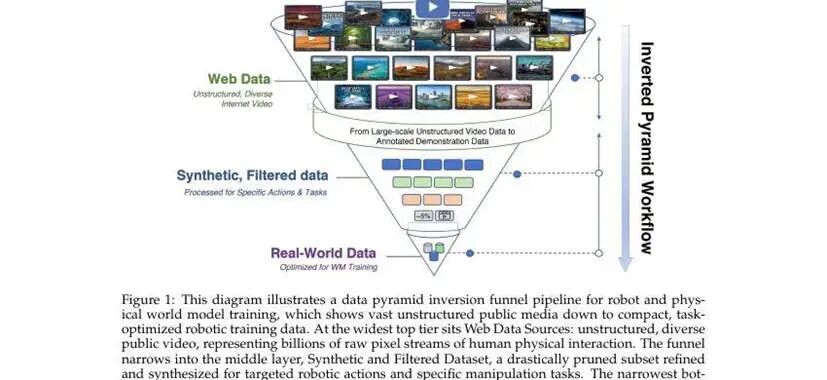
The "inverted pyramid" data workflow of world models from internet videos to task data
τ0-WM, jointly released by Ji Yuan and Shanghai Chuangzhi College, is a large-scale practice of this path: pre-trained on about 27,300 hours of heterogeneous corpora (including 17,800 hours of real robot teleoperation, 6,500 hours of UMI, and 3,000 hours of first-person human videos). The model only has 5B parameters, yet unifies "action generation", "video prediction" and "task evaluation" into a shared predictive representation. During inference, it samples multiple candidate actions, uses the action-conditional video simulator to "rehearse" the future, and then selects the most promising one — forming a closed loop of "proposal - evaluation - correction".
Overseas, Riemann-1.0 uses more than 200,000 hours of interaction data to integrate "executable robot strategies" and "multi-ontology visual world simulators" into the same autoregressive model, achieving a success rate of 94.3% on RoboTwin2.0 and 99.0% on LIBERO.
One of my judgments: Robots are following the path that LLM has taken — Scaling and data diversity determine the upper limit of capabilities. But physical data has a problem that LLMs do not have: action labels are scarce and collection is expensive. Whoever can win in "obtaining sufficient physically diverse data at low cost" will hold the admission ticket to physical AI.
04 Embodied AGI: From L1 to L5, Where Are We Now
With world models and action interfaces, how far are we from AGI? A review paper from Nanyang Technological University puts forward a clear-headed classification — L1 to L5, referencing the maturity classification of autonomous driving.
L1 is single-task completion, L2 is combined task completion, L3 is conditional general tasks, L4 is high-level generality, and L5 is an all-weather autonomous all-purpose robot. The conclusion of the paper is very calm: All current embodied intelligent systems are between L1 and L2.
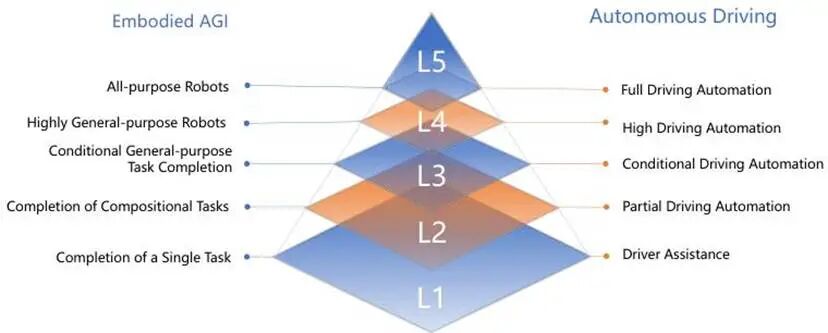
Five-level roadmap for embodied AGI
There are four measurement dimensions in total: full-modality capability, human-like cognition, real-time response, and open task generalization. The hardest one among them is "human-like cognition" — self-awareness, understanding of social connections, procedural memory, and memory reconstruction. None of these can be learned through ready-made supervised learning or reinforcement learning; they require lifelong learning: the model must continue to update its internal state after deployment, instead of being "frozen" after training.
This is exactly the essential difference between "embodied AGI" and "chat AGI": language models can run stably with frozen parameters, while a truly general robot must, like a living being with memory, continue to evolve in daily interactions. This is not only a technical issue, but to some extent a philosophical one.
05 Another Path to ASI: Vertical Superintelligence Comes First
If AGI is defined by "breadth", then superintelligence (ASI) can also be defined by "depth". A paper from Alias Robotics presents a real case of superintelligence in a vertical field — cybersecurity.
It divides the evolution into three steps: The first step, PentestGPT enables AI to "assist" humans in penetration testing (AI guides humans); the second step, Cybersecurity AI (CAI) enables AI Agent to reach expert level, completing security tasks at 3,600 times the speed of humans and at 1/156 of the cost; the third step, G-CTR integrates game theory (Nash equilibrium) into the LLM Agent, enabling it to have strategic reasoning beyond humans in "attack and defense confrontation" — doubling the success rate and reducing the behavior variance by 5.2 times.
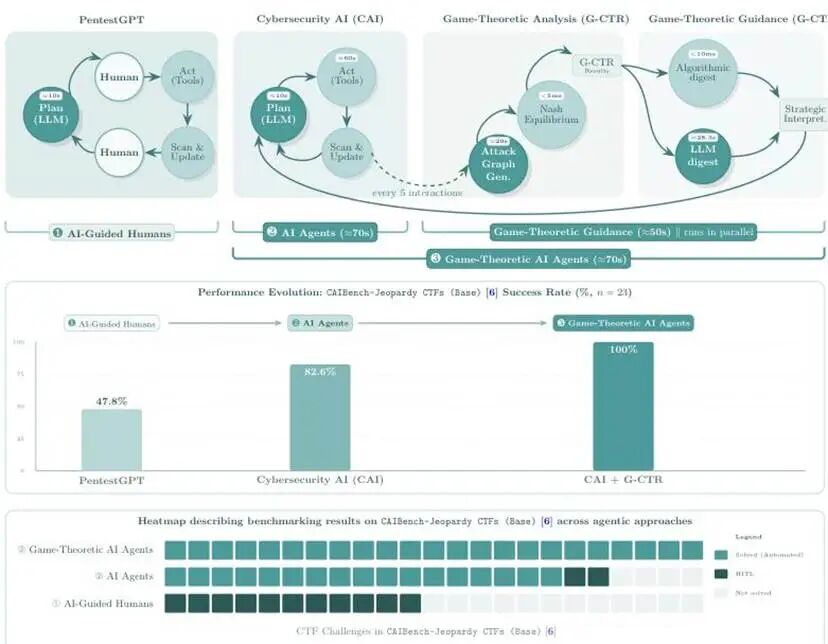
Three-stage evolution towards cybersecurity superintelligence
Humans evolve from "executors" to "operators", and then to "supervisors"; AI evolves from "consultants" to "executors", and then to "strategic actors". When both attack and defense sides use game theory AI, cybersecurity will develop from "human-machine collaboration" to "algorithmic arms race".
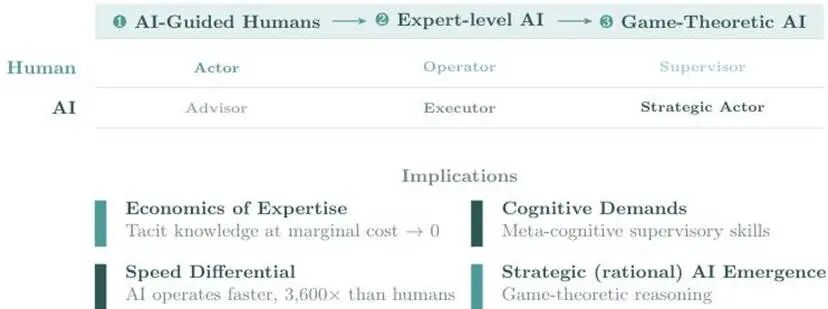
Human-role reversal — from AI guiding humans to humans guiding AI
This provides another imagination for "superintelligence": ASI does not have to be an omniscient and omnipotent general brain. It can be "an intelligent system that reaches superhuman level in a certain narrow field" — especially when it is embedded in an entity that can take actions. The convergence of AI Agents, artificial life and robots may lead to a silicon-based superintelligence form.
06 Roadmap to Physical AGI
We will first build a unified multi-modal world model, then realize "unified physical representation" (one state, multiple decoders — rendering, simulation, and planning are all decoded from the same compressed state), and finally build a "foundation-scale interactive simulator" — a closed-loop, reusable virtual physical world that allows safe trial and error.
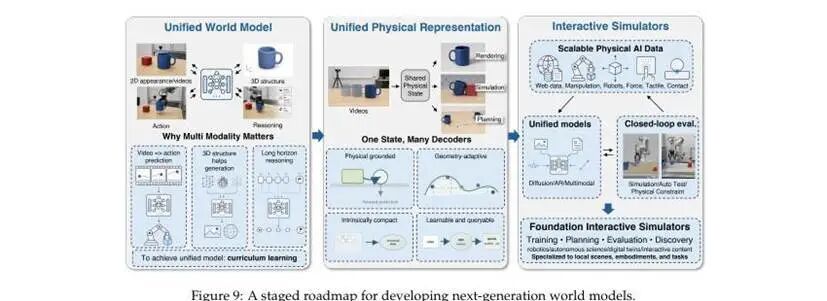
Phased roadmap for next-generation world models
This actually answers the question of "what the brain of a robot should look like": it should not be three separate modules (one for perception, one for thinking, one for action), but a unified compressed representation, paired with a simulator that can "rehearse" the world. The real challenge in the future is not to make robots "able to do things", but to make them "able to think" — before taking action in the real world, they can simulate the solution countless times in their mind, and the simulation is accurate enough.
Of course, this path is not that easy. Energy consumption, trade-offs between realism and precision, error accumulation in long-term prediction, and the sim-to-real gap are all tough problems to solve. A more essential concern is: when world models are powerful enough and robots are general enough, will the human-machine relationship repeat the "role reversal" in cybersecurity — humans retreat from executors to supervisors, while intelligent agents run faster and faster in the physical world.
The world model is that bridge, and robots are the foothold of AGI in the physical world. When sufficient and diverse physical data is fed into a large enough world model, robots may one day truly "think it through" before taking action.
And what we need to do is to see the direction clearly, and at the same time figure out: when we hand over the world to the robot's brain, what should we hold in our own hands.
References (Verification date: September 23, 2026): "World Model Definition and Roadmap" by Shanghai AI Laboratory; "Towards Embodied AGI: A Review of Embodied AI and the Path Ahead" by Nanyang Technological University, Singapore; "Towards Cybersecurity Superintelligence: From AI Guiding Humans to Humans Guiding AI" by Alias Robotics; "Cosmos 3: Full-Modality World Model for Physical AI" by NVIDIA; "GE-Act 2.0 Release Notes" by Ji Yuan Robotics; "τ0-WM: The Largest Pre-trained Embodied World Model" by Shanghai Chuangzhi College; "Embodied World-Action Model for Physical AI" by Riemann-1.0; "Native World Model Stack for Physical AI" by Kairos; "Evolving Physical Intelligence via Embodied Foundation Models" by Embodied-R1.5; "2026 Top 10 AI Technology Trends" by Beijing Academy of Artificial Intelligence.