Anker no longer wants to only sell power banks.
Not long ago, Anker Innovations released its semi-annual report, with a revenue of 16.605 billion yuan in the first half of the year, a year-on-year increase of 29.05%; the non-recurring profit and loss deducted net profit attributable to shareholders was 1.439 billion yuan, a year-on-year increase of 49.65%. The fact that the non-recurring profit and loss deducted growth rate is higher than the growth rate of net profit attributable to shareholders indicates that the growth is not driven by non-recurring gains and losses.
But what is more worth exploring about Anker is not reflected in its financial reports.
In April 2025, this company that started with charging accessories launched a UV printer E1 under its eufyMake brand. It raised more than 1 million USD in crowdfunding on Kickstarter within one minute of launch, and finally set a new all-category historical record on the platform with 46.76 million USD. In March this year, this product was officially launched for sale at the AWE exhibition in China, priced at 13,999 yuan.
Why did a company selling power banks achieve such outstanding results with a printer? This question is closer to the true profile of Anker than the growth rate data in its financial reports.
The market's perception of Anker has long been limited to the label of "consumer electronics accessories company". The charging category is indeed still Anker's largest source of revenue, contributing 53.8% of its revenue in the first half of 2026. But the remaining 46.2% of revenue comes from new categories such as energy storage, smart security, smart audio and video, and UV printing.
This revenue structure means that it is no longer sufficient to understand Anker with the framework of a "power bank company".
In its latest report, Huachuang Securities analyzed Anker by referencing Procter & Gamble, and this comparison points to a core question:
Is Anker a hardware company driven by single hit products, or a consumer electronics platform with platform capabilities that can continuously transfer its competitiveness across different categories?
1
The charging business has almost no correlation with mobile phone sales
The biggest misunderstanding the market has about Anker's charging business is tying it to the mobile phone industry cycle.
Intuitively, if mobile phone sales decline, the growth rate of accessories should also slow down. But the data shows the opposite: over the past five years, the actual average growth rate of Anker's charging business is about 22%, 7 percentage points higher than market expectations.
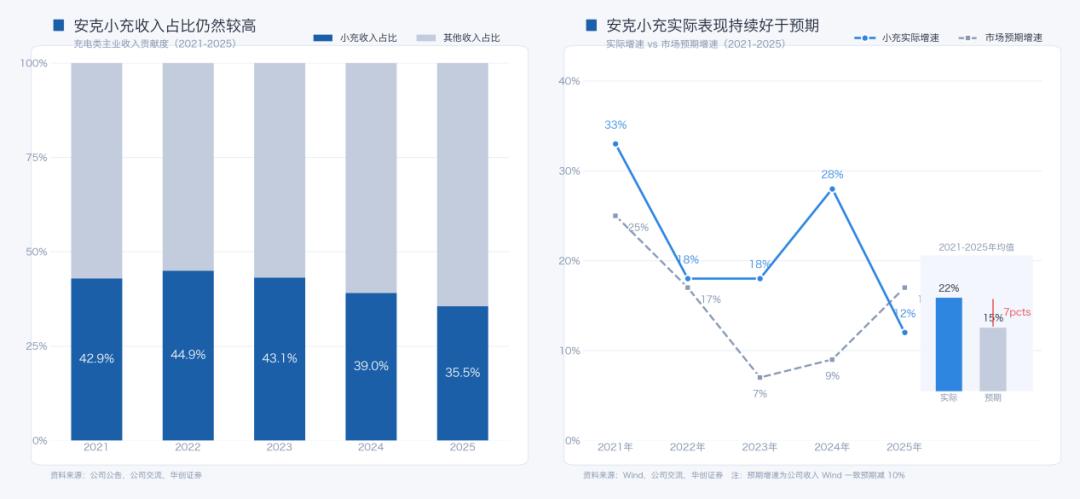
In 2025, the growth rate of mobile phone shipments was negative, but the growth rate of Anker's charging category still remained above 12%. The market tends to regard accessories as accessories of mobile phones, but the data does not support this judgment.
The reason is that the primary nature of charging accessories is not to extend the battery life of mobile phones, but to ensure the normal operation of electronic devices. In 2023, the global per capita ownership of mobile electronic devices reached 3.6, and watches, headphones, cameras, and laptops all require energy replenishment. The more devices people have, the more rigid the charging demand becomes, which has no direct relationship with the number of mobile phones sold.
In other words, the logic of volume growth does not depend on the mobile phone replacement cycle. The theoretical service life of a power bank is more than 5 years, but the actual replacement cycle is 1.5 years, for a very simple reason: they are easy to lose.
According to the statistics of lost items at Chengdu East Railway Station, power banks account for 22.8% of the total lost items, ranking first. The demand to repurchase immediately after loss gives this category an independent growth rhythm.
The logic of price increase is clearer. From 2020 to 2025, the average price of chargers rose from 79.5 yuan to 125.6 yuan, with an annual compound growth rate of 10%. The proportion of high-power, multi-interface, and wireless products continues to increase. The revenue proportion of Anker's 7-series products rose from 3% to 16%, with a long-term target of 30% to 40%.
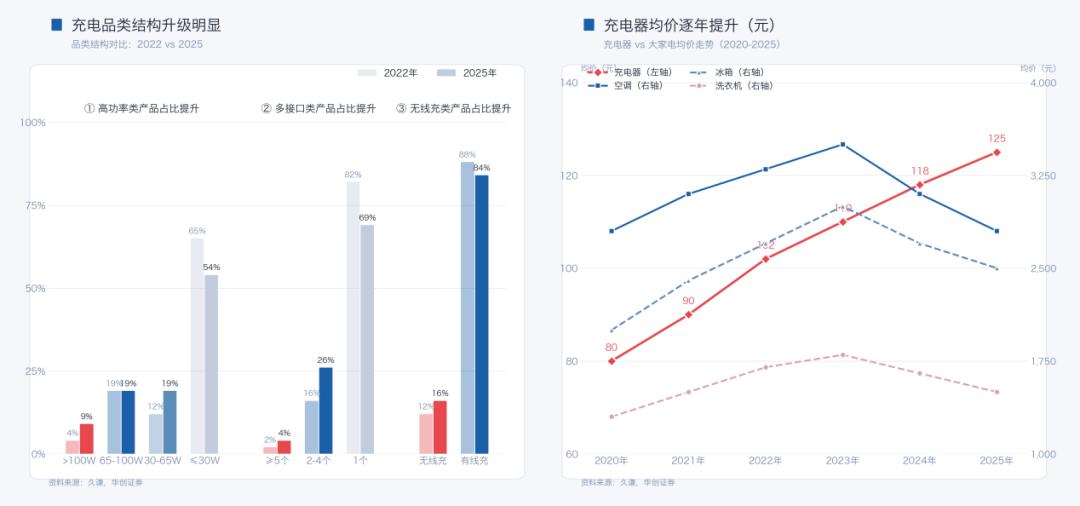
This is not just parameter upgrading, but differentiation centered on device identification and battery protection. Anker PowerIQ 5.0 identifies device models through a built-in protocol database, adjusts the output current and voltage according to the corresponding protocol, so that heat is retained in the charger instead of the mobile phone battery.
2
Certainty differentiation of the second growth curve
The charging business provides a stable foundation, but Anker's growth story cannot rely solely on charging. In the first half of 2026, categories including energy storage, smart security, and smart audio and video contributed 46.2% of the total revenue, among which the energy storage category has the fastest growth rate. The problem is that the certainty between these new categories varies greatly, and they cannot be generalized.
First, look at the energy storage category. The outbreak of demand in this category is not essentially driven by technological breakthroughs, but by whether the product form can meet the demand after the policy window opens.
The driving force in the US market comes from the aging of the power grid: 70% of transmission lines and transformers have been in operation for more than 35 years, and extreme weather has led to frequent power outages. California's NEM 3.0 policy cut the photovoltaic excess grid feed-in compensation from 0.3-0.4 USD/kWh to 0.05-0.08 USD/kWh, a decrease of about 75%.
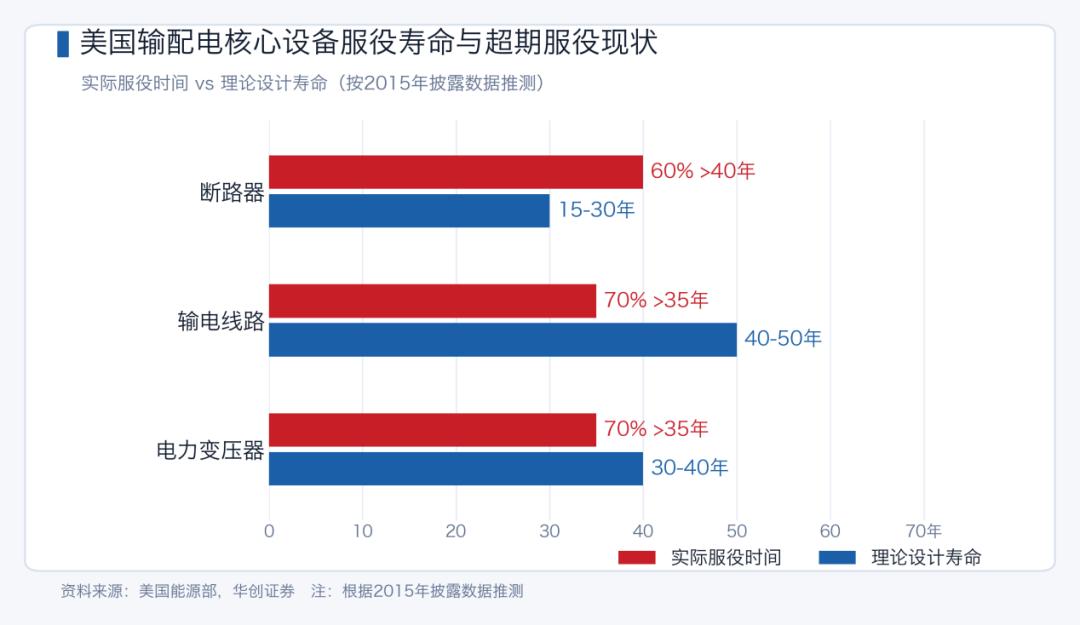
This policy change cut off the old path of recovering costs by selling electricity, and at the same time opened a new path of storing electricity for self-use. The residential energy storage allocation rate rose from just over 10% to 45%, which is the direct result of this logic.
However, the emergence of demand does not mean it can be satisfied. The installation cycle of traditional residential energy storage is 2 to 8 weeks, requiring professional electricians to come to the site, and the process involves survey, approval, scheduling, and grid connection. Users have to wait 3 to 4 months from signing the contract to using the stored power.
Anker's SOLIX E10 compresses this entire engineering process into the delivery experience of consumer electronics: it adopts a split modular design, users can stack the batteries by themselves, and the licensed electrician is only responsible for the final grid connection wiring, reducing the delivery cycle to 2.5 to 6.5 hours.
This is not a victory of product parameters, but a victory of product form. Traditional residential energy storage sells system integration, while Anker sells out-of-the-box usability. The former requires channel providers, installers, and approval processes to share profits layer by layer, while the latter cuts out intermediate links, and directly reaches users through standardized hardware and online direct purchases.
The logic in Europe is different, but the logic of product form is consistent. German balcony energy storage solves three pain points: slow speed, high cost, and difficult operation. Traditional residential energy storage takes 3 to 4 months to deliver, costs tens of thousands of dollars, and requires electricians to come to the site.
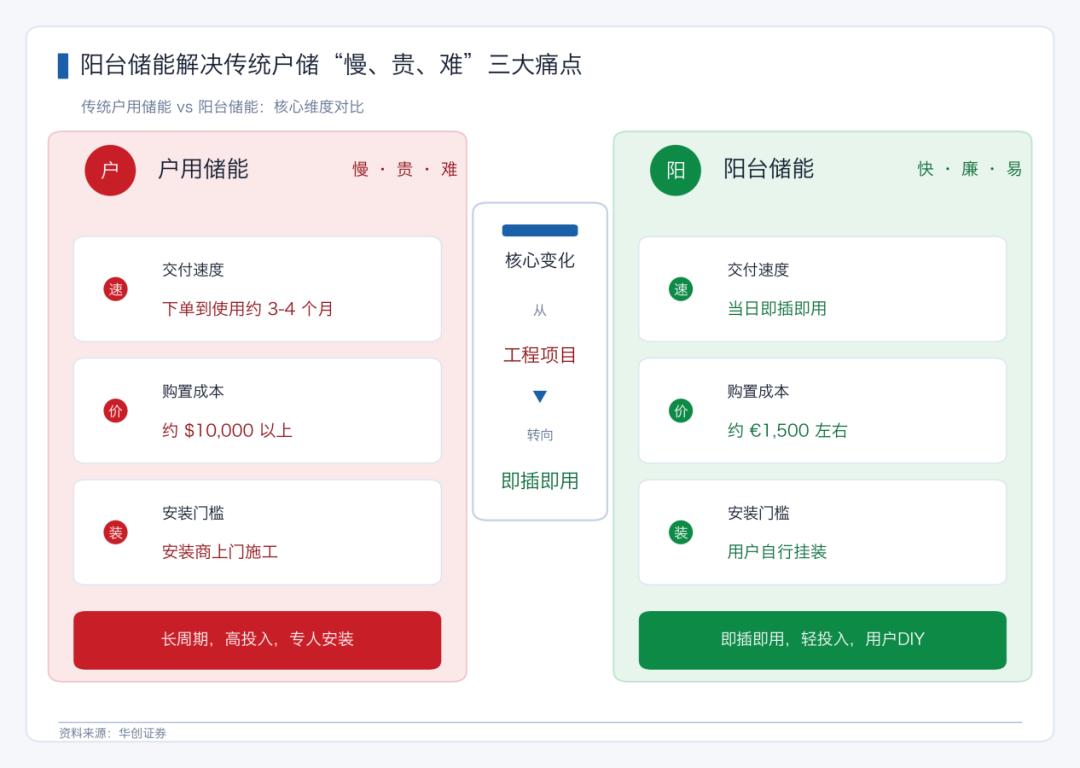
Balcony energy storage is plug-and-play, with the cost reduced to around 1500 euros, and users can install it by themselves. The premise for this category to thrive in Germany is that policies remove institutional barriers, and products remove installation barriers. Only after both barriers are removed can demand be released.
Anker holds a 55% market share in the German balcony energy storage market. The Solarbank series is iterated once a year, with capacity expanded from 1.6kWh to 30kWh. This market share is not obtained through first-mover advantage, but by keeping up with the pace of policy liberalization through product iteration speed.
The Dutch market is another type of window. There are 3.31 million photovoltaic installations, but the energy storage allocation rate is only 5%. After the net metering policy terminates in 2027, excess electricity can no longer offset the cost of purchased electricity, and can only be settled according to the repurchase price of suppliers.
This policy change will force existing photovoltaic households to recalculate their accounts: either accept lower revenue from selling electricity, or install additional energy storage to keep the electricity for their own use. Anker's Solarbank Max AC adopts an AC coupling solution, which does not need to replace the original photovoltaic inverter and can be directly connected to the household AC side, targeting this group of existing users who have photovoltaic systems but no energy storage configuration.
Looking at these three markets together, the certainty of energy storage comes from the same logic: policies create demand, and product form determines who can capture the demand.
The implementation of NEM 3.0 in the US, the legalization of balcony photovoltaics in Germany, and the termination of net metering in the Netherlands are all policy changes that have been implemented or have clear timetables. Anker has launched product forms that match the local policy windows in each market:
E10 corresponds to the backup power demand in California, Solarbank corresponds to the apartment scenario in Germany, and Max AC corresponds to the stock renovation demand in the Netherlands. The 55% market share in Germany is a natural result, not a coincidence.
The certainty of UV printing is much lower. This category has long been limited to industrial-grade applications, with equipment costing hundreds of thousands of yuan, and the cost of the print head accounts for 40% of the hardware cost. Anker independently developed the print head control board, reducing its cost from 4000 yuan to 400 yuan, and compressing the volume of the whole machine to one-tenth of that of industrial-grade products.
eufyMake E1 raised 46.76 million USD in crowdfunding on Kickstarter, setting a new platform record. But the success of crowdfunding only proves the existence of demand, not that repurchase and after-sales service can support long-term operation. Referring to Bambu Lab's path in the 3D printing track, which achieved revenue of over 10 billion yuan in 4 years and a net profit margin of 30%, the neutral expectation for Anker in the UV printing track is to contribute 7.8 billion yuan in revenue by 2030.
The premise of this expectation is that Anker can run through the consumable ecosystem and build a solid after-sales system before competitors such as Bambu Lab and xTool enter the market on a large scale.
3
What are the risks?
The policy dependence of the energy storage business is the most direct risk.
Australia's CHBP subsidy has been reduced: the initial policy subsidy in July 2025 was about 372 AUD/kWh, and the current policy in May 2026 dropped to 251.6 AUD/kWh, a decrease of 32%, and it will continue to decrease by tiers. Although the balcony energy storage policy in Europe has been liberalized, competitors such as EcoFlow and Zendure continue to increase investment, so Anker's 55% market share in Germany is likely to decline, and the neutral assumption in research reports has been lowered to 40%.
Energy storage is a capital-intensive and channel-dependent business. Subsidy reduction or narrowing of electricity price differences will directly reduce demand elasticity.
The risk of UV printing lies in the uncertainty during the category introduction period. Most crowdfunding users are geeks and early adopters, and there is a gap between them and the large-scale demand of the mass market.
To become a real consumer-grade product, UV printers need to cross multiple barriers such as consumable repurchase, operation simplification, and ecological construction. Anker has previously attempted 3D printing with the AnkerMake product line, and later adjusted its direction due to competition and iteration issues.
It is easy for a new category to grow from 0 to 1, but difficult to expand from 1 to 10. Bambu Lab's success is built on extreme engineering capabilities and community operation. Whether Anker can replicate this success in the UV printing track still needs to be verified.
Tensions at the organizational level also need attention. Anker once had nearly 30 product teams, and scattered category boundaries led to diluted resources and weak growth. Later, it proactively focused on three major directions: Anker, eufy, and Soundcore, and its operating performance continued to exceed expectations.
The expansion of energy storage and UV printing means that the organization is once again facing the balance challenge between focus and expansion. In the first half of 2026, the gross profit margin increased to 49.8%, up 5.1 percentage points year-on-year, but sales expenses and R&D expenses also rose simultaneously. The cost rigidity of multi-category operation cannot be ignored.
In terms of external variables, although Anker's revenue share in North America has dropped to 46%, the US market is still its core market. In the first half of 2026, the revenue shares of North America, Europe, China and other regions were 46%, 27%, and 28% respectively. The regional structure is continuously diversifying, but changes in tariffs, shipping costs, and exchange rates may still have a chain reaction on its global business.
4
Epilogue
In September 2026, at the IFA exhibition in Berlin, Anker announced a major move: unifying its five sub-brands, Anker, eufy, soundcore, SOLIX, and eufyMake, under the single brand name "Anker".
At the same time, Anker launched Anker MindBase, a local AI hub, trying to connect categories such as charging, security, cleaning, and energy storage into a self-processing smart home ecosystem.
The significance of this move is that it answers the question raised in the introduction. Anker is no longer satisfied with operating a single product line or a sub-brand. It wants to bring scattered categories together under one platform, and use unified brand awareness and underlying technical architecture to support cross-category collaboration.
This is structurally the same as P&G's logic of covering different daily chemical categories with Tide, Pampers, and Head & Shoulders: using organizational capabilities and brand assets to reduce the marginal cost of entering new categories.
The reason why Huachuang Securities placed Anker in P&G's reference system is that the two have similarities in organizational structure, product innovation concepts, and talent standards, and the starting point of Anker's residual value is also close to that of P&G in 2000. P&G has spent a hundred years proving that continuously increasing market share in scattered categories can help enterprises go through economic cycles.
But P&G's reference is only a long-term perspective. The current global market size of the categories Anker participates in is about 1.1429 trillion yuan, and its revenue in 2025 is 30.5 billion yuan, corresponding to a market share of only 2.7%. Even if the industry growth rate drops from 11.6% to 10.3%, as long as Anker's market share increases by 32 basis points per year, it can achieve a compound annual revenue growth rate of 21%.
This growth elasticity is much higher than that of