Starbucks, Luckin Coffee and Bawangchaji are collectively offering "discounts" on caffeine.
Caffeine Intake Is Bidding Farewell to the "Blind Box" Era?
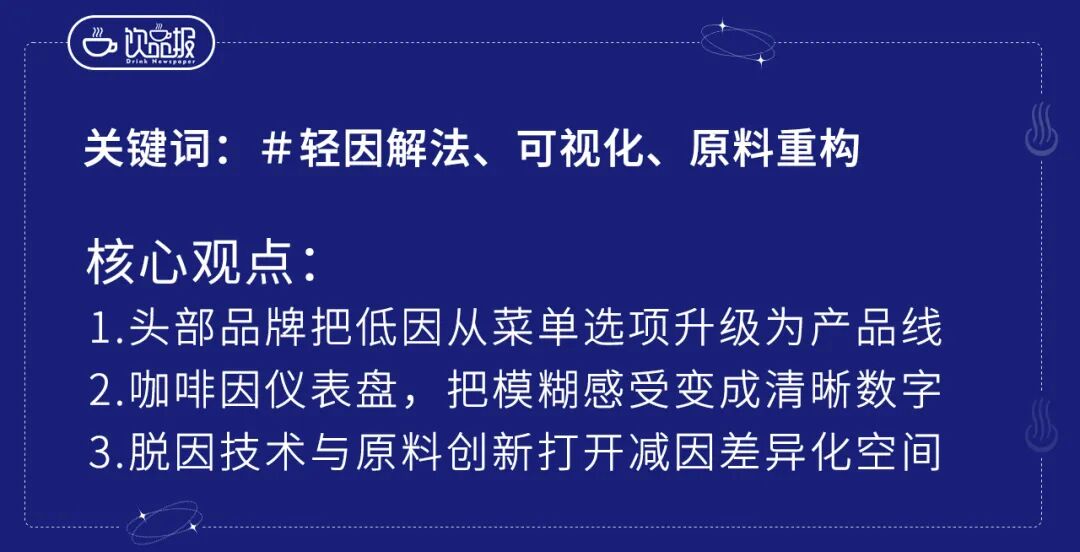
In July this year, Bawangchaji launched the "Caffeine Dashboard" across all channels, which intuitively displays the caffeine content. Netizens commented: "Finally, I can decide for myself whether to fall asleep before midnight or after midnight."
Furthermore, the "Low-Caffeine, No Sleep Disruption" series of Bawangchaji continues to expand its product line. As of press time, the mini-program shows that the series has 13 products.
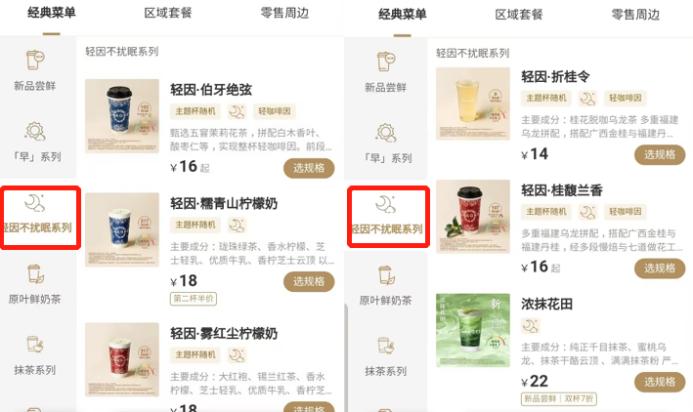
▲ Source: Bawangchaji Mini Program
Not just tea drinks, leading coffee brands are also actively "reducing caffeine content".
According to *The Korea Herald*, Starbucks Korea sold 45.5 million cups of decaf coffee in 2025, marking the highest annual record since it launched decaf products in 2017.
Following the "sugar reduction" trend, the "caffeine reduction" wave in the beverage industry is gaining increasing momentum.
01. After Sugar Reduction, These Brands Collectively "Cut Caffeine" in Their Products
The overworked generation in the new era relies on coffee to stay energized, but if you are not careful, you may end up "drinking coffee at 4 p.m. and going crazy at 4 a.m."
On social platforms, many people say they cannot quit coffee but are overly sensitive to caffeine.
How to resolve this contradiction? Beverage brands have their own solutions for "low caffeine".
As early as two years ago, many brands quietly added a "decaf" option to their ordering mini-programs, including leading brands such as Starbucks China and Tim Hortons.
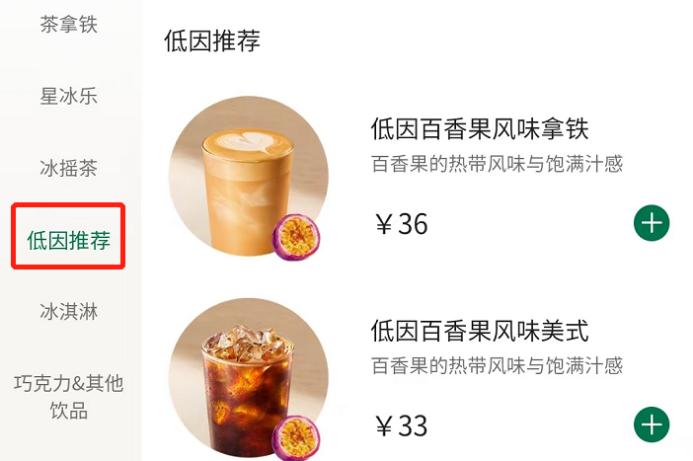
▲ Source: Starbucks Mini Program
Even Luckin Coffee, which was in its rapid growth period at that time and promoted the popularization of China's coffee market, first launched the "Light Coffee" concept in 2024, rolling out two new products: "Light Coffee Lemon Tea" and "Light Coffee Coconut Water". Later, it also launched "light coffee" products such as light milk tea and the light version of Coconut Latte, focusing on "mild refreshment with low burden".

▲ Source: Luckin Coffee
However, the "caffeine reduction" movement is obviously not limited to changing coffee beans and lowering caffeine content.
To turn caffeine from a "vague feeling" into a "clear figure", Bawangchaji did something unprecedented in the industry this year. In July, Bawangchaji launched the "Caffeine Dashboard" across all channels, marking the caffeine content of each tea drink on the menu with specific numbers and five color levels: 0~50mg in light green and 51~100mg in green are classified into the "low caffeine" level; 101~150mg in yellow; 151~200mg in orange; over 200mg in red, suggesting special groups to choose carefully and try to avoid drinking it at night. The tea-flavored version of Boya Juexian is marked as 105mg per cup, the floral version 122mg per cup, and the low-caffeine version is reduced to about 53mg.
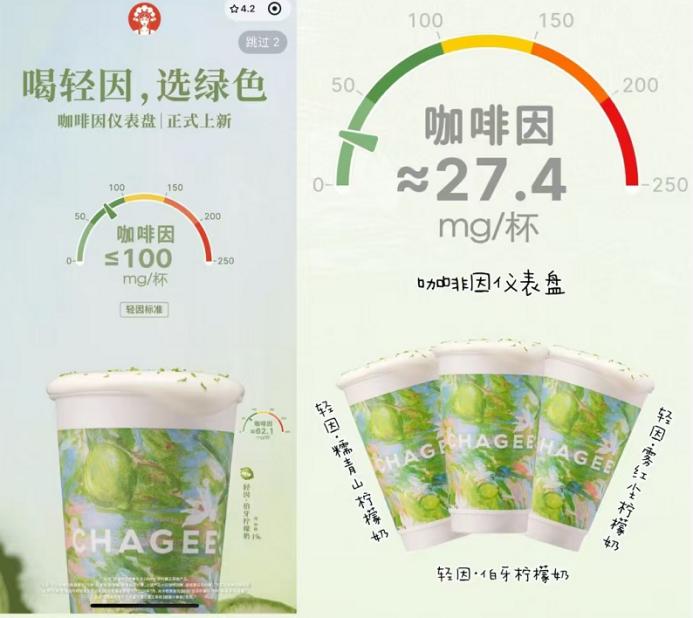
▲ Source: Bawangchaji
When ordering, consumers can glance at the dashboard and know exactly what "dose" they are taking. Some netizens commented: "Not only did I find out why I couldn't sleep after drinking, but I also found a way to drink it without losing sleep." This move by Bawangchaji was praised by the industry as: "Once again, giving the right of choice back to consumers."
It is also worth noting that the "caffeine reduction" track has also welcomed "tech-focused players" and "creative players".
The "tech-focused player" such as Tasly's "Low-Caffeine Tea" uses self-developed decaffeination technology to control the caffeine content to no more than 8mg per 100ml. The "creative player" such as Bond Coffee Pulp Coffee uses a dual extraction process to make coffee pulp into coffee base, reducing the caffeine content to one third of that of traditional American coffee, while retaining natural chlorogenic acid. The brand thus obtained the "First Creator of Freshly Extracted Coffee Pulp Coffee in China" certification from Sullivan.
From changing coffee beans to marking specific figures, from decaffeination technology to raw material restructuring, caffeine reduction has been developed into a wealth of diverse practices by major brands.
02. Why Is Caffeine Reduction Continuing to Boom? Four Hidden Signals Have Become Obvious
From "quietly adding an option" to "redesigning products on a large scale", "caffeine reduction" is evolving from a marginal product-side action to a strategic brand-side action. What kind of industry signals are released behind this collective shift?
1. Caffeine anxiety has evolved from "personal feeling" to "public issue"
"Caffeine tolerance level = overwork intensity level." "The world can be a little kinder to us people who are sensitive to caffeine." "I, a middle-aged person, don't know since when I can no longer metabolize caffeine properly."

▲ Source: Netizens' Posts
The high density of such comments on social platforms shows that caffeine sensitivity is not a problem for a small number of people. A ChinaMAP study with a sample size of over 10,000 cases shows that the genes of more than 60% of Chinese people lead to weak caffeine metabolism capacity.
When more and more consumers are troubled by "caffeine sensitivity", topics such as "caffeine intolerance" and "caffeine withdrawal" have sparked heated discussions on social platforms. "Palpitations after drinking" and "discomfort without drinking" are both repeatedly discussed. Caffeine anxiety is no longer a personal physical feeling, but a consumption pain point for a large number of consumers.
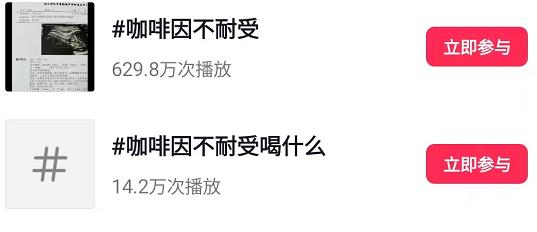
▲ Source: Douyin Topic
2. From "needing" caffeine to "managing" caffeine, consumers who "want both sides of the deal" are forcing brands to put caffeine on the table
On the one hand, the dailyization of coffee consumption leads to cumulative caffeine intake; on the other hand, sleep anxiety continues to amplify. The contradiction between the two needs an outlet.
In this regard, consumers' choices have been reflected in their purchasing behaviors. According to a report by *Xiaoshan Daily* in August 2026, the order volume of decaf and half-caffeine coffee of many chain coffee brands has increased by more than 80% year-on-year since the second half of 2025. Owners of many independent cafes in Xiaoshan, Hangzhou also reported that "decaf" has become a high-frequency demand after 2 p.m.
Shifting from "passive intake of caffeine" to "active management of caffeine", consumers who "want to stay refreshed and also want to sleep well" are forcing coffee brands to make changes.
3. Mature supply chain and lower technical threshold
The large-scale implementation of low-caffeine products is supported by the ready availability of upstream raw materials and equipment.
Local coffee supply chain enterprise Yunnan Yika Industrial has built a full-link production line covering decaf coffee processing, green bean processing, roasting and concentrate extraction, supplying decaf coffee green beans in stock and undertaking OEM/ODM processing for all categories of coffee. In the tender for blended coffee beans launched by Pacific Coffee in August 2026, an independent bid package for "decaf blended coffee beans" was specially set up.
The equipment side is also keeping up. Midea launched the "Caffeine Regulator" series of fully automatic coffee machines in 2026, which reduces the caffeine content by 30% in the low-caffeine mode through triple control of temperature, flow rate and time during the extraction process.
From raw materials to equipment, the supply chain foundation for caffeine reduction has been established.
03. Beverage News · Remarks by Yin Sir
From "full sugar" to "less sugar" and then to "no sugar", the beverage industry has made consumers reach a consensus: the formula can be chosen. "Caffeine reduction" is doing the same thing.
However, "caffeine reduction" is not just changing a dimension of the formula, but changing the relationship between consumers and caffeine. In the past, caffeine was hidden behind products and consumers could only accept it passively; now it is placed on the menu and becomes a parameter that can be actively selected. Behind this change is that the industry is beginning to face up to the differentiated demands of consumers for caffeine. Caffeine reduction is a specific response made by the industry after demand differentiation.
This article is from the WeChat official account "Beverage News", author: Liu Bianshi, authorized for release by 36Kr.