Chicecream is priced at 6.9 yuan, HEYTEA at 19 yuan, how much premium remains for the 28-yuan Mr. Wild Man?
On September 12, 2026, Luo Yonghao posted a consumption experience on Weibo, stating that Mr. Wild Man ice cream was "so mediocre that it can even be called unpalatable considering its price", and added, "It tastes far worse than Zhong Xuegao, I miss Zhong Xuegao". After four days of silence, the brand spoke for the first time on September 16, saying, "We will listen carefully to all opinions and suggestions from our customers."
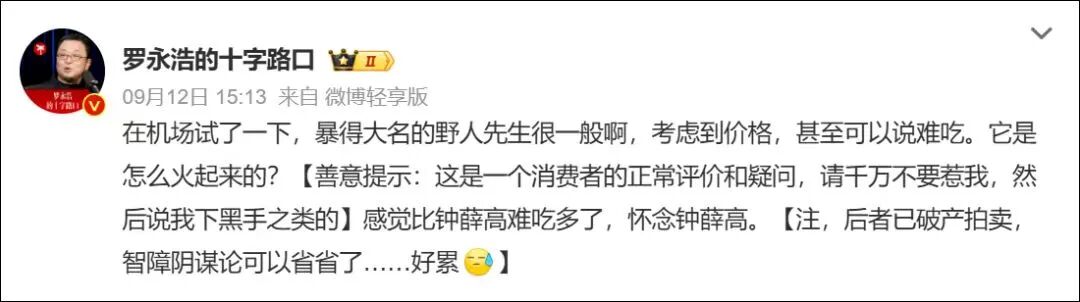
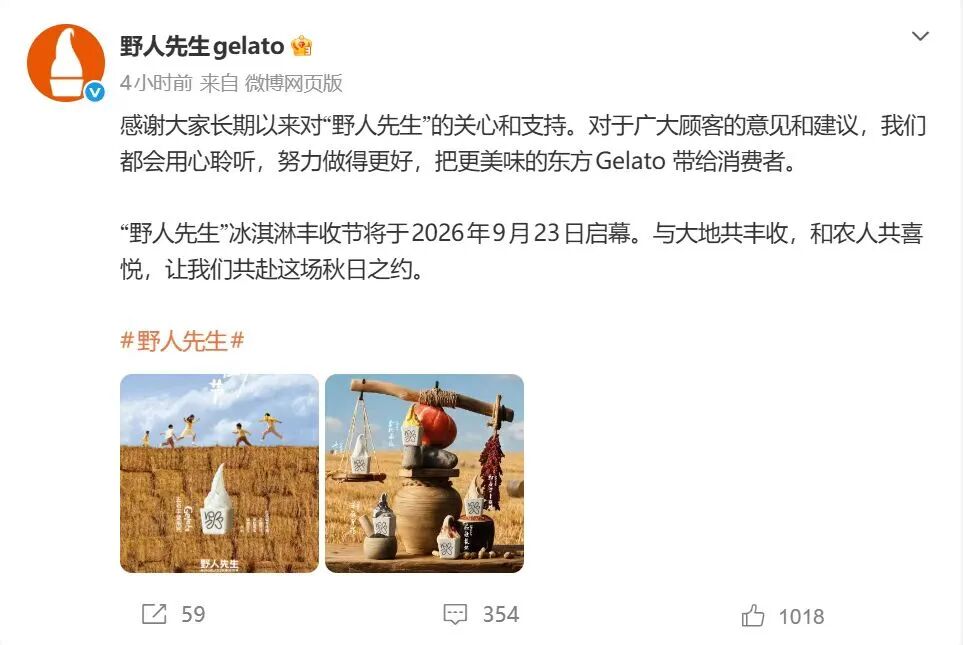
Source: Weibo
Mr. Wild Man is a brand that expanded from less than 100 stores to 1,712 stores within two years. A single scoop of its ice cream is priced at 28 yuan, and the sign hanging in its stores reads "Made fresh the same day, no overnight products".
13 Years of Steady Growth
Two Years of Explosive Expansion
For a long time, Mr. Wild Man did not seem like a brand that would expand at a breakneck pace. Its founder Cui Jianwei graduated from Guanghua School of Management, Peking University. He worked at an Italian investment institution for four years in his early career, and later got acquainted with Angelo Bergellano, a master of Italian-style ice cream, then started his Gelato business. In 2011, he opened his first soft-serve ice cream store in Wudaokou, Beijing. In 2015, the brand entered shopping malls, and officially established the Gelato model of "made fresh the same day, sold in time slots".
In the following more than 10 years, the brand has maintained a "restrained" attitude. No financing, no dividend distribution, no takeout service, and the number of its stores was less than 100 by the end of 2023. Cui Jianwei said in a media interview that if he had taken investment in the early stage, "it would be a disaster now", because he could not develop at his own pace.
The turning point came at the end of 2023: the brand opened franchising, and there were only about 100 stores at that time; in April 2024, "Yeren Mufang" was officially renamed "Mr. Wild Man". According to data from Zhaimen Can Yan, Mr. Wild Man opened 244 new stores in 2024 and 916 new stores in 2025; as of June 2026, the number of its stores exceeded 1400, covering 30 provinces. In an exclusive interview with Meiwen Renwu in August 2026, founder Cui Jianwei said that the total number of brand stores had exceeded 1600, ranking second among domestic chain ice cream brands, second only to DQ (the data counted by Zhaimen Can Yan in the same period was 1536, and there was a difference of about 100 stores between the founder's statement and the third-party data). According to data from Zhaimen Can Yan, as of September 11, 2026, the number of operating stores of Mr. Wild Man reached 1712, covering 31 provinces and 237 cities.
The expansion of Mr. Wild Man is a scale sprint driven by franchising. Some media reports show that the proportion of franchised stores of this brand has exceeded 80%. The initial investment for a single store is at least 500,000 yuan, and the actual investment is between 600,000 and 700,000 yuan. According to public reports, as of June 2026, the number of directly-operated stores was less than 10. From the perspective of financial structure, the revenue of the brand side mainly comes from franchise fees and raw material supply chain, while franchisees bear the rent, labor and operational risks. The territory of 1712 stores is supported by the capital of franchisees.
The public operating data of the brand is quite impressive. According to the founder, the average monthly revenue of a single store of Mr. Wild Man is 200,000 to 300,000 yuan, the gross profit margin exceeds 60%, and the store closure rate is close to zero. This statement has not been verified by independent data - more than 700 complaints related to "being cheated in franchising" and "no way to get refund" for Mr. Wild Man have been accumulated on the Heima Complaint Platform in the past year, and there are also reports of franchisees' rights protection.
The figures observed from the franchisee side are more scattered: according to Sina Finance, a franchisee in a third-tier city in northern China said that his background performance showed that even in the summer vacation with the best passenger flow, the turnover of the store on working days was about 4000 yuan, and it was barely over 10,000 yuan on weekends - this data is the statement of a single franchisee and cannot represent all stores, but there is an obvious gap with the monthly average level claimed by the brand. The brand narrative emphasizes "restraint", but franchisees are faced with specific turnover pressure. The difference between the two sets of accounts constitutes a side that needs to be faced squarely in the expansion model of Mr. Wild Man.
Under the Scale of 1000 Stores
How to Define "Freshly Made"
In the brand narrative of Mr. Wild Man, "freshly made" is the core. The store sign says "Made fresh the same day, no overnight products", and the large screen scrolls the finishing time of each flavor. The founder has repeatedly emphasized that "selling in time slots and only making a few single products" is a supporting measure under the store fresh-making model.
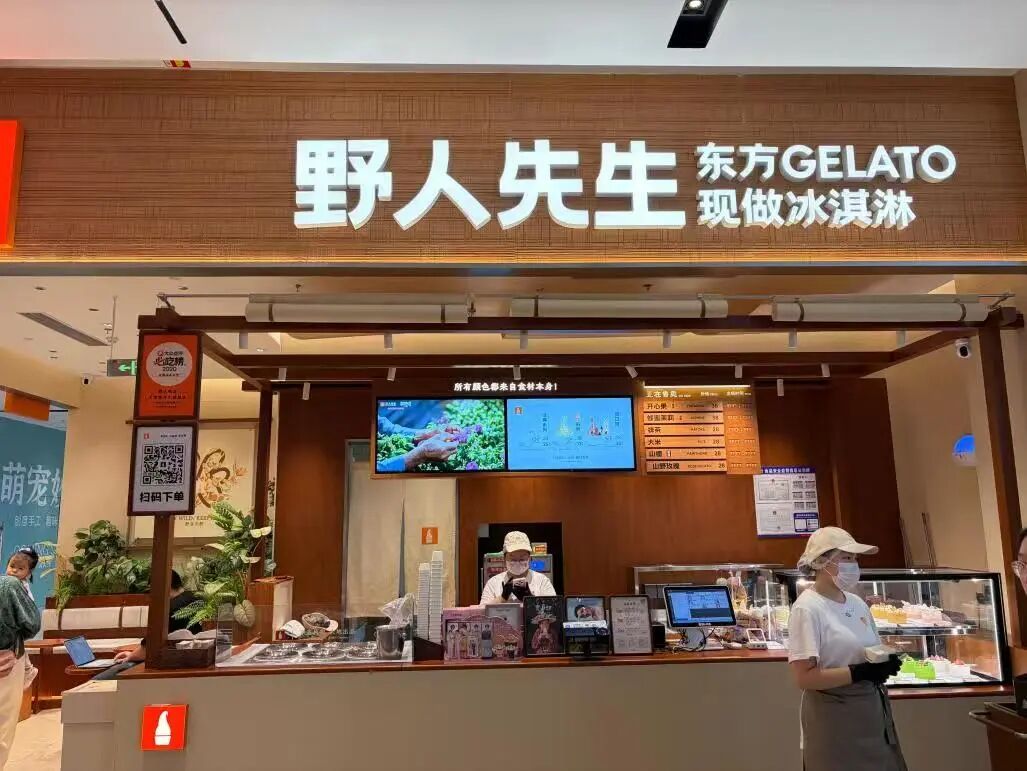
Source: Sister of Fast-Moving Consumer Goods
However, there is an obvious gap between the actual materials used in the terminal stores and the "freshly made" positioning conveyed by the brand to the outside world. Previously, consumers on social platforms showed the frozen milk slurry raw material bags used in Mr. Wild Man's stores, and the outer package was marked with "frozen storage, shelf life of 6 months".
Cui Jianwei's response to this is: the fresh-making model of Mr. Wild Man is the collaboration of "central factory pre-treatment + terminal store production". The central factory makes pasteurized fresh milk into frozen milk slurry, which is delivered to stores through cold chain. The staff will thaw it slowly on site, add ingredients such as fruits and nuts, and complete the production through the ice cream machine. He also admitted that "the shelf life of frozen milk slurry is half a year, but the actual turnover is very fast, and most of it is used up within a month". In August 2026, he gave an updated statement in the exclusive interview with Meiwen Renwu: with the increase of store density and process improvement, the shelf life of milk slurry "has been optimized to 15 days in core cities and 45 days in mainstream cities last year". This statement remains to be independently verified, and the brand side needs to further explain the semantic relationship between the six-month shelf life and "made fresh the same day".
That is to say, the milk slurry is made in the factory and frozen, with a shelf life of half a year; after being delivered to the store, the staff thaw it, add ingredients, and use the machine to freeze and shape it. The starting point of the so-called "freshly made" is not fresh milk, but a bag of industrial semi-finished products.
The larger the scale, the more prominent the demand for standardization. The standardized supply of 1712 stores itself relies on the large-scale pre-treatment of the central factory, and the essence of large-scale production is industrialization. Making ice cream "fresh on the same day" in one store is handicraft, while making it "fresh on the same day" in 1712 stores is an industrial process. Raw materials must be able to be transported over long distances, stored for a long time, and operated in a standardized way, otherwise the consistent output of each store cannot be guaranteed. The tension between "freshly made" and "large scale" ultimately falls on the right to define the term "freshly made" — Cui Jianwei's solution is to draft the standard of "freshly made ice cream" together with industry associations, defining freshly made as "completing the freezing process from liquid milk slurry to solid ice cream in the store". According to this definition, the store is indeed "making" it; but when consumers pay 28 yuan, the "freshly made" they understand starts from fresh milk and fruits, not a bag of thawed milk slurry. The gap between the two sets of understanding is the problem that needs to be clarified at present.
If the frozen milk slurry bag exposes the contradiction at the raw material level, the buy-one-get-one-free offer after 9 p.m. every night pushes this contradiction to the pricing level. The notice in Mr. Wild Man's store clearly states "no overnight products, zero inventory, starting from 21:00 every day, ice cream buy one get one free". According to the visit of Sister of Fast-Moving Consumer Goods, many Mr. Wild Man stores will have long queues after 9 p.m. The action of clearing inventory has created a grand scene that may not even appear in the full-price period.
The original intention of buy-one-get-one-free is to clear inventory and prove that "we don't sell overnight products". But the more spectacular the queue is, the more it shows that the passenger flow in the full-price period is not enough to digest the daily production capacity. The long queue after 9 p.m. and the sparse passenger flow in front of the full-price counter during the day constitute two sides of the same store. The picture of queuing is seen by franchisees and becomes the material of "brand momentum" during investment promotion; but the account that franchisees really need to calculate is the real turnover in the full-price period during the day.
It is worth noting that some consumers told Sister of Fast-Moving Consumer Goods that they deliberately waited until after 9 p.m. to buy. Cui Jianwei's public way to respond to the "too expensive" doubt is to calculate the weight account: before Mr. Wild Man appeared, a single scoop of 80 grams in the industry was sold for 30 to 40 yuan, while a 130-gram portion of Mr. Wild Man is sold for 28 yuan. "In terms of the price per gram, Mr. Wild Man has greatly reduced the price of Gelato". The actual operation at the store end constitutes another price system: buy-one-get-one-free at night, and there are group-buy packages of 36 yuan for double flavor and 25.9 yuan for optional two flavors on Dianping all year round. This two-tier pricing of "full price in the daytime, discount at night" is a normal business strategy in itself. But this structure conflicts with the fact of frozen milk slurry bags. When the factory form of raw materials is semi-finished products that can be frozen for a long time, the promise of "made fresh the same day" needs to be redefined.
The quality control problem under the franchising model cannot be ignored either. More than 80% of the stores are franchised stores, the main revenue of the headquarters comes from franchise fees and raw material supply chain, and franchisees bear the rent, labor and operational risks. Under this structure, the consistency of quality control is the most easily sacrificed link. The "unpalatable" taste that Luo Yonghao ate at the airport store may only be a microcosm of the deviation of standardization implementation, or it may be the taste preference of different consumers. But when the number of stores expands from 100 to 1712, the tiny deviation in each link will be amplified exponentially. These are the internal problems that Mr. Wild Man must answer first. But when these internal troubles are still being discussed, the external trend has changed earlier.
Zhong Xuegao Cuts Prices and Makes a Comeback
New Tea Brands Cross the Border to Seize Market Share
Parallel to the internal problems, the external competition pattern is accelerating its change.
Zhong Xuegao, the senior player in the same track, has already adjusted its strategy. On September 16, Zhong Xuegao announced its restart — from bankruptcy liquidation to asset auction, the brand once known as "Hermès in the ice cream industry" has been silent for more than a year, and now it is resurrected in the most simple way: the first three products of light milk, silky cocoa and half-half chocolate are expected to be launched in the fourth quarter of this year, with a starting price of 6.9 yuan, which is nearly 50% lower than the ice cream that used to cost 10 to 20 yuan. Both belong to the high-end track, and Zhong Xuegao's return to the shelves constitutes a direct reference for the 28-yuan per scoop pricing of Mr. Wild Man.
The entry of new tea brands has further accelerated the downward shift of the price range. In 2026, new tea brands collectively entered the Gelato track. Bawang Chaji created its own "Chalado", which was launched in 70 stores in 29 cities in May, priced at 18 to 26 yuan, and the number of stores has exceeded 190 by the end of August; Heytea launched "Hilado" after seven years of preparation, with a basic price of 19 yuan per scoop. Nayuki also launched the Gelato tea series in June, priced at 17 to 23 yuan. These brands have mature supply chains, ready-made store networks and huge membership systems. Their entry has directly pulled the price anchor point of Gelato from 28 yuan to below 20 yuan.
Cui Jianwei's response posture in the exclusive interview with Meiwen Renwu is quite calm: "There is no so-called advantage. Instead of discussing what advantages they have, it is better to say that whether this thing can be done successfully depends on their own ideas." He regards the emergence of competition as "a state of prosperity for the category" and the stage of the fastest industry increment. But objectively, the channel advantages and brand momentum of new tea brands do constitute a substantial diversion.
Zhu Danpeng said that for new Chinese tea brands, the "marginal input of making ice cream category is extremely low". The existing milk base, fruit and syrup supply chains of tea brands are highly coincident with those of ice cream, and they can launch the business by adding equipment worth tens of thousands of yuan. More importantly, "the high overlap of consumer groups is the key reason why brands choose ice cream and snack tracks". When new tea brands use the same group of young consumers to cover the ice cream consumption scenario, what Mr. Wild Man faces is not only a new category competitor, but also the dimensionality reduction entry of a whole set of supply chain and membership system that has been verified to work.
The whole industry is cooling down. According to data from Mashangying, in the second quarter of 2026, the domestic sales of ice cream and frozen treats decreased by 13.1% year on year, and the number of new products dropped from 790 last year to 408, which is almost halved. A survey by iiMedia Research shows that as high as 93.1% of consumers can only accept ice cream priced below 20 yuan. In this context, how far Mr. Wild Man's counter-trend expansion can go depends on whether consumers are buying Gelato or the brand of Mr. Wild Man.
How far Mr. Wild Man's counter-trend expansion can go depends on whether consumers are buying the Gelato category itself, or the brand of Mr. Wild Man. If consumers are buying the category itself, new tea brands can provide similar products at lower prices; if consumers are buying the brand, the brand side needs to present corresponding product differentiation, rather than just relying on the slogan of "made fresh the same day".
Luo Yonghao's bad review will pass, and the hot search will fade. But the real problem left by this incident is not about the taste dispute: how 1712 franchised stores can fulfill the promise of "made fresh the same day", and how to align the industrial reality of "freshly made" with consumers' daily understanding